Dimhaven The Lost Source Review: The Next Myst-Like Masterpiece?
There are plenty of games that call themselves “Myst-inspired,” but very few actually understand what made the classics unforgettable. Most modern puzzle adventures either shower players with hints every five minutes or replace clever problem-solving with simplistic interaction. Dimhaven: The Lost Source refuses to follow either path. Instead, it throws you onto a lonely island, trusts your intelligence, and quietly watches as your brain starts working overtime.
As someone who has spent countless nights wandering through Myst, Riven, Obduction, The Witness, and Quern: Undying Thoughts, I immediately recognized the philosophy behind Dimhaven. This isn’t a game interested in making everyone comfortable. It’s designed for players who genuinely enjoy getting lost, scribbling notes on paper, staring at strange machines for twenty minutes, and finally shouting, “I’ve got it!”
That feeling is becoming increasingly rare in modern gaming.
An Island That Feels Abandoned… and Alive
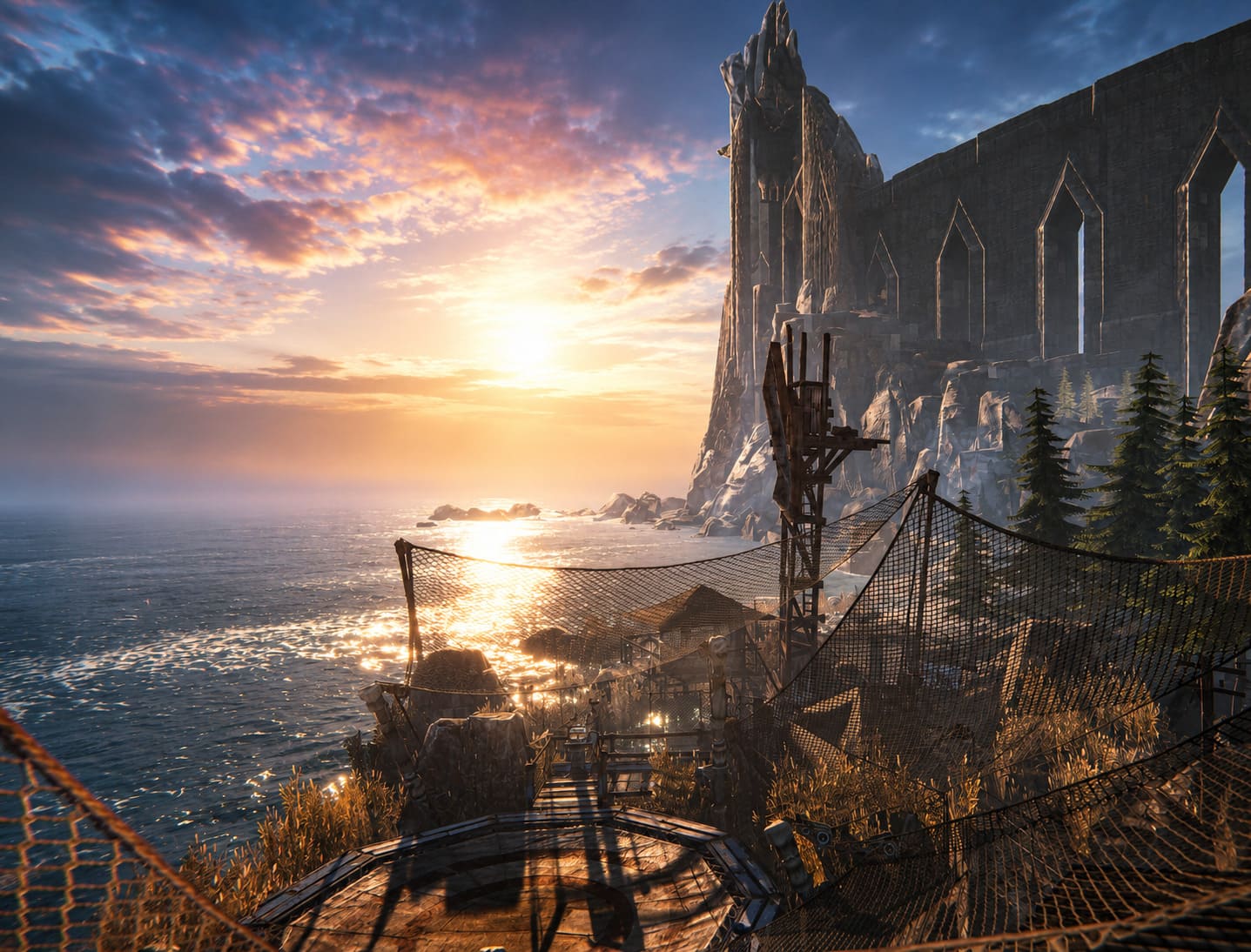
Dimhaven introduces players to Emily Ravenstone, who arrives on an isolated European-style island after receiving an unexpected letter from her missing uncle, Zack. Years earlier he disappeared while researching the mysterious history of their family, and now the island may finally reveal what happened.
The premise itself isn’t revolutionary, but execution matters far more than originality.
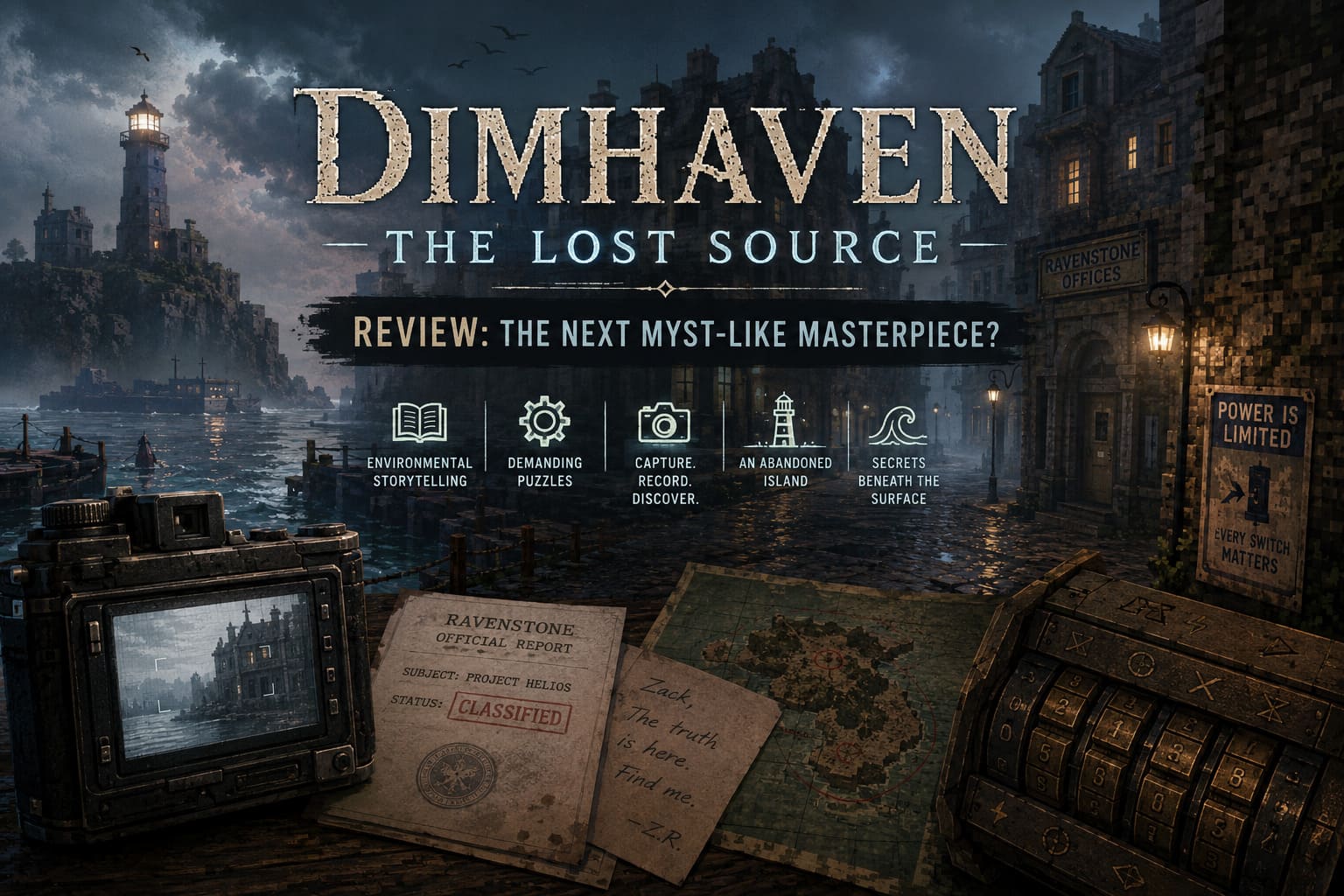
From the first moments, the atmosphere completely grabs your attention. The harbor is empty. Buildings stand silent. Electricity barely functions. Fog drifts between old streets while distant waves crash against rocky cliffs. There are no friendly NPCs waiting with tutorials, glowing quest markers, or giant arrows pointing toward your next objective.
You’re simply… there.
And honestly?
That’s exactly how this genre should begin.
Every abandoned office, forgotten café, government building, and mechanical device feels like a piece of a much larger mystery waiting to be reconstructed.
Environmental Storytelling Done Right
One thing that immediately impressed me is how naturally the narrative unfolds.
Instead of forcing lengthy cinematic sequences every thirty minutes, the game lets the environment tell its own story. Old reports, official documents, personal journals, travel brochures, visa paperwork, maintenance records—even seemingly meaningless posters become valuable pieces of the overall puzzle.
Nothing feels randomly placed.
Many games scatter collectibles simply because every exploration game is expected to have them. Dimhaven avoids that trap. Almost every document either expands the lore, explains local history, or secretly contributes to solving a future puzzle.
That level of design discipline deserves serious respect.
Puzzles That Actually Respect Your Intelligence
Here’s where Dimhaven separates itself from the crowd.
These puzzles are not designed to entertain you for thirty seconds before handing over the answer.
They’re built to challenge your observation skills, memory, logical thinking, and patience.
You’ll frequently encounter situations where several seemingly unrelated clues suddenly connect hours later.
Examples include:
- deciphering government paperwork;
- reconnecting electrical systems;
- understanding mechanical security devices;
- interpreting environmental symbols hidden across multiple locations;
- combining visual clues captured earlier in the game.
Sometimes you’ll solve three smaller puzzles before realizing they were actually preparing you for one enormous solution.
That’s incredibly satisfying.
The downside?
You’ll absolutely get stuck.
Not because the puzzles are unfair—but because they expect genuine attention.
If you’re the type of player who skips notes, ignores signs, or rushes through dialogue, Dimhaven is going to punish you without mercy.
The Camera Becomes Your Best Friend
One of the smartest mechanics is Emily’s mechanical camera.
Instead of relying entirely on memory, players can photograph important symbols, strange machinery, maps, warning signs, and unusual architectural details.
At first glance it seems like a simple convenience feature.
In reality, it changes how exploration feels.
Rather than constantly running back across the island because you forgot a symbol or number sequence, your photographs become a personalized investigation archive.
It never feels overpowered because the game still expects you to understand what you’ve photographed.
Taking the picture is easy.
Understanding why you took it is another story entirely.
Retro Visuals That Divide the Community
This is probably the game’s most controversial aspect.
Rather than pursuing photorealism, the developers combine modern lighting technology with intentionally low-resolution textures and chunky retro-inspired geometry.
Personally?
I absolutely love it.
The island has an identity.
Too many indie games today chase realistic graphics without having the budget to achieve them, resulting in generic-looking environments.
Dimhaven avoids that completely.
Its pixel-inspired aesthetic creates a strange dreamlike atmosphere where every building feels frozen somewhere between memory and reality.
Still, there’s a legitimate criticism.
Because textures intentionally appear rough and pixelated, some interactive objects don’t stand out clearly enough. Tiny switches, buttons, and important mechanical parts occasionally disappear into the environment.
In a game where noticing small details is literally the gameplay loop, visibility matters.
An optional texture filtering or accessibility mode would improve the experience without compromising the artistic direction.
Sound Design Quietly Carries the Experience
Games like this live or die by atmosphere.
Fortunately, Dimhaven absolutely nails it.
The soundtrack rarely dominates your attention.
Instead, subtle ambient music blends with:
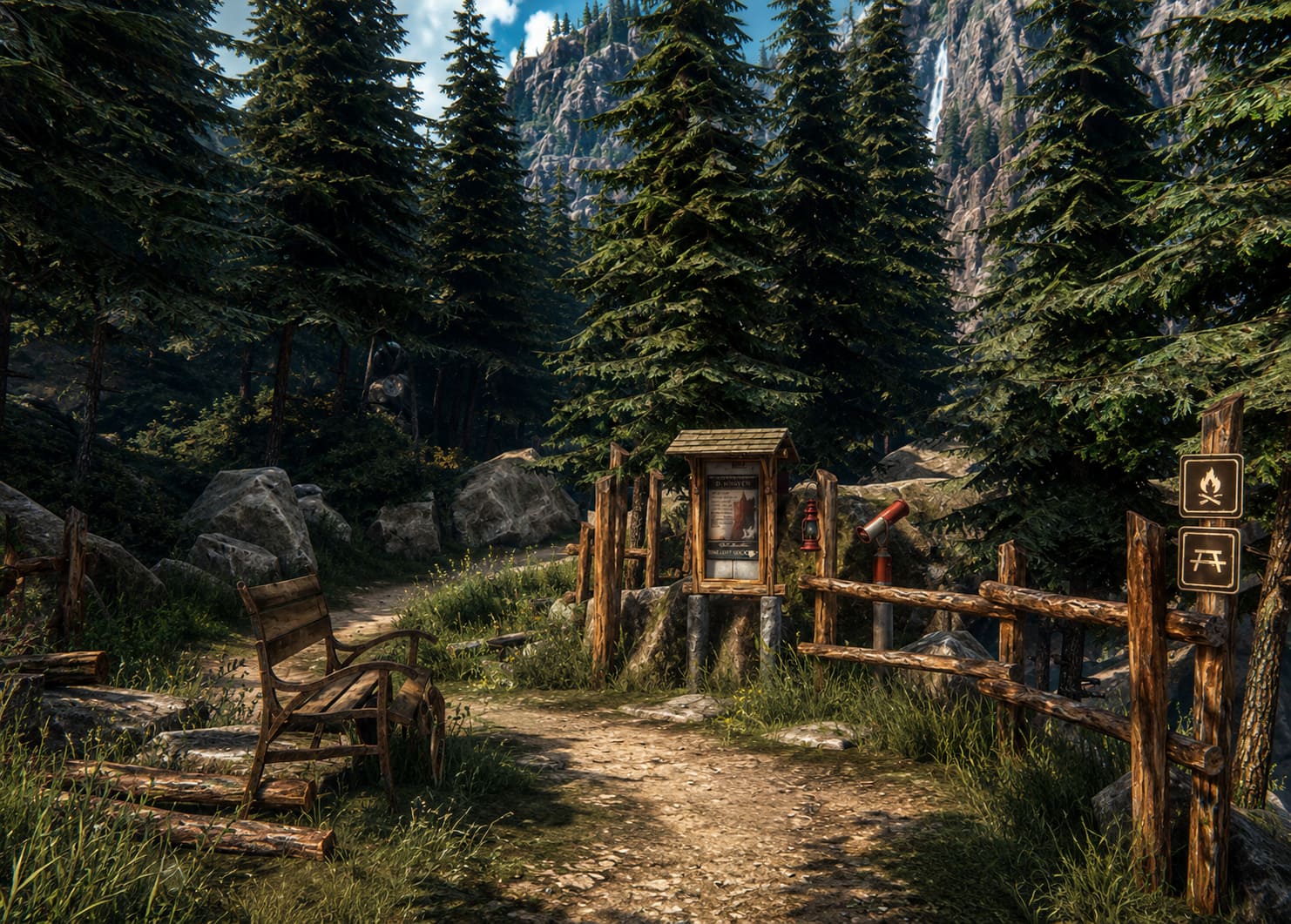
- distant seagulls;
- humming generators;
- echoing machinery;
- ocean waves;
- empty streets.
Silence becomes part of the storytelling.
Sometimes several minutes pass with almost no music at all, making every strange mechanical sound feel important.
It reminds me why less is often more.
Performance Is Surprisingly Solid
Considering the visual style, it’s no surprise that performance remains smooth across a wide range of PC hardware.
Loading screens are brief.
Transitions between areas rarely interrupt exploration.
Animations deserve special praise.
Every lever, gear, crank, and locking mechanism feels wonderfully heavy.
There’s genuine mechanical weight behind every interaction.
You don’t simply press a button.
You operate machines.
That tactile feedback makes puzzle-solving significantly more satisfying.
Strengths and Weaknesses at a Glance
| Category | Verdict |
|---|---|
| Atmosphere | Outstanding |
| Puzzle Design | Deep, demanding, rewarding |
| Storytelling | Excellent environmental narrative |
| Audio | Immersive and understated |
| Graphics | Beautiful but occasionally difficult to read |
| Accessibility | Could use additional visual options |
Who Will Love Dimhaven?
This isn’t a game for everyone.
If your favorite adventures constantly feed objectives onto your screen, you’ll probably become frustrated long before reaching the halfway point.
However, players who enjoy genuine discovery will likely become obsessed.
You’ll probably love Dimhaven if you enjoy games like:
- Myst
- Riven
- Quern: Undying Thoughts
- Obduction
- The Witness
These games ask players to think instead of react.
Dimhaven proudly continues that tradition.
What Could Be Better?
Even outstanding games have room for improvement.
The biggest issues I encountered weren’t technical problems but quality-of-life concerns.
Some text could benefit from larger scaling options.
Certain environmental interactions occasionally become harder to identify because of the chosen visual style.
A few additional accessibility settings would help newcomers without making puzzles easier.
Importantly, these aren’t flaws that undermine the core experience.
They’re refinements rather than fundamental problems.
Final Verdict
Dimhaven: The Lost Source isn’t chasing mainstream success.
It’s chasing something much rarer.
It wants players to slow down.
To observe.
To think.
To fail.
To return with fresh ideas.
That’s exactly why it feels refreshing.
There were several moments where I stared at a strange mechanism for fifteen minutes, convinced the puzzle was impossible, only to realize the answer had been sitting inside a document I’d read an hour earlier.
Those “aha!” moments never get old.
They’re the reason many of us fell in love with puzzle adventures decades ago.
If you miss games that trust your intelligence instead of constantly guiding you toward the next objective, Dimhaven deserves a place in your library.
It isn’t always forgiving.
It isn’t always convenient.
But when everything finally clicks together, few modern puzzle games deliver such a satisfying sense of accomplishment.
Score: 9.2/10
Dimhaven: The Lost Source proves that thoughtful game design, memorable atmosphere, and uncompromising puzzles are still capable of creating unforgettable adventures—even in an era obsessed with instant gratification.