Moonlighter 2 The Endless Vault Nintendo Switch Performance: Frame Rate, Graphics, and Technical Review
There is something strangely satisfying about Moonlighter. The first game managed to turn a simple idea—fight monsters at night, sell their loot by day—into one of those addictive gameplay loops that can quietly eat an entire weekend. I spent a ridiculous amount of time with the original, and what made it work for me wasn’t just the dungeon crawling or shop management. It was the feeling that every successful expedition directly improved the little business waiting for me back home. It was also exactly the kind of game I liked playing on Nintendo Switch: easy to pick up, difficult to put down, and perfectly suited to short handheld sessions.
Moonlighter 2: The Endless Vault takes that formula and throws a surprisingly ambitious technical challenge into the mix. Digital Sun has moved away from the charming 2D presentation of the original and built a much larger, more colorful 3D world. That sounds great on paper—and visually, it absolutely is—but it immediately raises a question for Nintendo Switch players: can the hardware keep up? After spending time looking at how the sequel handles its environments, combat, shop sections, loading and general responsiveness, I think the answer is more complicated than simply calling it a successful or unsuccessful port.
How to Fix Breathedge 2 Intel CPU Crashes: 13th/14th Gen Stability Guide
From Pixel Art to a Full 3D World
The biggest difference between the two games becomes obvious within minutes. The original Moonlighter used 2D pixel art to create its identity, allowing the developers to achieve a lot without placing enormous demands on the hardware. The Endless Vault is a completely different beast. Tresna has depth, layered environments, dynamic lighting, detailed geometry and a much more active camera. The dungeons also feel considerably more physical, with objects breaking apart, enemies moving through three-dimensional spaces and effects filling the screen during hectic encounters.
Personally, I think the move to 3D was worth the risk. The sequel feels more tactile when you swing a weapon, dodge through an enemy attack or watch a room explode into particles. There is simply more happening visually. At the same time, anyone expecting the Switch version to look identical to the PC release should lower their expectations before starting the game.
This isn’t necessarily a bad thing. Developers have to make compromises when bringing a visually ambitious 3D game to portable hardware, and Moonlighter 2 on Nintendo Switch clearly makes some of them. The important question is whether those compromises actually hurt the experience.
Moonlighter 2 Nintendo Switch Performance
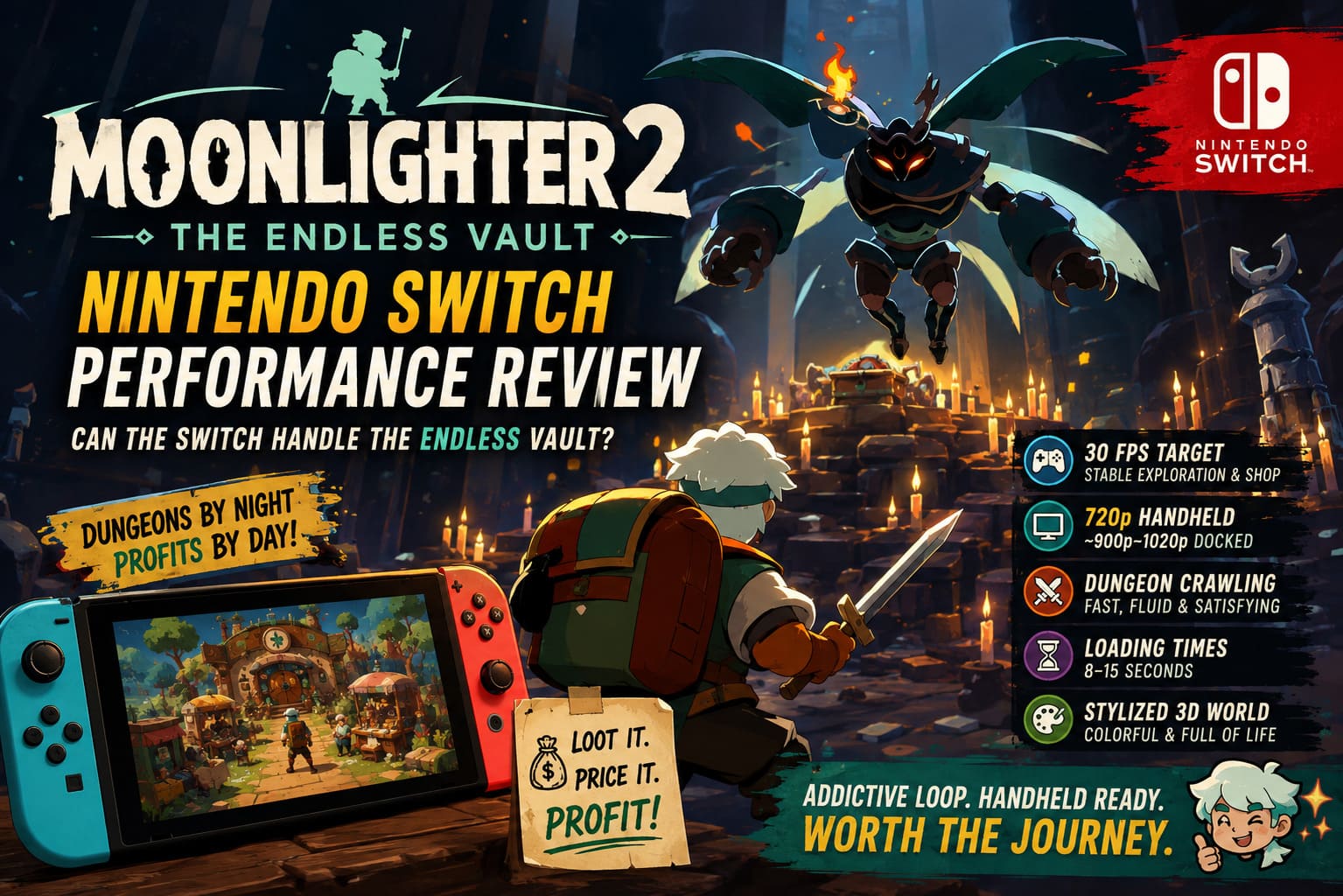
In handheld mode, the game targets 720p resolution and 30 FPS. That might sound modest in 2026, especially when so many games are pushing higher frame rates, but I would rather have a reasonably stable 30 FPS than an unstable performance mode that constantly jumps between different targets. For the majority of normal exploration, shop management and dungeon crawling, that is essentially what players get.
Running around Tresna generally feels smooth enough, and the shop itself is particularly responsive. Inventory management, pricing items, talking to customers and moving between menus don’t have the sluggish feeling that can sometimes affect technically demanding Switch games. For me, this matters almost as much as combat performance because the merchant side of Moonlighter 2 is half of the game’s personality.
There are still moments where the hardware shows its limits. Small stutters can appear when entering certain areas or during transitions, particularly around the main hub. They aren’t constant enough to ruin the experience, but if you’re the kind of player who notices every dropped frame, you will probably catch them.
Docked Mode
Docked play gives the game a little more breathing room visually, with dynamic rendering that can approach the 900p to roughly 1020p range, depending on the situation and upscaling. The 30 FPS target remains, which makes sense given the number of effects the game can throw onto the screen.
The more interesting test comes during combat. Once multiple enemies, abilities and environmental effects are active at the same time, performance can occasionally dip into the mid-20 FPS range. The new explosive-focused combat options are a good example. Watching several bombs detonate across a crowded room looks fantastic, but those moments can put noticeable pressure on the hardware.
Fortunately, these drops tend to be short-lived. I never got the impression that the game was constantly fighting against itself. For normal dungeon runs, 30 FPS remains the realistic expectation rather than an unrealistic promise.
| Feature | Nintendo Switch Experience |
|---|---|
| Handheld Resolution | Targets 720p |
| Docked Resolution | Dynamic resolution, roughly 900p–1020p target range |
| Frame Rate Target | 30 FPS |
| Heavy Combat | Occasional dips into the mid-20s |
| Loading | Approximately 8–15 seconds depending on transition |
| Visual Quality | Strong art direction with reduced texture and shadow quality |
How Much Visual Quality Has Been Sacrificed?
This is where the difference between Switch and more powerful hardware becomes easier to see. Texture filtering is reduced, distant surfaces can look noticeably softer, and shadows don’t have the same definition you’ll see on a capable gaming PC. Dynamic lighting is also simplified in places, and some environmental details have clearly been adjusted to keep the game running within reasonable hardware limits.
But here is the thing: Moonlighter 2 is saved by its art direction. Digital Sun isn’t chasing photorealism. The world is deliberately stylized, colorful and almost painterly, which means reduced texture resolution doesn’t destroy its visual identity. A technically weaker texture can still look attractive when it is surrounded by strong colors, interesting shapes and carefully designed environments.
This becomes especially noticeable on an OLED Switch. The darker sections of the Endless Vault contrast beautifully with glowing weapons, magical effects and colorful environmental elements. Obviously, the OLED display cannot magically improve the game’s underlying resolution or texture quality, but the presentation benefits enormously from its contrast and vibrant colors.
I’ve played plenty of Switch ports where visual compromises made the entire game feel cheap. Moonlighter 2 doesn’t fall into that trap. You can see the compromises if you deliberately look for them, but when you’re actually playing, the artistic style does a remarkably good job of hiding them.
Loading Times: Acceptable, But Not Perfect
The loading situation is more difficult to ignore because Moonlighter 2 encourages a very specific rhythm. You enter the vault, collect resources, fight your way through several floors, return home and start working on your shop. When you’re repeating that cycle frequently, unnecessary waiting can become irritating.
On Nintendo Switch, moving between Tresna and a dungeon can take roughly 12 to 15 seconds. Generating or entering new procedural sections can introduce shorter waits of around 8 to 10 seconds. Compared with a modern PC equipped with a fast SSD, that’s obviously slow, but I wouldn’t describe it as disastrous for a portable game.
The good news is that the parts of the game where you spend the most time interacting are generally responsive. Opening your backpack, rearranging items, changing prices and dealing with customers all feel immediate. In other words, the loading is noticeable, but the actual management gameplay doesn’t feel sluggish.
Combat Is Where the Switch Port Matters Most
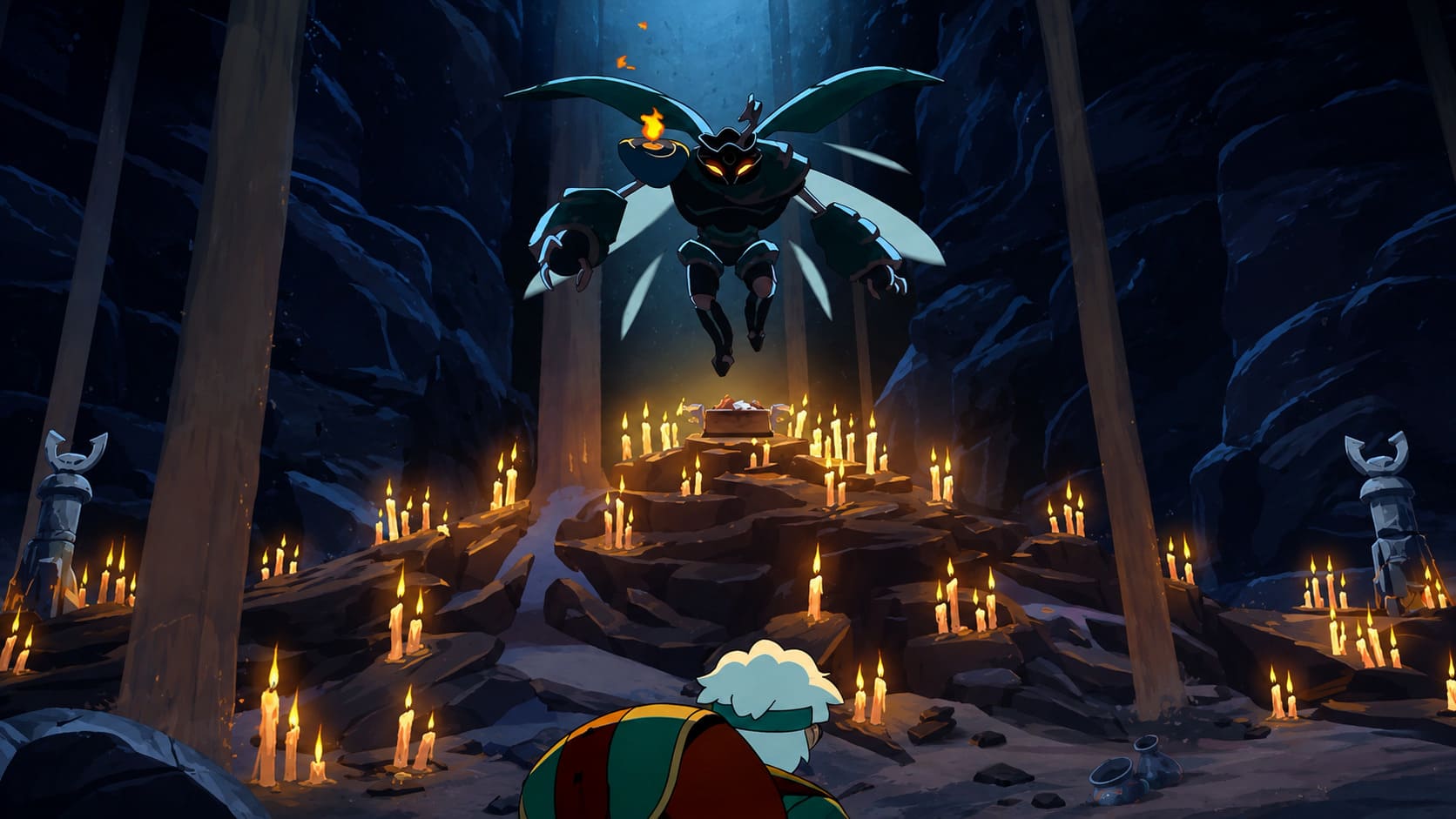
For me, combat is the area that determines whether a performance compromise is acceptable. Shop management can survive a little hesitation, but missing a dodge or mistiming an attack because of a performance problem is much more frustrating. Moonlighter 2 introduces more complex three-dimensional combat compared with its predecessor, so precision matters more than it did before.
Most encounters feel responsive enough at the 30 FPS target. The occasional performance dip during particularly chaotic fights can be noticed, but it doesn’t happen frequently enough to make the entire combat system unreliable. Players taking on the game’s more demanding difficulty options may be more sensitive to these moments, especially if they prefer extremely precise timing.
There are also reports of targeting occasionally behaving strangely when the game switches between different spatial situations. This is less about raw frame rate and more about adapting the original game’s design philosophy to a 3D environment. It isn’t something that happens constantly, but it is exactly the kind of small issue that can become more obvious once you’re playing at a higher difficulty.
Bugs and Early Technical Issues
No modern game launch is completely free of technical quirks, and The Endless Vault has a few of its own. Some players have encountered minor audio synchronization problems after leaving dungeons, while others have noticed unusual camera positioning during certain shop expansion interactions.
These aren’t the sort of bugs that make me recommend avoiding the game altogether. More importantly, they appear to be the type of problems that can be addressed through patches rather than fundamental problems with the game’s design. Digital Sun has already demonstrated that it pays attention to player feedback, which gives me more confidence that the Switch version can become smoother over time.
Is Moonlighter 2 Worth Playing on Nintendo Switch?
Yes—especially if portability is a major reason you liked the original. I wouldn’t pretend that the Nintendo Switch version is technically equal to the strongest versions of Moonlighter 2: The Endless Vault. It isn’t. You are accepting a 30 FPS target, lower-quality shadows, softer textures, occasional stutters and longer loading times in exchange for being able to take the entire experience with you.
For me, that trade-off makes sense. The core appeal of Moonlighter has always been its loop rather than its raw technical presentation. Going into a dungeon for valuable loot, deciding what to keep, returning to your store and watching your little business grow remains incredibly satisfying. That structure works almost suspiciously well on a handheld device because you can play for twenty minutes or disappear into it for several hours.
If you already own a powerful gaming PC or current-generation console and care primarily about image quality and frame rate, that version will obviously be the better technical showcase. But if you’re looking for a portable dungeon crawler with shop management, colorful 3D visuals and a genuinely addictive progression loop, Moonlighter 2 on Nintendo Switch is easy to recommend.
The sequel may not be the cleanest technical showcase Nintendo hardware has ever received, but that’s not really why I would play it. I would play it because few things are as satisfying as coming home from a dangerous dungeon with a backpack full of questionable merchandise and then trying to convince customers that, yes, they absolutely need to pay a ridiculous amount of money for it.
And honestly, that’s exactly the kind of slightly weird, endlessly repeatable gameplay loop that makes Moonlighter 2: The Endless Vault feel right at home on a handheld.