EA FC 27 Career Mode: How to Master TransferRoom Mechanics and Negotiations
There is one part of EA SPORTS FC 27 Career Mode that can completely change the way you run a club: transfers. After years of working around fairly predictable player values, Career Mode finally gives managers a system that feels much closer to an actual football transfer market. The big addition is TransferRoom, and if you are the kind of player who spends half the summer window scrolling through scouting reports and trying to turn a €20 million budget into a Champions League squad, this is a system you really need to understand.
What I like about the new approach is that you cannot simply memorize a player’s value and repeat the same negotiation trick every season. Player prices move, circumstances matter, contract situations matter, and timing matters. A talented player who barely sees the pitch can become a completely different transfer target from the same player six months later.
That makes EA FC 27 Career Mode transfers much more interesting, but it also means there is more room to waste money if you do not pay attention. Here is how I approach TransferRoom, Expected Transfer Value, negotiations, contracts, and the market when starting a new save.
Why TransferRoom Changes EA FC 27 Career Mode
Older Career Mode systems often made transfers feel like shopping from a spreadsheet. You looked at OVR, age, potential, and position, checked the approximate value, and then figured out how much extra the selling club wanted. Once you had played enough seasons, you could usually predict the answer before making the offer.
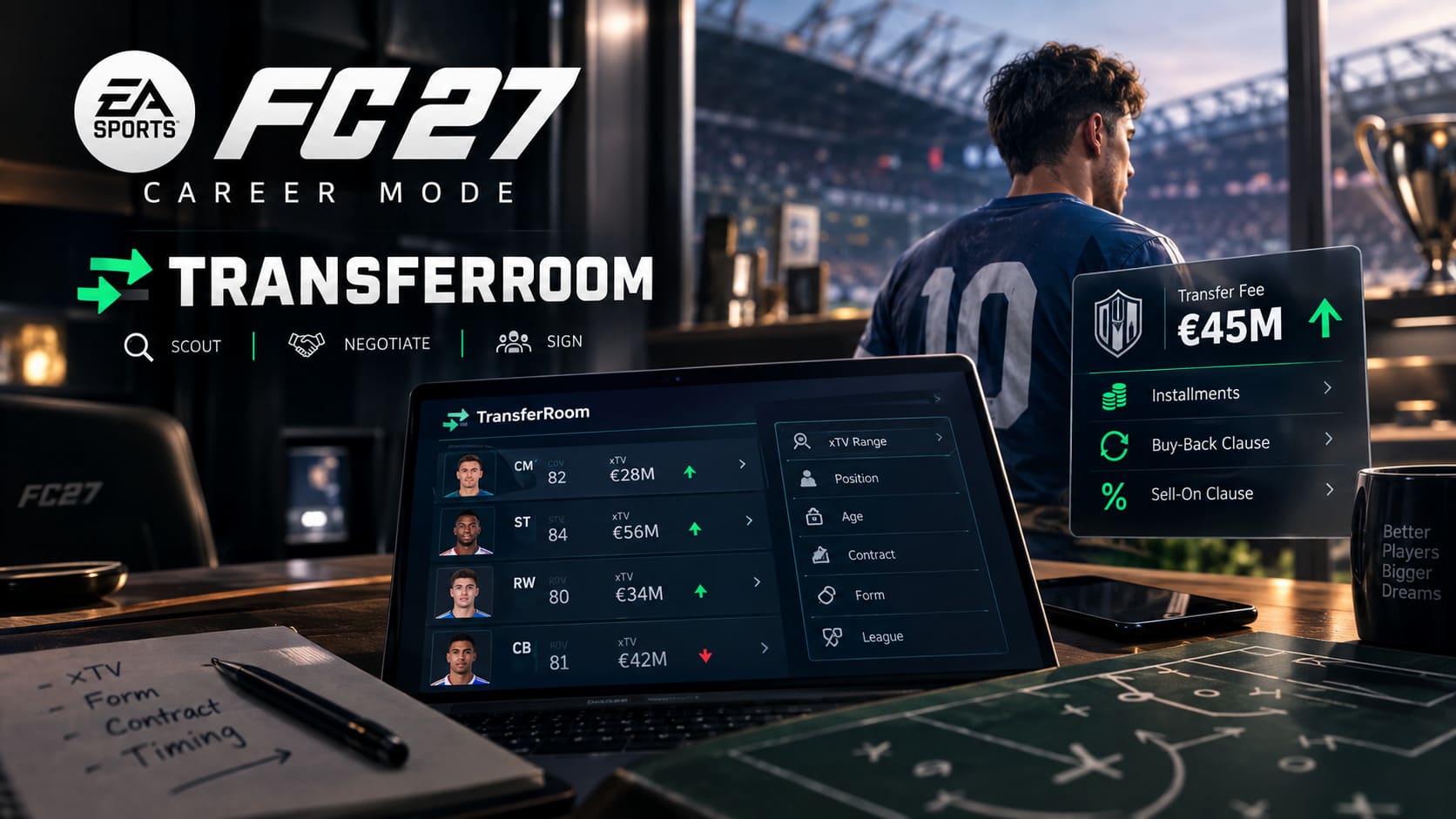
TransferRoom makes that process less straightforward. Instead of treating a player’s price as one permanent number, the game uses Expected Transfer Value (xTV) as a more dynamic indication of what the player might command on the market.
That does not mean OVR and potential suddenly stop mattering. They are still important. The difference is that they are no longer the entire story. A player’s form, contract, competition level, playing time, wages, and interest from other clubs can all affect the situation.
Personally, this is the kind of change I have wanted from Career Mode for a long time. Transfers are more fun when the circumstances around a player actually matter instead of every negotiation feeling like another variation of the same calculator.
How Expected Transfer Value (xTV) Works
The first thing to understand is that xTV is not simply another version of a player’s OVR-based market value. Think of it as the market’s current estimate of what the player is worth under the circumstances surrounding him.
| Factor | How It Can Affect xTV |
|---|---|
| OVR And Potential | Provides the basic foundation of the player’s value. |
| Current Form | Strong performances can increase market interest and value. |
| Playing Time | Regular starts can support value, while limited minutes can hurt it. |
| League Strength | Performance in stronger competitions can improve market perception. |
| Contract Length | A shorter contract can reduce the seller’s negotiating leverage. |
| Market Demand | Interest from multiple clubs can push the expected price upward. |
This creates some genuinely useful opportunities. For example, you might find an 82-OVR midfielder sitting on the bench at a major club. His reputation is still high, but his current situation may have dragged his market value down. That is exactly the sort of player I would investigate before spending my entire budget on a younger player with a much higher asking price.
Do Not Ignore Form When Scouting Transfers
This is one of the easiest things to overlook. When browsing potential signings, it is tempting to look at OVR and potential first and then immediately compare prices. With the TransferRoom system, I would spend more time looking at the context surrounding the player.
A star who has been playing every week and producing excellent performances is probably going to be expensive. A similarly talented player who has been stuck behind another starter may be much more approachable.
That creates a simple buy-low strategy for EA FC 27 Career Mode: look for players whose reputation is higher than their current market situation.
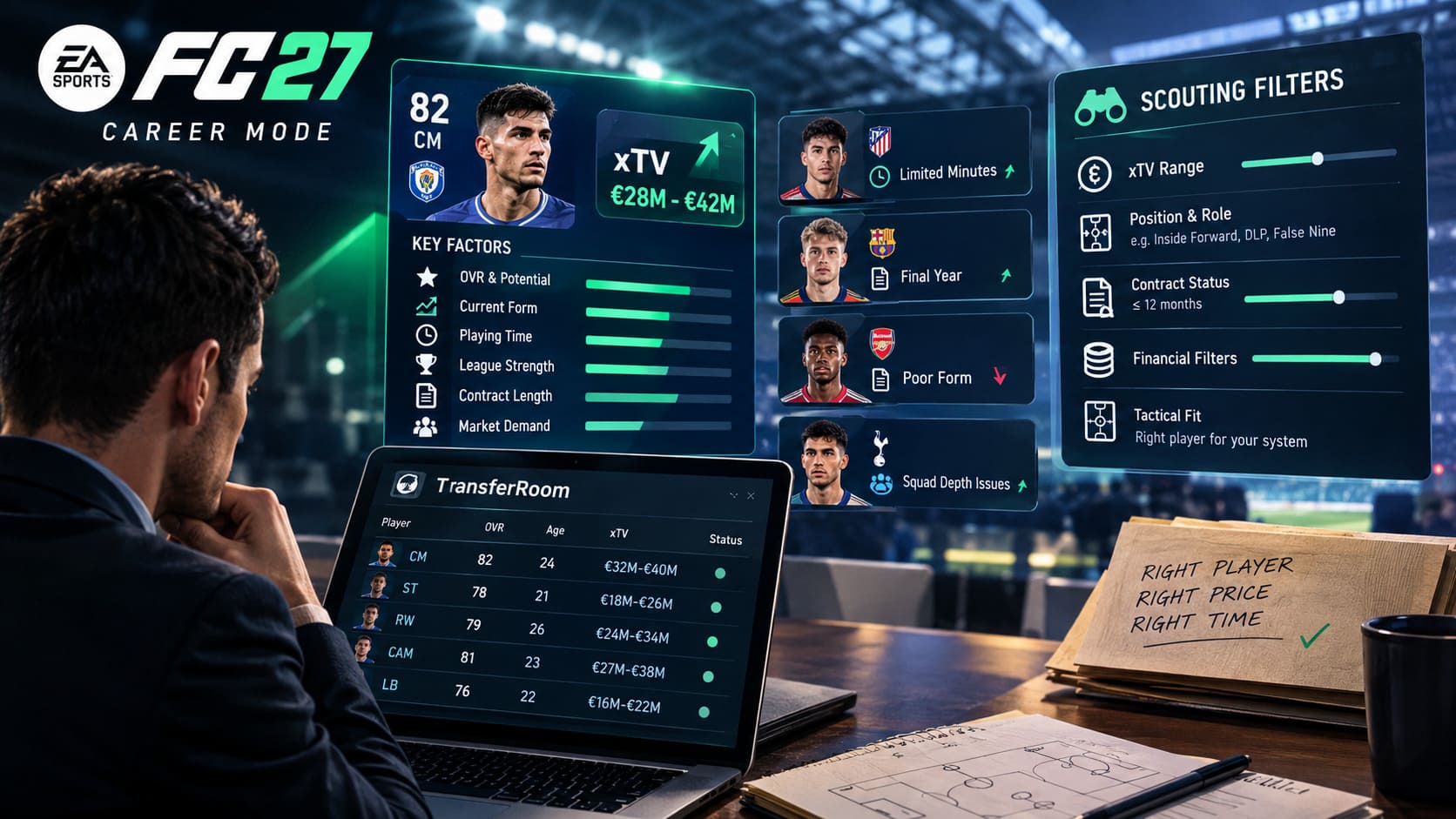
These are the players I would keep an eye on:
- High-OVR players receiving limited minutes.
- Players approaching the final year of their contracts.
- Talented players whose current form has dropped.
- Players at clubs with obvious squad depth problems.
You are not necessarily looking for a bad player. Quite the opposite. The best bargain can be a very good player whose current circumstances make the selling club more willing to negotiate.
Use the New Scouting Filters Properly
If you are still using the scouting system exactly like you did in older Career Mode saves, you are leaving useful information on the table. The TransferRoom-focused filters make it much easier to build a shortlist around your actual budget rather than searching through hundreds of players manually.
The xTV range filter is particularly useful when managing a smaller club. Instead of finding a dream target who costs three times your entire budget, you can narrow the search to players who should realistically fit your finances.
I also recommend combining financial filters with tactical requirements. If you need an Inside Forward, Deep-Lying Playmaker, or False Nine, there is little point buying a technically brilliant player who does not fit how your team actually plays.
The other filter I would check constantly is contract status. A player entering the final 12 months of a deal can become dramatically more interesting than someone with four years remaining, especially if the player’s current club does not want to risk losing him for nothing.
EA FC 27 Transfer Negotiations Are All About Timing
This is probably the biggest adjustment for anyone coming from older Career Mode versions. You cannot always treat a major transfer as something you can finish immediately.
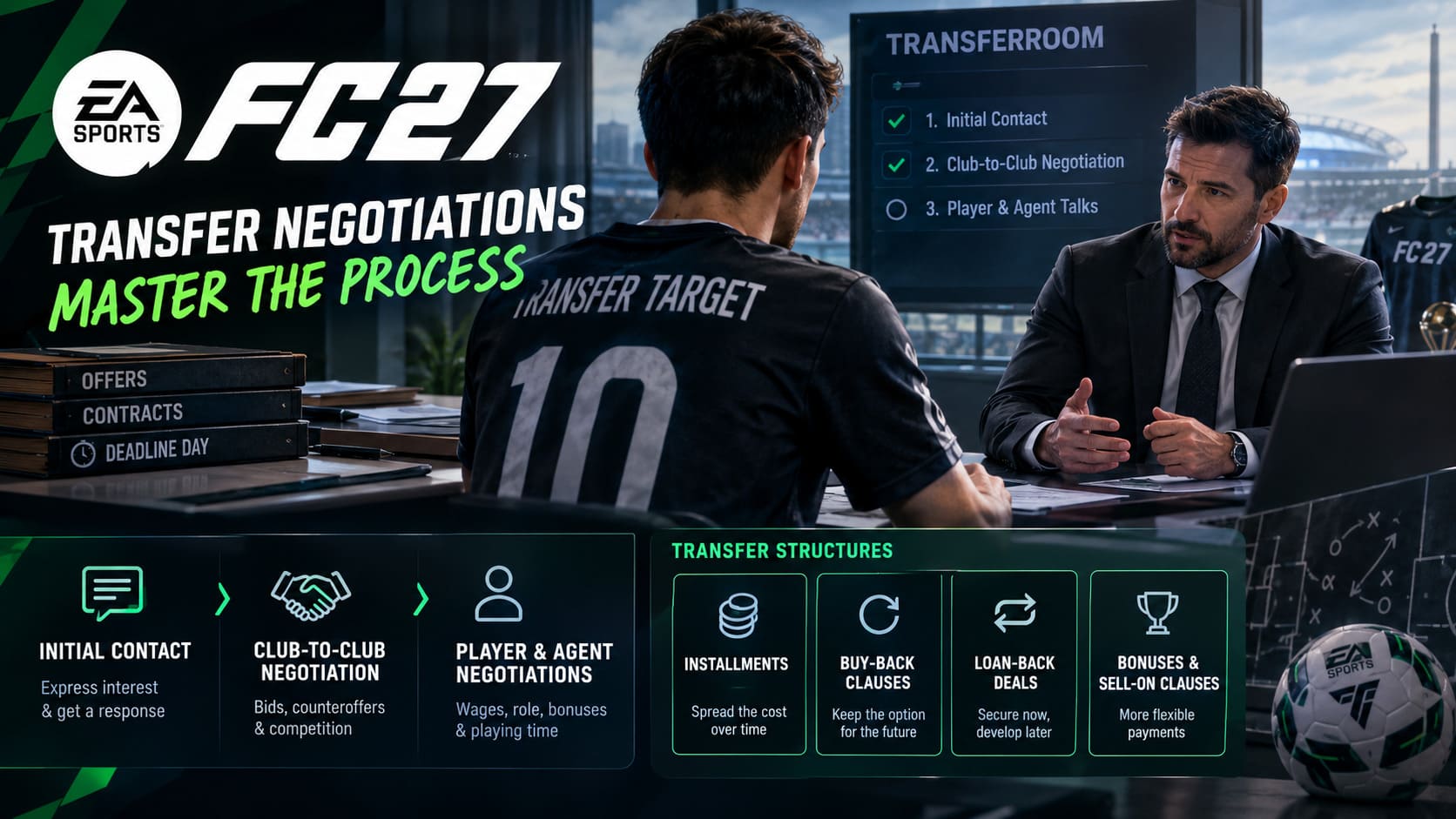
Transfer negotiations can play out across multiple stages, which means your calendar matters. You make contact, receive a response, submit an offer, wait for the other club, negotiate again, and only then move toward the player’s contract.
That makes Deadline Day a terrible time to begin complicated transfers. You might get away with it for a straightforward deal, but if a club wants another negotiation round or an agent demands additional terms, suddenly the clock is working against you.
Stage 1: Initial Contact
The process starts when you approach the club or use the TransferRoom interface to express interest. The selling club considers the player’s current situation, their own squad depth, and the market value associated with the target.
This is where I would resist the urge to throw money at the problem immediately. The first number you see should be treated as the beginning of the negotiation, not necessarily the final price.
Stage 2: Club-To-Club Negotiation
Once formal bidding begins, the selling club can respond to your offer and potentially counter it. Other clubs may also be competing for the same player, which changes the situation again.
This is where the TransferRoom system starts feeling more like an actual market. Sometimes getting your offer accepted is not about offering the absolute highest amount. The structure of the deal can matter too.
Stage 3: Player And Agent Negotiations
Getting the club to accept your bid is only half the job. You still need to convince the player.
Contract negotiations can involve wages, role expectations, release clauses, bonuses, and playing-time assurances. If you are signing a player to be an important starter but offer terms that suggest he is only a rotation option, do not be surprised if negotiations become difficult.
Transfer Structures You Should Actually Use
One of the more useful parts of the new system is that you have more ways to structure deals than simply offering one giant transfer fee.
Installment Payments
Installments are extremely useful when you are working with a limited immediate budget. Instead of paying the entire fee up front, you can distribute payments across future seasons.
For example, rather than putting €60 million down immediately, you could negotiate something closer to €20 million now with the remaining amount spread across future payments.
There is an obvious catch: the selling club may demand a larger overall package in exchange for giving you more time to pay. Still, for smaller clubs, installments can be the difference between signing a target and walking away from the negotiation.
Buy-Back Clauses
If you are selling a promising academy player, a buy-back clause can be extremely valuable. You get the player out of your crowded squad while allowing him to play regular football elsewhere, but you retain a route to bring him back later.
I especially like this approach for young players who are good enough to need senior football but not quite ready for a permanent role at your club.
Loan-Back Deals
A loan-back agreement is another interesting option for wonderkids. You can complete the permanent transfer but leave the player at his current club for the remainder of the season.
This can make sense when you are worried another club will eventually make a move for the same prospect. You secure the player now while allowing him to continue getting regular minutes before joining your squad.
Bonuses And Sell-On Clauses
Performance bonuses can also make negotiations more flexible. Instead of paying everything immediately, you can attach additional money to appearances, goals, clean sheets, or other achievements.
Sell-on clauses are particularly interesting when you are selling a young player. You might accept less money today in exchange for receiving a percentage of the player’s future transfer fee.
My Favorite TransferRoom Strategy: Hunt The Unhappy Star
If I had to choose one strategy to build a squad around, this would be it.
Go through the big clubs and look for players who are not getting enough football. Do not just search for young wonderkids. Look at established players who are sitting behind another star, have fallen out of the starting XI, or have seen their role shrink.
These players can be perfect Career Mode signings because you are buying ability without necessarily paying the maximum possible price for it.
The trick is not to wait forever. If the player starts getting regular minutes again, his market situation can change. Likewise, another club may notice him and start competing for the transfer.
Scout the player early, watch the situation, and make your move before everyone else catches up.
Contract Expiry Is Still One of the Biggest Bargain Opportunities
The contract filter should become part of your routine at the beginning of every transfer window.
Players approaching the final months of their contracts can offer incredible value. In leagues where pre-contract agreements are available under the relevant rules, you can potentially agree a free transfer for a player whose contract is about to expire.
If you want the player immediately instead, the final year of a contract gives you another angle. The selling club knows that keeping the player could eventually result in losing him for nothing, so there can be room for a lower transfer fee.
This is one of those Career Mode habits that costs nothing to develop: check expiring contracts every single window.
How To Handle Competing AI Clubs
The worst feeling is finding the perfect target and then discovering another club is already negotiating for him.
Do not automatically panic and throw your entire budget into the next offer. Look at the structure of the deal instead.
If your finances allow it, a stronger upfront payment can make your proposal more attractive. Alternatively, you can use installments, bonuses, or a sell-on clause to create a package that works for the selling club without destroying your own budget.
The key is knowing what you actually need from the transfer. If you are buying a squad player, there is no reason to get dragged into a ridiculous bidding war. If the player is a perfect tactical fit and fills a position you cannot otherwise solve, the situation is obviously different.
Selling Players: Do Not Leave Money on the Table
TransferRoom is just as important when you are the seller. In fact, I think this is where experienced Career Mode players can gain the biggest advantage over time.
If you know you are going to sell a player during the next window, try to create the best possible market conditions before the transfer period begins.
Give the player regular minutes. Keep morale high. Use him in a role where he can perform well. A strong run of form can help increase the player’s current market appeal.
Contract length matters too. If you have a valuable player entering the final years of his deal, consider extending the contract before putting him on the market. A longer contract gives you more leverage because the buying club cannot simply wait for the player’s contract to expire.
| Situation | What I Would Consider |
|---|---|
| Player In Excellent Form | Consider selling while demand and market perception are strong. |
| Player Has 3–4 Years Left | Use the contract length to strengthen your negotiating position. |
| Player Has 12 Months Left | Expect reduced leverage and consider whether an extension makes sense. |
| AI Offers Installments | Use them only if delayed income fits your club’s plans. |
| Young Player With High Potential | Consider a buy-back or sell-on clause before accepting a permanent sale. |
Do You Need the Money Immediately?
This is something I would decide before negotiating, not halfway through the conversation.
If you are selling a player because you need €40 million right now to replace him, a huge installment package is not particularly helpful. You need cash that can be reinvested during the same transfer window.
On the other hand, if your squad is already settled and you are thinking about the next two or three seasons, installments and sell-on clauses can create a useful long-term income stream.
Career Mode is much easier when you stop thinking about every transfer as an isolated transaction. Your current sale affects your next signing, which affects your wage bill, which affects future renewals, which eventually affects the next transfer window.
EA SPORTS FC 27 Clubs Guide: How to Join and Play in The Grounds
TransferRoom Tips I Keep Coming Back To
- Start major negotiations early. Multi-stage deals can take time, so do not leave complicated transfers until Deadline Day.
- Scout the market instead of blindly chasing OVR. An undervalued established player can sometimes solve your problem more cheaply than a fashionable wonderkid.
- Check contract expiry constantly. The final year of a deal can create serious opportunities for buyers.
- Use installments carefully. They can unlock expensive players, but make sure future budgets can absorb the payments.
- Protect valuable academy players. Buy-back and sell-on clauses can keep future options open.
- Prepare players before selling them. Form, morale, playing time, and contract length can all influence your leverage.
How to Fix EA Sports FC 27 AntiCheat Game Security Violation Error – Full Guide
Final Thoughts
The biggest change with TransferRoom in EA SPORTS FC 27 Career Mode is that transfers no longer feel like a simple exchange of coins for players. There is much more context around every deal, and that makes the transfer window something I actually want to spend time exploring rather than something I rush through before the first league match.
The xTV system gives you another reason to scout beyond OVR and potential. Contract situations create opportunities. Poorly utilized stars can become bargain targets. Installments can help smaller clubs compete for expensive talent, while buy-back and sell-on clauses give youth development a much longer life cycle.
Most importantly, timing matters. The best transfer is not always the player with the lowest asking price or the highest rating. Sometimes it is the player whose market situation has temporarily created an opportunity.
That is where I think the new TransferRoom mechanics become genuinely interesting. Once you stop treating Career Mode like a database and start treating it like a constantly moving football market, every transfer window becomes its own little strategy game. And honestly, that is exactly what I want from Career Mode.