Is PolyClassic: Wild Worth Playing in 2026? Gameplay, Price, and Honest Review
There is something I genuinely like about the current retro FPS scene.
While the biggest shooters keep getting larger, prettier, and more complicated, indie developers continue making games that basically ask one question: how quickly can you put a gun in the player’s hands and start throwing enemies at them?
That philosophy is exactly where PolyClassic: Wild comes in.
Developed by Quacky Games and published by Whale Rock Games, this low-poly first-person shooter originally launched back in 2021. It is still floating around PC storefronts in 2026, including Steam, GOG, and the Epic Games Store. The Wild West setting, chunky low-poly visuals, ridiculous weapons, and dirt-cheap sale prices make it look like the kind of game you might grab on impulse.
And, honestly? That is probably the best way to approach it.
I’ve played plenty of retro shooters over the years, from genuinely brilliant throwbacks to games that feel like someone discovered an asset store yesterday and decided to make a FPS. PolyClassic: Wild sits somewhere in the middle. It can be stupidly entertaining for a short session, but it also has some problems that become impossible to ignore once the novelty wears off.
So, is PolyClassic: Wild worth playing in 2026?
Yes — but only under very specific circumstances.
What Exactly Is PolyClassic: Wild?
PolyClassic: Wild is a single-player low-poly arena shooter built around short combat encounters rather than a traditional FPS campaign.

There is no elaborate story waiting for you. You won’t spend hours reading lore documents, talking to NPCs, or wondering what happened to civilization. The game basically drops you into a Wild West-inspired arena and says:
Here are some guns. There are enemies. Start shooting.
That simplicity is both its biggest strength and one of its biggest weaknesses.
The visual style is intentionally crude, with flat-shaded models, geometric environments, colorful textures, and deliberately simple character designs. It reminded me of those early 3D games where technical limitations accidentally became part of the visual identity.
And I actually think the aesthetic works.
It isn’t trying to compete with modern AAA graphics. The low-poly presentation gives the game a goofy arcade personality and also means the hardware requirements are extremely modest.
Quick Overview
| Feature | PolyClassic: Wild |
|---|---|
| Developer | Quacky Games |
| Publisher | Whale Rock Games |
| Genre | Retro FPS / Arena Shooter |
| Release | October 2021 |
| Levels | 6 |
| Mode | Single-player |
| Setting | Low-poly Wild West |
| Platforms | PC |
| Best For | Short arcade sessions |
| Typical Sale Price | Often Under $1 |
The Gameplay Is Fast, Simple, and Very Old-School
The basic PolyClassic: Wild gameplay loop doesn’t need much explanation.
You enter a map, move around the arena, enemies appear, and you shoot them until the objective is completed.
That’s it.
There are no complicated ability trees, no crafting system, no massive inventory, and no progression system demanding that you spend twenty hours upgrading your character. In some ways, that’s refreshing in 2026.
Movement is equally straightforward. You can walk, run, jump, and strafe while shooting. If you’ve played an old-school FPS before, you will understand the fundamentals within seconds.
The problem is that PolyClassic: Wild doesn’t have the movement depth of games like DUSK or ULTRAKILL. There is no air-dashing, sliding, wall-running, or elaborate movement tech to master.
Your main skill is simply strafing correctly and not standing in front of a shotgun outlaw like an idiot.
And believe me, the shotgun enemies will punish you for that mistake.
The Mouse Aim Is Probably My Biggest Complaint
This is where the game started losing me.
For a shooter that relies almost entirely on gunplay, the aiming doesn’t feel as polished as it should.
The mouse sensitivity can feel strangely unbalanced between the vertical and horizontal axes. On top of that, there appears to be an acceleration effect that makes precise aiming less consistent than I would like.
For a casual player, this probably isn’t going to ruin the experience.
For someone who has spent years playing PC shooters with carefully tuned sensitivity settings, however, it becomes noticeable almost immediately.
The gunplay needs to feel predictable. You should know exactly how the mouse is going to behave every time you move it. PolyClassic: Wild occasionally makes that relationship feel loose and slightly floaty.
That’s a shame because the actual weapons can be pretty fun.
The Weapon Selection Is Completely Ridiculous — In a Good Way
The Wild West setting suggests revolvers, rifles, and shotguns.
PolyClassic: Wild looks at that idea and basically throws it out the window.
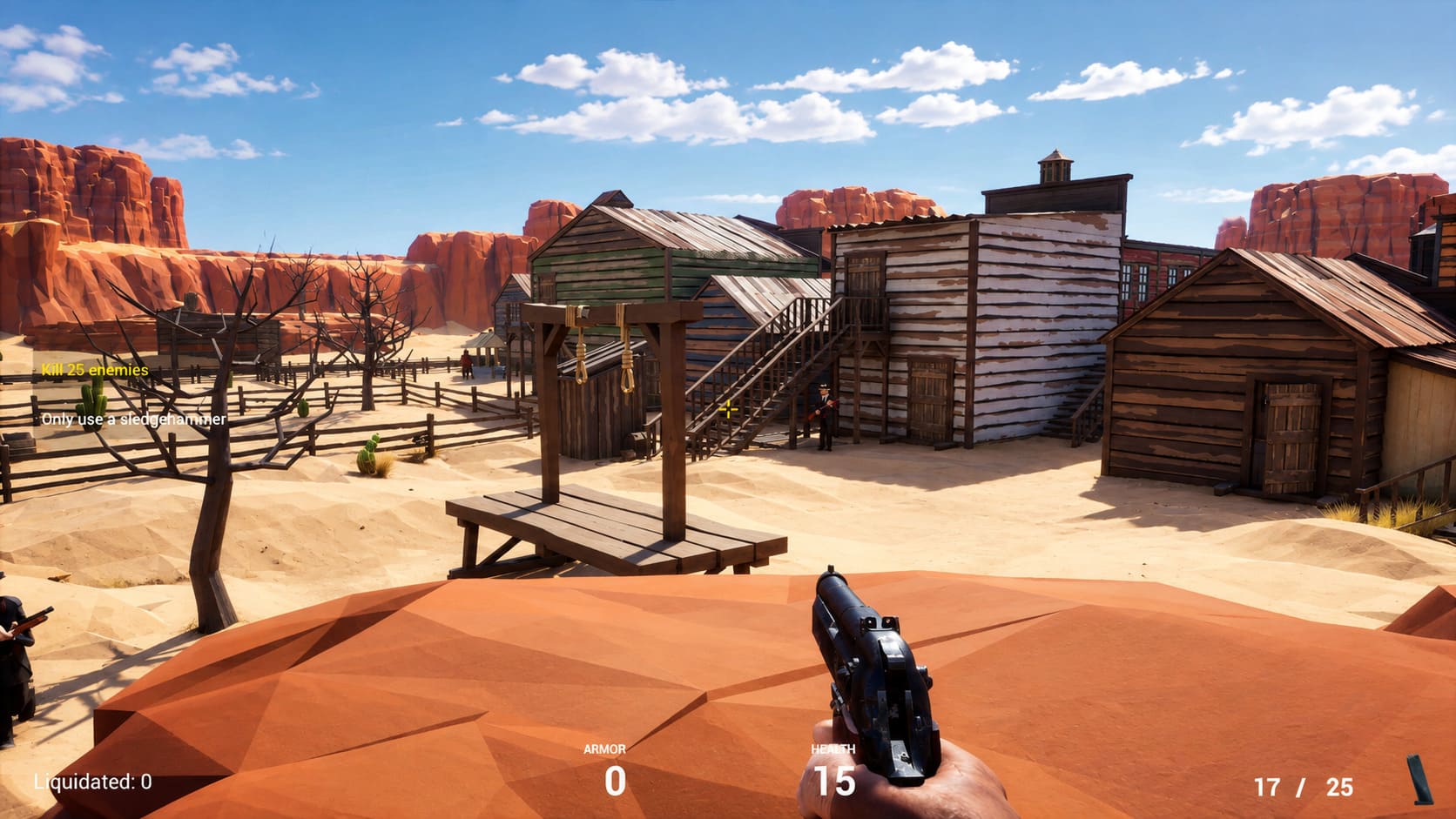
You’ll find a strange collection of weapons that feels more like an arcade shooter than a historical Western.
- Fists and a sledgehammer for close-range combat.
- A semi-automatic pistol that feels much more modern than the setting suggests.
- Single and double-barrel shotguns that become extremely useful against aggressive enemies.
- A minigun capable of shredding groups of enemies at ridiculous speed.
- A rocket launcher that wouldn’t look out of place in a Quake-inspired arena.
- A futuristic laser weapon that pushes the game even further into sci-fi territory.
Normally, I’d complain about the lack of thematic consistency.
Here, I don’t really mind.
The ridiculous weapon selection is part of the charm. PolyClassic: Wild isn’t attempting to be a serious Western simulator. It’s a low-poly shooting playground, and giving the player a minigun in a desert full of cowboy enemies is exactly the kind of dumb fun I expect from something like this.
There is one limitation, though: your weapon selection is largely determined by the individual level.
You don’t get the satisfying feeling of building a persistent arsenal and carrying your favorite loadout through an entire campaign.
Six Levels, One Very Familiar Environment
This is where the budget becomes obvious.
PolyClassic: Wild contains six levels, but don’t expect six radically different environments.
The same general visual ingredients appear repeatedly: desert terrain, wooden frontier buildings, saloons, fences, cacti, and open combat areas.
At first, the repetition isn’t terrible.
After a while, though, you start thinking, Wait, haven’t I already fought this exact battle in this exact place?
The maps are primarily designed around combat rather than exploration. You’re not hunting for complicated keycards or navigating elaborate labyrinths. Instead, you’re moving through relatively open spaces while enemy waves appear around you.
Health pickups, armor, ammunition, and temporary power-ups are scattered around the arenas, encouraging you to keep moving.
That part works reasonably well.
The problem is that there simply isn’t enough variety to keep the experience fresh for very long.
The Enemy Design Is Basic but Sometimes Surprisingly Mean
Most enemies are variations of low-poly outlaws and cowboys.
You’ll encounter melee attackers who charge straight toward you, ranged enemies who keep their distance, flamethrower units who pressure you from close range, and shotgun enemies who can absolutely wreck your afternoon.
The shotgun enemies are easily the ones I remember most.
Their hitscan attacks can feel brutal, especially when several of them spawn behind you. On higher difficulties, you can lose a huge chunk of health before you even understand where the damage came from.
That’s not always satisfying difficulty.
Sometimes it feels like the game is testing whether you’ve memorized enemy spawn locations rather than whether you’re actually improving your FPS skills.
Still, there is a certain old-school appeal to the brutality.
You make a mistake, you die, and the game basically says, “Okay, don’t do that again.”
How Long Does PolyClassic: Wild Take to Beat?
Don’t buy this game expecting a 15-hour campaign.
You can realistically finish the six levels in well under an hour, with roughly 45–60 minutes being a reasonable expectation depending on your difficulty and pace.
That’s extremely short.
There are additional challenges and reasons to replay individual stages, but I don’t think they provide enough variation to transform PolyClassic: Wild into a genuinely replayable FPS.
Personally, I don’t consider the short length automatically bad.
If I’m paying less than a dollar for something and getting an entertaining hour out of it, I don’t feel cheated.
The problem appears when the game approaches its regular asking price.
PolyClassic: Wild Price in 2026 Changes Everything
This is probably the most important part of my verdict.
At its normal price, which can sit around $9.99–$13.99 depending on the storefront, I would struggle to recommend PolyClassic: Wild.
There are simply too many better indie shooters available.
But the game regularly receives extremely aggressive discounts, sometimes reaching 90% or more off. That can push the price down into roughly the $0.49–$1.39 range.
And suddenly my opinion changes completely.
At fifty cents or a dollar, I’m much more forgiving.
The short campaign? Fine.
The repetitive maps? Whatever.
The weird mouse behavior? Annoying, but survivable.
The lack of story? I wasn’t expecting one anyway.
At that price, PolyClassic: Wild becomes a disposable arcade shooter that you can finish in an evening and forget about afterward.
And sometimes that’s enough.
What Players Seem to Think
The Steam community gives the game a Mostly Positive reception, with roughly three-quarters of its 230-plus user reviews leaning positive.
The positive reviews tend to focus on exactly what I think the game does best: cheap, uncomplicated shooting.
Players looking for a quick game on an older PC can get something that loads quickly, doesn’t demand powerful hardware, and gets straight to the action.
The negative side of the community is much harsher.
Some players describe the game as feeling like an asset-flip project. Others criticize the limited amount of content, repetitive environments, weak AI, and questionable aiming mechanics.
I can understand both sides.
Calling it a masterpiece would be ridiculous.
Calling it completely worthless is also unfair.
Pros and Cons
What I Like
- Extremely cheap during major sales
- Very low hardware requirements
- Immediate, uncomplicated FPS gameplay
- Fun selection of absurd weapons
- Colorful low-poly visual style
- Fast loading and simple structure
- Works well as a short arcade experience
What I Don’t Like
- Campaign can be finished in less than an hour
- Mouse aiming can feel inconsistent
- Six levels don’t provide much environmental variety
- Enemy AI is extremely basic
- Hitscan shotgun enemies can feel unfair
- No meaningful story or character development
- Limited replay value
Warlord Awaji Lag & Stuttering Fix: Performance Optimization Guide
So, Is PolyClassic: Wild Worth Playing in 2026?
Here’s my honest answer after looking at what this game actually offers.
At full price? No.
I wouldn’t recommend spending around ten dollars on PolyClassic: Wild when the PC market is packed with much better retro shooters. There are games with superior movement, stronger level design, better weapons, more interesting enemies, and significantly more content.
But if you see PolyClassic: Wild sitting in a Steam sale for under a dollar, I think it’s worth taking the gamble.
That’s the sweet spot.
For roughly the price of a snack, you get a weird little low-poly FPS with cowboy enemies, shotguns, rocket launchers, miniguns, and enough chaotic combat to fill an hour.
It isn’t deep.
It isn’t polished enough to become a serious competitor in the retro FPS genre.
And it definitely isn’t a hidden masterpiece I’ve been waiting years to discover.
But I don’t think every game needs to be one.
PolyClassic: Wild works best when you treat it like junk food gaming. You boot it up, shoot a ridiculous number of enemies, laugh at the bizarre weapon choices, finish the short campaign, and move on to something else.
For me, that’s enough to give it a cautious recommendation — but only at the right price.
If you’re building a huge retro FPS backlog, there are far better choices.
If you’ve got an old PC, one spare dollar, and about an hour to kill?
Give PolyClassic: Wild a shot. Just don’t expect the next DOOM.