Onimusha Way of the Sword Endings Guide: How to Unlock the True Ending
There is something wonderfully old-school about Onimusha: Way of the Sword. Capcom could have turned its return to the samurai action genre into a straightforward nostalgia trip, but instead the studio built a darker new chapter around Miyamoto Musashi, a supernatural Kyoto, and a sword-fighting system that actually demands attention.
And if you are anything like me, simply reaching the credits is not enough.
Onimusha: Way of the Sword features three possible endings, and the True Ending is clearly the one most players will want to see. The problem is that the game does not exactly hold your hand. Several optional activities, hidden treasures, upgrades, combat challenges, and dialogue decisions need to be handled before the story reaches its final stage.
That is where things can get frustrating. You can spend hours upgrading Musashi, explore most of Kyoto, and still accidentally cross the game’s point of no return before finishing something important.
So, here is my approach to the Onimusha: Way of the Sword True Ending. I will explain what matters, what you should finish before the final stretch, and how I would personally prepare for the ending if I were starting a fresh playthrough.
Onimusha: Way of the Sword Endings at a Glance
The game’s story revolves around Miyamoto Musashi, a young swordsman whose search for strength takes him directly into a supernatural nightmare. Kyoto has been infected by Malice, the Genma are everywhere, and Musashi finds himself connected to the mysterious Man in White through the powerful Oni Gauntlet.
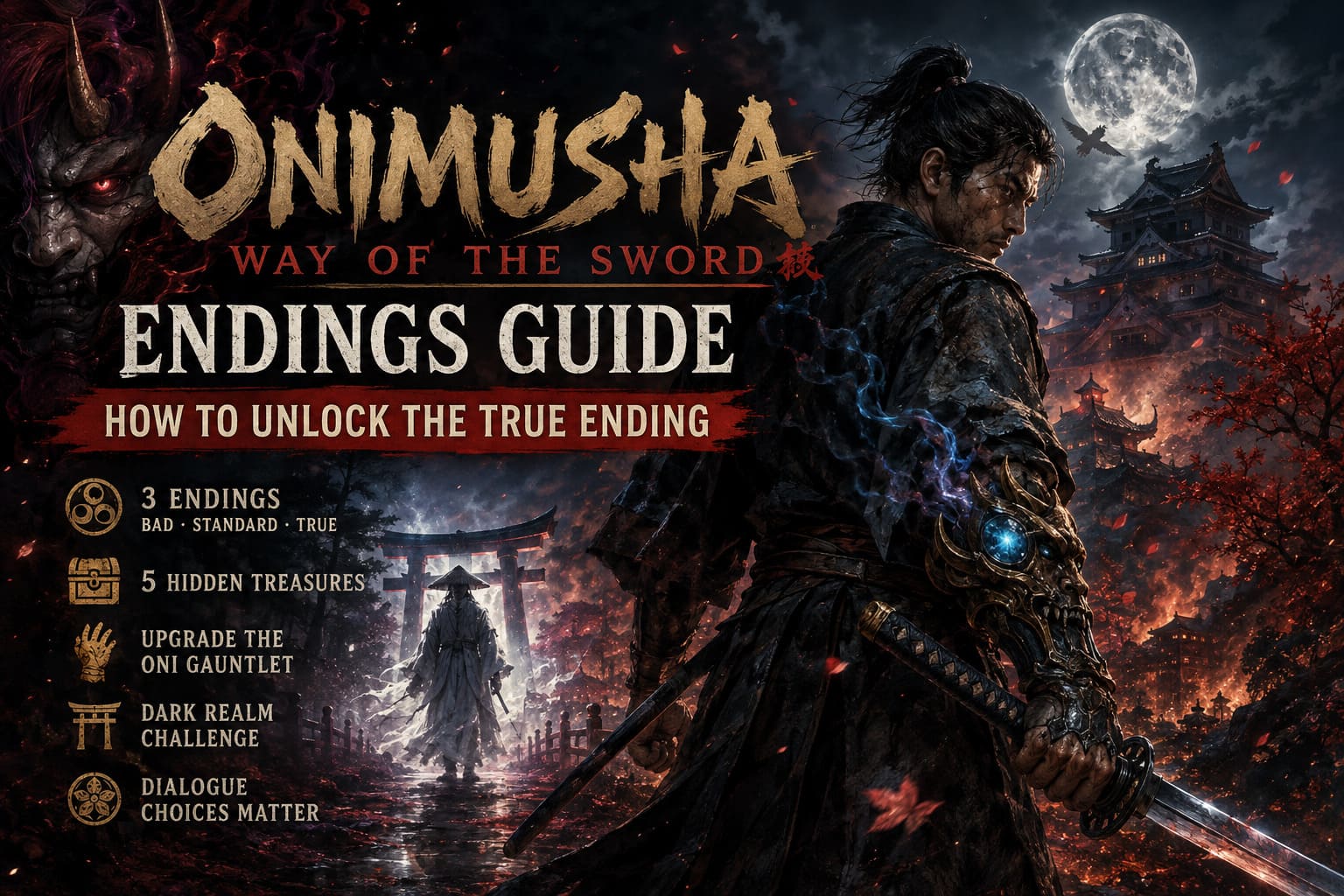
The narrative can ultimately lead toward three different outcomes.
| Ending | General Path | Result |
|---|---|---|
| Bad Ending | Low completion and poor decisions | Musashi falls to corruption |
| Standard Ending | Normal story completion | Kyoto is saved, but major questions remain |
| True Ending | Full preparation and optional objectives | The hidden conclusion is revealed |
Personally, I think the True Ending makes the extra work worthwhile. The Standard Ending works as a conclusion, but the True Ending feels much more satisfying if you have already invested heavily in exploration and character progression.
The Story Behind Musashi’s Journey
The basic setup is classic Onimusha: historical Japan collides with demons, supernatural forces, and brutally stylish sword combat.
Musashi arrives in Kyoto looking to establish himself as an exceptional swordsman. Instead, he walks straight into a disaster.
The city has been overwhelmed by Malice, a strange corruption capable of opening pathways to the underworld. The Genma soon follow, turning familiar locations into dangerous battlefields.
After a near-fatal encounter, Musashi receives the Oni Gauntlet from the mysterious Man in White. This becomes one of the most important tools in the entire game.
The gauntlet allows Musashi to absorb different types of souls from defeated enemies:
- Yellow Souls restore health.
- Red Souls are used for upgrades and progression.
- Blue Souls activate powerful Oni Armaments.
The system sounds simple, but it becomes central to how you prepare for the late game.
Then there is Izumo no Okuni, another warrior connected to the Oni powers, and Sasaki Ganryu, Musashi’s dangerous rival. Ganryu’s relationship with the Genma takes the story in a much darker direction. Rather than resisting their power, he becomes increasingly willing to use it to surpass his human limitations.
This rivalry is one of the reasons I enjoyed the setup. Musashi and Ganryu aren’t simply two guys waiting for a final boss fight. Their opposing attitudes toward power give the final stages much more weight.
The Most Important Thing: Don’t Rush Rendaino
If you remember only one thing from this guide, remember this:
“The Clash at Rendaino” is the point where you need to have your optional work finished.
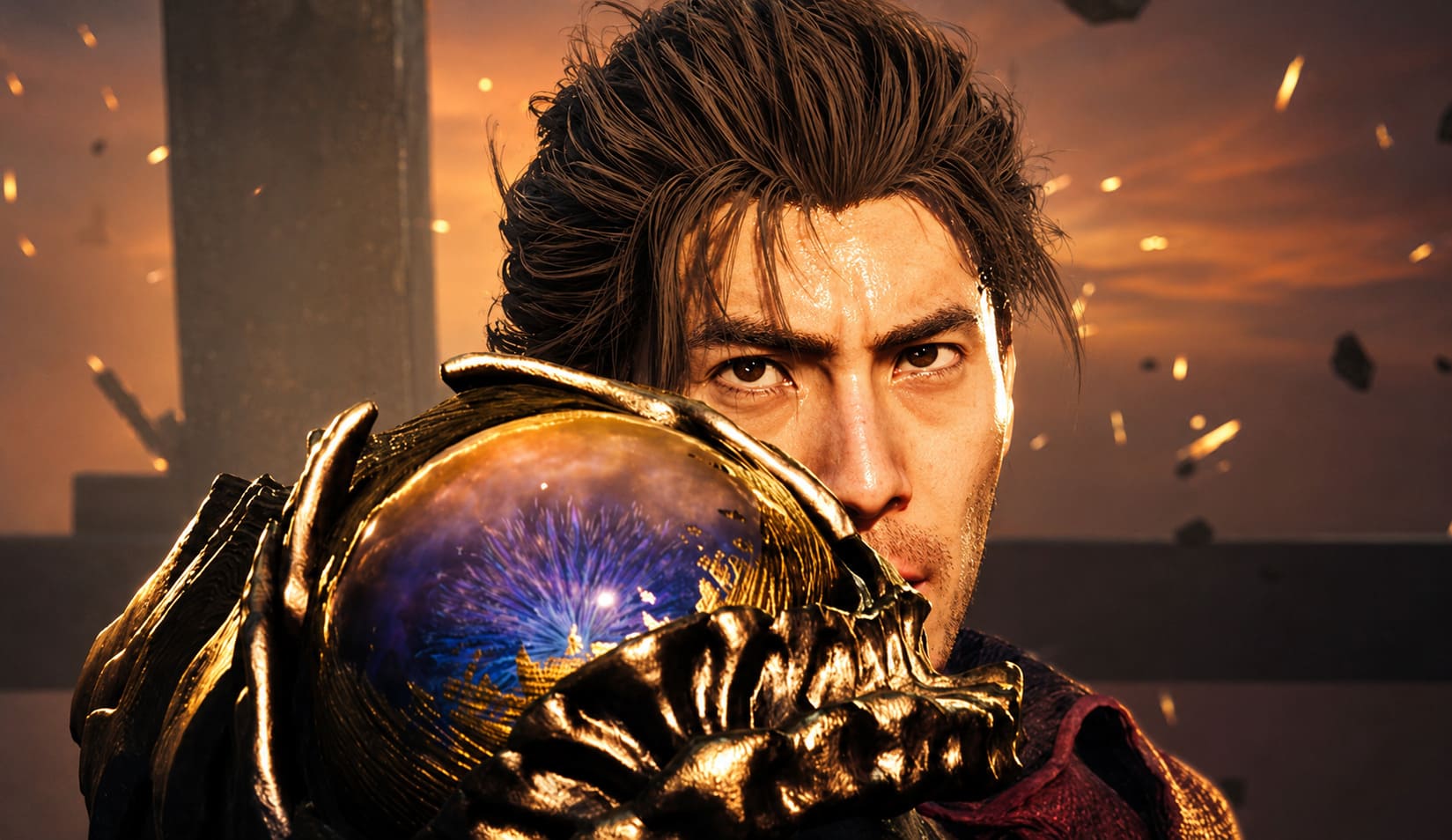
Once you move beyond this major story event, the game pushes you toward the final sequence at the corrupted Kyoto Castle. That means this is not the moment to think, “I’ll come back and grab that treasure later.”
You won’t want to discover that you missed something after committing to the finale.
Before triggering the mission, I recommend checking your progression carefully:
- Upgrade the Oni Gauntlet as far as possible.
- Find the hidden upgrade components.
- Complete all five Hidden Treasure Chance Encounters.
- Finish the associated Hidden Treasures.
- Clear the required Dark Realm challenge.
- Make the appropriate dialogue decisions.
- Stock up on healing and combat supplies.
This is basically your True Ending checklist.
1. Fully Upgrade the Oni Gauntlet
The Oni Gauntlet isn’t just a flashy story artifact. It is a major part of Musashi’s combat progression, so neglecting it can make the final encounters considerably harder.
I recommend spending your red souls carefully throughout the campaign instead of constantly saving them for some imaginary perfect moment. There is little point in sitting on a giant pile of resources if your current combat abilities are underdeveloped.
Exploration helps here too. Hidden areas can contain additional upgrade components, so don’t treat every side path as optional decoration.
Use Oni Vision frequently. I know it can become tempting to run through familiar-looking environments, especially when you just want to continue the story, but Onimusha rewards curiosity.
A few extra minutes of searching can make a noticeable difference later.
2. Find All Five Hidden Treasures
This is probably the part of the True Ending preparation that is easiest to overlook.
During your exploration of Kyoto, you can encounter NPCs who trigger special Chance Encounters. Five of these encounters provide an Old Drawing.
The drawings aren’t conventional quest maps. They show an area and give you enough environmental information to figure out where the treasure is hidden.
That’s actually one of my favorite ideas in this type of game. Instead of dropping a huge glowing waypoint on your map, the game asks you to pay attention to the world.
When hunting these treasures, look closely at:
- Temple entrances and gates.
- Shrines and nearby structures.
- Distinctive rocks and lanterns.
- Unusual architecture shown in the drawing.
- Suspicious patches of ground or interaction points.
The map is deliberately vague, so don’t expect the exact treasure location to be handed to you.
And yes, all five need to be collected if you are aiming for the complete True Ending route.
3. Don’t Ignore the Dark Realm
If you’ve played previous Onimusha games, you probably already know what kind of trouble the Dark Realm represents.
In Way of the Sword, it once again serves as an optional combat challenge where the game can throw increasingly dangerous Genma at you. This isn’t a sightseeing activity. It is essentially a test of whether you actually understand Musashi’s combat system.
Before going in, make sure your equipment is properly upgraded and that you have enough healing items.
The combat becomes much easier once you stop treating every encounter like a basic hack-and-slash fight.
Issen Is Your Best Friend
The Issen mechanic is especially important.
A perfectly timed counter can massively change the flow of an encounter. Instead of simply trading hits with enemies, you’re waiting for the right moment and punishing their attack.
The same philosophy applies to Deflect. Timing your defense correctly can damage an enemy’s stamina and create openings for devastating attacks.
Against stronger enemies, patience is often more useful than aggression.
That is especially true in the Dark Realm, where trying to mash your way through every wave can leave Musashi badly damaged before the later floors.
4. The Hidden Path During “In the Light of an Icy Moon”
One section that deserves special attention occurs during the “In the Light of an Icy Moon” mission.
At one point, the game gives you the rather vague objective to “Find the hidden path.”
If you are anything like me, this is the sort of objective that can result in five minutes of running around while wondering whether you missed a doorway.
The solution involves the frozen courtyard near the rear of the pagoda.
Look for the area behind the large stone lantern and examine the weakened icy wall. Using Musashi’s heavy two-handed attack allows you to break through it and reveal a concealed route.
That path eventually leads toward one of the entrances connected with the Dark Realm.
So, when the game gives you an objective that sounds ridiculously vague, start checking the environment rather than assuming there must be another quest marker.
Dialogue Choices Matter Too
Combat and exploration are only half of the equation.
Several important conversations influence how Musashi approaches the power contained within the Oni Gauntlet. For the True Ending route, you want decisions that reinforce Musashi’s humanity and self-control rather than his obsession with obtaining more power.
When confronted with opportunities to embrace dark Genma power, resist them.
This fits Musashi’s character arc quite well. The entire story is partly about strength and what someone is willing to sacrifice to obtain it.
Ganryu chooses one direction.
Musashi has the opportunity to choose another.
I would avoid blindly selecting every aggressive or power-focused response just because it sounds more like something a legendary swordsman would say. In this particular route, restraint matters.
Preparing for the Final Battle
Once your optional objectives are complete, you can finally move toward The Clash at Rendaino.
At this point, I recommend making one final check before committing:
| Check | Ready? |
|---|---|
| Oni Gauntlet upgraded | ✓ |
| Hidden upgrade components collected | ✓ |
| Five Old Drawings completed | ✓ |
| Five Hidden Treasures recovered | ✓ |
| Dark Realm cleared | ✓ |
| Human-focused dialogue choices made | ✓ |
| Healing items stocked | ✓ |
If everything is done, you’re ready.
The final stages take Musashi into increasingly dangerous encounters around Kyoto Castle, eventually leading to the confrontation with Sasaki Ganryu.
Ganryu’s attacks can become overwhelming if you try to fight him like a normal enemy. Watch his patterns, use your defensive mechanics, and don’t waste Oni Armaments simply because you have access to them.
Save your strongest tools for moments where they can actually interrupt or punish his attacks.
What Happens With the True Ending?
The payoff for completing the optional content is a different conclusion to Musashi’s journey.
Rather than simply defeating Ganryu and walking away from the supernatural disaster, the True Ending expands the final conflict and reveals more about the forces manipulating events behind the scenes.
The Man in White becomes much more important to the final confrontation, and Musashi’s relationship with the Oni Gauntlet reaches its ultimate point.
The crucial difference is that Musashi doesn’t simply become another victim of the power he has been carrying throughout the game.
He manages to confront the corruption without surrendering his humanity.
That makes the ending feel appropriate for the journey. Musashi spends much of the game chasing strength, but the final test isn’t necessarily about having the biggest sword or the most powerful supernatural ability.
It’s about whether he can control that power.
Onimusha: Way of the Sword Steam Deck Best Settings Guide: Maximize Performance & Battery Life
My Advice for a First Playthrough
If you’re playing Onimusha: Way of the Sword for the first time, I wouldn’t recommend obsessively following a checklist from the opening hour.
Enjoy the game.
Explore naturally. Learn Issen. Experiment with the Oni Armaments. Search the environments. Talk to NPCs.
But once you approach the late-game story, switch into completionist mode.
The biggest mistake would be reaching The Clash at Rendaino and realizing that you’ve skipped several optional objectives.
My personal priority would be:
Exploration → Oni upgrades → Hidden Treasures → Dark Realm → final dialogue checks → Rendaino.
That order keeps the preparation manageable without turning the entire campaign into a checklist simulator.
How to Fix Controller Input Lag and Delay in Onimusha: Way of the Sword on Steam
Final Thoughts
Onimusha: Way of the Sword works best when you let its combat and exploration systems breathe. Rushing from boss to boss is certainly possible, but you’re leaving a lot of the experience behind.
The True Ending is designed for players who pay attention.
Fully developing the Oni Gauntlet, tracking down the five Hidden Treasures, conquering the Dark Realm, and making careful dialogue decisions all fit naturally into the larger theme of Musashi’s journey.
And honestly, that’s why I like this kind of ending.
The game doesn’t just say, “Congratulations, you reached the final boss.” It asks whether you actually explored the world and understood what Musashi was fighting against.
So before starting The Clash at Rendaino, stop and check your progress.
If the five treasures are collected, the Dark Realm is cleared, your Oni Gauntlet is ready, and Musashi has resisted the temptation of Genma power, you’re in the best position to experience the game’s most complete conclusion.
Don’t rush the finale. In Onimusha, the road to the ending is part of the test.