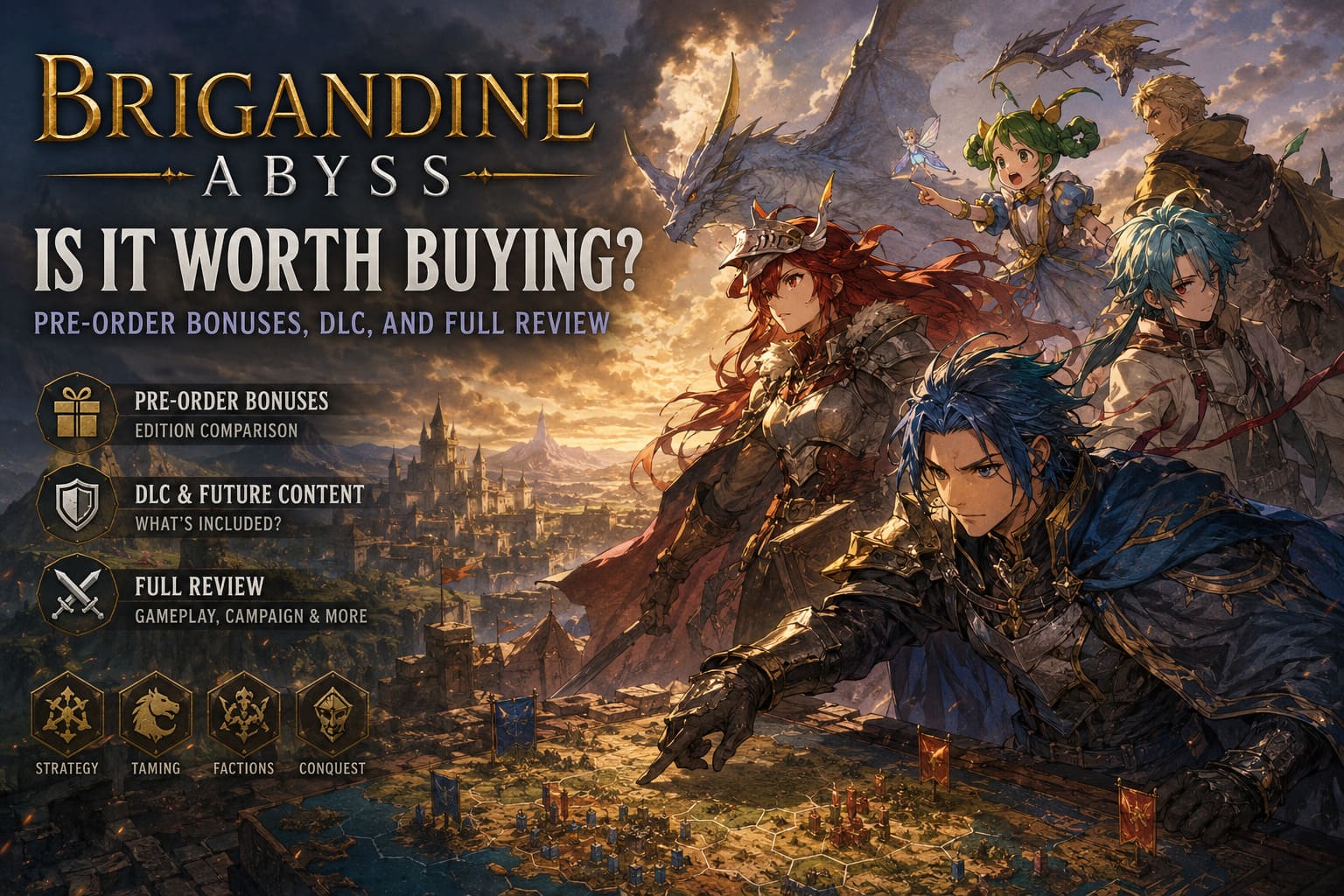
Is Brigandine Abyss Worth Buying? Pre-Order Bonuses, DLC, and Full Review
Brigandine: Abyss is the kind of strategy RPG that can eat an entire weekend without you noticing. You start with a handful of Rune Knights, a few underpowered monsters, and a map that looks manageable. Then you make one bad deployment, lose a monster you spent hours developing, and suddenly you are staring at the campaign map thinking, “Okay, I absolutely should have prepared for that.”
That is the appeal of the Brigandine formula.
Developed by Adglobe and Matrix Corporation and published globally by Happinet and NIS America, Brigandine: Abyss launches on PC via Steam on August 26, 2026, with PlayStation 5, Xbox Series X|S, and Nintendo Switch 2 versions following on August 27. It is the fourth major entry in the cult tactical strategy series after Brigandine: The Legend of Runersia, and this time the war moves to the new continent of Meltitea.
After hundreds of hours spent with strategy games, I have a fairly simple rule for games like this: mechanics matter more than presentation. If the strategic layer is strong, the battles have meaningful decisions, and the progression keeps pulling me back, I can forgive a lot.
Fortunately, Brigandine: Abyss has plenty of those things.
What Makes Brigandine: Abyss Different?
Calling Brigandine: Abyss a tactical RPG is technically correct, but it does not really explain what you are getting.
This isn’t simply a character-driven adventure where you move heroes across a battlefield and watch flashy skills explode. The real game exists at two different levels.
First, you manage an entire war from the Organization Phase. Then you personally fight the battles during the Attack Phase.
That combination is what makes the Brigandine formula so addictive.
During the Organization Phase, you control Rune Knights across the political map of Meltitea. You decide which territories need reinforcements, which commanders should attack, which units should stay home, and where your limited resources should go.
And then there are the monsters.
You can summon fantasy creatures such as dragons, centaurs, ghouls, pegasi, and other specialized units before developing them through different evolution paths. A weak creature early in the campaign can eventually become an absolute monster on the battlefield.
That progression is one of the game’s strongest hooks.
The Two Layers of War
| Phase | What You Do | Why It Matters |
|---|---|---|
| Organization Phase | Move Knights, summon monsters, manage resources, prepare armies | Determines your strategic position |
| Attack Phase | Fight battles on hex-grid maps | Determines who actually wins territory |
| Quests | Send unused Knights on missions | Provides gear, experience, and useful rewards |
| Unit Development | Promote Knights and evolve monsters | Builds stronger specialized armies |
The important thing is that these systems constantly feed into each other. A good strategic decision gives you a better tactical position, while a clever battlefield victory can completely change your next turn.
It creates that wonderful strategy-game feeling where every small decision has consequences several turns later.
Monster Taming Is Still the Secret Sauce
If you only care about conquering territories, you might miss what makes Brigandine: Abyss special.
The monster system is where I spent an absurd amount of time.
There are more than 100 distinct military units, and many monsters can be upgraded through evolution trees. That means you aren’t simply collecting disposable troops. You are effectively building personalized units that become part of your long-term military plan.
But there is a catch.
Monsters can die permanently.
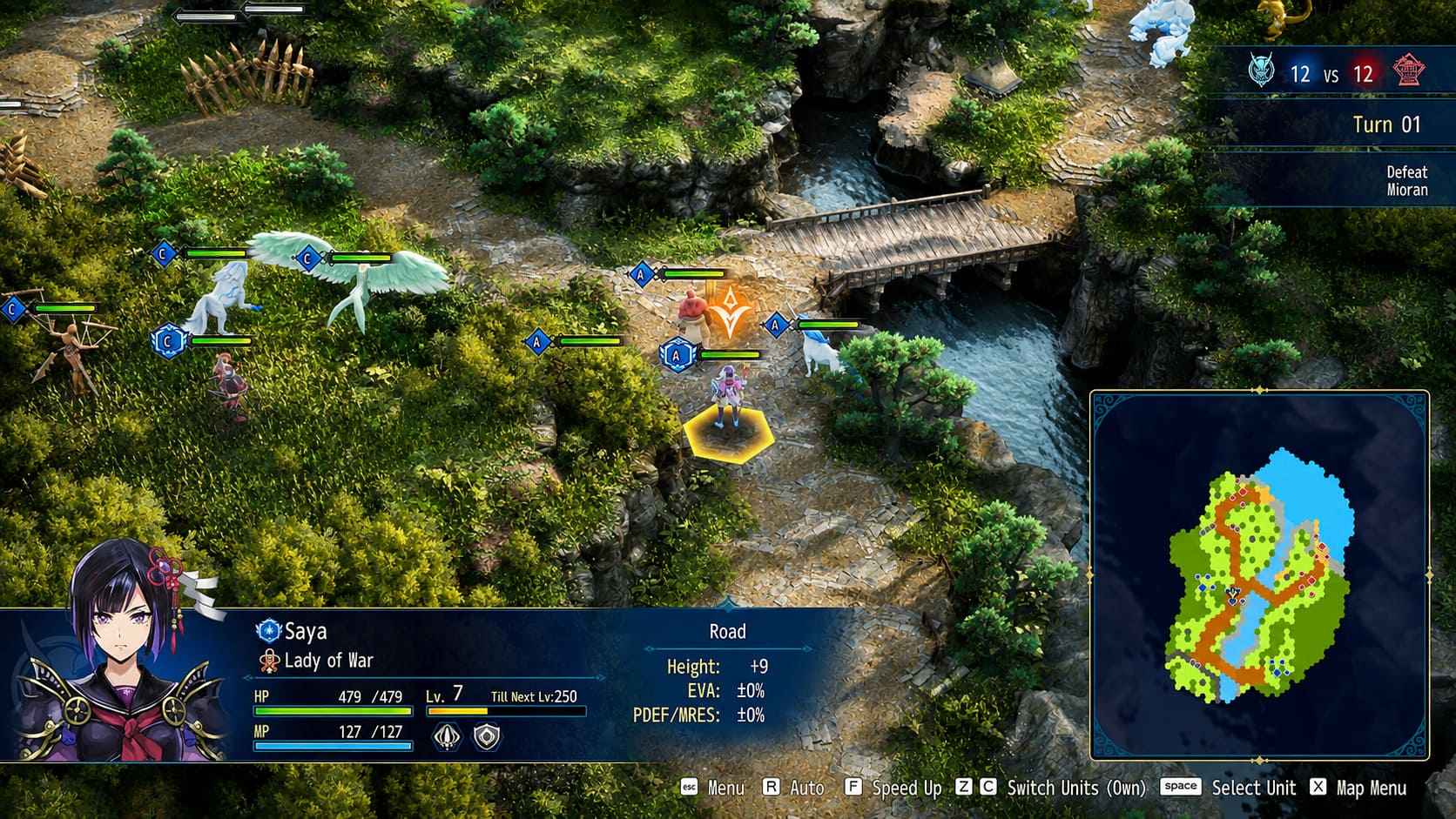
Rune Knights don’t work the same way. When one of your commanders falls, they are injured and temporarily removed from active duty. Eventually, they return.
A monster that dies on the battlefield? Gone.
That completely changes how you approach difficult battles.
If you have spent hours evolving a powerful creature into a high-tier combat monster, suddenly a seemingly harmless enemy attack can become terrifying. Sometimes the correct decision isn’t to push forward and grab another kill. Sometimes you retreat because keeping that monster alive is more valuable than winning one additional exchange.
That is exactly the kind of decision-making I want from a strategy RPG.
Six Story Campaigns and a Much Bigger Sandbox
The campaign structure is another major selling point.
Story Mode gives you six major nations, each with its own protagonist, political identity, battles, scenes, and ending. Instead of watching the entire conflict from one perspective, you can experience the war from completely different sides.
Among the highlighted factions are Gran Dragnica, commanded by Largo, Scarlet Will, led by Garnet, and the faerie nation of Purifanoe.
The different factions aren’t just palette swaps. Their campaigns encourage different approaches to the strategic layer, which makes replaying the game substantially more interesting.
But if you are anything like me, Mission Mode may be where the real addiction begins.
Mission Mode expands the selection to 24 factions and gives each one its own victory requirements. One faction might demand total conquest. Another can revolve around economic objectives. A smaller nation might have entirely different defensive or political goals.
This is where the game stops feeling like a traditional campaign and starts becoming a strategy sandbox.
And that is a huge deal.
A single linear campaign can give you 30 or 40 hours of entertainment. A sandbox with radically different objectives can keep you experimenting for months.
Brigandine: Abyss Pre-Order Bonuses and Editions
If you’re buying close to launch, there are several editions and bonuses worth understanding.
The standard pre-order offering centers around a Starter Guidebook, provided in physical or digital form depending on the version and retailer. For newcomers, this is actually a useful bonus because Brigandine has a lot of systems to understand before you can play efficiently.
The Western Deluxe Edition is more attractive to collectors. Physical PlayStation 5 and Nintendo Switch 2 versions include an “Art of ABYSS” character visual book and a digital soundtrack featuring music from composer Rei Kondoh.
One thing Switch 2 buyers should keep in mind is that the Western physical release uses a game-key card rather than a traditional cartridge.
Then there is the Japanese Limited Edition, which is clearly aimed at serious collectors.
The package includes physical game media with English language support, a special “16 Musashi” -ABYSS edition- board game, an artbook, an original soundtrack CD set, and a collector’s box featuring new artwork by Junko Kawano.
Some Japanese retailers also offer additional store-exclusive bonuses, including character acrylic keychains.
Quick Edition Comparison
| Edition | Main Extras | Best For |
|---|---|---|
| Standard | Starter Guidebook | Regular players |
| Western Deluxe | Artbook + Digital Soundtrack | Console collectors |
| Japanese Limited | Board Game + Artbook + OST + Collector Box | Hardcore fans |
| Retail Bonuses | Character Acrylic Goods | Completionists |
The important part is that the core tactical experience isn’t being carved up into a dozen expensive premium DLC packages. That’s refreshing in 2026.
What About DLC?
The launch approach is relatively straightforward.
The main game does not appear to lock essential tactical systems behind paid DLC. Pre-order bonuses focus primarily on physical extras and instructional material rather than selling players pieces of the actual campaign.
There has also been discussion around a Knights and Monsters Training Pack, expected to function as a free update or digital addition intended to help players get comfortable with the game’s progression systems.
For me, this is the correct approach.
A strategy RPG already has enough systems to learn. I don’t need the developer asking me to pay extra to understand how my monsters work.
Where Brigandine: Abyss Really Shines
The biggest strength is obvious once you’ve played several battles: the strategic depth is enormous.
You are constantly balancing competing priorities.
Do you reinforce the western border?
Do you spend mana on another monster?
Should your strongest Rune Knight attack now or wait?
Is that territory actually worth taking?
Should you send an unused Knight on a Quest instead?
Do you risk an evolved monster in a difficult battle?
None of these questions has a universal answer.
And that is why the game can become so addictive.
The progression system is also excellent for players who enjoy min-maxing. If you like experimenting with class paths, monster evolutions, party compositions, elemental advantages, and battlefield positioning, there is a ridiculous amount to tinker with.
The soundtrack deserves praise as well. Rei Kondoh’s orchestral score gives major battles the sense of scale they need. Strategy games live or die by atmosphere because you spend so much time looking at maps and menus. Strong music goes a long way toward keeping that experience exciting.
The quality-of-life improvements are another welcome addition, including adjustable graphical settings, higher frame-rate options, difficulty customization, and the ability to save during combat.
Those aren’t flashy features, but experienced strategy players know how valuable they are.
Where It Falls Short
Brigandine: Abyss isn’t perfect.
The biggest concern is combat repetition.
The hex-grid battles are strategically satisfying, but you will fight a lot of them. Once you’ve played enough encounters, certain battles can start to feel like variations on the same tactical puzzle.
The enemy AI can also struggle to take full advantage of the game’s systems. When the AI doesn’t properly exploit positioning or advanced abilities, some fights become less about solving a tactical problem and more about cleaning up another enemy army.
That can be frustrating.
The visual direction may also divide longtime fans.
The Legend of Runersia had a very distinctive fantasy identity, while Brigandine: Abyss moves toward a more contemporary anime-inspired aesthetic. Some players will love the cleaner presentation. Others may miss the more recognizable artistic identity of the previous game.
Personally, I think this is one of those changes that looks worse on screenshots than it feels during gameplay. Still, longtime fans have a legitimate reason to be disappointed.
The other issue is pacing.
The grand strategy layer means that Story Mode can take its time. You may have to fight multiple territorial battles before the narrative makes meaningful progress.
If you’re here primarily for the story, that can feel like a slog.
If you’re here for the strategy, you’ll probably be grinning.
Is Brigandine: Abyss Worth Buying?
This is where I land after looking at the complete package: yes, but only if you actually enjoy slow-burn strategy games.
Don’t buy Brigandine: Abyss expecting Fire Emblem: Three Houses with bigger maps.
Don’t buy it expecting nonstop cinematic storytelling.
And definitely don’t buy it expecting every battle to be a ten-minute tactical masterpiece.
What you are buying is a deep tactical grand strategy sandbox where army management, monster development, territorial conquest, and battlefield decisions constantly collide.
That is a much more specific proposition.
1666 Amsterdam Steam Deck Settings: Best Graphics Config for 45 FPS on OLED
Buy It If You:
- Love tactical RPGs mixed with grand strategy.
- Enjoy min-maxing characters, classes, monsters, and resources.
- Want a game with huge replay value.
- Like experimenting with different factions and victory conditions.
- Enjoy strategy games where losing a valuable unit actually hurts.
Wait for a Sale If You:
- Prefer fast, cinematic tactical RPGs.
- Need a strong story to keep you engaged.
- Get bored by repeated turn-based battles.
- Dislike anime-inspired fantasy presentation.
- Want a strategy game with extremely sophisticated enemy AI.
Final Verdict
Brigandine: Abyss is not trying to be everybody’s strategy RPG. That’s a good thing.
The game knows exactly what it wants to be: a dense, old-school tactical war simulator wrapped in a fantasy RPG structure.
Its greatest strength is also its biggest barrier to entry. There are a lot of systems here. You have to learn them. You have to make mistakes. You have to lose monsters you really didn’t want to lose. And eventually, after enough painful lessons, you start seeing the battlefield differently.
That’s when Brigandine: Abyss clicks.
Suddenly you’re looking three turns ahead. You’re planning monster evolutions before the battle even starts. You’re checking territory layouts and wondering which enemy base can be exploited. You’re sending one Rune Knight on a Quest while moving another toward the front line.
And then you look at the clock.
Three hours disappeared.
That’s the Brigandine experience.
For hardcore strategy fans, Brigandine: Abyss is one of the more interesting tactical RPG releases of 2026. It has enough depth to justify dozens of hours, and its Mission Mode gives the game a serious advantage over more linear competitors.
The repetitive combat, slower narrative pacing, imperfect AI, and divisive visual direction keep it from being an automatic recommendation for everyone.
But if your idea of a great night is staring at a giant fantasy map, calculating whether your strongest dragon can survive one more battle, and completely rebuilding your army because your original strategy went horribly wrong?
Yeah.
You probably already know whether you’re buying Brigandine: Abyss.