Tom Clancy’s Ghost Recon Wildlands Drop-In Drop-Out Co-Op Mechanics Guide: How Matchmaking and Progression Work in 2026
There are plenty of open-world shooters that let you play with friends, but Tom Clancy’s Ghost Recon Wildlands has always felt different to me. It isn’t just a game where multiplayer happens to exist alongside the campaign. The entire experience seems built around the idea that someone can join your squad, disappear ten minutes later, and the world simply keeps moving.
That sounds like a small feature on paper. In practice, it changes everything.
I have played plenty of co-op games where getting a friend into the same session feels like preparing a mission before the actual mission. Someone needs to finish a quest, another player has to reload a save, everyone has to use the same difficulty, and eventually somebody asks, “Wait, whose campaign are we playing?”
Wildlands mostly avoids that headache.
You can be cruising through Bolivia alone with AI teammates, receive a friend invite, and suddenly you’re running a four-person Ghost squad. Someone disconnects? The game doesn’t collapse around it. The human player leaves, AI fills the gap, and the operation continues.
That drop-in, drop-out philosophy is one of the biggest reasons I still think Ghost Recon Wildlands co-op is worth playing in 2026, especially if you have two or three friends who enjoy tactical shooters.
How Drop-In, Drop-Out Co-Op Actually Works
The basic structure is extremely simple.
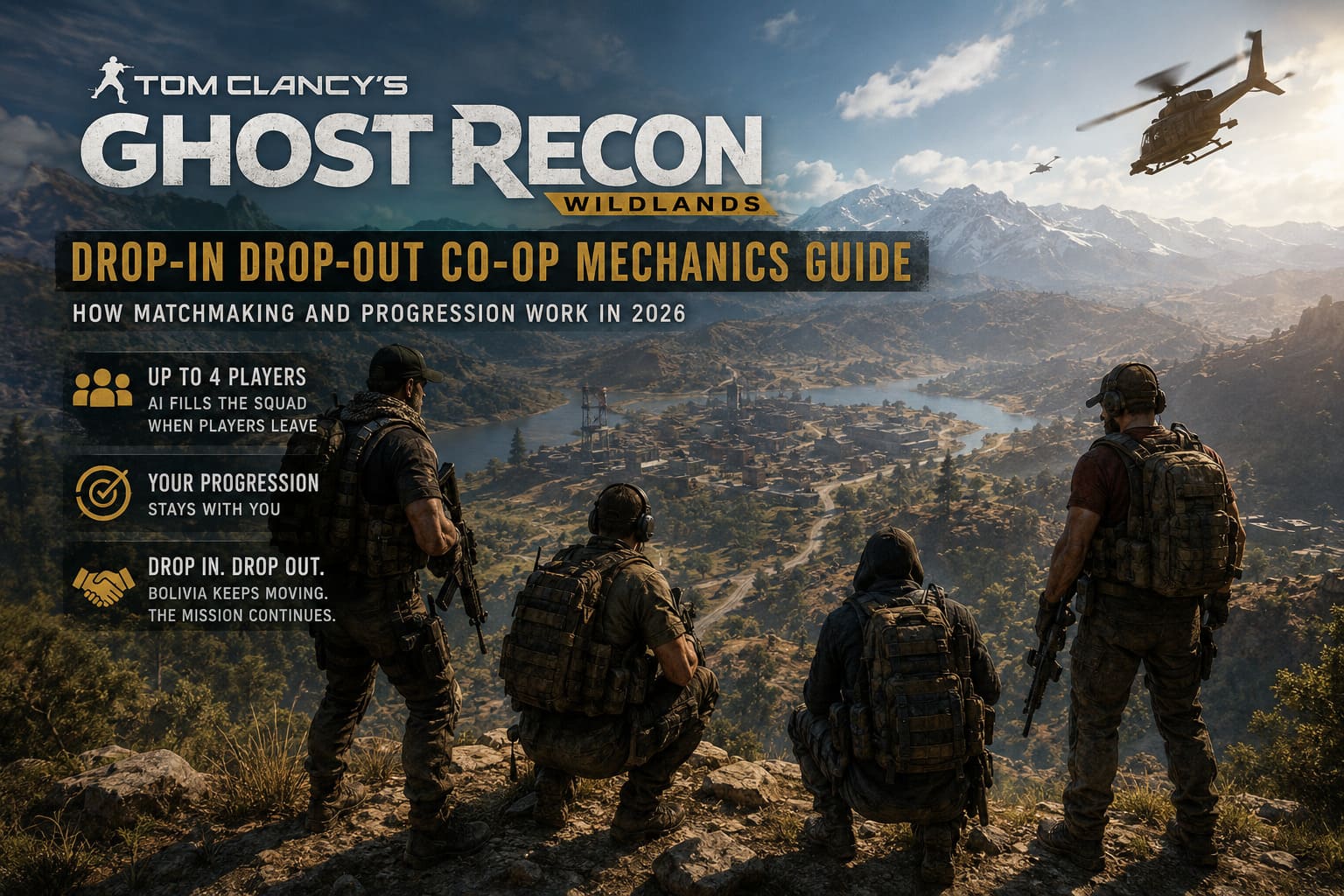
A normal Wildlands squad can contain up to four players, including the host. When you’re playing alone, the remaining positions are occupied by AI-controlled Ghosts. These teammates can be ordered around and used for mechanics such as Sync Shot.
The moment another human joins, the game adjusts the squad dynamically.
An AI teammate disappears and the incoming player takes their place. There is no need to restart the campaign or create a special multiplayer character. You’re essentially stepping into an already-running version of Bolivia.
That’s the part I really appreciate.
You don’t feel like you’re entering a separate “multiplayer mode.” You’re joining someone’s actual open-world campaign.
If the host is driving across the map, you can jump into the operation. If they’re preparing to attack a cartel base, you’re immediately part of that plan. If they’re flying a helicopter halfway across Bolivia, you’re probably going to spend the next few minutes wondering whether the pilot actually knows where they’re going.
And honestly, that’s part of the fun.
What Happens When Someone Leaves?
This is where the drop-out system becomes particularly convenient.
When a player leaves the squad, their character disappears and the game can return to the normal AI-supported squad structure. You don’t have to end the session just because one friend has to go.
That makes Wildlands surprisingly good for casual co-op sessions.
You can start with four people, lose one after an hour, continue with three, and eventually finish the night alone without having to rebuild your campaign from scratch.
For a game that was originally released in 2017, that flexibility still feels remarkably modern.
Does Your Progress Carry Over in Co-Op?
This is probably the most important question for anyone planning to play Wildlands with friends.
The short version is: your personal progression matters.
Your character isn’t simply borrowing the host’s entire progression system. Things you’ve earned and unlocked for your own character remain relevant to your personal campaign.
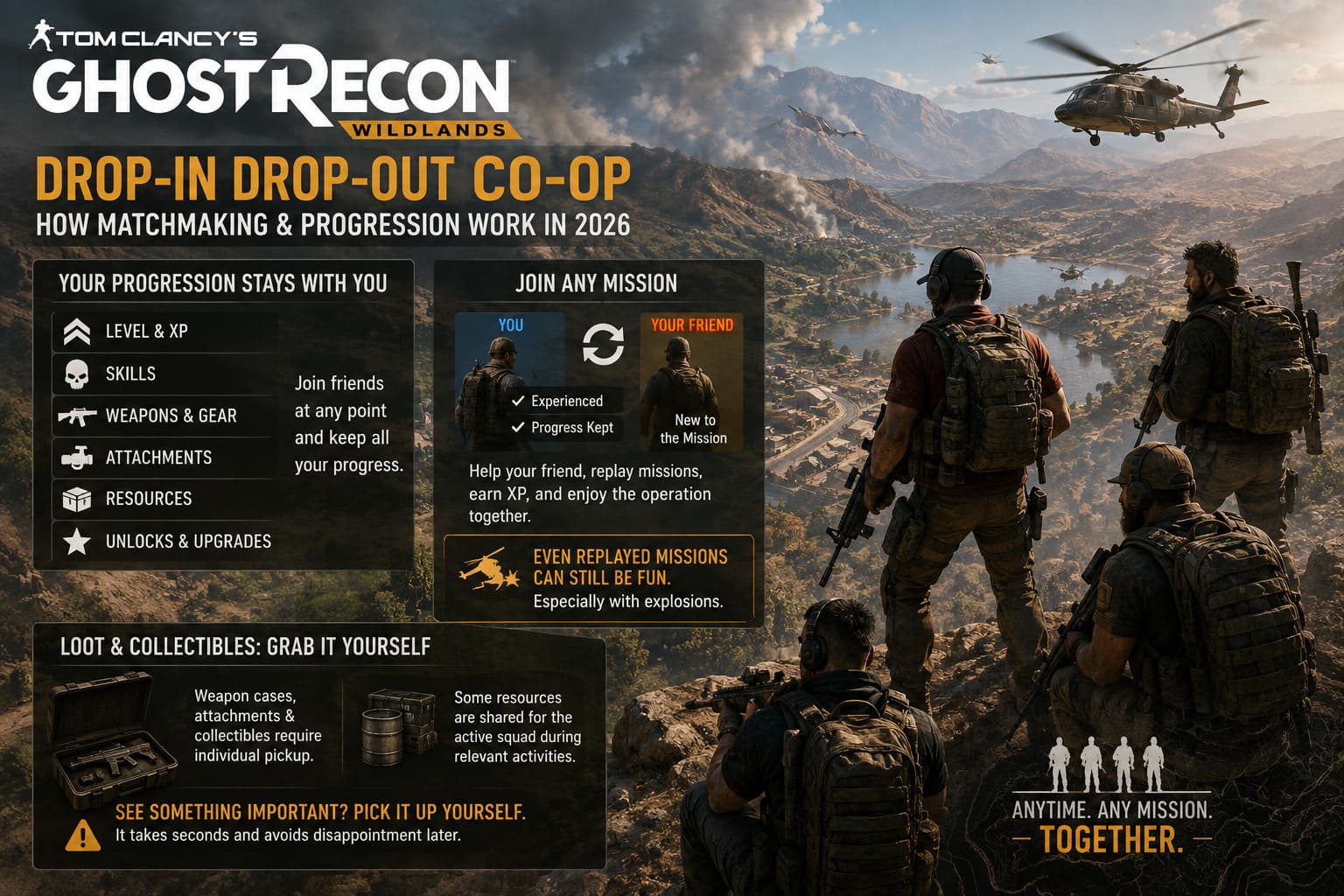
That includes things such as:
- Character level and XP
- Skill progression
- Weapons and equipment
- Weapon attachments
- Resource-related progression
- Personal unlocks and upgrades
This is a huge advantage if your friends are at different points in the game.
Imagine you’ve already spent 30 hours exploring Bolivia while your friend has just started. In a lot of co-op games, that difference can create an awkward barrier.
Wildlands basically says: come along anyway.
You can enter their session, help them complete missions and experience the world together without throwing away your own progression.
What If You’ve Already Completed the Mission?
This is another situation where Wildlands handles co-op pretty well.
If you’re the experienced player joining a friend who hasn’t completed a particular mission, you can still participate. You’re effectively replaying content while your friend progresses through it.
You shouldn’t expect to receive every major reward twice, but the session isn’t wasted for you either. You can still earn XP and contribute to the operation.
And let’s be honest: sometimes helping a friend storm a cartel base you’ve already cleared is more entertaining than grinding your own checklist.
Especially when your friend decides that a stealth mission absolutely needs an exploding helicopter.
Loot and Collectibles: One Detail Players Should Know
Wildlands also separates personal pickups from certain shared resources.
Weapon cases, attachments, collectibles and similar discoveries generally require individual interaction. If someone finds a weapon case, don’t just assume everybody automatically owns the item.
That is an easy mistake to make when you’re moving quickly through an area.
Some world resources, meanwhile, are handled more broadly for the active squad when players are participating in the relevant activity.
The practical rule is simple:
If you see something important on the ground or inside a case, grab it yourself.
It takes seconds and saves the inevitable “Wait, why don’t I have that weapon?” conversation later.
Difficulty and Co-Op: Can New and Experienced Players Play Together?
One of the best things about Wildlands is that co-op doesn’t require everyone to approach the game in exactly the same way.
Players can have very different skill levels, equipment choices and approaches to combat.
One player might prefer stealth, patiently marking enemies and waiting for the perfect opening. Another might be perfectly happy kicking down a door and turning the entire compound into a firefight.
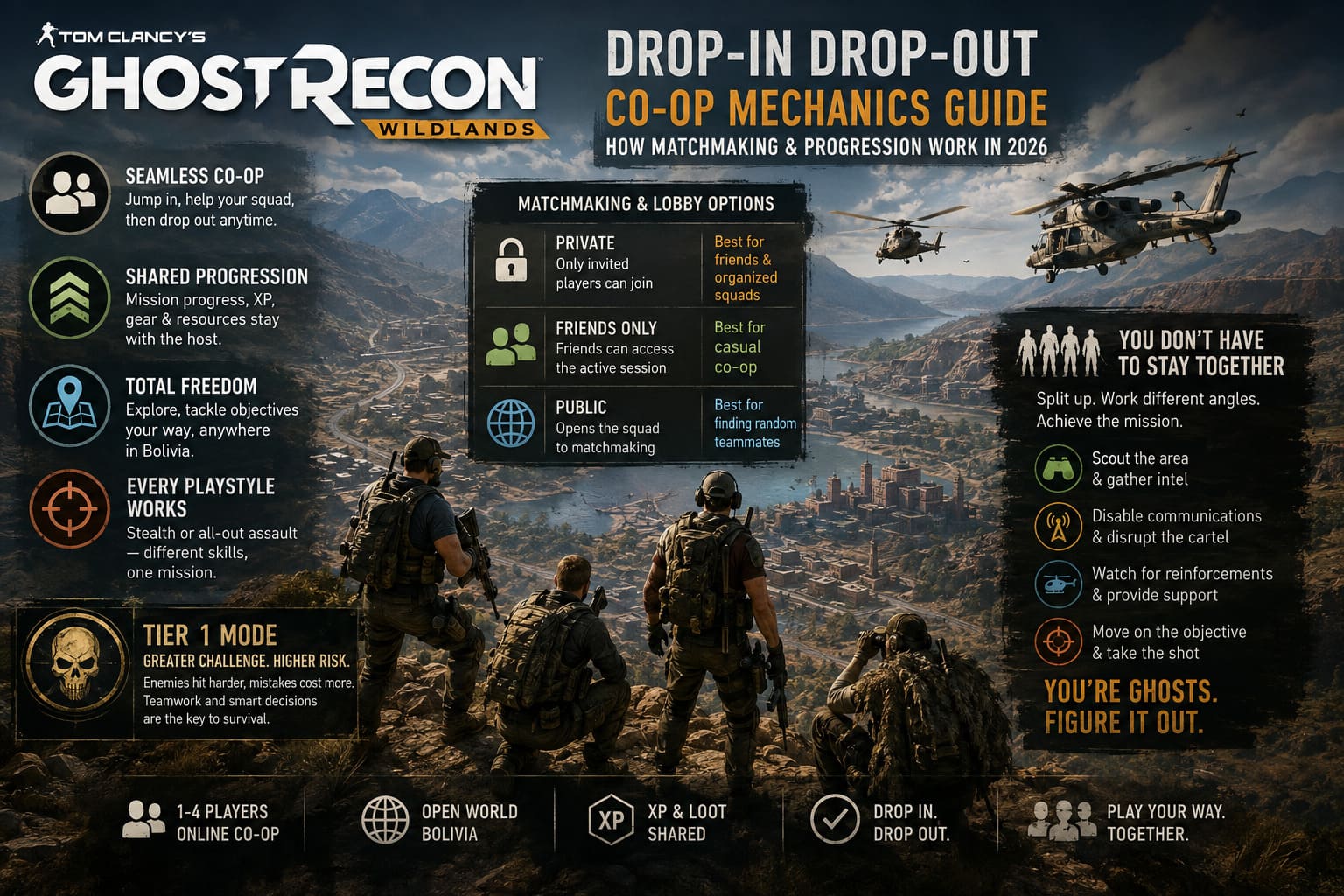
The game gives squads enough freedom for both styles to coexist.
That matters because good Wildlands co-op isn’t necessarily about everyone doing the same thing.
It’s about everyone contributing.
A veteran player can provide overwatch from a hilltop while a less experienced teammate sneaks toward an objective. Another squad member can handle a vehicle. Someone else can watch for reinforcements.
Suddenly, a mission that would have been chaotic solo becomes a coordinated operation.
Tier 1 Mode Makes Teamwork Even More Interesting
For players who have reached the higher levels, Tier 1 Mode adds another layer to the experience.
The idea is straightforward: the game becomes progressively more punishing as you advance through the Tier system. Enemies become more dangerous, mistakes become more costly, and the player has less room to recover from bad decisions.
This changes the way experienced players approach co-op.
If you’re playing at a high Tier level, charging directly into a Unidad position isn’t exactly a brilliant plan.
Meanwhile, a less experienced player may be more comfortable taking risks.
That creates an interesting dynamic where squad members don’t necessarily have identical priorities. The veteran might be focused on staying concealed and controlling the battlefield while another player creates a distraction.
Personally, this is where I think Wildlands starts feeling less like a conventional shooter and more like a sandbox tactical game.
Matchmaking and Lobby Options
Wildlands gives players several ways to control who can enter their session.
| Co-Op Option | How It Works | Best For |
|---|---|---|
| Private | Only invited players can join | Friends and organized squads |
| Friends Only | Friends can access the active session | Casual co-op |
| Public | Opens the squad to matchmaking | Finding random teammates |
For playing with people you actually know, I generally prefer keeping the session restricted.
Public matchmaking can be fun, but random players can completely change the tone of a mission.
You might carefully spend five minutes marking targets, only for a stranger to arrive in a stolen helicopter and announce their presence to every enemy within a two-kilometer radius.
That’s Wildlands.
The Real Strength: You Don’t Have to Stay Together
This is probably my favorite part of the entire co-op system.
Wildlands doesn’t constantly punish you for wanting to explore.
One player can be collecting intel. Another can be looking for a weapon attachment. A third might be preparing an assault on a cartel base while the fourth is several kilometers away driving toward the next province.
That freedom is rare.
Most co-op games eventually tell players, directly or indirectly, to stay together.
Wildlands often feels like it says the opposite:
“You’re Ghosts. Figure it out.”
Of course, splitting the squad can go horribly wrong. But that’s your decision.
And when everyone communicates properly, dividing the squad can actually make operations faster.
One player scouts. Another disables communications. Someone watches reinforcements. The fourth moves toward the objective.
Suddenly you’re not just four people shooting enemies.
You’re operating as a team.
Vehicles Turn Four-Player Co-Op Into Pure Chaos
The vehicle system deserves its own mention because it produces some of the most memorable moments in Wildlands.
A helicopter can carry multiple squad members. Ground vehicles can become mobile firing platforms. Players can switch between driving, shooting and providing overwatch while moving through hostile territory.
A well-organized squad can use this to its advantage.
- One player drives.
- Another handles the mounted weapon.
- A third watches the sides.
- The fourth is looking for enemies and marking targets.
Or, more realistically, everybody argues about who gets to drive.
Either way, co-op makes Wildlands’ massive map feel much more alive.
Is Tom Clancy’s Ghost Recon Wildlands Still on Xbox Game Pass in 2026? Full Guide for US Players
Is Ghost Recon Wildlands Co-Op Still Worth Playing in 2026?
Absolutely — especially if you approach it as a sandbox rather than a traditional linear shooter.
The campaign itself is enormous, but the real magic appears when you stop treating missions as rigid objectives and start experimenting with your squad.
You can stealth through a base.
You can snipe from ridiculous distances.
You can split the team.
You can coordinate an assault.
You can steal a helicopter.
You can accidentally turn a quiet reconnaissance mission into a war involving half the province.
And because the drop-in, drop-out co-op system doesn’t constantly get in your way, those moments can happen naturally.
Tom Clancy’s Ghost Recon Wildlands Steam Deck Best Settings: How to Hit 60 FPS in 2026
My Take
What makes Wildlands co-op special isn’t some revolutionary multiplayer technology. It’s the philosophy behind it.
The game doesn’t make you organize your entire evening around multiplayer.
A friend can join.
A friend can leave.
You can continue your campaign.
You can help somebody else progress.
You can play stealthily or aggressively.
You can explore completely different parts of the map.
And the world generally allows all of that to happen without constantly dragging you back into a lobby.
For me, that’s why Ghost Recon Wildlands remains one of the better open-world co-op shooters to revisit in 2026.
It isn’t perfect. Its AI can occasionally do something spectacularly stupid, its mission structure can become repetitive, and public matchmaking can produce some truly questionable tactical decisions.
But when three friends are communicating, splitting objectives, calling targets and moving through Bolivia as a coordinated four-person Ghost team, the game still clicks.
That’s the moment when Wildlands feels special.
Not because everyone is following the same script, but because the game gives your squad enough freedom to write its own.
And after all these years, that’s still one of the best reasons to jump back into Bolivia.