How to Fix Luminary High CPU Usage on AMD Ryzen 9 3900X (2026 Optimization Guide)
When Luminary launched, I immediately understood why so many RPG fans were excited. The world feels alive, exploration is rewarding, and co-op adventures are genuinely fun instead of feeling like an afterthought. After spending dozens of hours across different action RPGs over the years, I can honestly say Luminary has some fantastic ideas. Unfortunately, my excitement faded pretty quickly when I noticed my AMD Ryzen 9 3900X sitting at nearly 100% usage almost every time I entered larger areas.
The strange thing is that the Ryzen 9 3900X is far from outdated. Even in 2026, it’s still a capable processor that handles demanding games surprisingly well. Yet Luminary pushed it much harder than titles that are visually even more impressive. That made me curious enough to experiment with different settings, compare notes with other players, and test various optimization methods until I found what actually worked.
If you’re dealing with high CPU usage, random stuttering, FPS drops, or temperatures climbing into uncomfortable territory, you probably don’t need a new processor. In most cases, Luminary simply needs a bit of help using your hardware more efficiently.
Is Big Walk on Xbox Series X? Launch Platforms and Release Details Explained
Why Luminary Hits Ryzen 9 3900X So Hard
One thing I’ve learned after playing dozens of modern PC releases is that not every engine behaves the same way. Some games mostly stress the graphics card, while others lean heavily on the processor. Luminary definitely belongs in the second category.
Instead of only rendering beautiful environments, the game constantly calculates NPC behavior, world events, object streaming, combat systems, physics, and background loading. All these systems work simultaneously, which creates a surprisingly heavy workload.
For Ryzen 9 3900X owners, another factor comes into play. The processor uses a dual-CCD architecture, which has always been incredibly powerful for productivity, but certain games don’t distribute workloads efficiently between those chiplets. When threads constantly move between them, latency increases and the CPU starts boosting aggressively.
| Problem | What You Notice |
|---|---|
| High CPU usage | 90–100% processor utilization |
| Excessive temperatures | 85–95°C under heavy load |
| Thermal throttling | Sudden FPS drops and unstable performance |
| Stuttering | Inconsistent frame pacing |
| Random crashes | Usually after longer gaming sessions |
In my experience, Luminary isn’t actually ‘too demanding.’ The bigger problem is that the engine does not always make the smartest use of older Zen 2 processors.
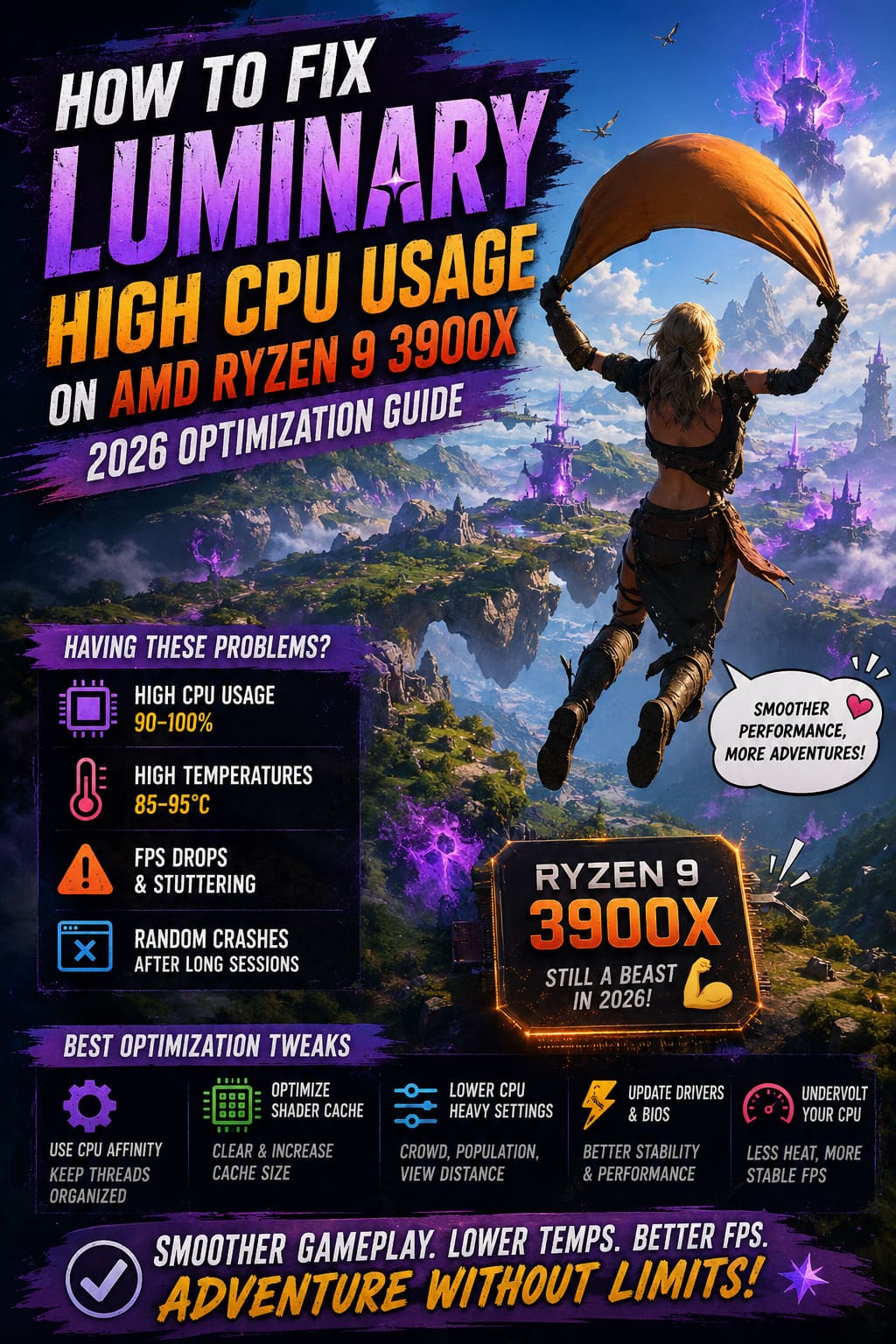
Use CPU Affinity to Keep Threads Organized
This was the biggest improvement I noticed while testing Luminary on my Ryzen 9 3900X. Instead of allowing Windows to constantly move game threads between both CCDs, I forced the game to stay on a single processor chiplet. The result was much more stable CPU behavior and fewer sudden spikes.
You can test this manually through Windows Task Manager:
- Launch Luminary.
- Open Task Manager.
- Go to the Details tab.
- Find the Luminary executable.
- Select Set Affinity.
- Disable half of the logical processors.
This method works, but Windows will forget the setting after restarting the game. Because of that, I personally prefer using Process Lasso. It allows you to create a permanent profile for Luminary and automatically apply CPU affinity settings every time you launch the game.
I also experimented with disabling SMT only for Luminary. Surprisingly, this helped reduce some of the extreme CPU spikes without noticeably hurting overall performance. I would not recommend disabling SMT globally, but creating a specific game profile can be a useful solution.
Don’t Ignore Shader Cache Optimization
One mistake many PC gamers make is forgetting about shader cache. Modern open-world and RPG games constantly compile and store graphical data while you explore new locations. If this cache becomes corrupted or limited, your processor may repeatedly rebuild the same information.
After clearing my old DirectX shader cache and increasing the available cache size, I noticed smoother transitions between areas. The average FPS increase was not huge, but the overall experience felt much better because frame pacing became more consistent.
The steps are simple:
- Open your NVIDIA Control Panel or AMD Software Adrenalin.
- Find the Shader Cache Size option.
- Increase it to 10GB or Unlimited.
- Use Windows Disk Cleanup to remove old DirectX Shader Cache files.
- Restart your PC and allow Luminary to rebuild fresh shaders.
Lower the Settings That Actually Affect CPU Performance
When performance problems appear, many players immediately lower texture quality or resolution. That usually helps the graphics card, but it does very little for CPU-related problems.
In Luminary, several options affect the processor much more than the GPU. These are the settings I would adjust first:
- Crowd Density – reduces AI calculations and active NPC behavior.
- Population Settings – lowers the number of simulated characters.
- View Distance – decreases the amount of world data processed at once.
- Frame Rate Limit – prevents unnecessary CPU workload.
Reducing these settings to Medium barely changes the visual quality during normal gameplay, but it can significantly reduce processor pressure. I also strongly recommend limiting your FPS to match your monitor refresh rate.
| Monitor Refresh Rate | Recommended FPS Cap |
|---|---|
| 60Hz | 60 FPS |
| 120Hz | 120 FPS |
| 144Hz | 144 FPS |
An unlimited frame rate may look attractive in benchmarks, but it forces your CPU and GPU to work harder than necessary, especially in less demanding scenes.

Update AMD Chipset Drivers and BIOS
I know BIOS updates are not the most exciting part of PC gaming. Most players ignore them until something breaks. However, motherboard firmware updates can improve how older Ryzen processors handle modern workloads.
Updating your BIOS and AMD chipset drivers can improve:
- Thread scheduling.
- Power efficiency.
- Boost behavior.
- System stability.
For Ryzen 9 3900X users, installing the latest chipset drivers is especially important because Windows needs accurate information about how to manage the processor’s cores and background tasks.
Undervolting Made a Bigger Difference Than Expected
I was honestly skeptical about undervolting at first. Every processor behaves differently, and aggressive changes can create instability. However, Ryzen 3000 processors often push voltage higher than necessary during heavy workloads.
Instead of allowing the CPU to constantly chase maximum boost clocks, I applied a conservative undervolt. The difference was immediately noticeable during long Luminary sessions.
The benefits included:
- Lower temperatures.
- Reduced fan noise.
- Fewer thermal throttling moments.
- More stable frame times.
- Less aggressive CPU boosting.
A voltage range around 1.25V–1.30V with stable clocks around 4.1–4.2 GHz provided a much smoother experience on my system. The goal was not making the processor faster. The goal was keeping performance consistent.
Choose the Correct Windows Power Plan
Windows power settings can also influence how Ryzen processors behave during gaming. Using an incorrect power profile may create unnecessary delays when the CPU needs to boost quickly.
| Setting | Recommended Value |
|---|---|
| Power Plan | AMD Ryzen Balanced |
| Minimum Processor State | 5% |
| Maximum Processor State | 100% |
This setup allows the processor to remain efficient while still delivering full performance when Luminary demands more power.
Extra Tips That Improved My Luminary Experience
After testing different combinations, I found several smaller changes that helped remove annoying micro-stutters and random performance drops.
- Close unnecessary background applications before launching the game.
- Disable unused overlays.
- Install Luminary on an SSD.
- Keep enough free storage space on your system drive.
- Restart Windows before long gaming sessions.
None of these adjustments alone will completely transform performance. However, combined together, they create a much cleaner and more stable gaming environment.
Is Ryzen 9 3900X Still Good Enough for Luminary?
Absolutely. After playing many modern PC games on this processor, I still believe the Ryzen 9 3900X has plenty of life left. Luminary is simply one of those games where optimization matters more than raw hardware power.
After adjusting CPU affinity, rebuilding shader cache, changing CPU-heavy graphics options, updating drivers, and applying a mild undervolt, my experience changed completely. CPU usage became much more stable, temperatures dropped, and the annoying stutters almost disappeared.
If you’re thinking about upgrading your entire platform only because Luminary runs poorly, I would wait. The Ryzen 9 3900X is still a strong gaming processor, and with the right optimization, it can handle this impressive RPG without forcing you into an expensive hardware upgrade.