Shift At Midnight Survival Guide: Flashlight and Stamina Management Tips for the 2026 Indie Horror Hit
Shift At Midnight is the kind of indie horror game that looks deceptively simple until you are standing alone in a dark gas station with a nearly dead flashlight, an empty stamina bar, and something outside the window that absolutely should not have a human face. Developed by solo creator Bun Muen and published by Kwalee, the game has quickly turned the humble night shift into one of the most stressful jobs in horror gaming.
Released for PC and Xbox Series X/S, including a day-one launch on Xbox Game Pass, Shift At Midnight combines the obsessive document-checking of Papers, Please with the escalating paranoia of Five Nights at Freddy’s. The setup is straightforward: you work as a gas station attendant at the Midnight Mart, serve customers, restock shelves, clean up messes, manage inventory, and hit your nightly profit targets.
Then the doppelgangers arrive.
Some customers are not customers at all. They are shape-shifting entities wearing human appearances and trying to get past your counter. Their IDs may contain subtle errors. Their loyalty cards may not match their personal information. Their shopping totals can be wrong. Their dialogue might not line up with the evidence in front of you. A single missed detail can turn a routine customer interaction into a much bigger problem later in the shift.
If you identify an impostor, you can deal with the threat immediately. If you let one through, however, the consequences can be brutal. That entity may return later as a mutated monster capable of hunting you through the store.
And this is where Shift At Midnight separates itself from a standard paperwork horror game. You are not sitting safely behind a desk waiting for the next scripted scare. You are constantly moving. You carry boxes, clean floors, repair barricades, run through dark areas, hide from monsters, and try to keep enough energy in reserve to survive the moment everything goes horribly wrong.
After spending enough time with the game’s survival loop, one thing becomes painfully clear: stamina and flashlight battery management are just as important as identifying doppelgangers. You can correctly inspect every ID in the building and still die because you sprinted at the wrong time or wasted your flashlight battery while standing under a perfectly good ceiling light.
Why Resource Management Matters So Much in Shift At Midnight
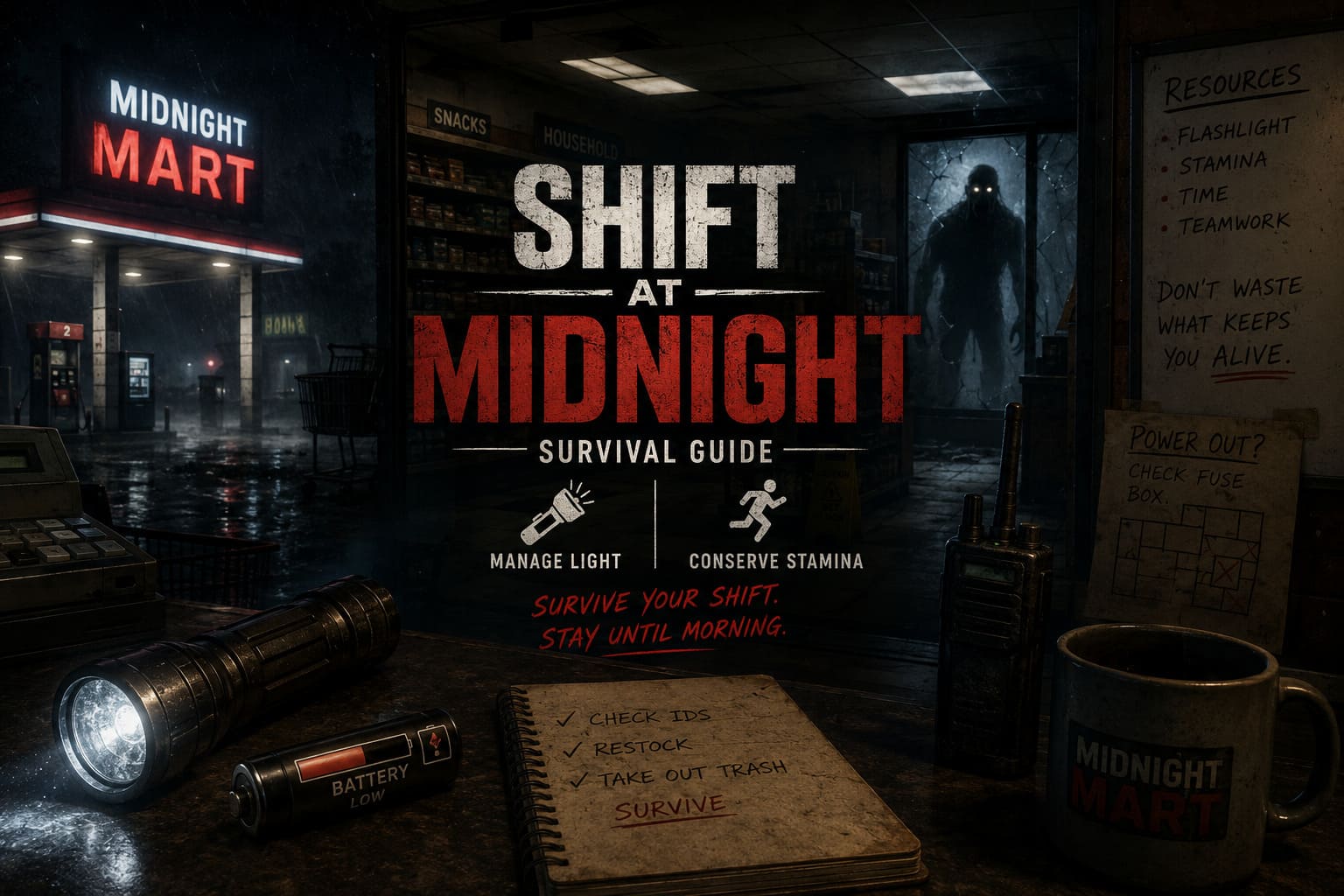
Every shift in Shift At Midnight is essentially two games happening at once. On one side, you are managing the business. Customers need to be served, shelves need to be restocked, trash needs to be removed, and the store has to remain profitable. On the other side, you are trying to detect supernatural threats while preparing for the possibility that one of them will eventually come hunting for you.
That creates a constant pressure loop. You might be examining an ID for a suspicious expiration date when you suddenly realize your flashlight has been running for several minutes. You might be carrying a heavy delivery box toward the stockroom when an entity breaks through a window. If your stamina is already empty, you are not escaping. You are basically delivering yourself to the monster.
The best players do not simply react to danger. They manage their resources before danger appears.
| Resource | Main Use | Biggest Mistake | Best Habit |
|---|---|---|---|
| Flashlight Battery | Exploring dark areas and tracking threats | Leaving it on constantly | Use short bursts and rely on ambient lighting |
| Stamina | Sprinting, movement, jumping, and heavy tasks | Running everywhere | Walk during routine work and save sprinting for danger |
| Time | Completing store duties and investigating customers | Rushing every task | Build efficient routes around the store |
| Team Resources | Supporting co-op survival | Everyone using batteries independently | Assign clear roles and share supplies |
Flashlight Battery Tips: Stop Burning Through Your Lifeline
The flashlight is one of the most important tools in the game, but it is also incredibly easy to waste. Midnight Mart is full of poorly lit corridors, shadowy storage areas, exterior sections, and flickering lights that make the entire building feel like it was designed by someone who hates employees working the night shift.
That darkness is not just atmosphere. It directly affects how you play.
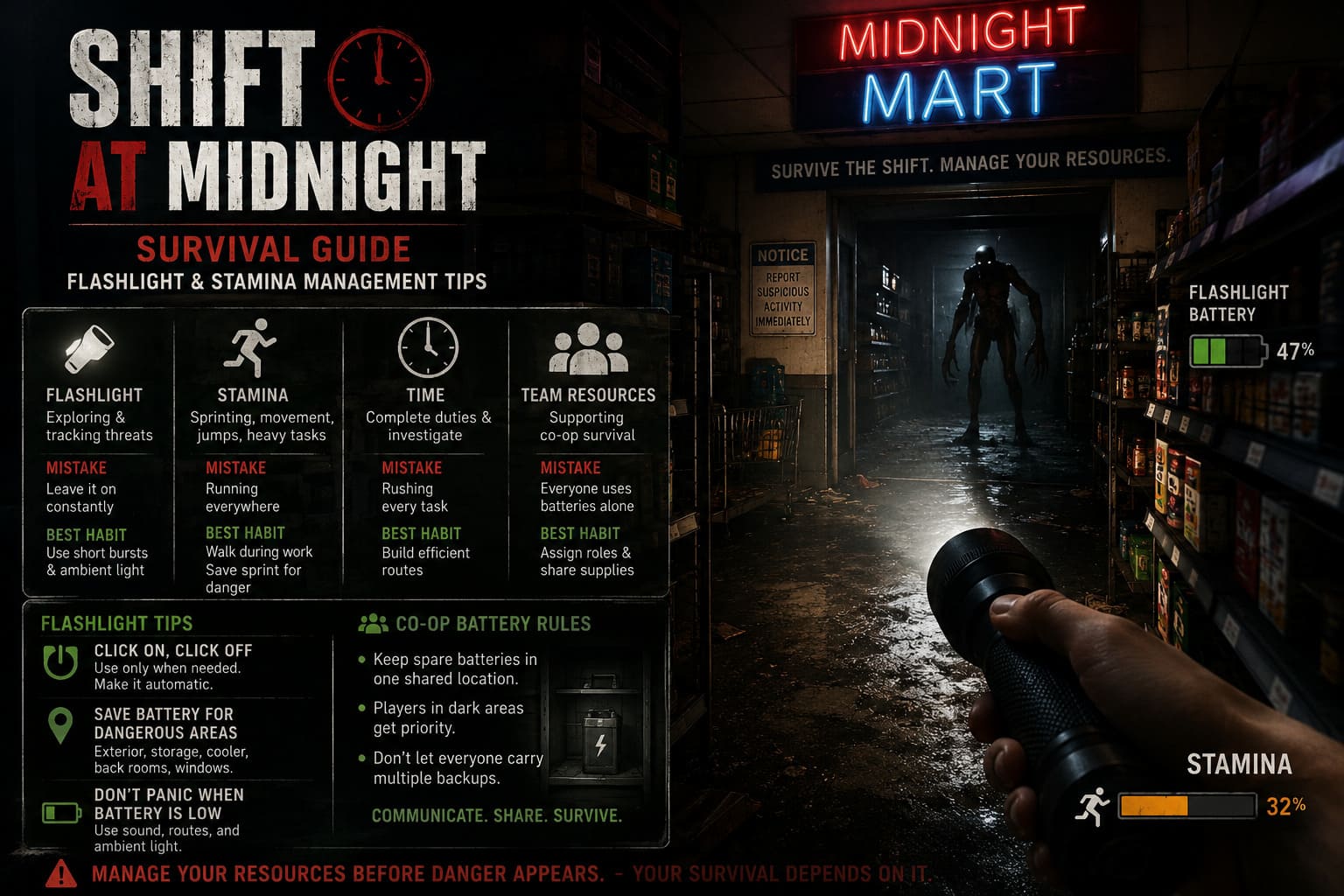
Use the Click-On, Click-Off Habit
The most useful flashlight habit is also the simplest: turn it on only when you actually need it.
Standing behind the register? Turn it off. Examining a customer under a functioning overhead light? Turn it off. Reading dialogue or checking information in a well-lit section of the store? There is no reason to waste battery.
I know this sounds obvious, but it is the kind of thing players completely forget once the game starts throwing distractions at them. You finish checking an ID, walk away from the counter, start organizing stock, and suddenly realize your flashlight has been shining into the floor for the last three minutes.
Make switching it off automatic.
Save Battery for the Dangerous Areas
Not every part of the map deserves the same amount of light. The darkest and most dangerous areas should receive priority:
- Exterior gas pumps
- Back delivery and loading areas
- Storage rooms
- Walk-in cooler and freezer sections
- Dark corners near windows and entrances
When you are working in the central store area, use ambient lighting whenever possible. When you enter a completely dark section, use the flashlight in controlled bursts rather than leaving it running constantly.
Do Not Panic When the Battery Gets Low
Once the battery drops below roughly 30%, the flashlight becomes much less reliable. The beam starts to flicker and shadows become harder to read. At zero, you are left completely blind unless you can reach another source of light.
The worst possible response is to panic and keep the flashlight running nonstop because you are afraid of the darkness. That simply guarantees that the battery dies even faster.
Instead, use sound, memorized routes, and environmental lighting. A flashlight should be your confirmation tool, not your permanent security blanket.
Battery Management in Co-Op
Multiplayer makes battery management even more important. When three players are running around with their flashlights switched on, the entire team can burn through available batteries at an absurd rate.
My recommendation is to establish a shared battery location. Keep spare batteries in one agreed-upon locker or storage area, and do not let every player carry multiple backups for no reason.
The player doing the majority of the back-room work should receive priority. A stationary Clerk does not need the same amount of flashlight power as the Stocker constantly traveling through dark areas.
Stamina Management: The Difference Between Escape and Game Over
Stamina is where many new players make the same mistake: they treat sprinting as normal movement.
It is not.
Sprinting should be considered an emergency resource. If you run everywhere during routine tasks, you will eventually find yourself with an empty stamina bar at exactly the worst possible moment.
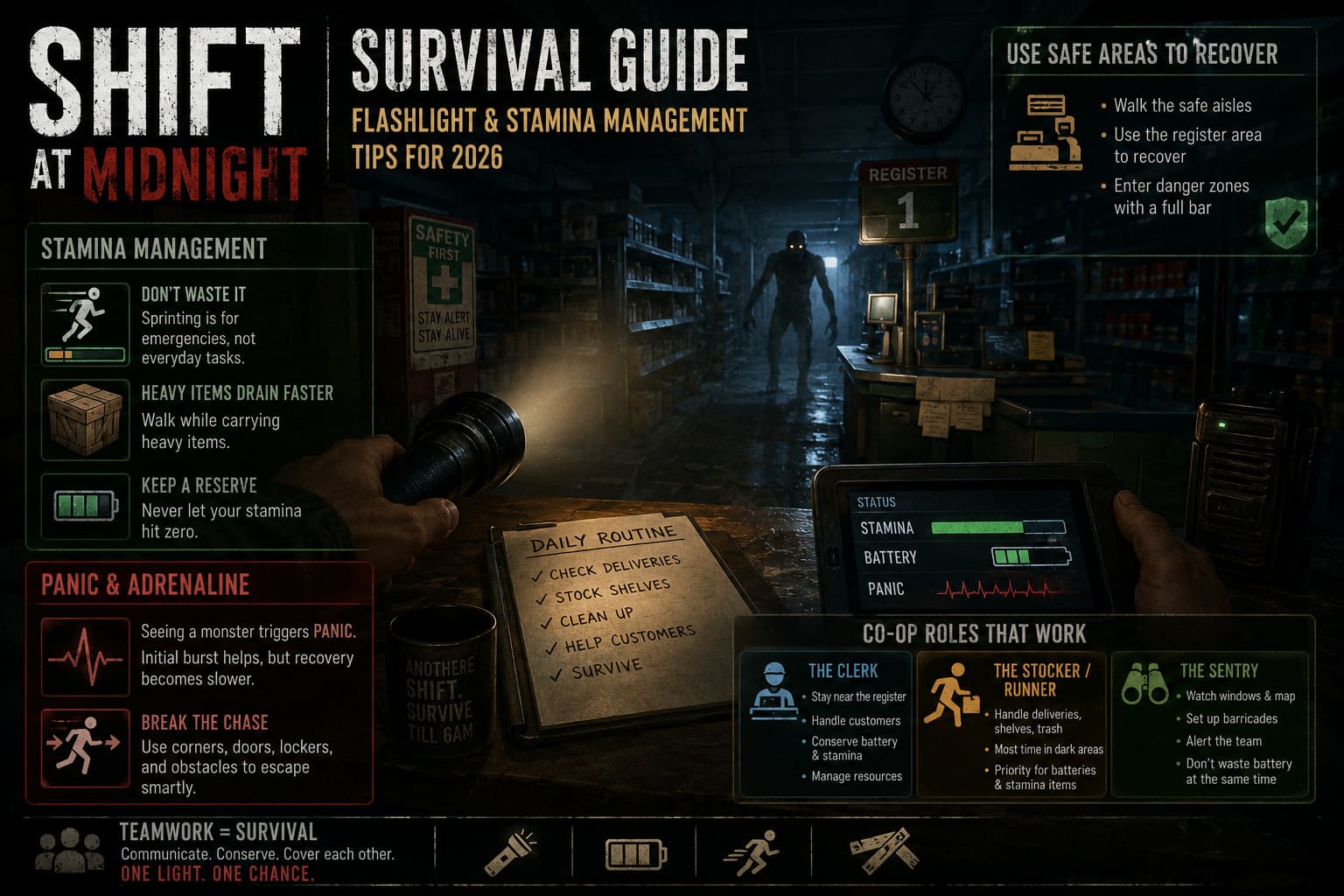
Heavy Items Drain You Faster
Carrying stock crates, trash bags, and wooden boards for barricades significantly changes how quickly your stamina disappears. Sprinting with heavy objects is especially wasteful.
Walk while carrying heavy items unless you are in immediate danger.
This might feel slower, but it gives you a much better chance of surviving a surprise attack. If a monster appears while you are carrying a delivery box and your stamina is still mostly full, you can drop the item and escape. If you already sprinted across the entire store with the box, you may have nothing left.
That is the difference between a minor inconvenience and an instant death.
Do Not Empty the Bar Completely
One of the worst habits in survival horror is sprinting until the stamina meter reaches zero. Players see a threat, hold the sprint button, and keep running until the character is completely exhausted.
That is usually a mistake.
Try to keep a reserve whenever possible. If your stamina reaches zero while a monster is still close, your escape options become extremely limited. You may be able to hide, but if you are caught in the open, the situation can collapse very quickly.
Use Safe Areas to Recover
Build your daily routine around natural recovery periods. Walk through the safe aisles. Complete basic tasks without sprinting. Use the area around the register as a recovery point whenever the situation allows.
Before calling the next customer or starting another major task, try to restore your stamina as much as possible. Entering a dangerous section with a full bar gives you options. Entering it exhausted is asking for trouble.
Understanding Panic and the Adrenaline Trap
When an anomaly or monster enters your direct line of sight, the game can push you into a panic state. The screen shakes, breathing becomes more noticeable, and the entire atmosphere suddenly feels much more aggressive.
The temporary adrenaline effect can help you move faster at first, but there is a catch. Once that initial burst is gone, stamina recovery becomes much less forgiving.
This creates a classic horror-game trap: you see the monster, panic, sprint at full speed, empty your stamina bar, and then discover that you are still in the monster’s line of sight.
The better approach is to break the chase intelligently. Use corners, lockers, obstacles, doors, and the environment to create distance. Do not assume that holding the sprint button until the bar is empty is always the fastest way to survive.
Co-Op Roles That Actually Make Sense
Playing with two or three players changes the entire resource economy. A group with no structure can waste more resources than a solo player. Everyone wants to explore, everyone turns on their flashlight, everyone starts sprinting, and suddenly the team has no batteries left.
Assigning roles helps a lot.
The Clerk
The Clerk remains near the register and acts as the team’s anchor. This player handles customer interactions and should avoid unnecessary movement.
Because they spend most of the time under the main lighting, the Clerk should conserve both flashlight battery and stamina. They can also help manage shared resources and keep track of battery locations.
The Stocker / Runner
This is the most physically demanding role. The Stocker handles deliveries, shelves, trash, and other tasks that require constant movement.
Because this player spends the most time in dark and remote areas, they should receive priority for batteries and stamina-recovery items. The Clerk can act as the team’s supply manager, directing useful resources toward the player who actually needs them.
The Sentry
In a three-player team, the Sentry becomes the mobile defender. Their job is to monitor windows, investigate suspicious movement, prepare barricades, and keep an eye on dangerous sections of the map.
The Sentry and Stocker should avoid wasting their flashlight batteries at the same time. If one player is working in darkness, the other should conserve their battery whenever possible. That way, the team always has at least one strong light source available during an emergency.
Use the Environment Before Using Your Equipment
One of the smartest things you can do in Shift At Midnight is stop treating the flashlight as the only answer to darkness.
If the power goes out, learn where the fuse box is. Memorize the building layout. Practice moving through the store using landmarks instead of relying on your flashlight every second.
Restoring the main power can illuminate huge sections of the building instantly. That is far more efficient than burning through batteries while wandering around in the dark.
Learning the route to the breaker box is one of those small skills that feels unimportant until you are suddenly trapped in darkness. Then it becomes the most valuable piece of knowledge you have.
Pets Are More Than Just a Cosmetic Bonus
The pet system is one of the more charming additions to Shift At Midnight. You can choose between options such as a cat, husky, puppy, or goose, but bringing one to work is not immediately free.
Early on, veterinary bills can put serious pressure on your finances. You need to maintain strong profit margins during the first few shifts if you want to pay for your pet’s medicine.
Once those costs are covered, the pet can join you during your night shifts.
That is where the system becomes genuinely useful. Pets wander around the store, provide company, and can help clean up messes left by customers.
That might sound like a small convenience, but cleaning takes time and physical effort. If your pet handles part of that workload, you can spend more time focusing on stocking shelves, checking customers, and preparing for potential threats.
In a game where every second and every bit of stamina can matter, that adds up quickly.
Train Your Ears to Save Your Battery
One of the best advanced strategies is learning to trust audio cues.
Shift At Midnight gives many threats and events their own sound signatures. Scratching near a window can indicate an entity outside. A breaking window creates an unmistakable crash. The register and customer interactions have their own audio cues.
Do not immediately spin around and wave your flashlight through every dark aisle whenever you hear something.
Stop. Listen. Identify the direction.
Then use the flashlight for a quick confirmation burst.
This approach saves battery and helps you understand the map. After enough hours, you begin to recognize the difference between a normal store sound and something that absolutely does not belong there.
Shift At Midnight Survival Guide: How to Survive the Monster Phase
Shift At Midnight Survival Checklist
- Flashlight: Keep it off in well-lit areas and use short bursts in darkness.
- Stamina: Walk during routine work and save sprinting for genuine danger.
- Heavy Items: Avoid sprinting while carrying crates, trash, or barricade materials.
- Recovery: Let stamina regenerate before entering risky areas or starting another major task.
- Co-Op: Assign roles so the entire team does not waste batteries and stamina at the same time.
- Environment: Learn the route to the fuse box and use building lights whenever possible.
- Pets: Pay off veterinary costs early to unlock their useful cleaning assistance.
- Audio: Listen for directional clues before wasting flashlight power searching blindly.
Shift At Midnight ID Verification Guide: How to Spot Doppelgangers and Survive the Graveyard Shift
Final Thoughts: Surviving the Night Is About Discipline
Shift At Midnight works because it constantly forces you to make small decisions under pressure. Should you sprint to finish the delivery faster? Should you use the flashlight to check the dark corner or trust your ears? Should you spend time recovering stamina or risk continuing the job?
Those decisions may seem minor when everything is calm. They become incredibly important when the lights go out and something starts chasing you through the store.
The biggest mistake is playing every shift at maximum speed. You do not need to sprint everywhere. You do not need your flashlight on constantly. You do not need to carry every item as quickly as possible. The game rewards players who understand that survival is about maintaining options.
Keep your stamina in reserve. Protect your flashlight battery. Learn the map. Use the breaker. Listen carefully. Give the right resources to the right co-op player. And if you can afford it, let your pet deal with the mess while you focus on the things that can actually kill you.
Once these habits become automatic, Midnight Mart becomes much easier to control. You will still have terrifying moments, because the game is absolutely designed to ruin your confidence at the worst possible time. But you will stop dying because you wasted all your stamina carrying a box across the parking lot or left your flashlight running while standing directly under a ceiling lamp.
That is the real key to mastering Shift At Midnight: do not panic before the game gives you a reason to panic.
Now the question is simple: how many shifts have you managed to survive in Endless Mode? And which pet did you choose to bring to work? The goose is already looking suspicious to me.