Solarpunk Resource Guide: All Material Locations & Uses (2026)
When I first started playing Solarpunk, I expected another cozy crafting game with a few farming mechanics and some light exploration. What I didn’t expect was how deeply resource management would shape the entire experience. Unlike many survival games that push players into endless combat loops, Solarpunk focuses on something far more satisfying: building a thriving, self-sustaining ecosystem high above the clouds.
Developed by Cyberwave and published by rokaplay, Solarpunk invites players to transform floating islands into efficient, eco-friendly settlements powered by renewable energy, advanced automation, and smart resource planning. The game may look relaxing on the surface, but behind its beautiful visuals lies a surprisingly deep progression system where every stick, stone, and battery matters.
After spending countless hours expanding my islands and optimizing production chains, I’ve learned that understanding where resources come from—and what they’re truly used for—is the key to progressing smoothly. This guide covers every major material currently available in the full 2026 release and explains why each one matters.

Tier 1 Resources: Building the Foundations of Survival
The first few hours in Solarpunk are all about stability. Before you dream of drones and wireless energy grids, you’ll need to secure the essentials.
Sticks
| Resource | Location | Main Uses |
|---|---|---|
| Sticks | Ground foraging, crafted from logs or boards | Basic tools, survival guide, build hammer |
Sticks may seem insignificant at first, but they’re involved in nearly every early-game crafting recipe. I always gather every stick I see while exploring because they quickly disappear once you start making tools.
The fastest alternative is converting wood materials directly into sticks through the quick crafting system.
Stones
| Resource | Location | Main Uses |
|---|---|---|
| Stones | Loose pebbles and green stone deposits | Stone tools, furnace construction |
Your first stone pickaxe and axe depend on having enough stones available. More importantly, you’ll need a large stockpile for building a Stone Furnace, one of the most important structures in the entire game.
Without a furnace, progression slows dramatically because metal production remains locked.
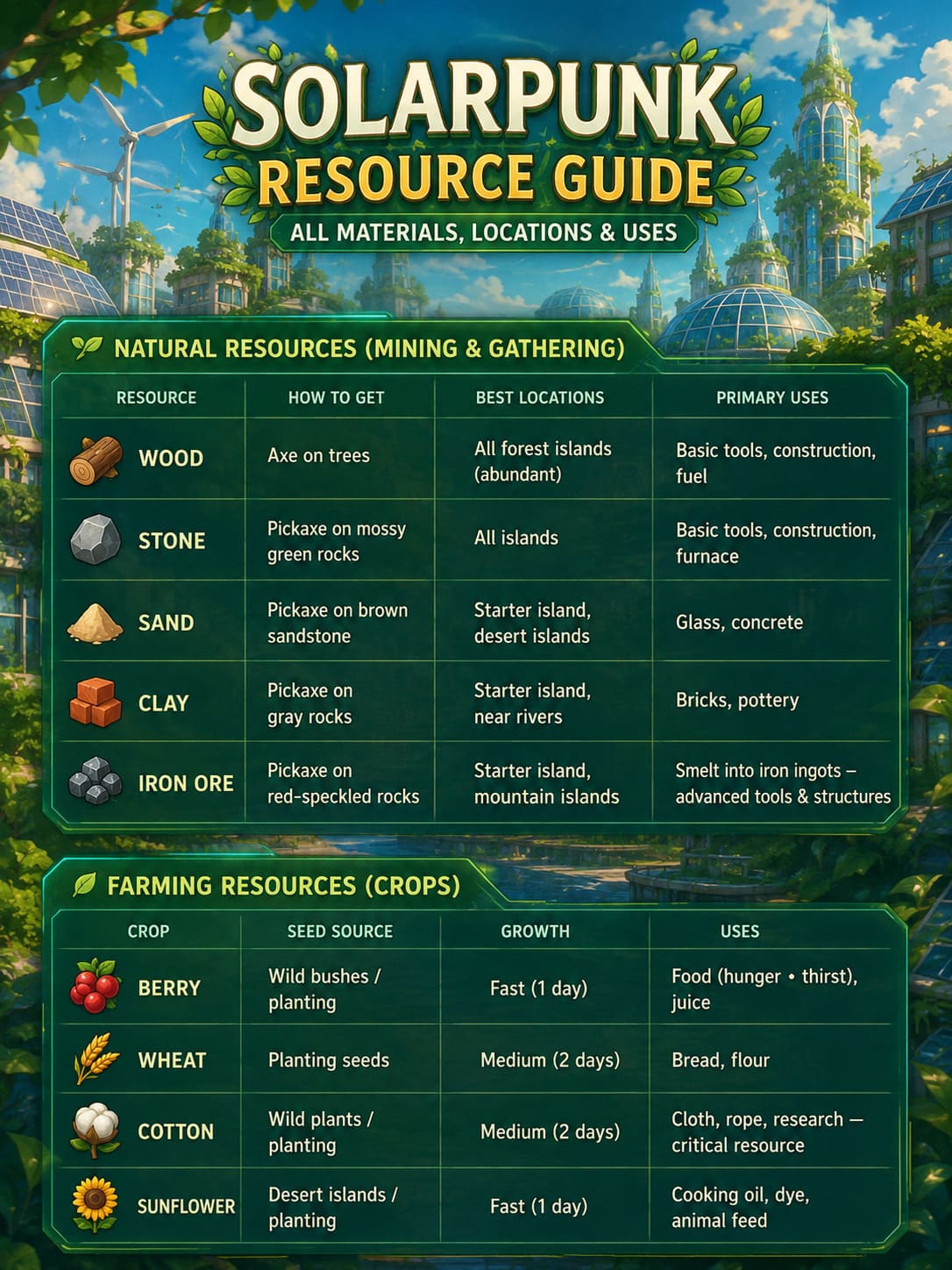
Wood Logs and Wood Boards
Trees are effectively the backbone of early progression.
Green trees provide wood logs, which can be processed into boards at the Workbench. Almost every structure in the opening hours requires some form of wood.
Common uses include:
- Crafting tables
- Workbenches
- Housing structures
- Staircases
- Decorative construction
- Storage containers
My recommendation is to establish a small tree farm as early as possible. Running out of wood during a major building project is surprisingly frustrating.
Sand
Many new players ignore sand until later, which is a mistake.
Sand is collected by mining brown rock formations typically found near island edges and coastal areas. While it may seem like a niche resource initially, it becomes extremely important once glass production begins.
Sand is used for:
- Glass panes
- Decorative objects
- Storage jars
- Greenhouse construction
Trust me—future you will appreciate having several chests full of sand.
Fresh Water
Water isn’t merely a survival requirement.
You can collect it from ponds using buckets or generate it passively through Rain Collectors.
Water is essential for:
- Drinking
- Cooking
- Crop irrigation
- Filling watering cans
- Agricultural expansion
As your farm grows, water demand increases significantly.
Tier 2 Resources: Farming and Botanical Progression
One of my favorite aspects of Solarpunk is how farming isn’t treated as a side activity. It’s directly connected to technological advancement.
Cotton and Cotton Seeds
If there’s one resource I would tell new players to prioritize above everything else, it’s cotton.
Cotton plants appear as white flowering nodes scattered across the starter island. Some are easy to find, while others are hidden on elevated cliffs that require constructed pathways.
Harvesting provides:
- Raw Cotton
- Cotton Seeds
At the Workbench, two units of cotton become one piece of cloth.
Why does this matter?
Because cloth unlocks several critical technologies, including:
- Research Table
- Airship progression
- Advanced blueprints
- Exploration upgrades
Cotton is essentially the gateway resource that opens the rest of the game.
Raspberries and Berry Seeds
Food management becomes much easier once you establish a berry farm.
Wild raspberry bushes are common throughout temperate islands and provide both immediate nutrition and long-term farming opportunities.
Benefits include:
- Reliable food source
- Renewable harvesting
- Easy cultivation
- Low maintenance requirements
I usually dedicate an early farming section exclusively to berries before expanding into more advanced crops.
Truffles
Truffles are one of the most interesting resources in Solarpunk because players cannot harvest them directly.
Instead, they rely on pigs.
Once pigs are domesticated and properly cared for, they begin rooting through soil and discovering hidden truffles underground.
These rare ingredients are primarily valuable for:
- Premium cooking recipes
- Trading opportunities
- Luxury production chains
It’s a clever mechanic that encourages animal husbandry rather than simple gathering.
Tier 3 Resources: Industrial Materials and Metal Production
Eventually your humble island evolves into a serious production center.
This is where furnaces, smelting, and industrial planning become important.

Charcoal
Produced by burning wood logs inside a furnace, charcoal serves several useful purposes.
Primary uses include:
- Furnace fuel
- Dye production
- Carbon filtration components
- Industrial crafting
I often maintain dedicated charcoal production simply because energy requirements increase dramatically later in the game.
Copper Ore and Copper Ingots
Copper marks the beginning of the electrical era.
Ore can be mined from surrounding islands or purchased through merchant interactions.
After smelting, copper ingots become essential for:
| Material | Major Applications |
|---|---|
| Copper Ingots | Electrical wiring, plumbing, automation parts |
Without copper, your automation dreams simply don’t happen.
Iron Ore and Iron Ingots
Iron represents a major progression milestone.
Unlike copper, iron is generally found on more distant islands accessible through airship exploration.
Iron is needed for:
- Tool upgrades
- Machinery construction
- Reinforced structures
- Mechanical components
- Industrial expansion
Whenever I discover a rich iron deposit, it immediately becomes a priority mining location.
Glass
Glass is produced by smelting sand in a furnace.
Its importance grows steadily throughout the game.
Major uses include:
- Windows
- Greenhouses
- Laboratory equipment
- Decorative structures
- Advanced crafting requirements
Glass also plays a significant role in protecting crops from harsh weather conditions.
Cloth
Even after the early game, cloth remains highly valuable.
Common applications include:
- Airship sails
- Research unlocks
- Decorative structures
- Advanced crafting projects
Many players stop collecting cotton after unlocking initial technologies, but maintaining cloth production pays off later.
Tier 4 Resources: Automation, Energy, and Advanced Technology
This is where Solarpunk truly separates itself from traditional survival games.
The goal is no longer survival.
The goal becomes optimization.
Airship Technical Components
These rare parts are found within ancient wrecks scattered throughout distant islands.
They are among the most valuable items in the game.
Uses include:
- Airship construction
- Flight range upgrades
- Exploration improvements
- Transportation systems
Whenever I discover a crashed airship, exploring it immediately jumps to the top of my priority list.
Wireless Power Relays and Transmitters
One of the most satisfying moments in Solarpunk is removing huge networks of ugly cables.
Wireless power systems allow electricity to move seamlessly across your settlement.
Benefits include:
- Cleaner base layouts
- Greater building freedom
- Easier expansion
- Efficient energy distribution
These systems require refined metals and advanced materials but are absolutely worth the investment.
Automated Sprinklers and Rain Detectors
Automation becomes increasingly important as farming operations scale.
Sprinklers automatically irrigate crops while rain detectors disable watering systems during storms.
Advantages include:
- Reduced manual labor
- Better water efficiency
- Lower energy waste
- Improved crop productivity
It’s one of the first automation chains I build.
Transport Drones
Transport drones completely change how logistics work.
Instead of running back and forth carrying materials, drones automatically move resources between storage networks and production stations.
They can:
- Collect harvested crops
- Empty production machines
- Organize storage systems
- Support industrial expansion
Once drones are operational, the game feels dramatically different.
Batteries
If renewable energy powers your island, batteries keep it alive.
Weather directly affects power generation in Solarpunk.
Solar panels excel during sunny days.
Wind turbines perform better during storms.
Batteries bridge the gap between these changing conditions.
Without sufficient battery storage, power shortages can shut down critical systems instantly.
Solarpunk Lore: The Tragic History and Uplifting Secrets of the Floating Islands
My Personal Resource Strategy for Faster Progression
After many hours of experimentation, I’ve found a few habits that consistently improve progression speed:
- Rush cotton production immediately.
- Build the Research Table as soon as possible.
- Unlock the world map before focusing on aesthetics.
- Start stockpiling sand earlier than you think necessary.
- Always maintain surplus battery capacity.
- Move critical crops into greenhouses quickly.
- Use drones for logistics before expanding production chains.
The biggest mistake I see new players make is treating Solarpunk like a traditional survival game. The real objective isn’t merely collecting resources—it’s creating interconnected systems that eventually manage themselves.
That’s where Solarpunk shines.
Watching a network of renewable energy generators power automated farms, drone logistics hubs, and industrial workshops across floating islands is incredibly rewarding. Every resource listed above plays a role in that transformation, from the humble stick you pick up on day one to the advanced batteries powering a late-game technological paradise.
Master these materials, and your tiny crash site won’t stay tiny for long.