Resonance: A Plague Tale Legacy – Complete Character Progression and Skills Walkthrough
There is something refreshing about Resonance: A Plague Tale Legacy. After spending so much time with the slower, more methodical progression systems of earlier A Plague Tale games, I honestly didn’t expect Sophia’s adventure to feel this different. This isn’t simply another story-driven stealth game where you quietly collect materials, upgrade a few tools, and hope the next encounter goes according to plan.
Instead, Sophia’s progression is built around exploration, combat, sound, light, and the strange connection between two different eras. And after looking at the progression system as a whole, I think this is one of the most interesting changes the series could have made.
The biggest thing to understand is that you shouldn’t approach the game like you’re following a conventional RPG skill tree. Resonance: A Plague Tale Legacy rewards players who are curious. If you constantly stick to the obvious route, you can easily miss the resources that make Sophia dramatically more capable later.
So, if you’re looking for a practical Resonance: A Plague Tale Legacy skills guide, here is how I would approach the entire progression system.
A Completely Different Progression Philosophy
One of the first things that stood out to me is how far the game moves away from the upgrade structure associated with Amicia.
There is no familiar routine of collecting fabric, leather, tools, and other crafting components simply to improve equipment at workbenches. Instead, Sophia’s progression revolves around Resonance Points, which are hidden throughout the world.
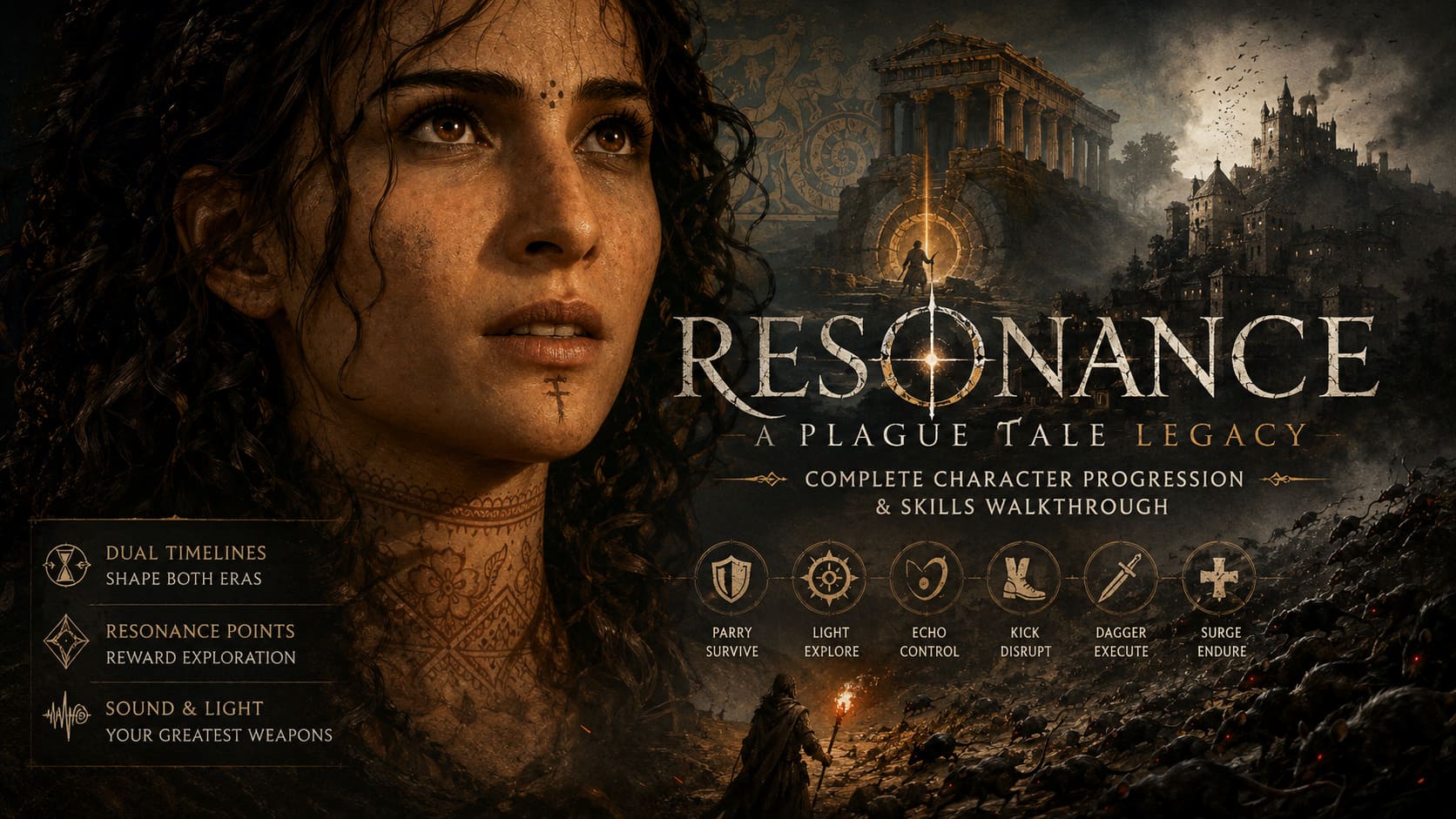
That sounds simple, but the important part is where you find them.
Resonance Points tend to reward exploration rather than simply completing objectives. They can be tucked into side rooms, obscure corners, abandoned structures, or areas that initially look completely irrelevant. In other words, the game is basically saying: slow down and look around.
And honestly, I like that.
It gives exploration a real purpose instead of making collectibles feel like something you’re gathering just because the developers needed to fill the map.
Why the Two Timelines Matter
The dual-timeline concept also has a major impact on progression.
The ancient Minoan sections aren’t simply interesting historical detours. Actions and discoveries made during these sequences can influence routes and opportunities in the medieval world. Some of the most valuable exploration areas become accessible because of what you accomplish during the earlier timeline.
This creates a satisfying loop:
Explore the past → change the environment → return to the medieval world → discover new routes → find better progression rewards.
For me, this is probably one of the smartest ideas in the game’s structure. It encourages you to think about the two timelines as parts of the same puzzle rather than treating them as separate chapters.
Don’t Rush Through the Main Story
If there is one piece of advice I’d give to a new player, it’s this: don’t play Resonance: A Plague Tale Legacy like a linear action game.
You can absolutely follow the main objectives, but you’ll be leaving a lot of progression potential behind.
Resonance Points are often placed away from the most obvious route, which means exploration directly affects how powerful Sophia becomes. A player who investigates every suspicious doorway and strange-looking structure can end up with a much more versatile character than someone who simply moves from objective marker to objective marker.
This is particularly important because the talent system has a relatively structured unlock path. You can’t simply grab every attractive ability whenever you want. Some later talents require investment into earlier traits.
That makes your early decisions matter.
The Skills That Matter Most
The talent system covers several different aspects of Sophia’s abilities, but I wouldn’t recommend treating every skill equally.
Some upgrades are nice conveniences. Others can fundamentally change how combat feels.
Here are the abilities I’d personally prioritize.
| Skill | What It Does | My Take |
|---|---|---|
| Perfect Parry Window Extension | Gives you more room to successfully deflect attacks | Essential early upgrade |
| Echo’s Return | Lets you counter an attacker and throw them into nearby enemies | Excellent for groups |
| Bullbreaker Kick | Expands stagger attacks with powerful knockback | Fantastic near hazards |
| Heroic Surge | Provides protection after certain lethal attacks | Very useful later |
| Dagger Combo Finisher | Enables fast executions against broken enemies | Great late-game damage |
| Light-Bending Efficiency | Improves the duration of the Minoan Sphere | Extremely useful for puzzles |
1. Perfect Parry Window Extension
This would be my first major investment.
Combat in Legacy is considerably more physical than what longtime fans might expect from the franchise. Once enemies start surrounding Sophia, being able to react to attacks consistently becomes incredibly important.
The extended parry window doesn’t make you invincible, obviously, but it gives you something every player appreciates: more room for error.
And that matters because a missed parry can quickly turn into a chain of attacks when you’re fighting several opponents.
If you’re still learning the combat system, this skill is even more valuable.
2. Light-Bending Efficiency
My second early priority would be Light-Bending Efficiency.
The Minoan Sphere isn’t just a cool story artifact. It is deeply connected to exploration and environmental puzzles, and improving its efficiency makes those sequences much easier to manage.
I wouldn’t underestimate this upgrade simply because it doesn’t directly increase Sophia’s combat power.
A longer operating window can mean fewer failed attempts, less frantic resource management, and more freedom when solving environmental puzzles.
For players who enjoy the exploration side of A Plague Tale, this is one of those upgrades that quietly pays for itself over time.
3. Echo’s Return
Once you’ve got your basic survival tools, I’d start moving toward Echo’s Return.
This is where the combat system starts becoming much more interesting.
Rather than simply blocking an enemy attack, Sophia can turn the opponent into a weapon against the rest of the group. Throwing an attacker into nearby enemies creates an opportunity to disrupt multiple opponents at once.
That’s exactly the kind of ability I enjoy in action games because it rewards positioning.
Instead of thinking, How do I defeat this enemy?, you’re thinking, Where can I put this enemy so that the next three enemies have a problem?
That’s a much more dynamic approach to combat.
4. Bullbreaker Kick
If you enjoy using the environment, Bullbreaker Kick is one of the most satisfying choices.
The game’s environments aren’t just decorative backgrounds. Ledges, hazards, fire, swarm zones, and other dangerous spaces can become part of your combat strategy.
A powerful knockback can therefore be more useful than raw damage.
Why spend time fighting an enemy when you can send them over a ledge?
That’s particularly useful against ordinary guards, where environmental kills can save valuable resources and reduce the amount of time you spend in direct combat.
5. Heroic Surge
I’d leave Heroic Surge for later.
It’s a defensive ability that rewards aggressive play by providing temporary protection after a successful lethal action or critical attack. This becomes particularly useful once encounters become larger and more chaotic.
The reason I wouldn’t rush toward it is simple: early in the game, I’d rather build the fundamentals that help me survive every encounter.
Later, when Sophia already has strong defensive and offensive options, Heroic Surge becomes much more valuable because it can help maintain momentum during prolonged battles.
6. Dagger Combo Finisher
This is my late-game damage pick.
Once an enemy’s posture has been broken through parries and other attacks, Dagger Combo Finisher lets Sophia capitalize on that opening with a quick execution.
It’s not necessarily the first skill I’d recommend, but once your defensive foundation is established, it can dramatically speed up encounters.
And there is something undeniably satisfying about turning a perfectly timed parry into a fast finishing move.
Sound Is More Than Just Stealth
One of the more unusual systems in Legacy is its focus on sound.

Noise isn’t merely a basic stealth indicator. Different surfaces and actions affect Sophia’s acoustic signature, which can influence enemy behavior and even interact with the plague mechanics.
That means movement itself becomes a tactical decision.
Running through an area might be faster, but it can also make your presence much easier to detect. Carefully choosing your route and understanding how sound behaves can sometimes be more effective than relying purely on combat skills.
This is where the game starts feeling very different from a traditional action game.
You’re constantly balancing movement, noise, visibility, enemies, and environmental hazards.
Don’t Ignore the Tuning Fork
The Tuning Fork is another tool that I think players could easily underestimate.
Its frequency-based functionality gives you another way to manipulate encounters and investigate spaces. High-frequency use can help push back smaller portions of the rat plague, while lower-frequency applications can serve as distractions.
I especially like the idea of using it for scouting.
If you can manipulate an enemy’s movement before entering an area, you can potentially avoid a much more dangerous confrontation.
That fits perfectly with the philosophy of the game: combat is powerful, but preparation is often better.
The Echo-Crystals Are Worth Your Attention
While Resonance Points are the main focus of character progression, don’t completely ignore environmental resources such as Echo-Crystal deposits.
These materials support secondary alchemical options and help maintain your flexibility.
I’ve always preferred games where exploration gives you something useful rather than another meaningless collectible, and this system works best when you treat the environment as one giant resource network.
If something looks unusual, investigate it.
That simple habit can save you later.
My Recommended Progression Order
If I were starting a new playthrough today, this would be my general progression route:
- Perfect Parry Window Extension
- Light-Bending Efficiency
- Echo’s Return
- Bullbreaker Kick
- Dagger Combo Finisher
- Heroic Surge
I wouldn’t consider this the only viable build. In fact, that’s one of the strengths of the system. Players who prefer stealth and environmental manipulation can lean into utility, while more aggressive players can develop Sophia’s combat capabilities.
But for a balanced first playthrough, I think this order gives you a good combination of survivability, exploration utility, crowd control, and finishing power.
Is Star Wars Zero Company Coming to Xbox One and PS4? Release Platforms Explained
A Few Habits That Make a Big Difference
There are a handful of small things I’d keep in mind throughout the campaign.
- Search beyond the objective path. The best progression rewards are often where the game doesn’t immediately tell you to look.
- Use the environment as a weapon. Knockbacks and hazards can save resources and eliminate enemies much faster than direct attacks.
- Think before sprinting. Noise can turn a manageable situation into a disaster.
- Keep your alchemical inventory under control. Having useful items available is far better than discovering too late that you’ve filled your capacity with less important materials.
- Use high ground intelligently. An encounter doesn’t always have to begin with Sophia standing in the middle of the enemy group.
Final Thoughts
What I like most about Resonance: A Plague Tale Legacy’s character progression is that it doesn’t feel completely detached from the world.
You’re not just collecting arbitrary XP and watching numbers go up. You’re exploring forgotten places, manipulating light, experimenting with sound, solving problems across different eras, and gradually turning Sophia into a more capable survivor.
The combat system also gives the progression mechanics a more active feeling than the traditional upgrade structure. Parries, knockbacks, executions, sound manipulation, and environmental hazards all work together, rather than existing as isolated mechanics.
For me, the best approach is therefore not to chase damage as quickly as possible. Build a strong defensive foundation, improve your ability to manipulate the environment, and then start investing heavily in offensive abilities.
Most importantly, don’t rush the exploration.
If you’re willing to search every suspicious corner, experiment with the Minoan Sphere, pay attention to sound, and use the environment creatively, Sophia becomes far more than a character with a bigger collection of abilities. She becomes a genuinely flexible combatant who can adapt to the situation instead of simply overpowering it.
And that’s exactly what I want from a modern A Plague Tale progression system.