Resonance: A Plague Tale Legacy PS5 vs Xbox Series X Performance Comparison
There is something about the A Plague Tale games that makes technical performance matter more than it does in most story-driven adventures. These aren’t just games where you walk through pretty medieval landscapes. They throw enormous crowds of rats, dense environments, dynamic lighting, stealth encounters, physics-heavy moments, and cinematic effects at the hardware all at once.
That is exactly why Resonance: A Plague Tale Legacy caught my attention.
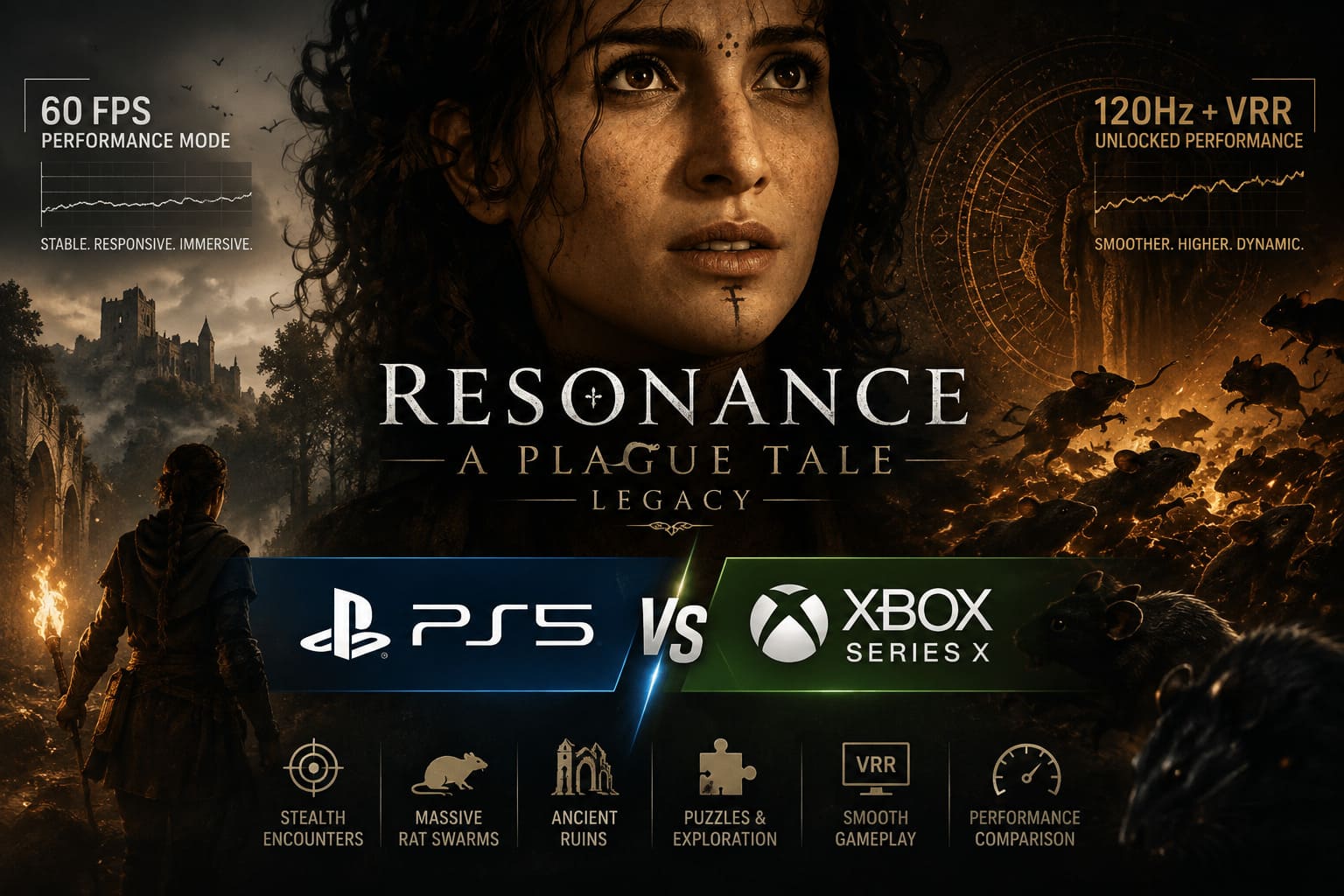
As a prequel centered on Sophia, the game takes the familiar grim atmosphere of the series and pushes it into a new direction, with ancient ruins, strange mythic forces, stealth, puzzles, and plenty of moments where the environment itself feels like an enemy. But there is an obvious question for anyone playing on console: PS5 or Xbox Series X?
After looking closely at the Performance Mode differences described for both machines, my answer is fairly straightforward: both versions are good, but Xbox Series X gets my vote if performance is your number-one priority.
That doesn’t mean the PS5 version is bad. Far from it. In fact, I think most players will be perfectly happy with it. But once you start looking at the unlocked 120Hz modes and the way each console handles demanding scenes, the Series X becomes the more interesting choice for performance enthusiasts.
Performance Mode Is the Real Sweet Spot
Let’s get one thing out of the way first: I would play Resonance: A Plague Tale Legacy in Performance Mode.
I know there will always be people who prefer maximum image quality, and I completely understand that. A Plague Tale is a gorgeous series, and the cinematic 30 FPS presentation can make its environments look fantastic.
But 60 FPS changes the experience.
The difference isn’t something you only notice when staring at a Digital Foundry graph. You feel it when moving through narrow corridors, aiming during tense encounters, turning the camera quickly, or trying to react to something attacking from the darkness.
The basic trade-off is familiar:
- Resolution Mode: higher visual quality, approximately 30 FPS.
- Performance Mode: lower internal resolution and reduced graphical settings in exchange for a 60 FPS target.
- 120Hz/VRR modes: potentially higher and unlocked frame rates on compatible displays.
For me, the last two options are where things get particularly interesting.
The Performance Mode reportedly works around a dynamic 1080p-class internal resolution before reconstruction and upscaling are applied. That sounds low compared with the 4K marketing surrounding modern consoles, but I don’t think native resolution tells the whole story anymore.
A stable 60 FPS image with good temporal reconstruction can look much better in motion than a sharper-looking 30 FPS presentation.
And in a game like this, motion matters.
Why This Game Is So Hard on Consoles
One of the reasons I find the PS5 vs Xbox Series X comparison interesting here is that Resonance isn’t demanding for just one reason.
The game has to deal with huge amounts of environmental detail, lighting, foliage, enemy behavior, effects, and potentially enormous groups of animated entities. That creates pressure on both the CPU and GPU.
The rat swarms are an obvious example.
Whenever the screen becomes crowded with hundreds or thousands of moving creatures, the engine isn’t simply drawing textures. It also has to manage animation, movement, visibility, interactions, lighting, and everything happening around them.
That is where seemingly small hardware differences can become noticeable.
The Performance Mode reportedly makes several compromises to keep the frame rate high. Foliage and distant geometry are reduced, ambient occlusion is adjusted, texture filtering can take a small hit, and some background entities don’t update at the same frequency as objects immediately around the player.
Honestly? I’m okay with that.
If I have to choose between slightly less grass in the distance and a significantly more responsive game, give me the frame rate every time.
PS5 Performance: Very Good, With Some Pressure Points
The PS5 version sounds like the more than capable baseline.
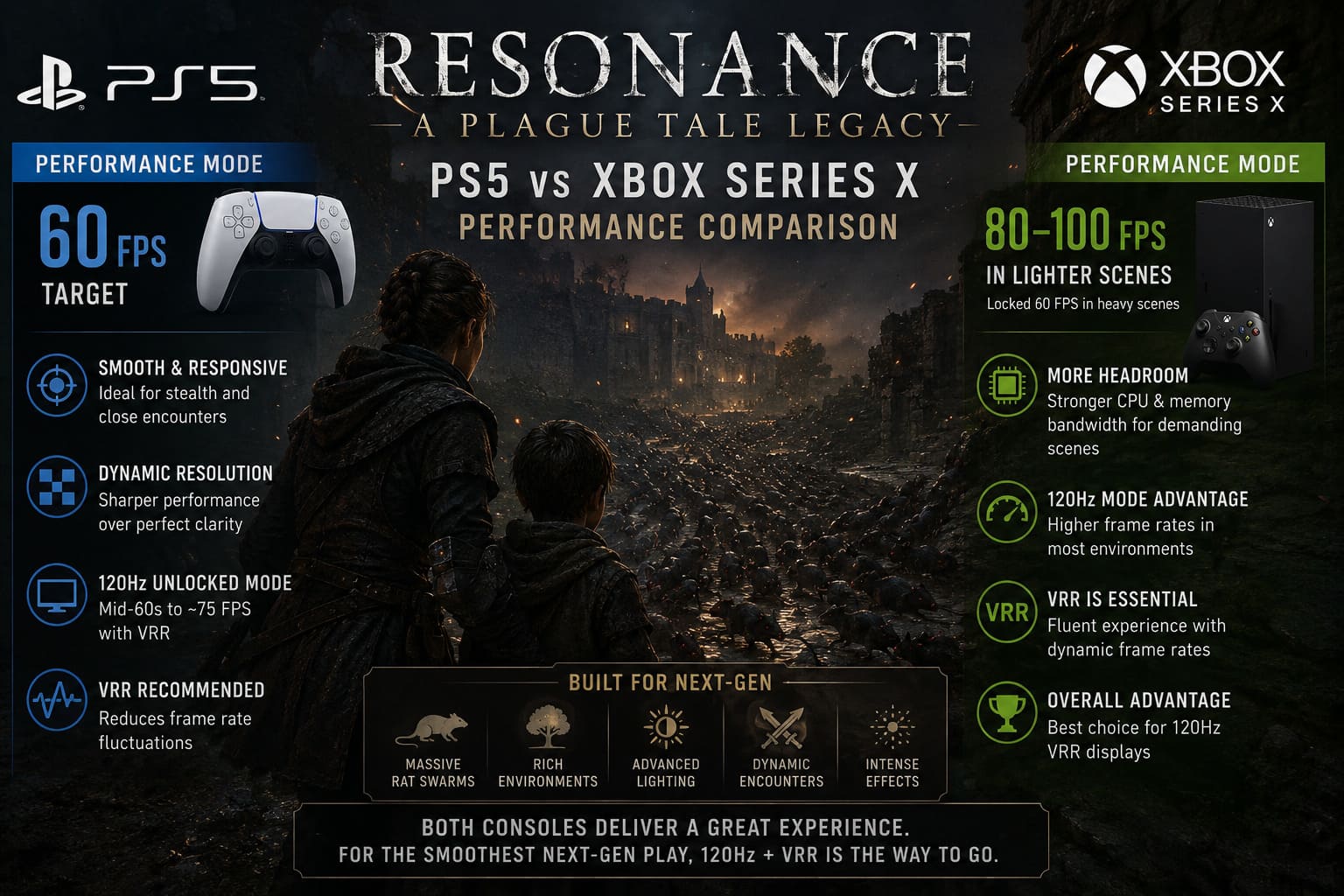
During typical exploration, indoor sections, stealth encounters, and tighter environments, the 60 FPS target should be the experience most players remember. The responsiveness is the big win here.
And that’s important because the PS5 controller makes these games feel particularly immersive. Moving through dark environments at 60 FPS, turning the camera quickly, and reacting to enemies simply feels more natural than playing the same sequences at 30 FPS.
The problem appears when the game opens up.
Large environments with long draw distances, environmental effects, and demanding encounters can put additional pressure on the console. Dynamic resolution scaling can become more aggressive in those moments, which may result in a softer image.
I don’t consider that a major failure.
Actually, dynamic resolution is doing exactly what it is supposed to do: sacrificing image sharpness to protect performance.
That’s a compromise I’m happy to accept.
The more interesting feature is the unlocked mode for 120Hz displays. With VRR enabled, the PS5 can move above 60 FPS in lighter scenes, reportedly reaching the mid-60s and sometimes around 75 FPS.
That won’t transform the game in the same way that a 120 FPS title does, but it can make camera movement feel noticeably smoother.
The catch is that the frame rate can fluctuate considerably depending on the scene. Without VRR, those fluctuations become much easier to notice.
So my advice for PS5 owners is simple: if you have a VRR television, absolutely use it.
Xbox Series X Has the Performance Advantage
This is where I think the Xbox Series X vs PS5 performance comparison becomes much more interesting.
On paper, the Series X has some hardware advantages that make sense for a technically demanding game. Its CPU configuration and memory bandwidth give developers additional headroom in certain workloads, and that headroom appears particularly useful when the game is trying to push beyond the standard 60 FPS target.
At a conventional locked 60 FPS, the difference isn’t dramatic.
Both consoles can deliver the experience the developers clearly intended.
But activate the 120Hz mode and the gap becomes more meaningful.
The Series X can reportedly push well beyond 60 FPS in less demanding environments, with some scenes reaching roughly 80–100 FPS. Obviously, you shouldn’t expect 100 FPS everywhere. Heavy encounters can pull that number down considerably.
Still, that’s impressive for a game with this kind of visual complexity.
And this is where VRR becomes almost essential.
Instead of obsessing over whether the game is hitting exactly 120 FPS, I’d rather have a frame rate that moves dynamically between 70, 80, 90, or higher depending on what is happening. A good VRR display makes those transitions far less distracting.
For a player with a 120Hz VRR television, the Series X therefore has a pretty compelling advantage.
PS5 vs Xbox Series X: The Numbers That Matter
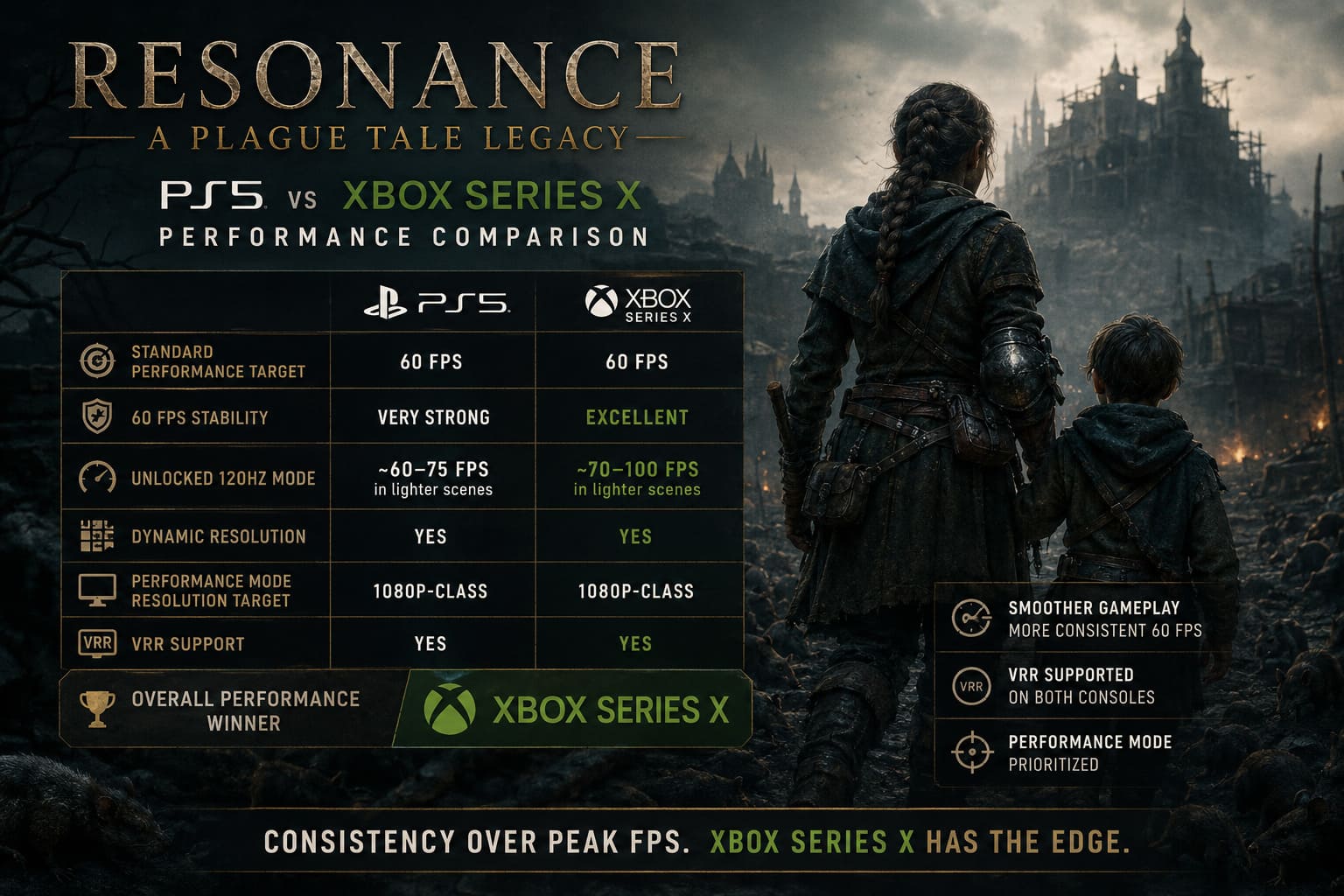
| Feature | PS5 | Xbox Series X |
|---|---|---|
| Standard Performance Target | 60 FPS | 60 FPS |
| 60 FPS Stability | Very Strong | Excellent |
| Unlocked 120Hz Mode | Roughly 60–75 FPS in lighter scenes | Roughly 70–100 FPS in lighter scenes |
| Dynamic Resolution | Yes | Yes |
| Performance Mode Resolution Target | 1080p-class | 1080p-class |
| VRR Support | Yes | Yes |
| Overall Performance Winner | — | Xbox Series X |
The important thing here is not to get obsessed with the maximum FPS number.
If someone tells you, “The Series X can hit 100 FPS,” that doesn’t mean you’re getting a 100 FPS experience throughout the entire campaign.
Likewise, saying the PS5 can reach 75 FPS doesn’t mean it is permanently stuck there.
Average performance and consistency matter much more than peak numbers.
And that’s why I give the Series X the win. It seems to have more breathing room when the game gets really ugly from a performance perspective.
The Image Quality Difference Is Smaller Than You Might Expect
One thing I wouldn’t do is buy the Xbox version purely because you expect a massive visual difference.
That’s not what this comparison is about.
The core graphical presentation is essentially the same. Both consoles are making similar compromises in Performance Mode. You aren’t suddenly getting dramatically better textures, exclusive lighting effects, or a completely different version of the game on Series X.
The difference is more subtle.
Dynamic resolution may hold a slightly higher floor on Xbox in demanding situations, which can make distant surfaces and fast camera movement look a little cleaner.
But while standing still and comparing screenshots, you might notice differences that disappear completely once you’re actually playing.
This is one of those situations where performance is more important than pixel counting.
And honestly, I think that’s the right choice for this game.
What About Resolution Mode?
I wouldn’t completely dismiss Resolution Mode.
If you’re playing on a huge 4K television, sitting relatively close to the screen, and primarily interested in atmosphere, the 30 FPS mode can make sense.
There is something undeniably cinematic about A Plague Tale’s visual design. The shadows, ruined architecture, fog, firelight, and enormous environmental scenes benefit from higher graphical settings.
But I still wouldn’t choose it for my first playthrough.
The moment-to-moment gameplay is too good at 60 FPS.
Stealth feels more responsive. Camera movement feels cleaner. Combat reactions are easier. Traversal simply feels less sluggish.
For me, the visual downgrade is something I notice occasionally.
The frame-rate improvement is something I notice constantly.
That’s an easy decision.
What Players Should Know About VRR
If you own a modern 120Hz television or monitor, this is one of the most important parts of the entire comparison.
VRR can completely change how you perceive an unlocked console performance mode.
Without VRR, a game moving between 60 and 80 FPS can produce inconsistent presentation because the display is refreshing at a fixed rate.
With VRR, the screen can adjust its refresh rate to better match the current frame rate.
That makes the unlocked modes far more attractive.
For PS5 players, VRR can help smooth out the fluctuations when the game becomes demanding. On Series X, it allows the higher frame-rate ceiling to actually become useful instead of merely looking impressive on paper.
So if you’re buying a television specifically for games like this, 120Hz + VRR is absolutely worth prioritizing.
Resonance: A Plague Tale Legacy – Complete Character Progression and Skills Walkthrough
My Verdict: Xbox Series X Takes It, But PS5 Owners Shouldn’t Worry
After stripping away the console-war nonsense, the conclusion is actually pretty simple.
Resonance: A Plague Tale Legacy appears to be a demanding game that benefits enormously from Performance Mode.
The PS5 handles that mode very well. In the majority of normal gameplay, you’re getting the responsive 60 FPS experience you’d want, and VRR makes the unlocked option more attractive.
But the Xbox Series X has the stronger argument for enthusiasts.
Its additional performance headroom appears to help when the engine is pushed hard, and the advantage becomes much easier to appreciate in the unlocked 120Hz mode. If you’re sitting in front of a good VRR display and want the smoothest possible console experience, I’d pick Xbox Series X.
That said, I wouldn’t tell a PS5 owner to buy another console just for this game.
That’s ridiculous.
The PS5 version still delivers a strong 60 FPS experience, and the differences become most relevant to people who have a 120Hz VRR display and actively care about frame-rate fluctuations.
For everyone else, the decision can come down to where you already play, which controller you prefer, and where your friends are.
My Personal Ranking
- Xbox Series X + 120Hz VRR — my preferred setup for maximum performance.
- PS5 + 120Hz VRR — excellent and very smooth, with a little less headroom.
- Xbox Series X + standard 60 FPS Performance Mode — extremely solid and consistent.
- PS5 + standard 60 FPS Performance Mode — still a great way to play.
- Resolution Mode at 30 FPS — gorgeous, but not my choice for gameplay.
At the end of the day, Resonance: A Plague Tale Legacy isn’t a game I want to experience while worrying about whether every blade of grass is rendered at maximum quality.
I want to sneak through the ruins, react quickly, survive the chaos, and enjoy the atmosphere without feeling like I’m dragging the camera through molasses.
That’s why Performance Mode wins for me.
And between the two consoles, the Xbox Series X gets the nod. It isn’t because the PS5 version is somehow broken or dramatically inferior. It’s simply because when a game this demanding gives you the opportunity to chase higher frame rates, the Series X appears to have a little more horsepower left in reserve.
For a technical showcase like this, that extra breathing room matters.
If you’re choosing purely on PS5 vs Xbox Series X performance, I’d go Xbox Series X. If you already own a PS5, though, don’t hesitate to play it there. Turn on Performance Mode, enable VRR if your display supports it, and enjoy the game.
Sometimes the best performance analysis ends with the simplest advice: stop staring at the numbers and start playing.