Onimusha Way of the Sword Weapon Tier List: Best Weapons and Upgrade Guide (2026)
Onimusha: Way of the Sword is the kind of game where your weapon choice can completely change how a fight feels. On paper, Musashi has access to a relatively compact arsenal compared with a traditional loot-heavy RPG, but that is honestly one of the things I like most about it. You are not constantly replacing your sword because some random chest gave you a weapon with +3 attack.
Instead, the game asks a much more interesting question: which weapon is actually worth investing your limited upgrade materials into?
After spending time looking at the available weapon styles, upgrade paths, elemental abilities, and their usefulness against both regular Genma and tougher enemies, I have a pretty clear opinion on the current Onimusha: Way of the Sword weapon tier list.
If you’re looking for the short version, Wind-Whipper and Enryu are the two weapons I’d prioritize, while Raizan is probably the safest all-rounder for players who don’t want to specialize too heavily. The Standard Katana is also better than its boring appearance suggests, particularly if you’re trying to conserve rare materials.
But there is more to this system than simply picking the weapon with the biggest damage number.
Onimusha: Way of the Sword Weapon Tier List
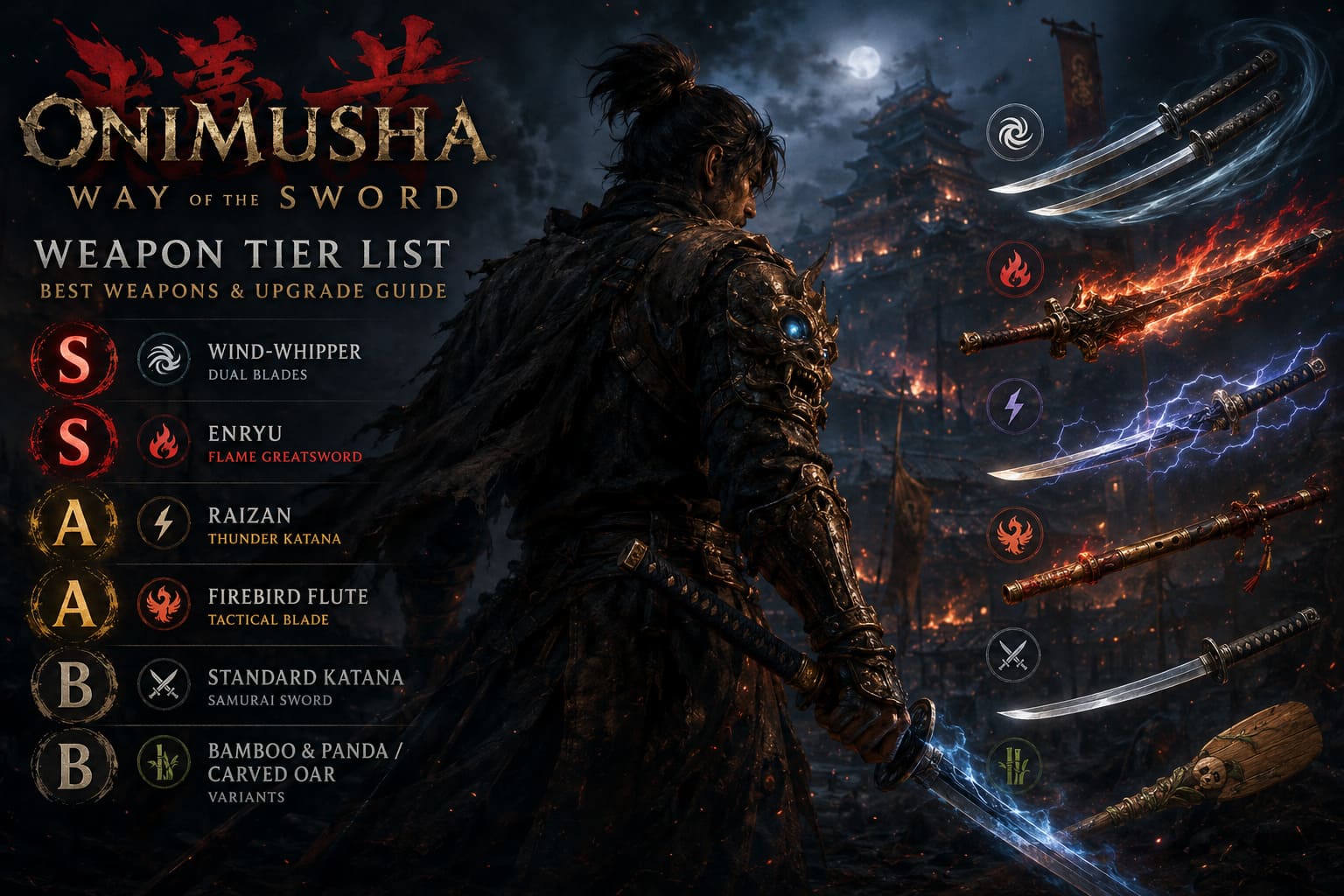
Here is how I would rank the main weapons based on damage, speed, Issen potential, crowd control, versatility, and upgrade efficiency.
| Tier | Weapon | Style | Best Use |
|---|---|---|---|
| S | Wind-Whipper | Dual Blades | Crowd Control & Mobility |
| S | Enryu | Flame Greatsword | Boss Damage & Guard Breaking |
| A | Raizan | Thunder Katana | Balanced Combat & Issen |
| A | Firebird Flute | Tactical Blade | Hybrid Combat & Stagger |
| B | Standard Katana | Samurai Sword | Reliable Physical Damage |
| B | Bamboo & Panda / Carved Oar | Variants | Style & Early Game |
My personal ranking: Wind-Whipper > Enryu > Raizan > Firebird Flute > Standard Katana > Deluxe variants.
That doesn’t mean the B-Tier weapons are bad. In fact, the Standard Katana can be surprisingly effective when fully upgraded. But if we’re talking about where I’d put my rare resources when preparing for the harder parts of the game, I’d rather specialize.
S-Tier: The Weapons I’d Build Around
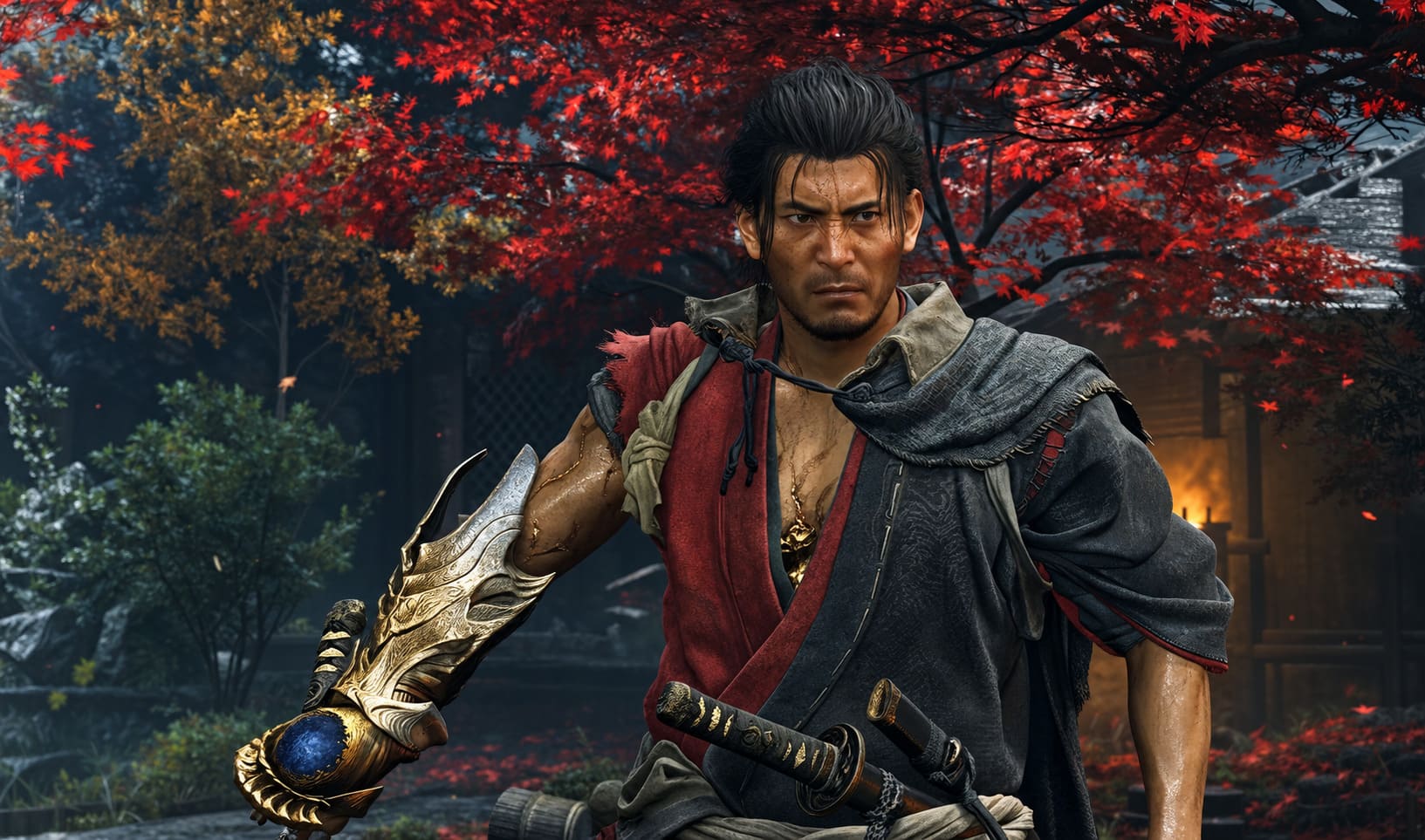
1. Wind-Whipper – My Favorite Overall Weapon
If I had to choose one weapon for a full playthrough, Wind-Whipper would probably be my first pick.
The biggest reason isn’t simply damage. It’s how comfortable this weapon makes Musashi feel in the middle of a chaotic fight.
The dual-blade style is extremely fast, and its attack strings naturally lend themselves to aggressive play. More importantly, Wind-Whipper works beautifully with the game’s Reflex Combo mechanics. You can maintain pressure without feeling completely committed to every animation.
That matters a lot when you’re fighting groups.
One second you’re cutting through a Genma, the next you’re surrounded by three more enemies, and suddenly that ability to transition into a dodge or defensive action becomes much more valuable than another few points of raw attack power.
The weapon’s special Oni attack is where things get even better. The vacuum-like waves can pull enemies together, effectively turning a scattered group of Genma into one convenient target cluster.
And if you’ve been practicing your Issen timing, this is where Wind-Whipper gets ridiculous.
Pull several enemies together, create an opening, and punish them with a well-timed counter. It is exactly the kind of combat loop that makes Onimusha feel different from a standard action RPG.
My verdict: If you’re still deciding where to spend your early materials, Wind-Whipper is the safest offensive investment.
2. Enryu – The Boss-Killing Monster
Wind-Whipper is my favorite, but Enryu might be the weapon I’d want in my inventory when facing a terrifying boss.
This massive flame greatsword sacrifices speed for impact. That’s not a weakness so much as a declaration of intent.
You aren’t using Enryu to dance around enemies with endless light attacks. You’re using it to land devastating blows that make every opening count.
The heavy attacks are particularly useful against enemies that rely on guarding. Instead of repeatedly bouncing off defensive animations, Enryu can put serious pressure on them with its powerful vertical strikes.
Then there’s the fire element.
Once upgraded and paired with the appropriate Oni abilities, Enryu becomes particularly nasty against tougher targets because its flame effect adds sustained damage rather than relying entirely on one huge hit.
For me, that’s what pushes it into S-Tier. The weapon has a clear identity. It is slow, brutal, and extremely satisfying when you learn its timing.
The downside is obvious: if you panic and start swinging wildly, you’re going to get punished.
My verdict: Fantastic for confident players who understand spacing, parries, and enemy attack patterns.
A-Tier: Weapons That Can Carry You Through the Game
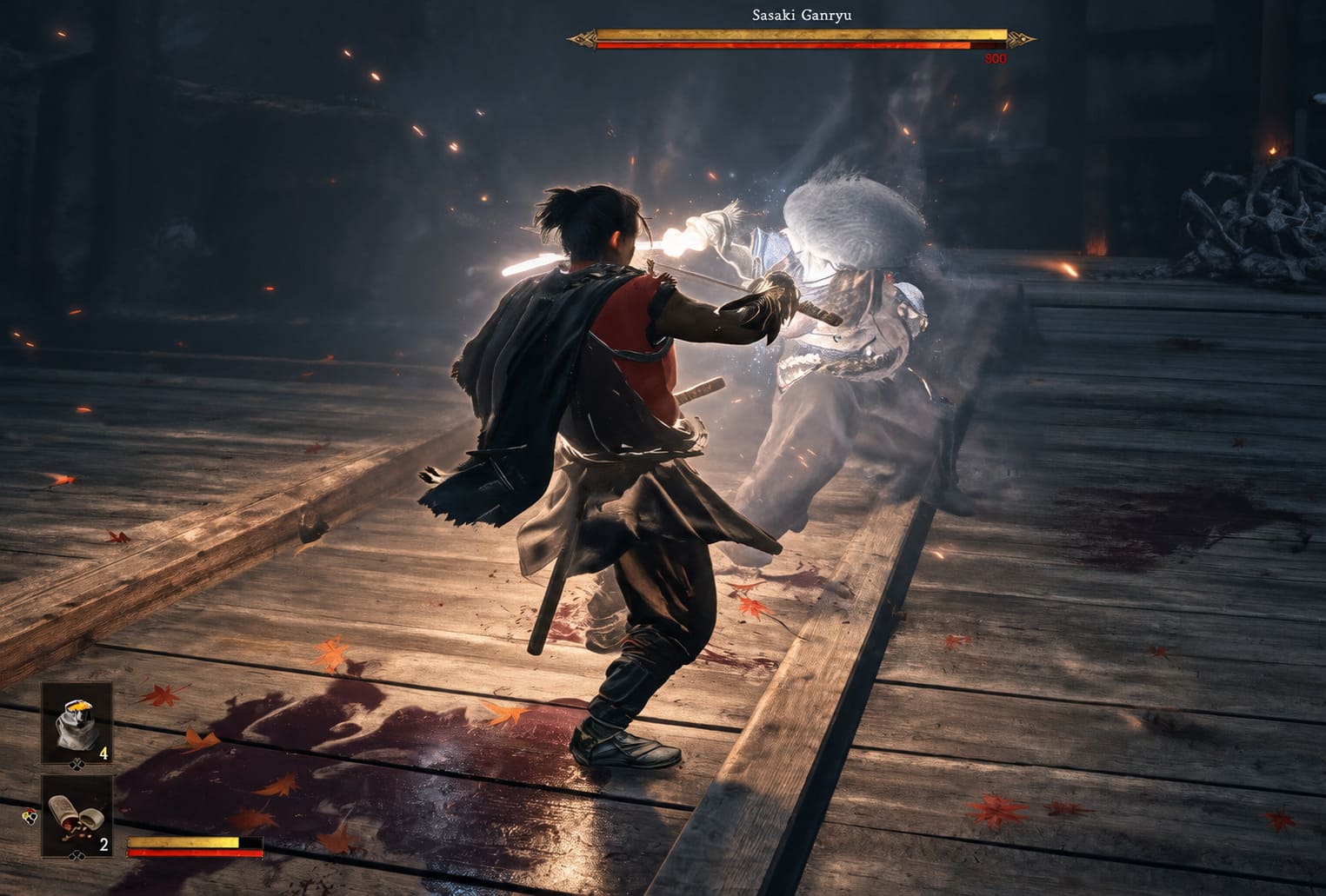
Raizan – The “Just Give Me a Katana” Choice
There is something wonderfully straightforward about Raizan.
If Wind-Whipper feels like controlled chaos and Enryu feels like swinging a wrecking ball, Raizan sits comfortably in the middle.
Its attack speed is familiar, its moveset is easy to understand, and it works extremely well with players who want to focus on Issen counters.
That makes Raizan particularly attractive for newcomers.
The Thunder Orb also gives it some extra personality. Repeated light attacks can trigger lightning effects that help interrupt smaller enemies, giving the weapon useful crowd-control potential without turning it into a dedicated AoE weapon.
Where Raizan really shines, though, is against individual targets.
When you’re locked into a boss fight and every opening matters, having a fast, predictable weapon can be more useful than having something flashy. I’d happily use Raizan from the opening chapters all the way through the endgame.
It isn’t necessarily the most exciting weapon on this list, but it might be the most dependable.
Firebird Flute – Weird, But Surprisingly Useful
I’ll admit it: Firebird Flute initially looks like the kind of weapon I’d probably ignore.
Then you actually look at what it does.
Its ability to deal fire damage to several nearby enemies gives it a nice advantage when fights become crowded. More importantly, its stagger potential makes it useful against heavier opponents.
That utility is what earns it A-Tier for me.
Firebird Flute isn’t necessarily going to beat Enryu in a straight damage competition, but that’s not really the point. It provides tools that can create openings, disrupt enemy formations, and give you opportunities to switch tactics.
I’d especially recommend it to players who enjoy mixing melee attacks with Oni abilities rather than sticking to one pure combat style.
B-Tier: Don’t Confuse “B” With “Bad”
Standard Samurai Katana
The starting weapon is almost always the victim of the same problem: players see it first, use it for a while, and then immediately assume it must be inferior to everything unlocked later.
I wouldn’t make that assumption here.
The Standard Katana is extremely reliable, particularly when upgraded.
It doesn’t have lightning, fire, vacuum waves, or any other spectacular gimmick. But that simplicity can actually be an advantage.
Its upgrade requirements are less demanding than some specialized weapons, which means you can maintain respectable physical damage without burning through all your rare resources.
If you’re struggling to collect enough Tempered Iron for several weapons, investing heavily into the Standard Katana can be a perfectly sensible decision.
It isn’t my first choice for an endgame build, but I would absolutely rather have a Level 5 Standard Katana than three half-upgraded weapons competing for my resources.
Bamboo & Panda / Carved Oar Variants
These weapons are a different story.
The Bamboo & Panda and Carved Oar options are primarily about style and presentation, particularly for players with the appropriate Deluxe or Premium content.
I like the idea of having unusual weapon appearances, but I wouldn’t treat these variants as some secret endgame meta strategy.
They’re perfectly serviceable during the earlier stages, but their biggest selling point is making Musashi look ridiculous in the best possible way.
And honestly? Sometimes that’s enough.
How the Weapon Upgrade System Actually Works
One of the most important things to understand in Onimusha: Way of the Sword is that upgrading everything equally is usually a mistake.
Weapons progress through five levels, with Spirit Mirrors acting as the main upgrade checkpoints.
The resource requirements become increasingly demanding as you climb toward Level 5.
Iron
Iron is your main early-game upgrade material. You’ll use it to improve weapons through the first several stages of progression.
Tempered Iron
This is where things get serious.
Tempered Iron is much more valuable, particularly when you’re trying to push your preferred weapon toward Levels 4 and 5.
That means you shouldn’t treat every weapon like a collection project.
Pick a weapon.
Upgrade it.
Learn it.
Then start investing in something else.
That’s much more efficient than spreading your resources across the entire arsenal.
My Best Upgrade Strategy
If I were starting a new playthrough today, this is the approach I’d use.
- Choose one primary weapon early. I’d personally pick Wind-Whipper, with Enryu as my alternative.
- Upgrade that weapon before spreading resources around. A single powerful Level 3 or Level 4 weapon is much more useful than several weak Level 2 options.
- Explore every area properly. Don’t rush through Kyoto. Treasure chests can contain important upgrade materials, and missing them early can make the later resource grind more annoying.
- Save rare materials for your endgame weapon. Tempered Iron is not something I’d casually spend just because another weapon looks interesting.
- Don’t ignore Oni Stones. Weapon damage isn’t the entire combat equation. Oni Armaments can dramatically improve what your build is capable of doing.
Spirit Mirrors, Oni Stones and the Other Half of Your Build
Your sword isn’t the only thing worth upgrading.
The Oni Gauntlet plays a major role in Musashi’s overall combat efficiency. Its improvements affect things such as magic recovery, Soul Absorption range, and absorption speed.
That can have a surprisingly large impact during difficult encounters.
Then there are Oni Stones, which can be used to strengthen active Oni Armaments.
This is something I wouldn’t overlook.
A maxed weapon paired with weak magical equipment isn’t necessarily the strongest possible setup. The real fun starts when your physical weapon and Oni abilities complement each other.
For example, a fast weapon such as Wind-Whipper can benefit enormously from abilities that help control groups, while a slower weapon like Enryu can use magical effects to create openings before committing to its devastating attacks.
That’s where the equipment system becomes much more interesting than a simple damage-number race.
What I Would Upgrade First
If you want my personal priority order rather than a completely objective spreadsheet ranking, here’s what I’d do:
| Priority | Investment | Why |
|---|---|---|
| 1 | Wind-Whipper | Best combination of speed, mobility and crowd control |
| 2 | Enryu | Excellent against bosses and guarded enemies |
| 3 | Raizan | Extremely reliable all-rounder |
| 4 | Oni Armaments | Adds major combat utility |
| 5 | Armor | Improves survivability and stamina management |
| 6 | Secondary Weapons | Upgrade once your main build is established |
Armor deserves more attention than it initially gets, too. Increasing maximum health gives you more room for mistakes, while additional stamina directly affects your ability to dodge and block.
And in a game where one mistimed defensive action can turn into a brutal combo from a Genma enemy, that extra breathing room is valuable.
How to Fix Onimusha Way of the Sword Crashing, Black Screen, and Not Loading on PC
Final Verdict: Which Onimusha Weapon Is Best?
There isn’t one weapon that magically makes Onimusha: Way of the Sword easy. Your personal combat style matters too much for that.
But if we’re talking about the weapons I’d recommend investing in first, Wind-Whipper is my overall winner.
It is fast, flexible, excellent against groups, and pairs beautifully with the game’s counter-focused combat. It rewards aggressive players without forcing them to abandon defensive fundamentals.
Enryu is my second choice, especially for players who love heavy weapons and want to absolutely punish bosses when an opening appears.
Raizan is the weapon I’d recommend to anyone who doesn’t want to overthink their build. It is consistent, balanced, and useful virtually everywhere.
And don’t completely abandon the Standard Katana. It may lack the spectacle of the specialized weapons, but its low-risk upgrade path makes it a surprisingly practical fallback.
Ultimately, the biggest mistake you can make is trying to upgrade everything at once.
Pick the weapon that matches your preferred way of fighting, push it toward Level 4 and eventually Level 5, then build your Oni Armaments around it. Once your weapon, armor, Gauntlet, and Oni abilities start working together, Musashi becomes dramatically more dangerous.
And that’s when Onimusha: Way of the Sword really starts to click.