Nightwater Game Guide: How to Build, Automate, Explore, and Reach the Endings
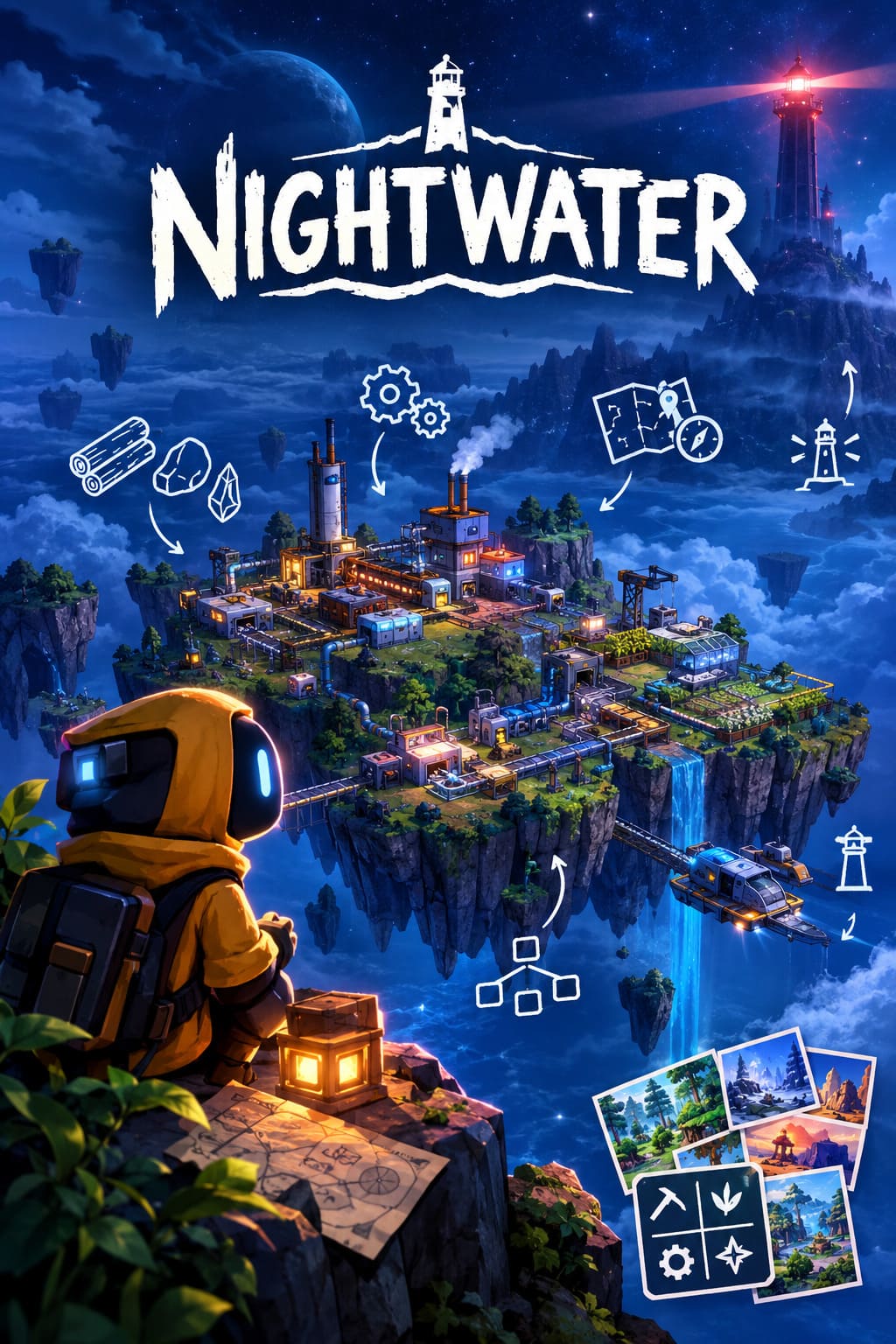
There is something strangely calming about Nightwater. At first glance, it looks like another indie survival and factory-building game where the obvious goal is to collect materials, craft better tools, and create increasingly complicated production lines. After spending time with games in this genre, from classic factory simulators to survival sandboxes, I expected Nightwater to follow the same familiar formula. Instead, Studio Ashty takes that formula and puts it on a floating island surrounded by an enormous sea of darkness, distant stars, and an unsettling lighthouse that seems to be watching from beyond the mountains.
That atmosphere immediately changes how the game feels. You are not simply building a factory because you want to see bigger numbers on a production screen. Every technological upgrade also feels like another step toward understanding where you are and why this strange world exists. Nightwater combines survival crafting, exploration, incremental progression, automation, and environmental storytelling without forcing the player to follow a traditional quest structure.
If you’re starting Nightwater for the first time, the sheer number of systems can be a little confusing. The game gives you plenty of freedom, but freedom can also mean making inefficient decisions early on. This guide covers the progression system, island expansion, factory automation, minigames, exploration, and the game’s four endings.
Nightwater Game Xbox Game Pass Entry: Release Date, Studio Ashty Insights, and Rumors
Why Nightwater Feels Different From Other Automation Games
Nightwater’s biggest strength is the way it blends systems that normally belong to very different genres. The survival mechanics are straightforward enough to understand quickly, while the automation layer gradually becomes more demanding as your island grows. At the same time, the mysterious setting gives your industrial progress a purpose beyond simply producing more resources.
Unlike a typical factory simulator where the world can sometimes feel like little more than a giant production board, Nightwater constantly reminds you that something strange is happening around your base. The distant Lighthouse, unexplained environmental details, and hidden locations create an atmosphere that encourages exploration even when your next objective is technically just another upgrade.
Nightwater’s Main Gameplay Loop
The basic structure is easy to understand: gather resources, craft better equipment, unlock new technology, expand your island, automate production, and use that new production capacity to reach another technological milestone.
What makes the loop interesting is that Nightwater connects industrial progression with exploration. You cannot simply remain on the starting island forever and expect every useful material to appear there. New regions contain resources that become necessary for later recipes, which means expansion is not just an optional way to make your base look bigger.
| Era | Main Focus | Important Progression |
|---|---|---|
| Stone Age | Gathering and survival | Basic tools, crafting stations, wood and stone |
| Bronze Age | Metalworking | Smelting, stronger tools, early automation |
| Industrial Era | Factory production | Steam power, pipes, logistics and complex machinery |
| Futuristic Technology | Void-powered industry | Advanced machines and large-scale expansion |
The first stage is deliberately hands-on. You will spend a lot of time collecting basic materials manually, and honestly, that’s one of the few moments where I recommend resisting the urge to rush. Getting a solid resource foundation early makes everything afterward considerably smoother.
Your First Priority Should Be Resource Stability
One mistake that is easy to make in Nightwater is rushing into the next age simply because the next technology tree looks exciting. I’ve made this mistake plenty of times in other crafting games, and it usually creates the same problem: you unlock better machines before you have enough basic materials to actually support them.
Wood, stone, and basic forage should become your first reliable production chain. Even after unlocking early automation, keep some manual gathering upgrades active. The extra yield from manual collection might look insignificant later, but during the opening hours it can dramatically reduce the amount of time spent waiting for basic resources.
Storage is equally important. Nightwater’s automated systems can produce surprisingly quickly once several machines are operating simultaneously. A production line that stops because the output container is full is one of those problems that feels completely avoidable afterward.
Reinforced chests are particularly useful because they can hold up to 60 items. Build more storage than you think you’ll need, especially around factories producing multiple materials.
Expanding the Floating Island
Island expansion is one of Nightwater’s most important progression mechanics. Your starting area is intentionally limited, so eventually you need to construct outward and gain access to new environments.
Each new biome can introduce different materials, plants, creatures, and mineral deposits. That means expansion directly affects what you can craft and which technologies you can unlock.
However, there is a catch: bigger territory means bigger logistical problems.
A resource node that was originally right next to your factory might eventually be several production stages away from your main storage area. Long conveyor routes and pipe networks can quickly become messy if you build without thinking about future expansion.
I recommend leaving room between major production blocks rather than squeezing every machine together. It might feel inefficient during the early game, but once your factory becomes large, that extra space becomes incredibly valuable.
And don’t ignore the horizon. The strange visual design of the void isn’t only there to make screenshots look good. Distant structures, unusual terrain formations, and environmental details can point toward areas worth investigating.
How to Build a Better Automated Factory
Automation is where Nightwater really starts to become addictive. Once you have enough infrastructure, the game changes from survival crafting into something closer to an industrial puzzle.
There are more than 60 buildings and machines to work with, including miners, farmers, assemblers, storage structures, and specialized production equipment. You don’t need to automate everything immediately, though. Automate the materials you use constantly first.
Basic resource automation should be your foundation. Once those systems are stable, you can start building specialized production chains on top of them.
Pipes and Production Lines
Pipes and conveyors are the nervous system of your factory. Machines need reliable connections to receive raw materials and send finished products onward.
Early layouts can be extremely simple, but later production chains benefit from planning. Advanced pipe infrastructure introduces useful options such as splitters, mergers, and extenders, allowing you to control how resources move between machines.
The goal isn’t simply to connect everything. The goal is to prevent bottlenecks.
If one machine consumes resources faster than another produces them, you’ll eventually have either an empty input or an overflowing output. Watching your production lines for a few minutes can reveal these problems much faster than constantly rebuilding the entire factory.
The Primary-Only Upgrade
One of the most useful upgrades I would prioritize for harvesters is Primary-Only.
This option makes the harvester concentrate exclusively on its main resource while automatically removing unwanted byproducts. That might sound like a small quality-of-life feature, but it becomes extremely useful once production begins scaling.
Without it, secondary materials can fill storage containers and interfere with the rest of the production chain. Eventually you end up spending more time cleaning inventories than actually expanding your factory.
Primary-Only is one of those upgrades that doesn’t look spectacular on paper but becomes incredibly valuable once you’ve experienced the alternative.
Don’t Forget the Collector
Another structure worth unlocking early is the Collector.
Checking individual machines for finished products is manageable when you have five or six production buildings. Once you have dozens, it becomes busywork. The Collector helps gather outputs into a centralized inventory, which means less running around your island and more time spent actually planning your next expansion.
For me, these are exactly the kinds of automation tools that make a factory game enjoyable rather than exhausting. Good automation should remove repetitive chores while leaving the interesting decisions in the player’s hands.
Nightwater’s Optional Minigames Are Worth Your Time
Nightwater includes five separate minigames hidden inside the game’s interface. They are completely optional in the sense that you can continue the main progression without constantly interacting with them.
But calling them irrelevant would be a mistake.
Each minigame has its own progression, item pools, upgrades, and rewards. Some of those rewards provide permanent bonuses that affect the main game, while others unlock recipes or buildings that can make your industrial development considerably easier.
The Deep Dark minigame is a good example. Progressing through it can provide incremental resource bonuses, including an increase to the maximum yield from manual harvesting.
This creates an interesting strategic choice. You can ignore the minigames and focus entirely on factory construction, but investing some time into them can make your main progression more efficient.
I would treat them as part of the overall progression rather than distractions from it. If a game gives me an optional system that can permanently improve the rest of the experience, I usually want to understand it before deciding that it’s not worth using.
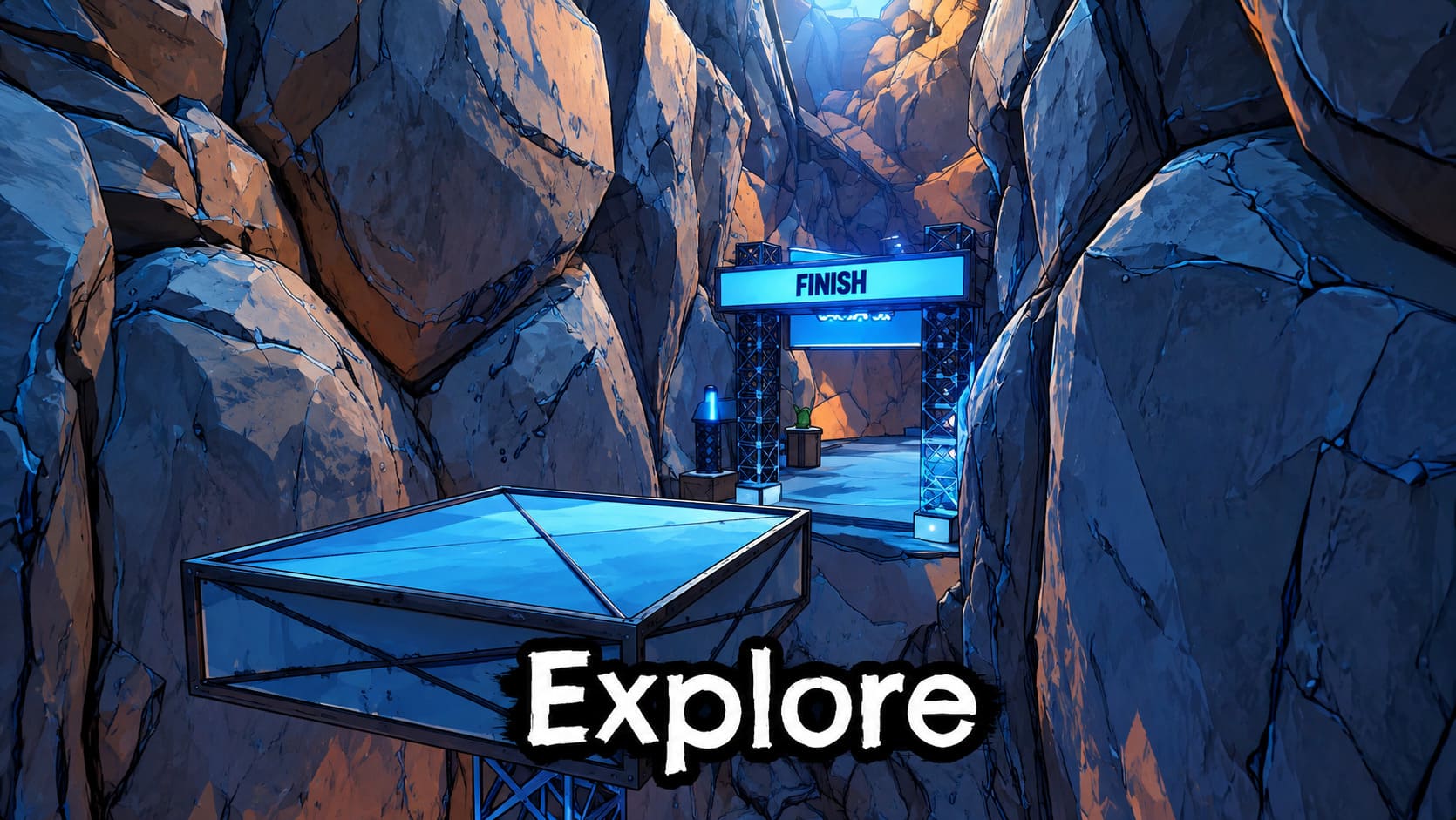
The Lighthouse and Nightwater’s Four Endings
This is where Nightwater becomes much more interesting than a conventional automation simulator.
The game’s story isn’t presented through constant dialogue or cinematic cutscenes. Instead, it is scattered throughout the environment. Item descriptions, hidden locations, strange objects, environmental details, and mysterious logs gradually build a picture of what happened to this world.
The Lighthouse is particularly important.
You can technically play Nightwater as a pure building and automation game, ignoring most of its lore. If that’s your preferred way to play, the game supports it. But if you’re the type of player who reads descriptions and investigates suspicious corners of the map, there is considerably more waiting underneath the surface.
There are four different endings, with your discoveries and progression influencing which conclusion you can reach.
The important thing to remember is that simply reaching the highest technological tier isn’t necessarily enough if you’re hunting for the complete story. Exploration matters.
Tips for Finding the Endings
- Explore newly unlocked areas instead of immediately returning to your factory.
- Read unusual item descriptions and logs carefully.
- Pay attention to structures that look out of place.
- Keep checking areas around the edges of your expanded territory.
- Continue technological progression while investigating the Lighthouse and other secrets.
The true conclusion requires both substantial technological progress and careful exploration of hidden areas. In other words, Nightwater rewards players who treat the world as something to investigate rather than simply as a collection of resource nodes.
A Practical First-Two-Hours Strategy
If you’re opening Nightwater for the first time, I’d approach the beginning with a fairly simple philosophy: build a stable foundation before trying to become an industrial giant. The opening hours are where small decisions can save you a surprising amount of time later.
- Gather aggressively at the start. Build up a healthy supply of wood, stone, and basic materials before spending everything on unnecessary crafting.
- Upgrade manual gathering. Early bonuses have a surprisingly large impact because you’re still doing most of the work yourself.
- Automate basic resources first. Don’t build an enormous complicated factory before your fundamentals are stable.
- Expand storage early. Full containers can stop production chains and create problems that are easy to prevent.
- Leave space for expansion. Your factory will become much larger than it looks during the opening hours.
- Experiment with the minigames. Their rewards can improve your main progression.
- Explore while expanding. Don’t treat new biomes as resource warehouses only; look for unusual locations and environmental clues.
- Watch the Lighthouse. Even when you’re focused on factory optimization, keep the mystery in the back of your mind.
Final Thoughts on Nightwater
After playing enough survival games and factory builders, it takes something unusual to make the familiar resource-production loop feel fresh. Nightwater manages that by making the factory part of a larger mystery. You’re not just optimizing pipes and machines; you’re gradually turning a tiny floating island into an industrial complex while trying to understand the bizarre world surrounding it.
The automation mechanics are deep enough to satisfy players who enjoy optimization, while the exploration and environmental storytelling give the game a reason to slow down and look around. I especially like that the narrative doesn’t constantly interrupt the building process. If you want to spend an evening obsessing over production ratios, you can. If you want to chase the secrets behind the Lighthouse, the game gives you plenty of reasons to do that too.
My biggest advice is simple: don’t rush Nightwater. Build your foundations properly, automate the boring parts, expand carefully, and explore whenever something catches your attention. The best moments are often not the ones where you unlock another machine, but the ones where a strange detail in the environment suddenly makes you wonder what happened before you arrived.
For players looking for a Nightwater game guide that goes beyond basic crafting instructions, that’s really the key to the whole experience: build efficiently, but don’t become so focused on production numbers that you forget you’re standing on a floating island above an apparently endless void.