Goblin Company Gameplay Walkthrough: Complete Mining and Survival Guide
When I first saw Goblin Company pop up on my Steam recommendations, I honestly expected another lightweight co-op game that would entertain my friends and me for a weekend before disappearing into the ever-growing backlog. Instead, after several late-night sessions filled with screaming teammates, runaway mine carts, terrible decisions, and surprisingly tense cave expeditions, I found myself completely hooked.
Developed by BitBorne Studio, Goblin Company takes familiar ideas from cooperative survival and mining games and twists them into something that feels refreshingly chaotic. You are not a legendary hero, a futuristic space marine, or some chosen savior. You are a goblin employee working for a corporation that clearly values profit more than worker safety. Somehow, that simple premise creates some of the funniest and most memorable moments I’ve experienced in a multiplayer game this year.
First Impressions: A Workplace Nightmare in the Best Possible Way
From the very first expedition, Goblin Company establishes its identity. The caves are dark, dangerous, and fully destructible. Every tunnel you create feels like a small achievement, while every wrong turn can quickly transform into a disaster.
What immediately stood out to me was how the game combines resource gathering with logistics management. Digging up valuable minerals is only half the challenge. Getting those resources back to base without losing everything is where the real gameplay begins.

Unlike many mining games that let you simply teleport resources home or carry unlimited amounts in your inventory, Goblin Company forces players to think about transportation. The rail system becomes just as important as your mining equipment.
That design choice gives every expedition a sense of purpose and progression that keeps the gameplay loop engaging for hours.
The Darkness Is Your Real Enemy
Most survival games throw monsters at you and call it a day.
Goblin Company does something smarter.
The darkness itself becomes a constant threat.
The game’s fear mechanic creates genuine tension during exploration. Venture too far into unlit territory and your goblin starts suffering from panic and health loss. The deeper you go, the more dangerous this becomes.
At first I underestimated this system completely.
Big mistake.
Several early runs ended not because of hostile creatures, but because our team got greedy and pushed deeper without maintaining a proper light network. Suddenly everyone was scrambling to place torches while trying to avoid losing sanity.
It sounds simple on paper, yet during gameplay it creates some incredibly stressful situations.
My advice for new players:
- Always carry backup torches.
- Never assume you’ll remember the route back.
- Light intersections heavily.
- Treat darkness like an active enemy.
The players who survive longest are usually the ones who respect the lighting system.
Why Railways Matter More Than You Think

If there’s one feature that truly separates Goblin Company from other co-op mining games, it’s the railway system.
Initially, I thought the tracks would simply be a convenient transport mechanic.
I was wrong.
Rail networks quickly become the backbone of every successful operation. Building efficient routes through winding cave systems becomes almost a game within the game.
A poorly designed rail line can lead to:
- Lost resources
- Damaged carts
- Injured teammates
- Delayed extraction runs
A good rail network, however, completely transforms the experience.
Instead of spending twenty minutes hauling materials manually, you can establish a transportation route that continuously moves resources toward your base while your team focuses on exploration.
Some of our most satisfying moments came from creating massive interconnected rail systems stretching through multiple cave layers.
Solo vs Multiplayer: Two Completely Different Experiences
One thing I genuinely appreciate is how differently the game feels depending on player count.
| Feature | Solo Play | Multiplayer |
|---|---|---|
| Atmosphere | Horror-focused | Chaotic and funny |
| Exploration | Slow and cautious | Fast and aggressive |
| Resource Collection | Limited | Highly efficient |
| Rail Management | Personal responsibility | Shared workload |
| Survival Difficulty | High | Moderate |
| Replay Value | Strong | Excellent |
Playing alone feels surprisingly intense.
Every decision matters because you’re responsible for mining, lighting, transportation, combat, and navigation. The caves feel larger, darker, and far more threatening.
Multiplayer, meanwhile, turns the game into organized chaos.
One friend inevitably forgets to place torches.
Another launches a cart down the tracks without warning.
Someone gets lost.
Someone dies.
Everybody laughs.
And somehow the mission still succeeds.
That’s where Goblin Company shines brightest.
Biome Progression Keeps Exploration Fresh
The game’s environmental progression deserves special praise.
Each biome introduces meaningful changes rather than simply increasing enemy health values.
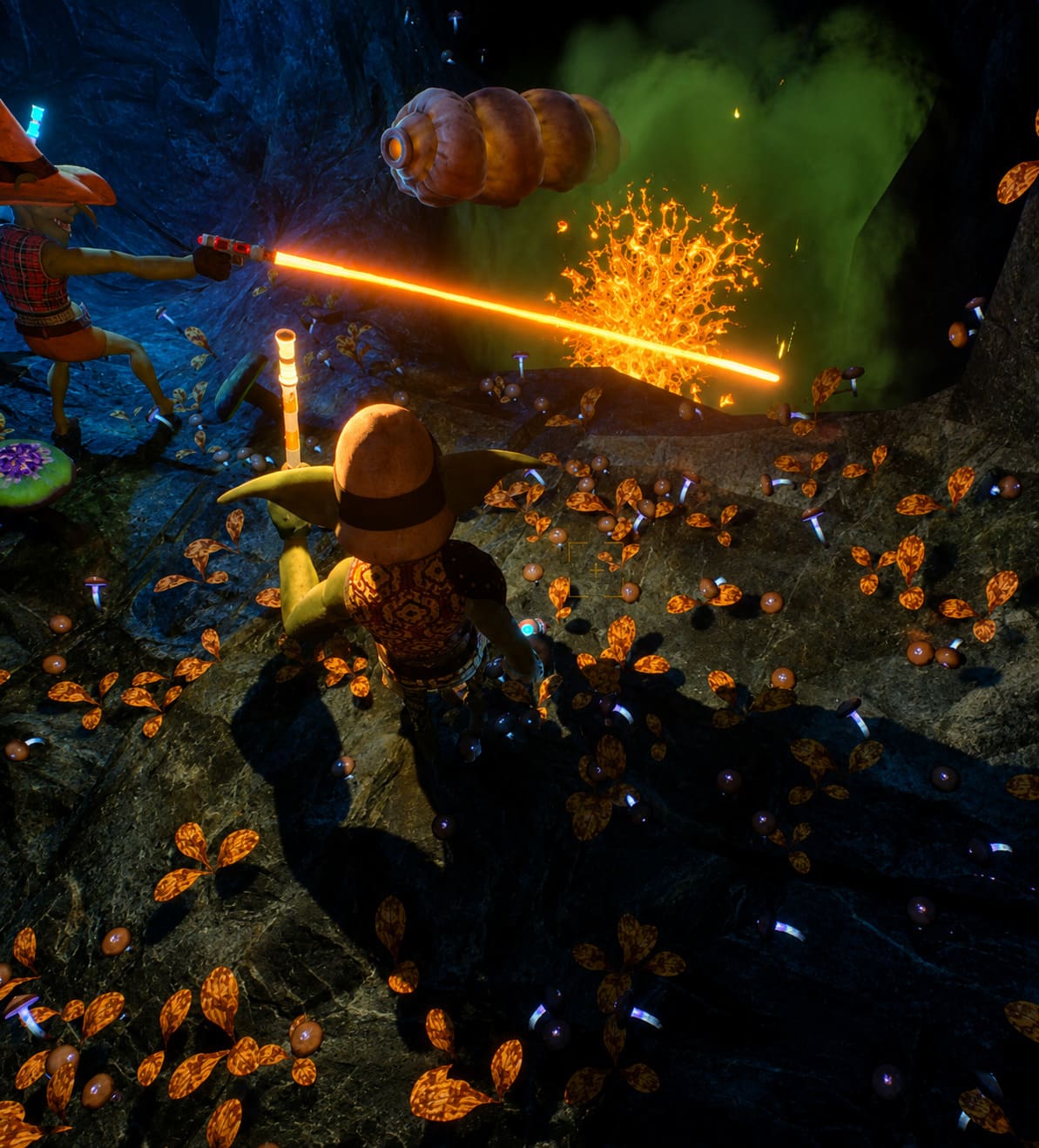
Ancient Caverns
The starting area acts as an excellent introduction to the game’s mechanics.
Resources are relatively easy to obtain, navigation remains manageable, and players can experiment without facing overwhelming punishment.
Crystal Chasm
This is where things become significantly more interesting.
The enormous cavern spaces create new lighting challenges, and vertical exploration becomes a major factor. Visibility becomes both your greatest advantage and your biggest weakness.
I spent more time here than anywhere else because the environment constantly encouraged exploration.
Core Deep
The final region feels appropriately dangerous.
Harder rock formations, increased hazards, and valuable rare materials create a genuine risk-versus-reward dynamic.
By the time you reach this area, the game expects you to fully understand its systems.
And honestly, that’s exactly how endgame content should work.
The Upgrade System Rewards Smart Decisions
Not every upgrade offers equal value.
After dozens of runs, certain improvements consistently delivered the biggest impact.
My Recommended Upgrade Priority
- Drill Efficiency
Faster excavation means quicker access to valuable resources and reduced exposure to danger.
- Energy Capacity
Longer operating times reduce interruptions and improve overall expedition efficiency.
- Movement Enhancements
Mobility becomes increasingly important as cave systems grow larger and more complex.
Investing in these areas first noticeably improves long-term progression.
Cosmetic items are plentiful too, which helps distinguish teammates during chaotic multiplayer sessions.
And trust me, when four goblins are running around in panic during a cave collapse, visual distinction matters.
What Goblin Company Does Better Than Similar Games
After spending significant time with the game, several strengths stand out.
The game excels at:
- Emergent gameplay moments
- Environmental storytelling
- Team coordination
- Risk versus reward decision-making
- Resource transportation systems
- Replayability
Many co-op games rely heavily on scripted encounters.
Goblin Company instead allows chaos to emerge naturally from its systems.
Some of our funniest moments weren’t designed by developers. They happened because someone made a terrible decision that triggered a chain reaction of increasingly ridiculous consequences.
Those unpredictable situations are what keep players coming back.
Gothic 1 Remake Magic Guide: Runes vs Spell Scrolls Explained
Final Verdict: A Hidden Gem Worth Digging Into
Goblin Company may not have the budget or visibility of major AAA releases, but it delivers something many larger games struggle to achieve: memorable experiences.
Every successful mining run feels earned.
Every railway system tells a story.
Every expedition creates new problems that require creative solutions.
Most importantly, the game consistently generates those “you had to be there” moments that define great cooperative gaming.
If you’re a fan of mining adventures, survival mechanics, cooperative strategy, or simply enjoy games that create hilarious disasters on a regular basis, Goblin Company deserves a place on your radar.
It’s challenging without feeling unfair, funny without becoming a parody, and surprisingly deep beneath its goofy goblin exterior.
For me, what started as a curiosity became one of the most enjoyable co-op experiences of the year.
Just remember one thing before heading underground:
Always bring extra torches.
Seriously.
You’re going to need them.