33 Immortals Beginner Guide: A Veteran Gamer’s Take on Surviving the Chaos
If you’ve just stepped into 33 Immortals, the first thing you’ll notice is simple: it’s chaos. After years of playing action RPGs, roguelikes, and MMO-style raids, I can say this game sits in a strange hybrid space where coordination matters more than individual skill, but individual mistakes still get punished instantly.
It feels like trying to survive inside a moving battlefield made of 33 unpredictable players, dozens of enemies, and constant visual overload.
This guide is written from a practical perspective—based on how real runs actually play out after the initial confusion wears off. It’s not theorycrafting. It’s what works when things get messy.
Does Progress Carry Over from Demo in 33 Immortals? My Honest Take After Playing It
Play as a Group or Fail Alone
The most important rule in 33 Immortals is simple: you do not survive alone. The game is built around collective momentum, and splitting off from the group almost always leads to inefficient farming or outright death.
When players stay together, everything improves: damage scales better, enemies melt faster, and co-op systems activate consistently. When players scatter, the run collapses into chaos with no real progress.
What good grouping looks like
- Large packs moving together across objectives
- Focused target elimination instead of random fights
- Shared engagement on elites and bosses
If you find yourself alone for more than a short period, you are already behind the pace of the run.
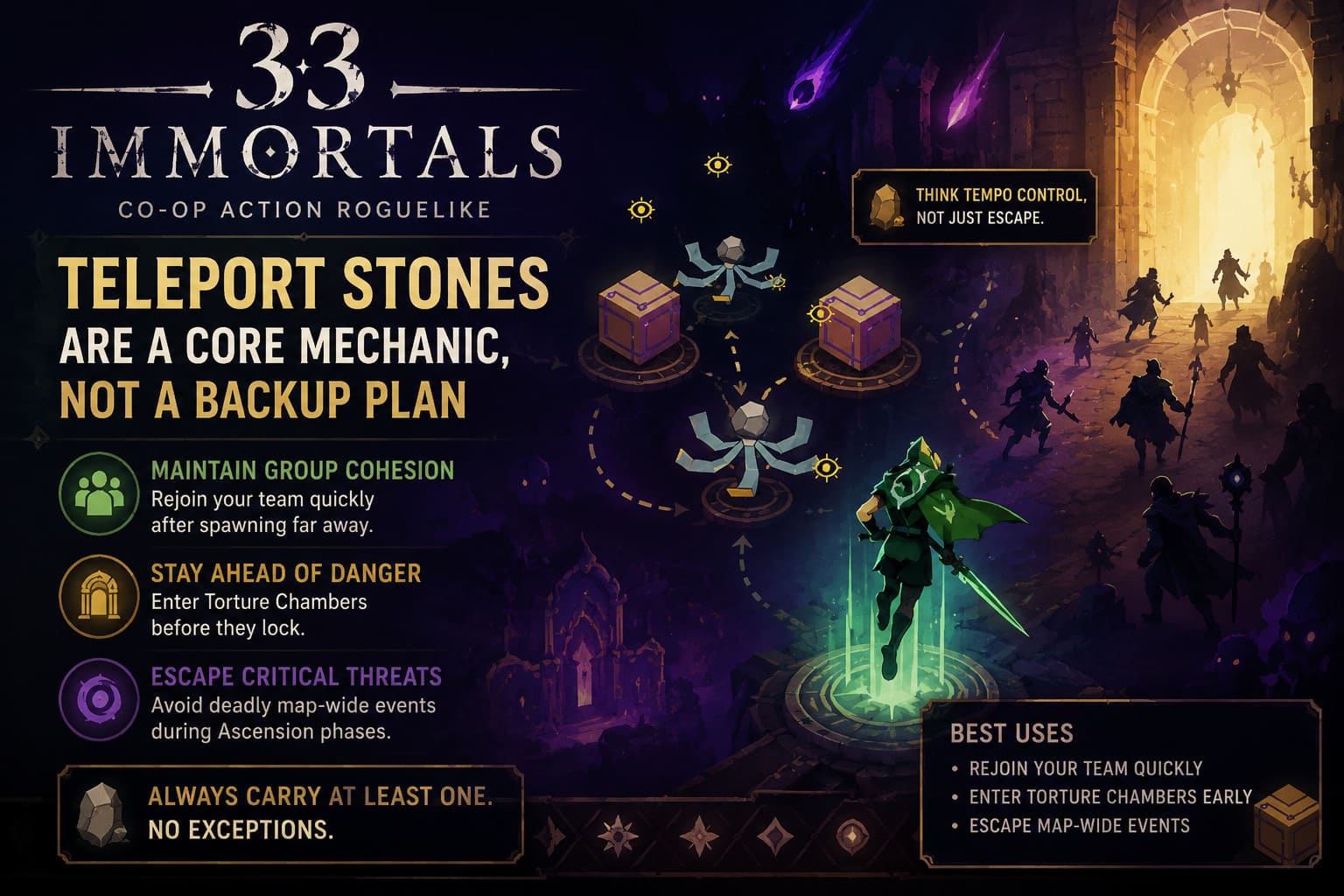
Teleport Stones Are a Core Mechanic, Not a Backup Plan
Many beginners treat Teleport Stones as emergency items, but experienced players use them constantly to control positioning. In reality, they are one of the most important tools for maintaining group cohesion.
You should always carry at least one. No exceptions.
33 Immortals Co-Op Gameplay Guide: A Player’s Take on Team Action, Synergy, and Real Match Flow
Best uses for Teleport Stones
- Rejoining your team quickly after spawning far away
- Entering Torture Chambers before they lock
- Escaping dangerous map-wide events during Ascension phases
Think of them as tempo control rather than escape tools.
Efficient Farming and Upgrade Timing
One of the most common beginner mistakes is overfarming low-value enemies while ignoring upgrade timing. The game rewards efficiency, not constant fighting.
Players collect purple remnants that fill an upgrade meter. Once full, you must immediately cash it in or risk wasting potential progression.
Stat priorities (practical view)
| Stat | Priority | Why it matters |
|---|---|---|
| Attack | High | Speeds up clears and boss damage phases |
| Health | High | Reduces random deaths in chaotic fights |
| Empathy | Medium | Improves co-op scaling and ability uptime |
Efficient players focus on elites, objectives, and group movement instead of endless mob clearing.
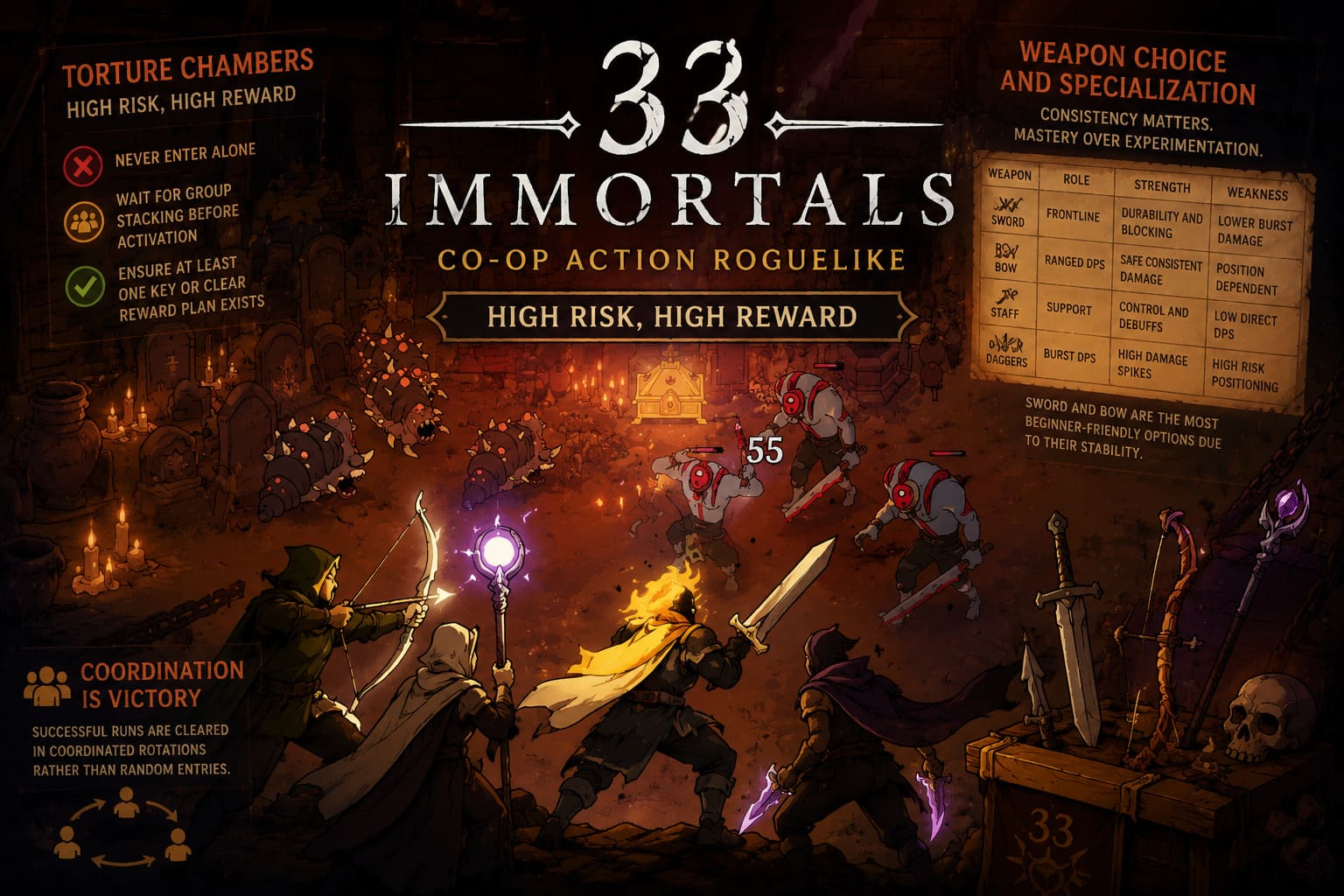
Torture Chambers: High Risk, High Reward
Torture Chambers are one of the strongest progression tools in the game, but also one of the easiest places to lose control of a run.
The mistake most new players make is rushing in without coordination. That almost always ends badly.
How to handle them properly
- Never enter alone
- Wait for group stacking before activation
- Ensure at least one key or clear reward plan exists
In successful runs, chambers are cleared in coordinated rotations rather than random entries.
Weapon Choice and Specialization
Weapon swapping might seem appealing at first, but consistency matters more. The game rewards mastery over experimentation in early progression.
Weapon overview
| Weapon | Role | Strength | Weakness |
|---|---|---|---|
| Sword | Frontline | Durability and blocking | Lower burst damage |
| Bow | Ranged DPS | Safe consistent damage | Position dependent |
| Staff | Support | Control and debuffs | Low direct DPS |
| Daggers | Burst DPS | High damage spikes | High risk positioning |
From experience, Sword and Bow are the most beginner-friendly options because they offer stability in unpredictable fights.
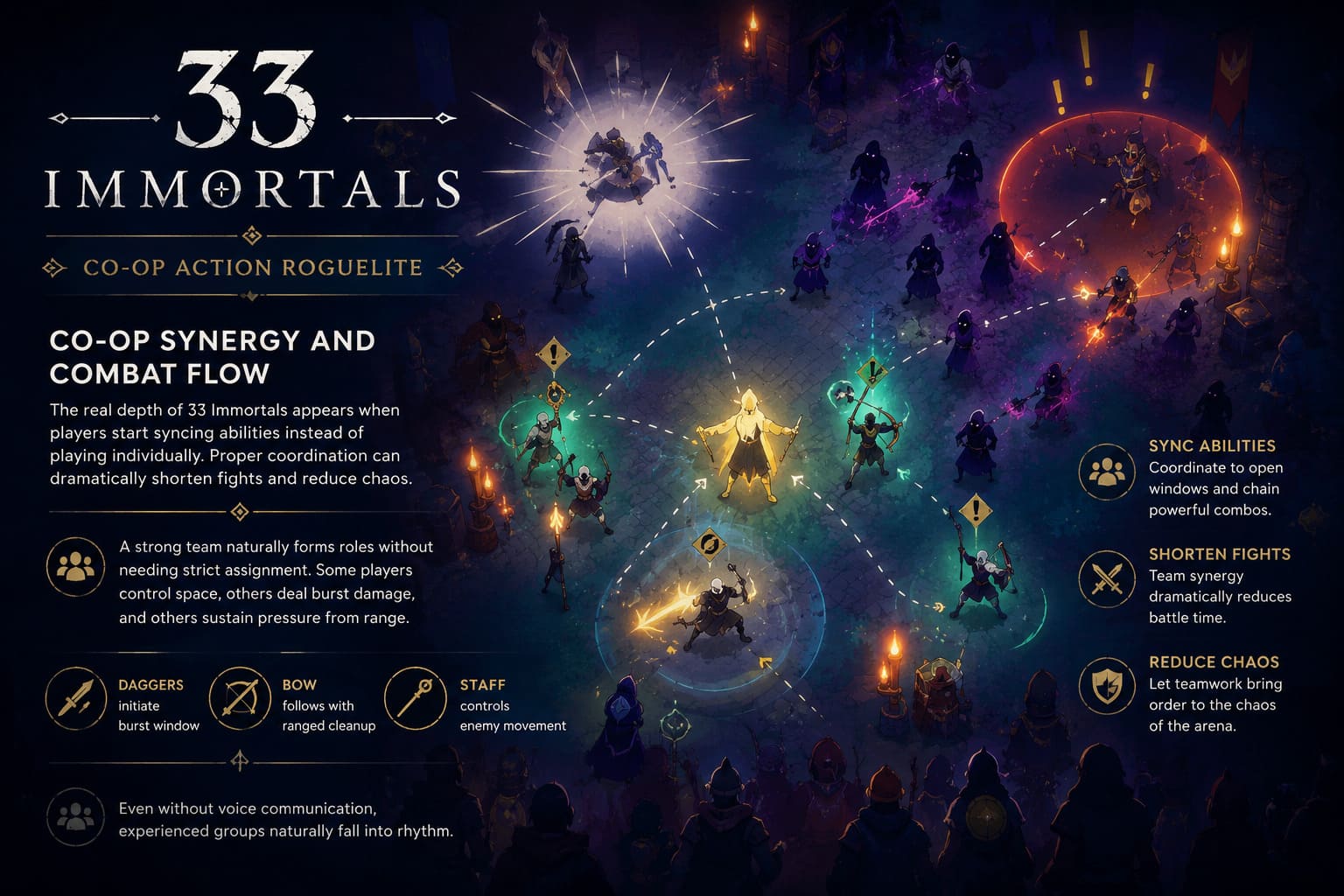
Co-op Synergy and Combat Flow
The real depth of 33 Immortals appears when players start syncing abilities instead of playing individually. Proper coordination can dramatically shorten fights and reduce chaos.
A strong team naturally forms roles without needing strict assignment. Some players control space, others deal burst damage, and others sustain pressure from range.
Simple synergy example
- Daggers initiate burst window
- Bow follows with ranged cleanup
- Staff controls enemy movement
Even without voice communication, experienced groups naturally fall into rhythm.
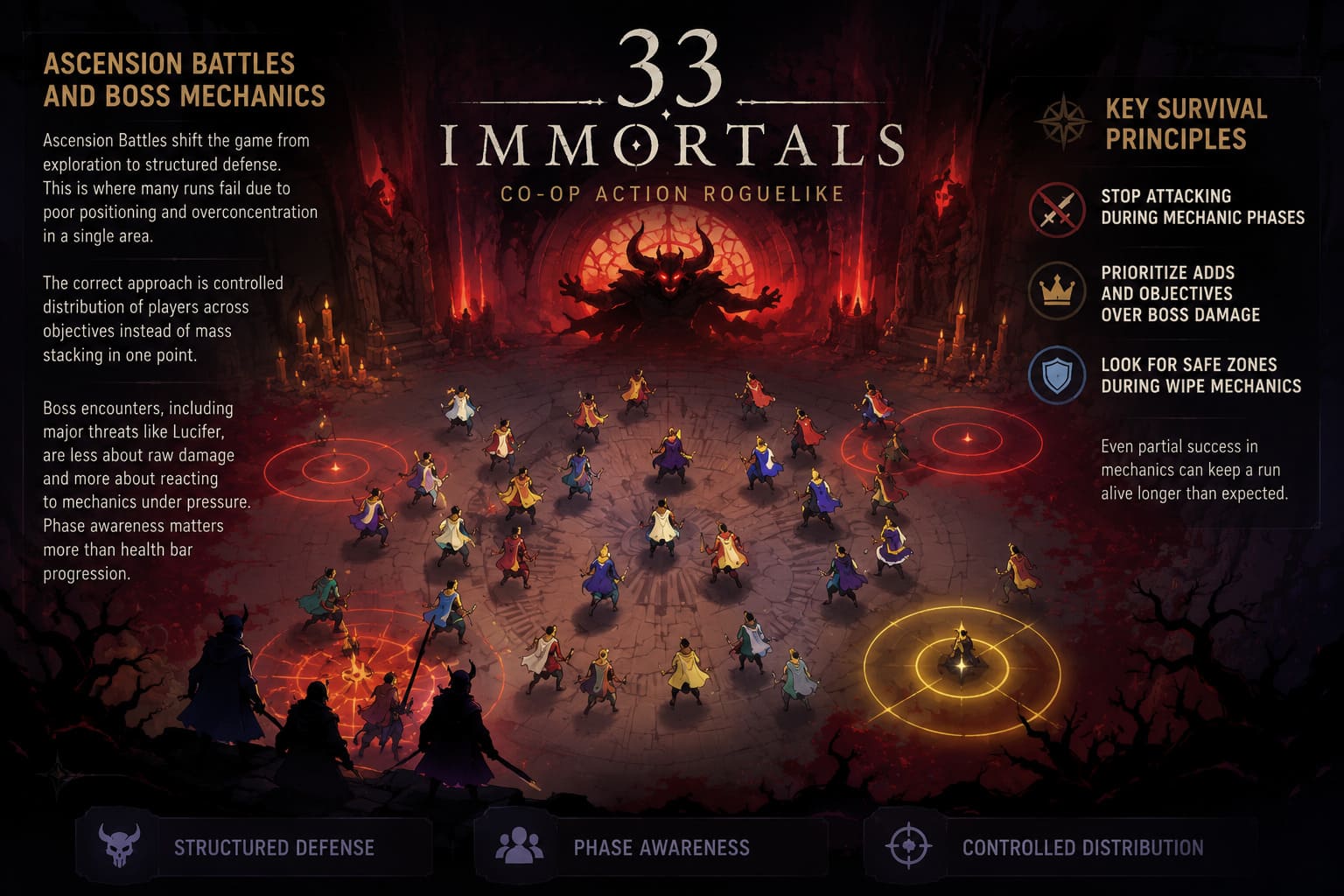
Ascension Battles and Boss Mechanics
Ascension Battles shift the game from exploration to structured defense. This is where many runs fail due to poor positioning and overconcentration in a single area.
The correct approach is controlled distribution of players across objectives instead of mass stacking in one point.
Boss encounters, including major threats like Lucifer, are less about raw damage and more about reacting to mechanics under pressure. Phase awareness matters more than health bar progression.
Key survival principles
- Stop attacking during mechanic phases
- Prioritize adds and objectives over boss damage
- Look for safe zones during wipe mechanics
Even partial success in mechanics can keep a run alive longer than expected.
Final Thoughts
33 Immortals is not a game where individual skill alone carries you. It is a game about awareness, positioning, and adapting to the flow of 33 players acting at once.
The biggest shift happens when you stop trying to control everything and start playing as part of a system. Once that clicks, runs become less chaotic and more readable.
Success ultimately comes down to one idea: being in the right place with the right group at the right time matters more than anything else.