Forza Horizon 6 Time Attack Guide: Best Circuits, Car Builds, and Pro Driving Lines
Time Attack in Forza Horizon 6 is where I actually feel like I’m playing the game at its highest level. Everything else in the open world can get chaotic, but Rivals mode strips it down to something pure: you, the track, and a stopwatch that doesn’t care about excuses.
I’ve sunk way too many hours into chasing ghosts, restarting perfect laps because of one sloppy corner, and trying to understand where exactly those missing tenths disappear to. It’s frustrating, but that’s also why it’s addictive.

What I’ve learned over time is that speed alone doesn’t matter nearly as much as consistency. Anyone can build a fast car or hit a lucky lap, but Time Attack is about reproducing perfection again and again. That means understanding how the physics behave, how each circuit flows, and how your car reacts when you push it beyond comfort.
Forza Horizon 6 PC Optimization Guide: Best Settings for Smooth FPS
Building a Proper Time Attack Car
A Time Attack build is not the same as an online race build. I stopped treating them like the same thing after realizing I was losing time in corners just to gain speed I never actually used. In this mode, corners are everything.
Core principles I always follow
Weight reduction is always the first priority. A lighter car rotates faster, brakes shorter, and recovers from mistakes more easily. After that, I focus on grip rather than horsepower. Power only matters when you can consistently exit corners cleanly, otherwise it just turns into wheelspin and wasted time.
Drivetrain choice depends heavily on circuit layout. AWD helps massively on tight exits and technical sections, while RWD tends to shine on flowing tracks where momentum matters more than traction. Downforce is another area where most players hesitate, but I don’t. I’d rather sacrifice top speed than lose stability in fast corners.
My general build priorities
In most setups, I follow a consistent order: reduce weight, improve grip, tune suspension, then adjust power if needed. The goal is not maximum stats—it’s predictable behavior at the limit.
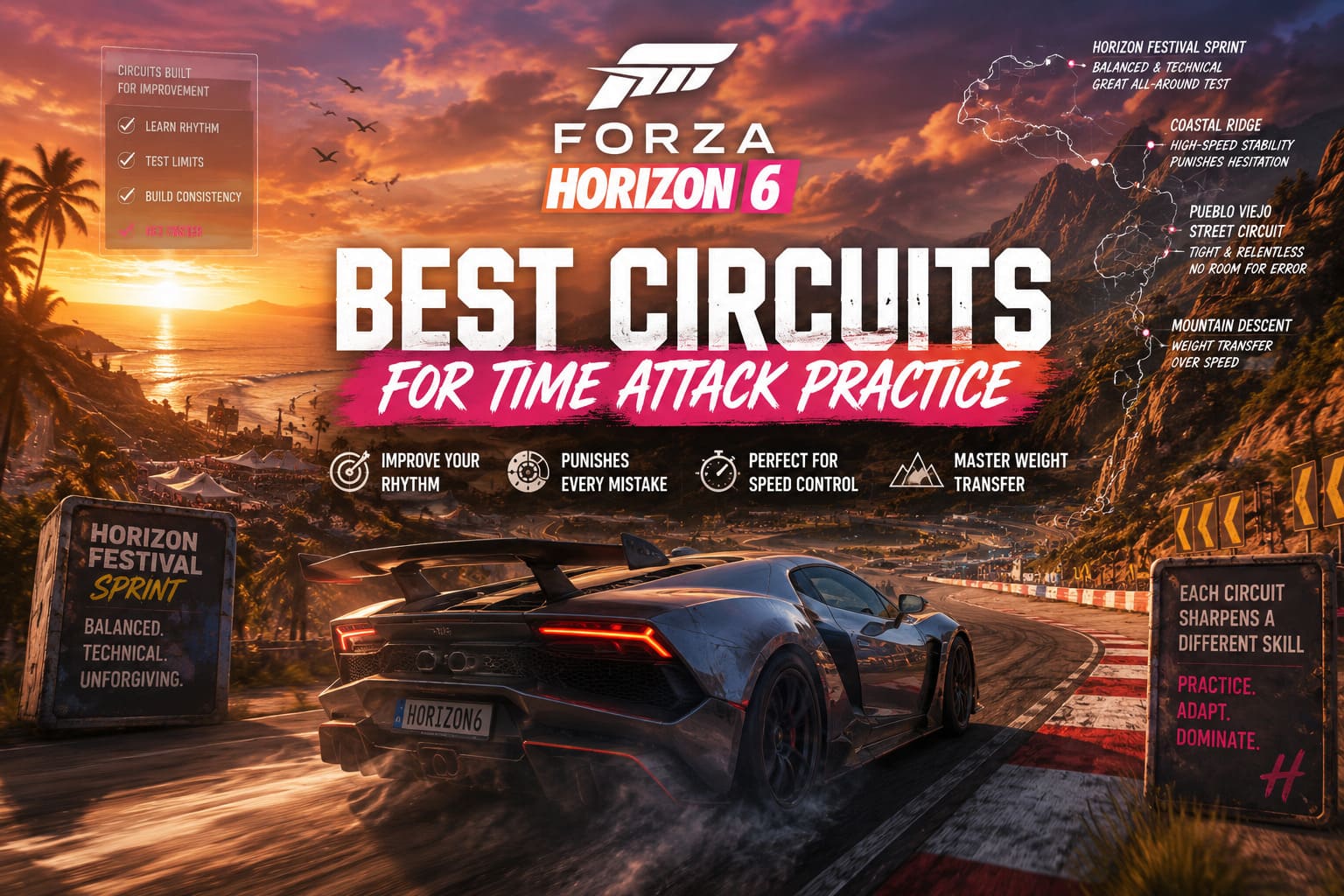
Best Circuits for Time Attack Practice
Over time, I’ve found that not all tracks are equally useful for improvement. Some are great for learning rhythm, others punish every mistake, and a few are perfect for testing pure speed control.
Circuit breakdown from my experience
The Horizon Festival Sprint is my default testing ground. It’s balanced, technical, and exposes weaknesses in both tuning and driving style. Coastal Ridge is where I test aerodynamic stability at high speed, especially long sweeping corners that punish hesitation.
Pueblo Viejo Street Circuit is probably the most punishing of the bunch. Tight corners, barriers everywhere, and no margin for error. If your braking points are off even slightly, the lap is basically dead. Mountain Descent is a different kind of challenge entirely. It’s less about speed and more about control under constant weight transfer downhill.
What each circuit teaches
Each track improves a different skill. Technical circuits improve braking discipline, high-speed circuits improve stability, street circuits punish inconsistency, and downhill runs force you to understand weight transfer at a deeper level.
Tuning for Real Lap Time Gains
I stopped trusting generic tunes a long time ago. The difference between a good setup and a great one is usually subtle, but it shows up in consistency over multiple laps.
Path of Exile 2 King in the Mist Guide: Spirit Rescue and Endgame Farming Strategy
Tire and alignment setup
Tire pressure is one of the most underrated adjustments. Too high and you lose grip, too low and the car becomes sluggish. I adjust based on feel after a few laps rather than sticking to fixed values.
Camber settings are another area where less is often more. Too much negative camber improves cornering grip but destroys exit speed, which is often more important in Time Attack than entry speed.
Differential tuning approach
Differential tuning is where the car really starts to feel alive. I prefer setups that allow rotation without forcing instability. AWD cars benefit from rear bias to avoid understeer, while RWD setups need balance to prevent excessive wheelspin out of corners.

Driving Techniques That Actually Matter
After hundreds of laps, I stopped focusing on raw speed and started focusing on rhythm. That changed everything. Time Attack is less about aggression and more about control under pressure.
Braking discipline
Braking consistency is the foundation of every fast lap. If braking points shift even slightly between corners, everything downstream becomes unstable. I treat braking markers like fixed reference points that I never compromise.
Throttle control as steering
One of the biggest breakthroughs for me was realizing that throttle input is just as important as steering input. Lifting slightly can tighten your line, holding steady keeps the car balanced, and smooth reapplication ensures clean exits without spinning tires.
Ghost cars and mental focus
Rivals ghosts are helpful but dangerous. It’s easy to get distracted chasing someone else’s line instead of trusting your own rhythm. I use ghosts as reference points, not instructions.
Driving Styles by Circuit Type
Different tracks demand completely different mindsets. Treating every circuit the same is the fastest way to plateau.
General approach I use
Technical circuits reward patience and exit speed. High-speed circuits reward early commitment and stability. Street circuits punish mistakes heavily, so survival becomes part of performance. Mountain routes require patience and control over bravery.
What Actually Improved My Lap Times
It wasn’t a single tuning trick or meta car build that made me faster. It was repetition with structure. I started breaking sessions into warm-up laps, push laps, and cooldown laps focused only on consistency. That alone improved my times more than constant setup changes ever did.
Consistency beats experimentation when you’re chasing milliseconds. Once you stop constantly changing everything and start refining your driving instead, progress becomes much more noticeable.
Final Thoughts
Time Attack in Forza Horizon 6 is one of those modes that never really ends. There’s always another tenth of a second hiding somewhere, another corner that can be taken cleaner, another braking point that can be refined. That’s what makes it so engaging over time.
The real key isn’t finding a perfect setup or copying the fastest ghost. It’s building familiarity with the track until your driving becomes instinctive. Once that happens, lap times stop feeling forced and start feeling natural.
Pick a circuit, stick with it longer than you think you should, and focus on consistency over constant change. That’s where real improvement starts.