DragonSword Awakening Roadmap 2026: Content Updates, New Heroes, and Gacha-Free Transition Explained
When I first heard that DragonSword: Awakening was abandoning its original live-service direction, I honestly expected another troubled project trying to survive after a difficult launch. We’ve seen plenty of games promise a “fresh start” only to repeat the same mistakes under a different business model.
After following the developer updates, community discussions, and the official roadmap, I came away with a completely different impression.
Instead of simply removing gacha mechanics, Hound13 appears to be rebuilding the game’s identity around something many action RPG fans have wanted for years: a premium adventure where unlocking heroes actually feels rewarding rather than dependent on luck or expensive pulls.
The roadmap released after the global Steam launch on July 23, 2026 makes one thing very clear—the developers aren’t treating launch day as the finish line. They’re planning to expand DragonSword: Awakening throughout the rest of 2026 with new playable heroes, gameplay improvements, quality-of-life features, and additional story content while keeping the core experience free from pay-to-win mechanics.
A Rare Success Story: Walking Away From Gacha
One of the biggest reasons DragonSword: Awakening caught my attention isn’t its flashy combat or beautiful anime-inspired world.
It’s the story behind the game itself.
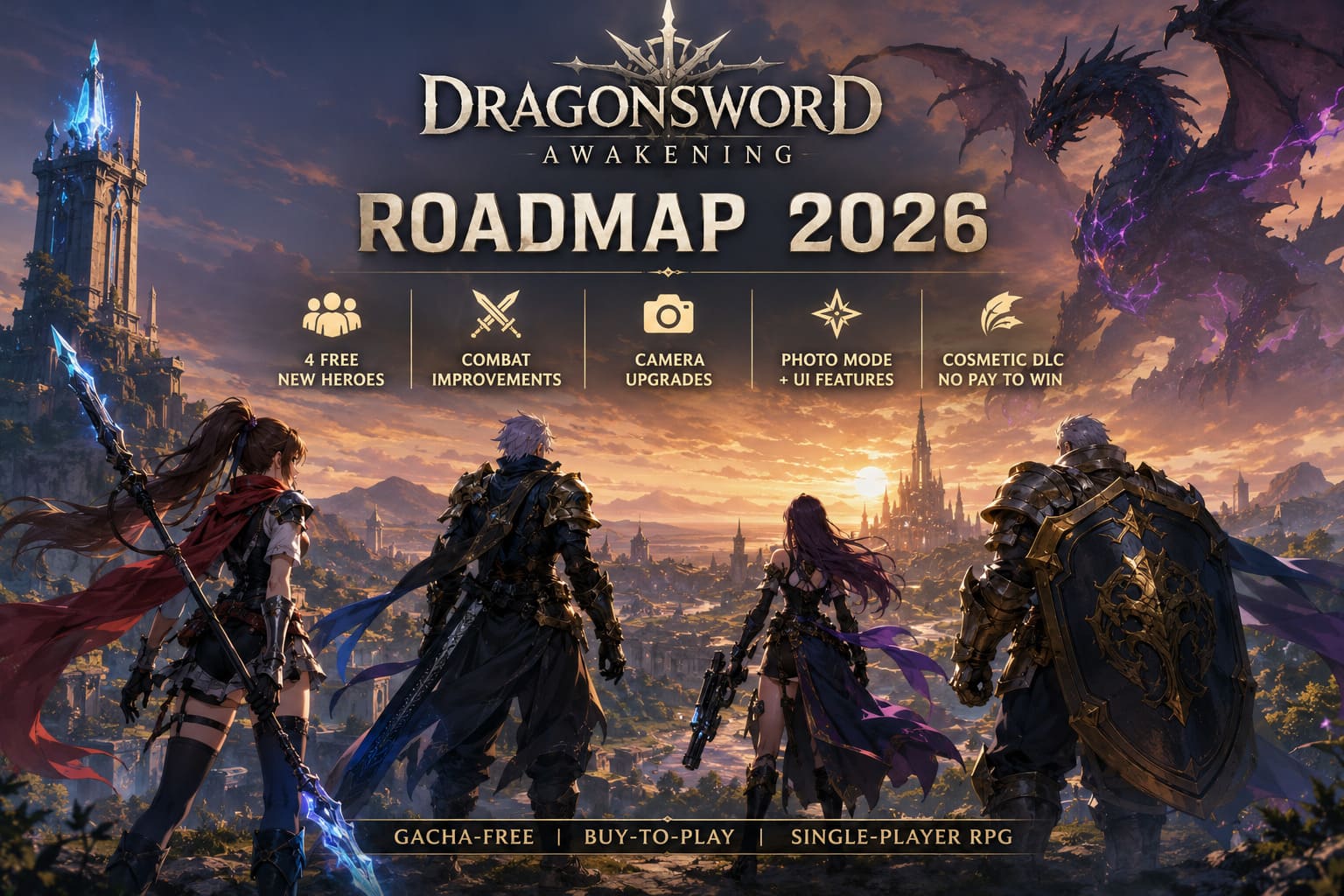
Originally designed as a mobile live-service RPG, the project went through a dramatic transformation after Hound13 separated from its previous publishing arrangement. Rather than trying to squeeze microtransactions into every system, the studio made the bold decision to release DragonSword: Awakening as a buy-to-play single-player RPG.
For me, that’s one of the smartest decisions they could have made.
Players are becoming increasingly tired of progression systems that lock characters behind random banners or require constant spending just to stay competitive. DragonSword instead rewards exploration, story progression, and gameplay.
That alone gives the game a much stronger identity than many of its competitors.
Why the New Roadmap Actually Feels Exciting
Many developers publish roadmaps full of vague promises.
DragonSword: Awakening’s late-2026 roadmap is surprisingly concrete.
Instead of teasing mysterious “future content,” Hound13 already confirmed four entirely new playable heroes, several combat improvements, camera upgrades, interface additions, and long-term support plans.
Here’s a quick overview.
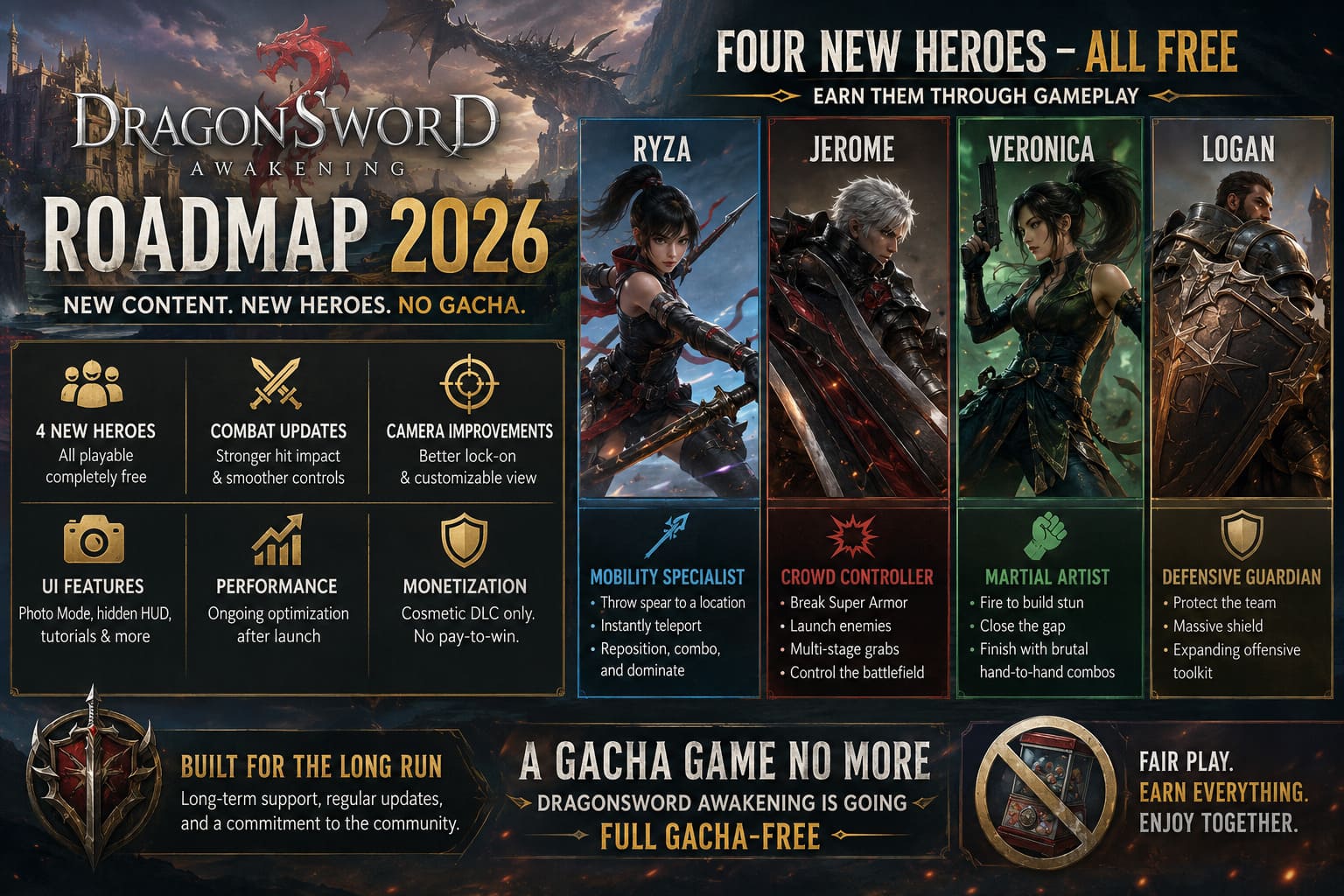
| Roadmap Feature | What Players Can Expect |
|---|---|
| New Heroes | Four free playable characters. |
| Combat Updates | Better hit impact and smoother controls. |
| Camera Improvements | Enhanced lock-on and customizable camera. |
| UI Features | Photo Mode, hidden HUD, tutorials. |
| Performance | Continued optimization after launch. |
| Monetization | Cosmetic DLC only with no pay-to-win elements. |
For an action RPG launching in 2026, that’s a healthy amount of planned content.
Four Free Heroes Are Coming
Perhaps the biggest surprise is that every announced hero will be completely free.
Considering DragonSword originally belonged to the gacha genre, this feels almost refreshing.
Rather than charging players for every new character, Hound13 plans to integrate each newcomer directly into the game’s progression.
Ryza Brings Fast-Paced Mobility
Ryza looks like the character I’ll probably spend the most time playing.
Her spear isn’t just a weapon.
It’s also a movement tool.
She throws it across the battlefield before instantly teleporting to its location, creating incredibly fluid combat opportunities.
That mechanic should allow players to:
- Instantly reposition during boss fights.
- Chain aerial combos more efficiently.
- Escape dangerous attacks.
- Maintain constant offensive pressure.
Fast movement always makes action RPG combat feel more satisfying, and Ryza seems built entirely around momentum.
Jerome Adds True Crowd Control
Jerome immediately stands out because of the contrast between his appearance and his weapon.
Despite his smaller frame, he swings an enormous greatsword capable of breaking enemy defenses.
What interests me most isn’t his damage.
It’s his focus on controlling battles.
His toolkit revolves around:
- Breaking Super Armor.
- Launching enemies.
- Multi-stage grab attacks.
- Positioning larger opponents.
That’s something DragonSword’s launch roster was noticeably missing.
Veronica Answers Community Feedback
I always appreciate when developers actually listen instead of simply pretending to.
According to Hound13, Veronica exists largely because players wanted a dedicated martial arts fighter.
She’s an unusual hybrid.
She combines firearms with close-range hand-to-hand combat.
The combat loop sounds particularly satisfying:
- Fire ranged attacks to build stun.
- Close the distance.
- Finish enemies with martial arts combos.
That combination should create a much more aggressive playstyle compared to traditional ranged characters.
Logan Could Become the Team’s Best Defender
Every RPG needs someone willing to stand in front of giant monsters.
That’s Logan.
His oversized shield makes him the defensive specialist of the roster, but Hound13 has already acknowledged they don’t want him to feel boring.
Developers mentioned they’re continuing to expand his offensive toolkit before release.
If they manage to balance offense with defense, Logan could become much more than just another tank.
Combat Improvements Matter Just as Much
New heroes are exciting.
But what impressed me more were the improvements coming to the combat system itself.
After gathering player feedback from demos and launch impressions, Hound13 is refining nearly every aspect of how combat feels.
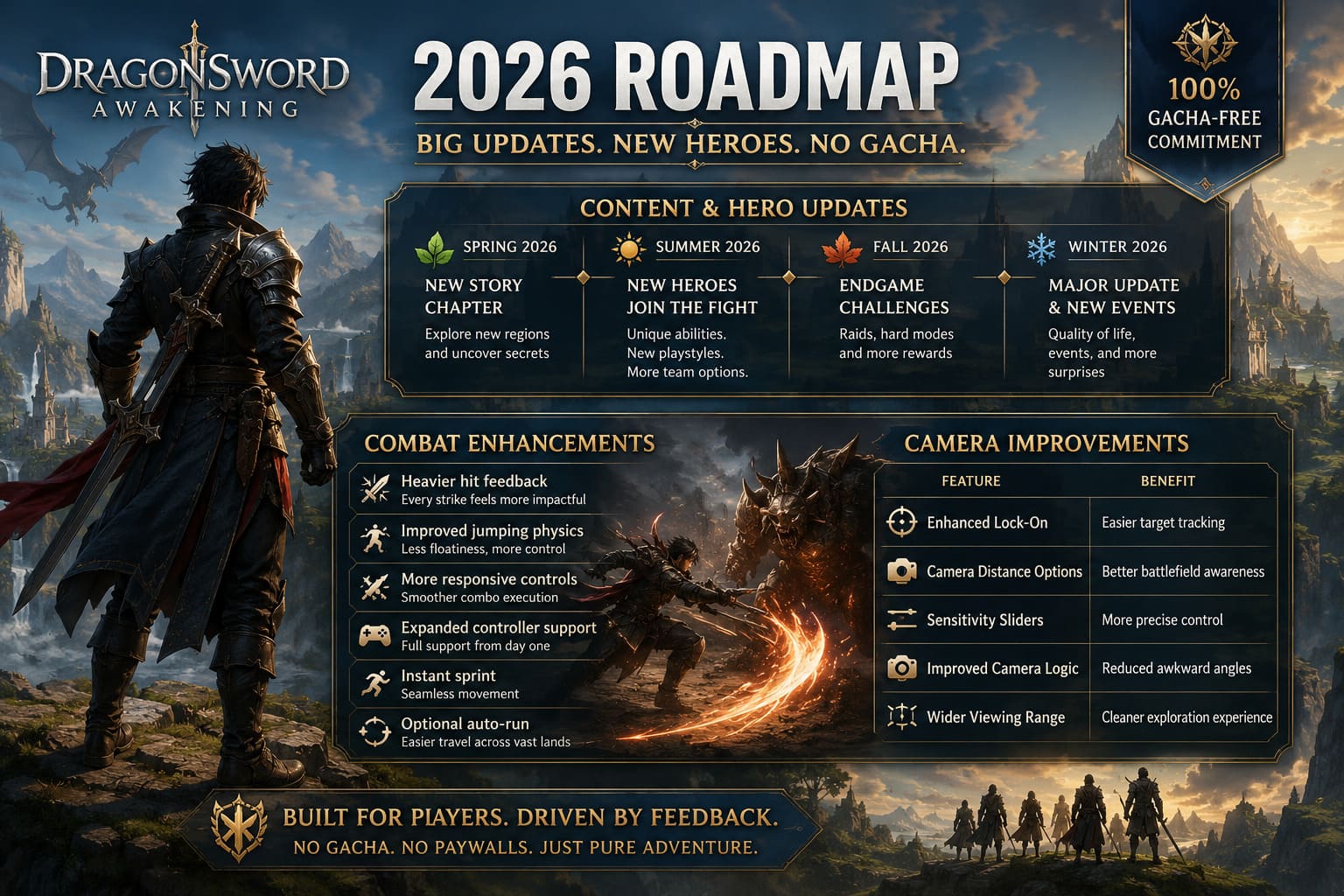
Some of the biggest upgrades include:
- Heavier attack feedback that makes every hit feel more impactful.
- Improved jumping physics to reduce floatiness.
- More responsive controls during fast combo chains.
- Expanded controller support from day one.
- Instant sprint functionality for smoother exploration.
- Optional auto-run settings for traveling across larger environments.
None of these changes sound revolutionary individually.
Together, however, they significantly improve the overall experience.
Small adjustments often make the biggest difference in action games.
Better Camera Controls Were Absolutely Needed
Camera systems rarely receive much attention until they become frustrating.
Anyone who enjoys fast-paced action games knows how quickly poor camera behavior can ruin difficult boss fights.
Thankfully, DragonSword: Awakening is addressing this early.
The roadmap confirms improvements including:
| Feature | Benefit |
|---|---|
| Enhanced Lock-On | Easier target tracking. |
| Camera Distance Options | Better battlefield awareness. |
| Sensitivity Sliders | More precise control. |
| Improved Camera Logic | Reduced awkward angles. |
| Wider Viewing Range | Cleaner exploration experience. |
For players using controllers, these improvements may become some of the most appreciated changes after launch.
Photo Mode Is More Important Than People Think
Open-world RPGs often create incredible environments.
Unfortunately, players don’t always have good tools to capture them.
DragonSword: Awakening plans to solve that by introducing a dedicated Photo Mode alongside options to completely hide the interface.
It’s a small feature on paper.
In reality, games with attractive worlds benefit enormously from players sharing screenshots online.
That kind of organic community marketing often becomes more valuable than traditional advertising.
A Monetization Model I Actually Respect
Modern RPGs constantly walk a fine line between supporting development and annoying players.
DragonSword’s solution feels surprisingly reasonable.
Instead of selling power, Hound13 focuses on Familiars—small magical companions that accompany players throughout Orbis.
At launch, roughly thirty Familiars are available.
The important detail is how they’re distributed.
| Familiar Content | Availability |
|---|---|
| Most Familiars | Earned naturally through gameplay. |
| Deluxe Companion | Cosmetic bonus. |
| DLC Familiars | Cosmetic only. |
| Gameplay Bonuses | None. |
That’s exactly how cosmetic DLC should work.
Buying an optional companion changes appearance—not combat effectiveness.
No hidden stat boosts.
No exclusive gameplay advantages.
No pressure to spend money simply to remain competitive.
As someone who’s watched countless RPGs become overloaded with monetization systems, this approach feels refreshing.
DragonSword Awakening: How to Defeat the Reawakened Dragon Final Boss (Complete Guide)
Can DragonSword Stay Relevant?
That’s probably the biggest question moving into 2027.
Launching without recurring gacha revenue isn’t easy.
However, premium RPGs succeed when developers consistently deliver meaningful updates.
Looking at everything Hound13 has planned:
- Four free heroes.
- Gameplay improvements.
- Technical optimization.
- Additional customization.
- Cosmetic-only DLC.
The roadmap suggests they’re investing in player goodwill rather than short-term profits.
Whether that strategy proves financially successful remains to be seen, but from a player’s perspective it’s difficult to argue against it.
DragonSword Awakening: How to Claim Free Abyssal Direwolf Familiar DLC (Complete Guide)
Final Thoughts
After spending time following DragonSword: Awakening’s development, I think the game’s greatest strength isn’t its visuals or even its combat.
It’s the philosophy behind it.
Hound13 had every opportunity to continue chasing the endless cycle of banners, premium currencies, and limited-time character pulls that dominate so many anime RPGs today.
Instead, the studio chose something riskier.
They trusted players would rather buy a complete game than constantly pay for pieces of one.
The late-2026 roadmap reinforces that philosophy by delivering substantial free content instead of locking major gameplay additions behind expensive monetization.
If Hound13 continues supporting DragonSword: Awakening with the same player-first mindset shown in this roadmap, I genuinely believe it has the potential to become one of the standout open-world action RPGs of this generation—not because it’s trying to imitate the biggest names in the genre, but because it’s finally doing something many fans have been asking for all along: letting the adventure, the characters, and the combat take center stage instead of the cash shop.