Diablo 4 Living Steel Farming Guide: How to Get Living Steel Fast (2026 Meta)
If there is one thing I have learned from grinding Diablo 4’s endgame, it is that boss materials can become a bigger time sink than the bosses themselves. You can have a ridiculous build, delete elites in seconds, and still spend half your evening wondering where all the Living Steel went.
Living Steel is tied directly to Grigoire, The Galvanic Saint, making Helltides one of the most important activities if you’re building toward targeted endgame loot. Blizzard originally introduced Living Steel as the Helltide material for Grigoire, and the material has remained closely connected to his loot progression through later system changes.
I’ve spent enough time running Helltides to realize that the difference between a good Living Steel farm and a bad one isn’t simply how quickly you kill monsters. Your route, Cinder management, timing, and willingness to move between activities matter just as much.
So here is the way I’d approach Living Steel farming in Diablo 4 in 2026, with the focus firmly on efficiency rather than turning the game into a second job.
Why Living Steel Still Matters
Living Steel is associated with Grigoire, whose lair is the Hall of the Penitent. In the current endgame system, Living Steel is also used as a Lair Boss key material, while Blizzard’s later boss-system changes moved the emphasis toward boss keys and individual Hoard rewards.
That makes Living Steel valuable for players who are already farming bosses rather than simply leveling a character.
The important part is that you don’t want to treat Living Steel as something you casually accumulate. If you’re targeting Grigoire, your Helltide sessions should be built around producing boss materials as efficiently as possible.

Quick Living Steel Reference
| Activity | What You’re Looking For |
|---|---|
| Helltide | Primary Living Steel farming |
| Tortured Gift of Living Steel | 275 Aberrant Cinders |
| Blood Maiden | High-density Helltide combat and extra rewards |
| Whispers | Supplemental boss-material income |
| Grigoire | Converts your farming effort into targeted boss progression |
| Party Farming | Faster clearing and more efficient boss rotations |
Helltides Are Still the Core of the Farm
If I’m specifically sitting down to farm Living Steel, Helltide is where I start.
The reason is simple: Helltide combines monster density, events, Cinders, chests, elites and other rewards into one activity. You aren’t forced to spend your entire session doing one repetitive action.
The basic loop looks like this:
Enter Helltide → collect Cinders → find Living Steel chest → open it → continue farming → repeat.
Living Steel chests cost 275 Aberrant Cinders, so the entire game becomes a race toward that number.
The mistake I see players make is wandering around Helltide without a plan. Killing everything you see feels productive, but if you’re constantly riding between low-density packs, you’re wasting the biggest advantage Helltide gives you: concentrated enemies and events.
I would rather spend ten minutes inside a dense event area than fifteen minutes riding across the map looking for isolated packs.
My Preferred Helltide Farming Loop
When I load into a Helltide specifically for Living Steel, I use a simple priority system.
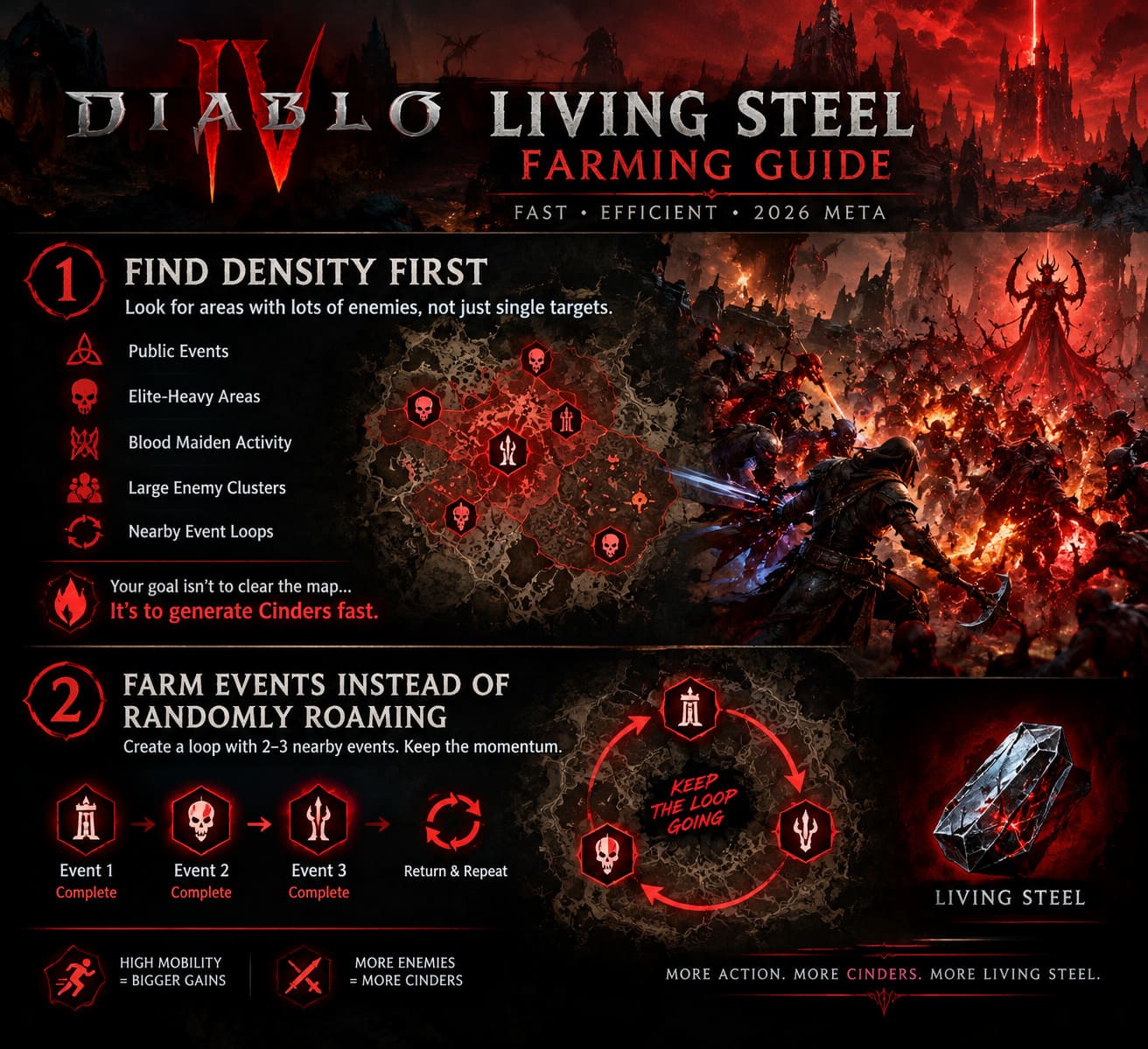
1. Find Density First
Don’t obsess over individual monsters.
- Public events
- Elite-heavy areas
- Blood Maiden activity
- Large enemy clusters
- Nearby event loops
Your objective isn’t to make the map 100% dead. Your objective is to generate Cinders quickly.
A high-mobility build makes a huge difference here. Anything capable of deleting large groups while moving quickly feels dramatically better than a slow single-target build.
2. Farm Events Instead of Randomly Roaming
This is probably the biggest practical improvement you can make.
Once you find two or three events relatively close together, create your own little circuit.
Complete one → move to the next → clear it → return to the first area → repeat.
This gives you a predictable source of enemies and keeps downtime low.
And personally, this is much more enjoyable than endlessly riding through empty sections of Sanctuary. Diablo 4 is at its best when the screen is exploding with enemies and your build is constantly doing something.
Blood Maiden Can Make the Farm Feel Completely Different
The Blood Maiden is one of the reasons modern Helltide farming can feel much faster than simply wandering through the zone.
When players repeatedly activate the ritual, you get a concentrated combat encounter with plenty happening around you. Current Helltide documentation describes Blood Maiden as a summonable boss that rewards Cinders and other useful loot, making the ritual area a natural farming hotspot.
If other players are already there, stay there.
This is one of those situations where Diablo 4’s shared-world design actually works in your favor.
You get:
- Constant enemy spawns
- Multiple players contributing damage
- Very little travel time
- Frequent combat
- Cinders from dense encounters
- Additional loot while you farm
Instead of thinking of Blood Maiden as something you visit once, think of the ritual area as a temporary farming station.
If the group is active and killing quickly, I would rather farm there than ride around the entire Helltide looking for random packs.
Don’t Waste Your Cinders
This sounds obvious, but it is surprisingly easy to mess up.
You have a large pile of Cinders. You are feeling powerful. You see a chest. You open it.
Then ten minutes later you realize you could have opened a Living Steel chest instead.
If your objective is specifically Living Steel, your Cinders should have a clear purpose.
The Living Steel chest costs 275 Cinders, and current references continue to identify it as the dedicated Helltide chest for this material.
That doesn’t mean every other Helltide chest is worthless. Diablo 4’s loot economy has enough moving parts that Mystery chests, gear rewards and other activities can still make sense depending on what you’re farming.
But if your question is:
“I need Living Steel as quickly as possible.”
Then I would prioritize the Living Steel chest rather than spending Cinders randomly.
The Clock Matters More Than People Think
There is another part of Helltide farming that experienced players should pay attention to: the timing of chest rotations and Helltide resets.
Helltides operate on a fixed event cycle, and the exact chest availability can change during the event. Because of that, I recommend checking the clock before committing to a route instead of blindly assuming that the chest you saw five minutes ago will remain your best target.
The exact mechanics have changed across Diablo 4’s seasons and system updates, so I would not build your entire 2026 strategy around old seasonal guides claiming a particular chest-reset trick without checking the current Helltide state. Current guides confirm that Living Steel chest locations and active chest availability vary by Helltide zone.
That distinction matters.
Old Diablo 4 farming tricks age quickly.
The general principle, however, remains excellent: know where the active chests are before you start spending your Cinders.
Why I Like Kehjistan for Route Planning
Kehjistan deserves special attention when you’re planning a Living Steel route because it has a large number of possible Living Steel chest locations.
Current location references list 18 possible Living Steel chest locations in Kehjistan, compared with 12 in Fractured Peaks, 10 in Scosglen, 12 in Dry Steppes, 12 in Hawezar and 9 in Nahantu. These are possible locations, not a guarantee that every location is active simultaneously.
That’s an important distinction from some older farming guides.
So I wouldn’t tell you to blindly assume that Kehjistan always produces a specific number of Living Steel chests. Instead, I’d use it as a route-friendly region where having the location information available can save travel time.
And that is really what matters.
Five seconds spent checking a map is nothing.
Five minutes riding around Sanctuary because you don’t know where you’re going? That’s an entire farming cycle disappearing.
Don’t Forget the Threat System
Helltide isn’t only about events.
As you kill enemies, your Threat increases. Higher Threat creates increasingly dangerous encounters and can eventually trigger Hellborne enemies.
From a Living Steel farming perspective, this is useful because danger and efficiency can work together.
If you’re strong enough to handle the enemies comfortably, don’t deliberately slow your pace just because your Threat is getting high.
Keep killing.
Keep moving.
Keep collecting.
The only time I start playing more conservatively is when my Cinder total becomes significant and I’m far away from a chest.
Why?
Because dying in Helltide can cost you half of your accumulated Cinders.
And losing half an hour’s farming because you got greedy is one of the worst feelings in Diablo 4.
Solo vs Group Farming
This is where I personally prefer playing with other people.
Solo farming gives you complete control over your route, but group Helltide activity can create much higher enemy density around popular farming locations.
If you’re playing with friends, you can also coordinate event movement and boss rotations afterward.
The bigger advantage comes once you have enough materials for repeated boss runs.
Instead of spending all your Living Steel on one isolated Grigoire attempt, look for a proper rotation group.
The idea is straightforward: everyone contributes materials and everyone receives the appropriate boss rewards from their own participation.
Blizzard has changed how Lair Boss rewards work in groups, including systems where each player needs to use their own Lair Boss key to open the Hoard.
That means the old mentality of “one person pays and everybody gets everything” isn’t something I’d rely on in the current system.
Always check the current boss rules before committing a large stack of materials.
What About Whispers and Other Sources?
Helltides should be your primary focus if you’re specifically targeting Living Steel, but Diablo 4 gives you opportunities to collect boss-related materials from other endgame activities too.
Current item databases list Helltides as a common source of Living Steel, while also listing sources such as Tree of Whispers, World Bosses and other endgame systems depending on the current version of the game.
That’s why I don’t recommend playing Diablo 4 like a spreadsheet.
If you’re already doing Whispers, don’t abandon them just because they aren’t your main Living Steel farm.
If a World Boss is about to spawn, there’s no reason to ignore it just because you’re waiting for another Helltide.
Stacking several endgame systems together is usually much more enjoyable than repeating one activity until you’re completely burned out.
How I Would Build a Living Steel Farming Session
If I had around an hour and my only objective was preparing for boss farming, my session would look roughly like this:
- Enter an active Helltide.
- Check the active chest locations before committing to a route.
- Find the highest-density event area.
- Farm Cinders aggressively.
- Join a Blood Maiden group if one is already active.
- Avoid unnecessary travel.
- Hit 275 Cinders and prioritize the Living Steel chest.
- Keep farming if the Helltide still has time remaining.
- Bank your materials instead of immediately spending everything.
- When you have enough for multiple boss attempts, look for a coordinated rotation.
The goal isn’t to make every minute mathematically perfect.
The goal is to eliminate dead time.
That’s the part that actually makes a difference after dozens of runs.
My Recommended Living Steel Setup
| Priority | What I Would Do |
|---|---|
| Build | Fast AoE + strong mobility |
| Main Activity | Helltide |
| Main Target | Tortured Gift of Living Steel |
| Cinder Goal | 275 per chest |
| Best Farming Areas | Dense events and active Blood Maiden rituals |
| Map Preparation | Check current chest locations |
| Biggest Risk | Dying with a large Cinder stack |
| Endgame Strategy | Save materials for repeated Grigoire runs |
I also wouldn’t obsess over using one particular “meta” class solely because someone on Reddit says it farms 20% faster.
The best farming build for you is the one that kills quickly without forcing you to stop every few seconds.
Movement speed, AoE, survivability and low downtime are what I care about.
Diablo 4 PvP Tier List 2026: Best Classes and Meta Builds for Fields of Hatred
Final Thoughts: Farm Smarter, Not Longer
Living Steel farming isn’t particularly complicated, but Diablo 4 rewards players who stop treating Helltide as a random open-world event and start treating it like a timed farming route.
Helltides are the foundation. Blood Maiden provides density. Cinders are your currency. Living Steel chests are the target.
The biggest mistake is wasting time.
Don’t ride across the map for a single elite. Don’t spend 250+ Cinders on something you don’t actually need. Don’t carry a huge pile of Cinders into a dangerous fight if you could bank them first. And don’t blindly follow a farming trick from an old Season 2 guide when the game’s systems have changed several times since then.
I’ve always liked Diablo 4 most when the endgame gives me a reason to move constantly: jump into Helltide, find a packed event, watch the screen fill with demons, grab the loot, and immediately start looking for the next target.
That’s the Living Steel farm I would use.
Farm Helltides with a purpose, prioritize dense combat, protect your Cinders, track the active chests, and save your Living Steel for organized boss runs. Once that rhythm clicks, Grigoire stops feeling like another grind and starts feeling like the next step in your gearing loop.