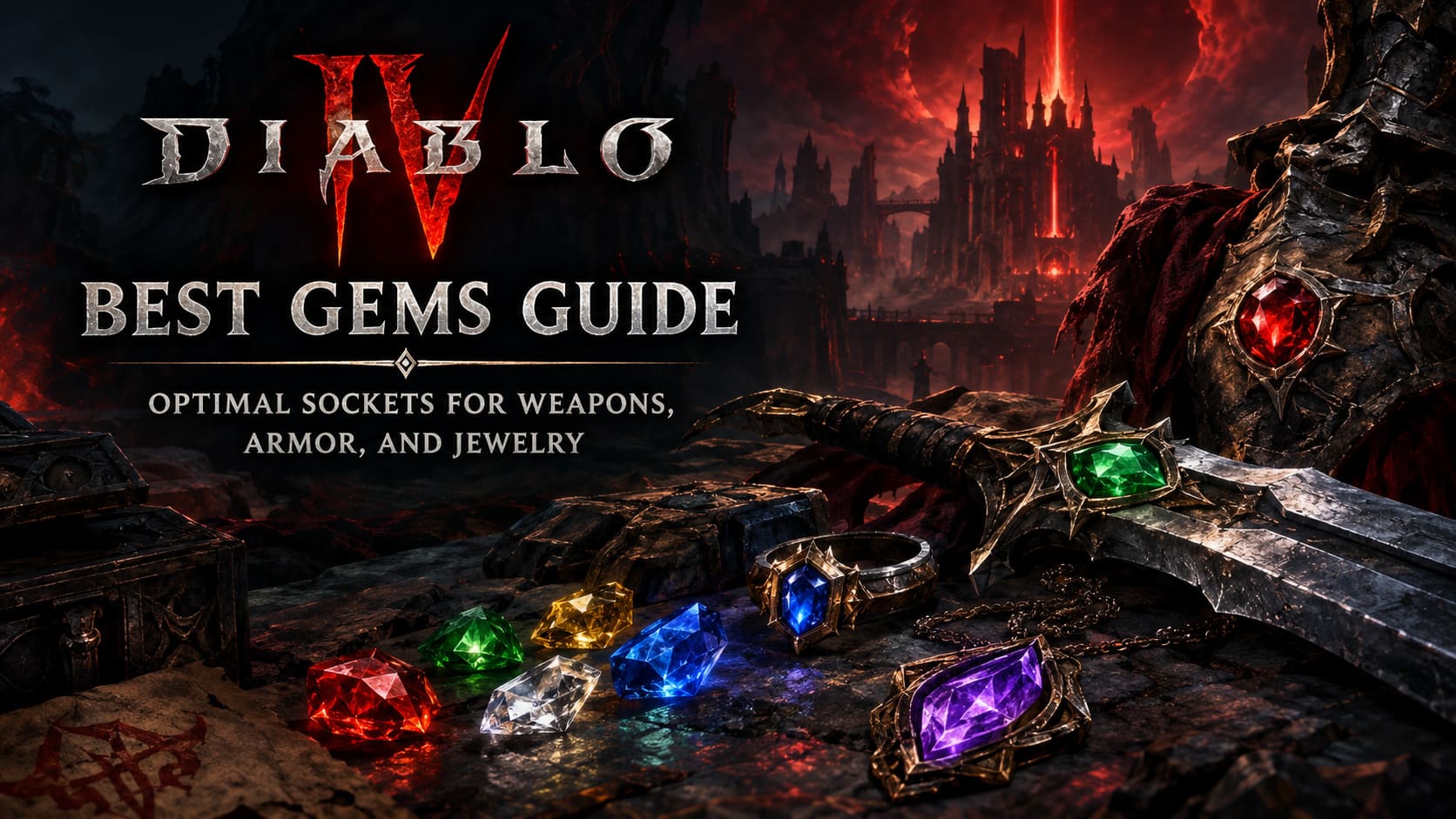
Diablo 4 Best Gems Guide (2026 Update): Optimal Sockets for Weapons, Armor, and Jewelry
Gems in Diablo 4 used to be one of those systems you could almost ignore until you had nothing else to upgrade. Throw a Ruby into your armor, an Emerald into your weapon, fill your jewelry sockets, and move on. That approach worked for a long time.
In 2026, I would not recommend treating gems that casually.
The modern Diablo 4 itemization system has turned gems into a surprisingly important part of endgame optimization. The right socket can noticeably improve your damage, push an important attribute breakpoint, or fix a resistance problem that would otherwise make high Torment content unnecessarily painful.
The biggest change is that your gem choice should now follow the role of the item. Weapons are primarily about damage amplification, armor is heavily tied to your main attribute or specialized defensive scaling, and jewelry is where you solve resistance problems.
And once you start working with the higher Grand Gem tiers, the difference between “good enough” and properly optimized socketing becomes very noticeable.
So, if you’re sitting at the Jeweler wondering what to craft next, here’s how I approach gems in 2026.
How the Diablo 4 Gem System Works Now
The easiest way to understand the current system is to stop thinking about gems as generic stat boosters.
Each equipment category has a job.
Weapons = damage.
Armor = primary stats or specialized defensive scaling.
Jewelry = elemental resistance.
That simple rule eliminates a lot of the confusion.
The modern gem system also includes Grand Gems, which sit above the traditional Royal tier. Getting them is a serious endgame investment because crafting requires a huge amount of Gem Fragments. According to the current system, a Grand Gem requires 100,000 Gem Fragments, so you shouldn’t treat every crafting decision as disposable.
Personally, I would rather build a small collection of useful Grand Gems than constantly spend fragments chasing every possible variation.
Best Gems for Weapons
This is where gems can become extremely powerful.
Weapon sockets are focused on multiplicative damage, meaning the correct gem can provide a much bigger practical improvement than an old-fashioned “whatever has the highest number” approach.
The important question is simple:
What type of damage does your build actually deal?
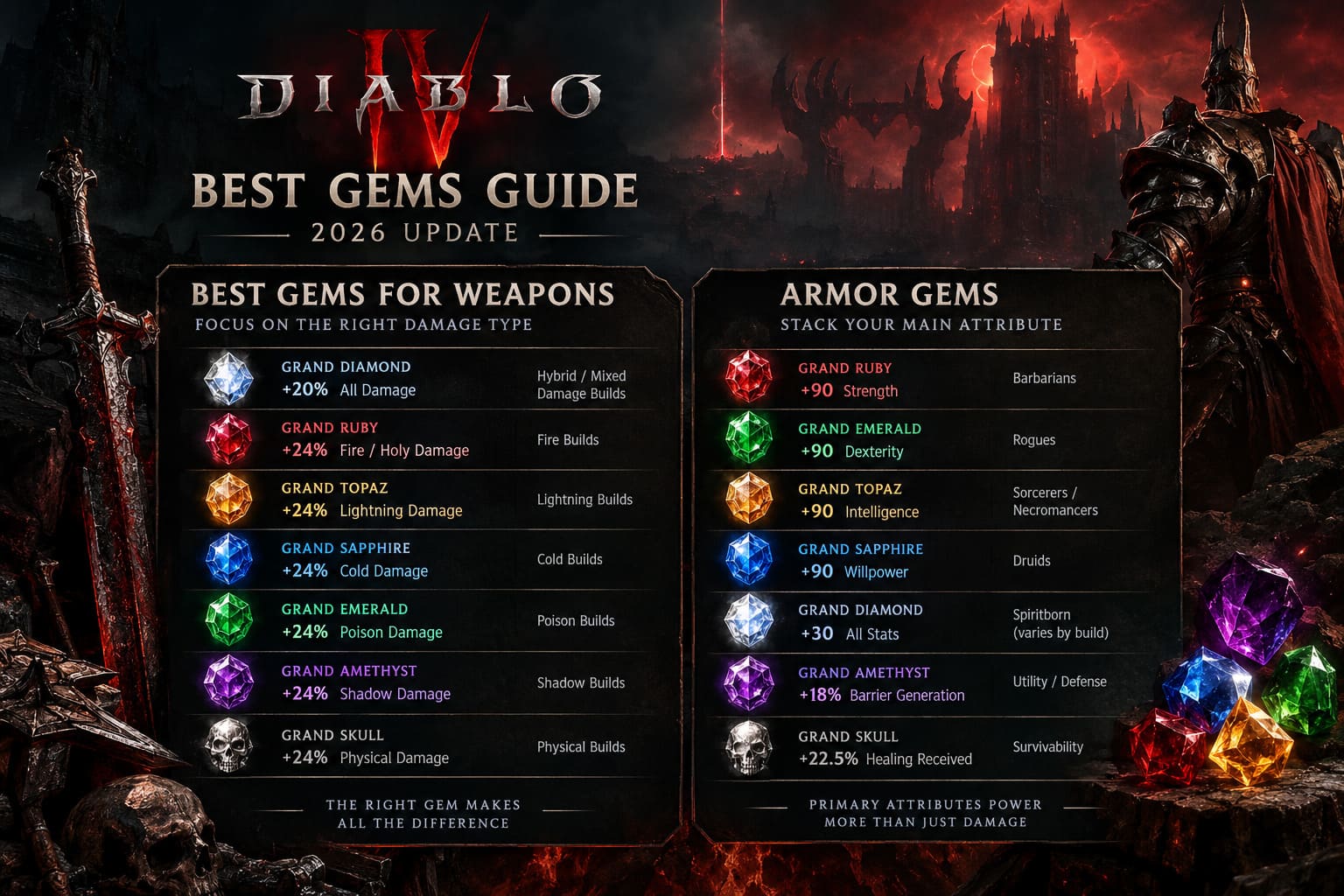
| Gem | Grand Gem Bonus | Best Use |
|---|---|---|
| Grand Diamond | x20% All Damage | Hybrid or mixed-damage builds |
| Grand Ruby | x24% Fire / Holy Damage | Fire-based builds |
| Grand Topaz | x24% Lightning Damage | Lightning builds |
| Grand Sapphire | x24% Cold Damage | Cold builds |
| Grand Emerald | x24% Poison Damage | Poison builds |
| Grand Amethyst | x24% Shadow Damage | Shadow builds |
| Grand Skull | x24% Physical Damage | Physical builds |
If your character is built almost entirely around one damage type, I would usually go with the corresponding 24% specialized multiplier.
For example, a Lightning Sorcerer has a pretty obvious choice with Grand Topaz. A Poison Rogue gets much more value from Grand Emerald. A physical Barbarian is naturally looking toward Grand Skull.
The Grand Diamond is the interesting exception.
Its 20% All Damage bonus is lower than the specialized 24% options, but that does not automatically make it bad. Hybrid builds, mixed-element setups, companions, and characters relying on several different damage sources can get more consistent value from Diamond.
In other words, don’t look at the number in isolation.
A 24% bonus to the wrong damage type is worse than a 20% bonus that affects practically everything you do.
Armor Gems: Stack Your Main Attribute
Armor is where the modern system feels completely different from the old “put Rubies everywhere for more life” mentality.
For most builds, your armor sockets should be helping push your primary class attribute.
The Grand Gem values currently look like this:
| Gem | Armor Bonus |
|---|---|
| Grand Ruby | +90 Strength |
| Grand Emerald | +90 Dexterity |
| Grand Topaz | +90 Intelligence |
| Grand Sapphire | +90 Willpower |
| Grand Diamond | +30 All Stats |
| Grand Amethyst | +18% Barrier Generation |
| Grand Skull | +22.5% Healing Received |
For straightforward builds, the choice is easy.
Barbarians want Strength.
Rogues want Dexterity.
Sorcerers and Necromancers want Intelligence.
Druids want Willpower.
Spiritborn builds can vary depending on the build and passive interactions.
Primary attributes aren’t just damage stats, either. They can contribute to your broader defensive and utility profile, which makes them much more attractive than they might initially appear.
My Favorite Armor Alternative: Grand Amethyst
There is one exception I wouldn’t ignore.
Grand Amethyst can provide +18% Barrier Generation per socket, which becomes interesting on builds designed around maintaining barriers consistently.
This is especially relevant when your build has mechanics that directly benefit from having an active barrier. In those cases, blindly stacking your primary attribute may not always be the optimal choice.
I wouldn’t recommend Amethyst as the default for every character, though.
If your build doesn’t actually use barriers as an important part of its gameplay loop, you’re essentially paying for a stat you aren’t exploiting.
Jewelry Gems Are About Fixing Problems
Jewelry is probably the part of gem optimization where I see players overcomplicate things.
You don’t need to automatically fill every ring and your amulet with Diamonds.
You need to look at your character sheet.
High Torment content puts serious pressure on your resistances, and sitting below the 70% resistance cap can make certain encounters dramatically more dangerous. Instead of trying to create the perfect theoretical resistance setup before equipping your actual gear, check what your character is missing.
The Grand Jewelry gems provide large amounts of individual resistance:
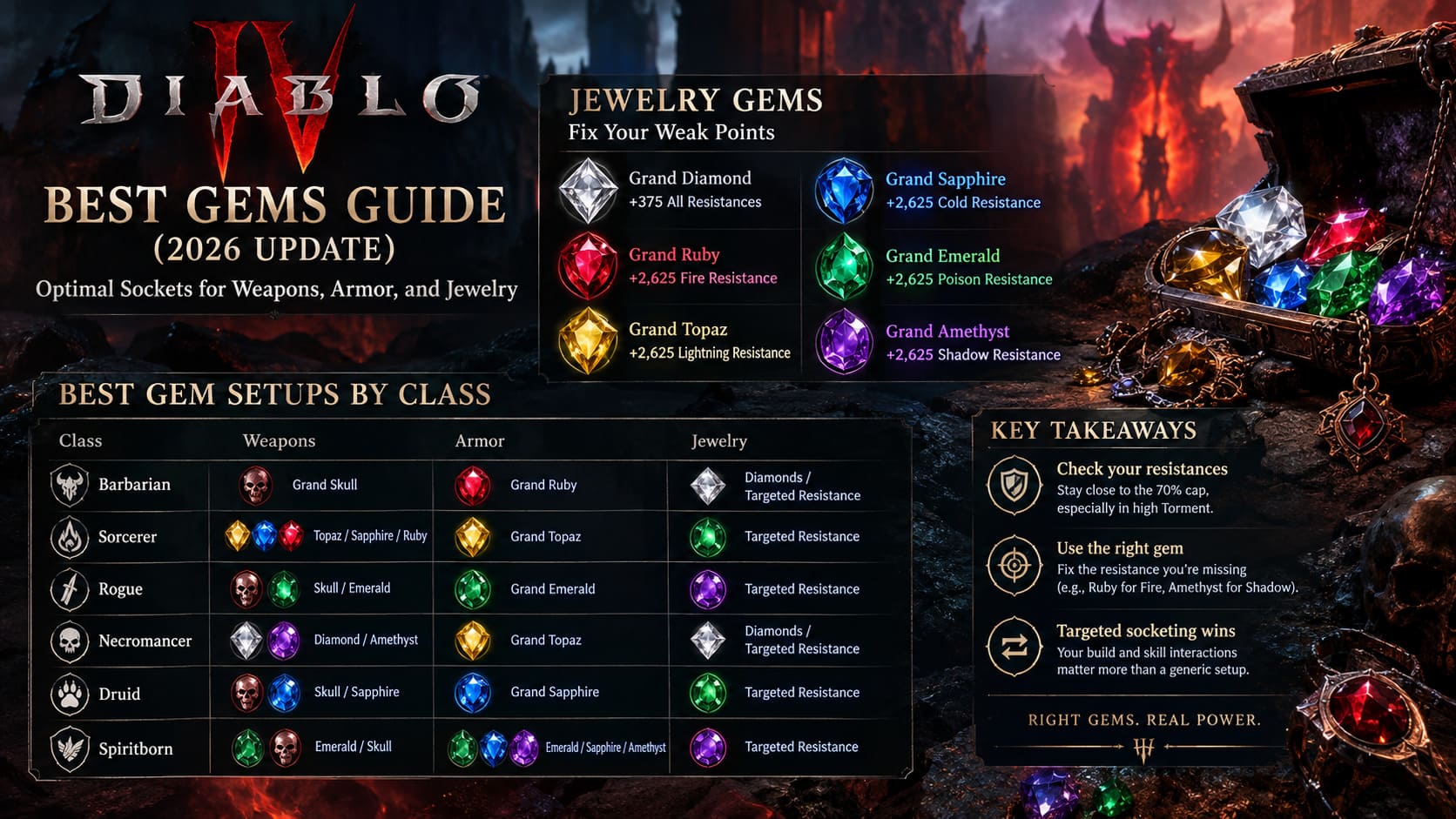
| Gem | Resistance |
|---|---|
| Grand Diamond | +375 All Resistances |
| Grand Ruby | +2,625 Fire Resistance |
| Grand Topaz | +2,625 Lightning Resistance |
| Grand Sapphire | +2,625 Cold Resistance |
| Grand Emerald | +2,625 Poison Resistance |
| Grand Amethyst | +2,625 Shadow Resistance |
This is one of those situations where targeted socketing beats blindly following a meta setup.
If Fire resistance is your problem, use Ruby.
If Shadow resistance is the weak point, use Amethyst.
If you’re slightly below several caps simultaneously, Diamonds become much more attractive.
I actually like this approach because it makes gem optimization feel connected to your gear rather than something you set once and never touch again.
Best Gem Setups by Class
Here’s the quick version I would use when gearing the most common class archetypes.
| Class | Weapons | Armor | Jewelry |
|---|---|---|---|
| Barbarian | Grand Skull | Grand Ruby | Diamonds / Targeted Resistance |
| Sorcerer | Topaz / Sapphire / Ruby | Grand Topaz | Targeted Resistance |
| Rogue | Skull / Emerald | Grand Emerald | Targeted Resistance |
| Necromancer | Diamond / Amethyst | Grand Topaz | Diamonds / Targeted Resistance |
| Druid | Skull / Sapphire | Grand Sapphire | Targeted Resistance |
| Spiritborn | Emerald / Skull | Emerald / Sapphire / Amethyst | Targeted Resistance |
Obviously, this isn’t meant to replace looking at your actual build.
A Fire Sorcerer shouldn’t suddenly equip Topaz because another Sorcerer build does. A Centipede Spiritborn and a Jaguar Spiritborn can have completely different requirements. The skill and passive interactions on your build matter more than the class name printed at the top of the character screen.
Don’t Ignore Hybrid Builds
This deserves its own section because it’s an easy mistake.
Some builds look like they should use a specialized elemental gem, but their actual damage profile is more complicated.
Maybe your main skill deals physical damage while your supporting mechanics produce Shadow damage. Maybe your minions contribute a different damage type. Maybe you’re constantly triggering secondary effects that make a universal modifier more valuable.
That’s where Grand Diamond can become a very respectable choice.
I would never pick a gem simply because a build guide says “this is BiS.” Check what your character is actually doing during combat.
If the majority of your damage comes from one source, specialize.
If your damage is spread across several sources, consider the universal option.
Grand Gems: What Should You Craft First?
This is where I would be careful with Gem Fragments.
Grand Gems aren’t something I would craft randomly just because I finally have enough fragments. Your first major investment should improve the part of your build that gives you the biggest immediate return.
For most damage-focused characters, weapon gems are a natural first priority because their multiplicative bonuses can directly improve farming speed.
Faster kills mean faster Pit runs, faster Torment farming, and ultimately faster accumulation of the resources needed for everything else.
After that, I’d work on armor gems and then fill out the jewelry collection based on whatever resistances your gear requires.
There is no reason to own fifteen different Grand Gems if eight of them are sitting in your stash forever.
A Few Gem Mistakes I Would Avoid
There are a couple of habits from older Diablo 4 versions that I would leave behind.
- Don’t automatically stack Rubies in every armor slot. Your main attribute may provide much more relevant scaling now.
- Don’t use Diamonds in every jewelry socket without checking your resistances. Targeted resistance gems can solve specific weaknesses far more efficiently.
- Don’t choose a weapon gem based only on the largest percentage. That percentage needs to affect your actual damage.
- Don’t spend all your Gem Fragments immediately. Keep enough flexibility to adapt when your build or equipment changes.
And perhaps most importantly:
Don’t treat your current socket setup as permanent.
Diablo 4 endgame gear changes constantly. A new ring can completely alter your resistance profile. A different legendary item can change your damage type priorities. A build adjustment can make a previously useless defensive gem suddenly valuable.
Diablo 4 Crossplay Voice Chat Not Working: Xbox & PC Fix (2026)
What About Removing Gems?
One of the nicer quality-of-life rules is that you don’t need to panic when replacing an item.
If you’re upgrading a piece of gear, you can salvage the old item and recover the socketed gems rather than treating those expensive Grand Gems as permanently attached to the equipment.
That makes experimentation much less painful.
And honestly, I think that’s important.
A good socketing system should encourage players to test builds rather than punish them for making one bad decision.
Diablo 4 Codex of Power Guide: How to Extract, Upgrade, and Max Out Legendary Aspects (2026 Update)
My Final 2026 Gem Strategy
If I had to reduce the entire Diablo 4 gem system to a few rules, this is what I’d keep in mind:
- Match weapon gems to your dominant damage type.
- Use your primary attribute gems in armor unless your build has a specific defensive interaction that justifies something else.
- Use jewelry gems to fix resistance gaps rather than blindly copying a preset.
- Consider Grand Diamond for genuinely hybrid damage builds.
- Prioritize Grand Gems that immediately improve your farming efficiency.
- Keep several resistance options available because your gear will change.
The biggest lesson is that there isn’t one universal “best gem” in Diablo 4.
There is a best gem for your current build, your current gear, and the content you’re actually running.
That’s why I wouldn’t blindly copy a screenshot of someone else’s socket setup. Look at your damage breakdown, check your primary attribute, open the resistance panel, and then decide.
Once you start doing that, gems stop feeling like another boring checklist and become what they should be: one more way to squeeze real power out of a well-built character.