CS2 Cache Remake Guide: How to Play Cache in Premier Season 5 (2026)
For years, Cache has been one of those maps that players never really stopped talking about. Even after it disappeared from the Active Duty rotation, people continued launching workshop versions, watching old professional matches, and hoping for the day it would officially return.
Now that day has arrived.
With the launch of Premier Season 5, Cache is back in Counter-Strike 2, rebuilt for the Source 2 engine and officially replacing Overpass in the competitive map pool. After spending time exploring the remake, watching community reactions, and comparing it with the original, I honestly think Valve made the right decision.
This isn’t simply an old favorite with better graphics. It feels like Cache has matured. The identity is still there, but many of the frustrating visual and gameplay issues that existed in CS:GO have finally been addressed.
If you’re planning to grind Premier this season, Cache is absolutely one of the first maps you should master.
Cache Still Feels Familiar — And That’s Its Biggest Strength
One thing I immediately appreciated is that Valve didn’t try to reinvent everything.
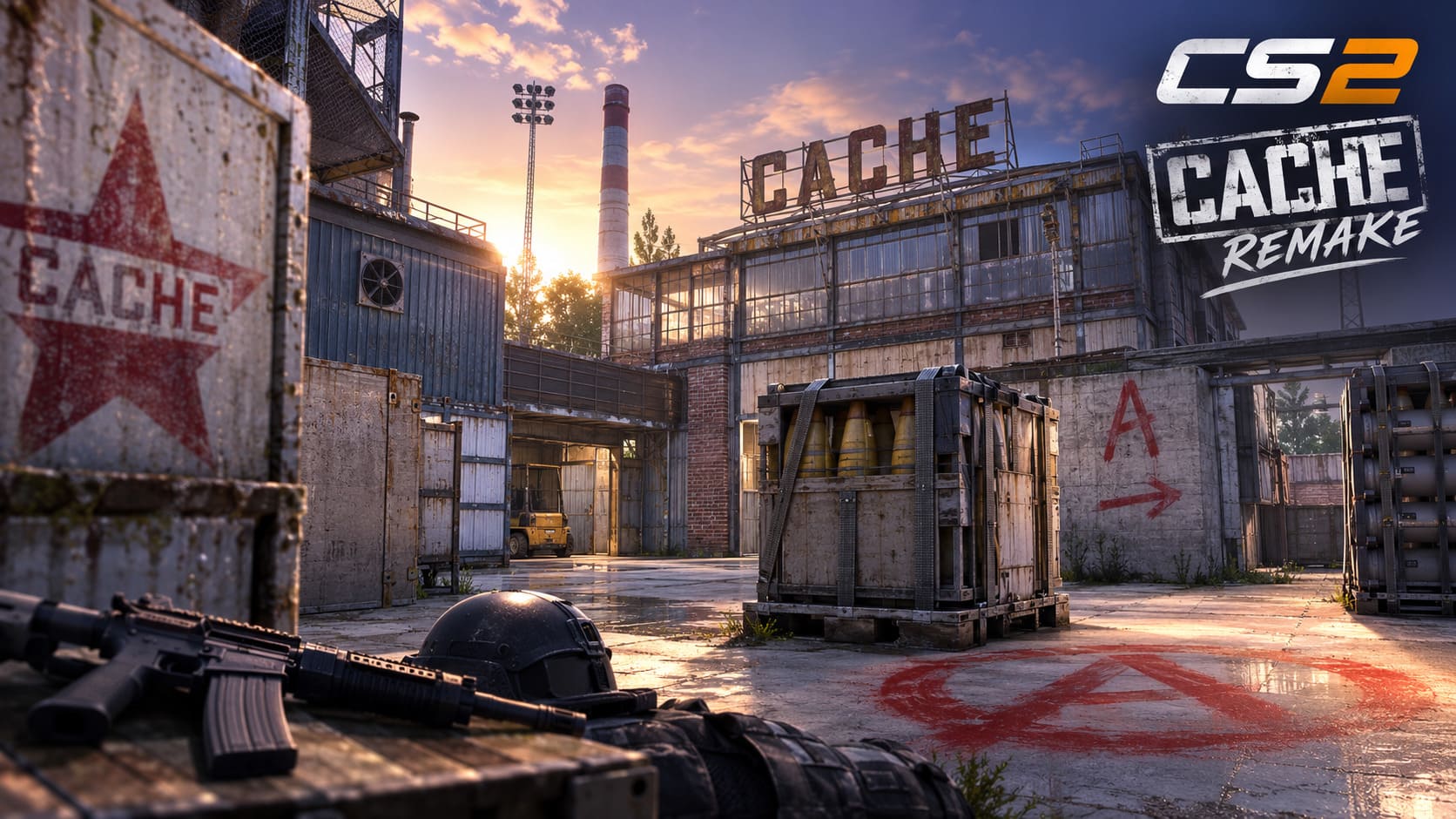
The legendary three-lane structure remains almost untouched:
- A Site
- Middle
- B Site
If you spent hundreds of hours on the original version, your muscle memory still matters. Rotations make sense, callouts remain recognizable, and the pacing feels unmistakably like Cache.
At the same time, almost every important combat area has received subtle improvements that make firefights cleaner.
Instead of asking players to relearn the entire map, the developers refined what already worked.
Personally, I think that’s exactly what a remake should do.
Source 2 Makes Cache Easier to Read
One of my biggest complaints about late-era CS:GO Cache was visibility.
- Too many dark corners.
- Too much foliage.
- Too many distracting background objects.
- Enemies often blended into the environment.
The new version fixes those problems almost immediately.
Bright industrial textures, cleaner lighting, updated materials, and improved contrast make player models stand out far better than before.
You spend less time wondering whether someone is hiding in a shadow and more time focusing on your crosshair placement.
That alone changes the feel of every duel.
The Small Layout Changes Matter More Than You Expect
Although Cache looks similar at first glance, several areas now play differently.
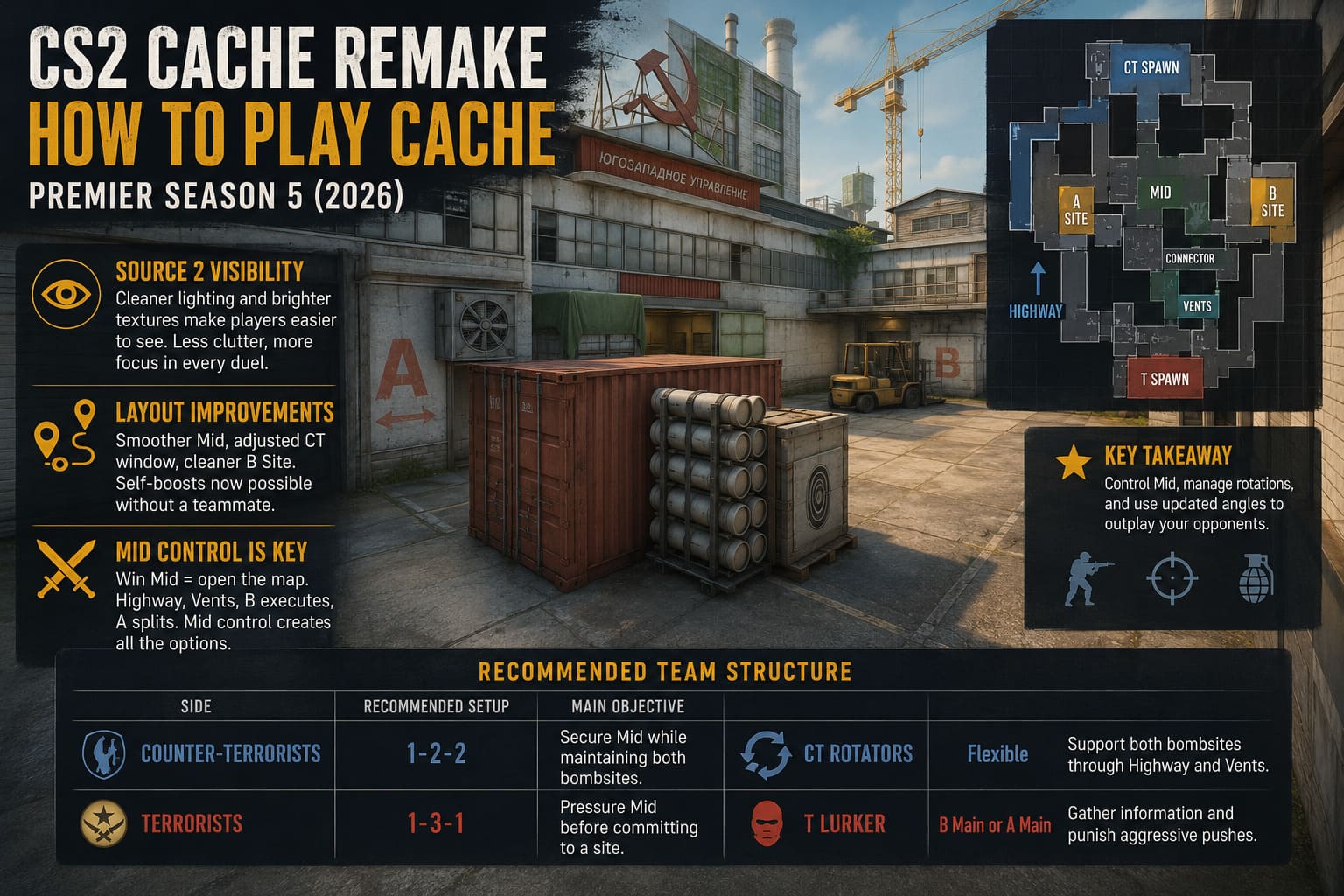
The Middle section has become smoother. The old vertical clutter around Connector has been simplified, making movement feel more natural. The CT window position has also been adjusted, creating slightly different sniper angles without changing the overall balance.
Meanwhile, B Site feels considerably cleaner. The awkward visual clutter around Checkers is gone, and movement around the back boxes feels much more consistent.
One feature I really like is the ability to perform certain self-boosts that previously required another teammate.
Small quality-of-life improvements like this make solo queue noticeably less frustrating.
Mid Control Is Still the Most Important Part of Cache
If someone asked me for one piece of advice before playing Cache, it would be simple:
Win Middle.
Everything else becomes easier afterward.
Just like Mirage, controlling Mid opens almost every strategic possibility.
Once Terrorists establish presence there, defenders suddenly have to worry about multiple attack routes at the same time.
- Highway pressure
- Vent splits
- B executes
- Late A splits
- Constant rotation pressure
Counter-Terrorists should treat Mid almost like another bombsite. Lose control there too easily, and the defense quickly starts falling apart.
I’ve noticed many newer players overcommit to holding A or B while completely ignoring Mid. That’s usually how rounds slip away.
Recommended Team Structure
| Side | Recommended Setup | Main Objective |
|---|---|---|
| Counter-Terrorists | 1-2-2 | Secure Mid while maintaining both bombsites. |
| Terrorists | 1-3-1 | Pressure Mid before committing to a site. |
| CT Rotators | Flexible | Support both bombsites through Highway and Vents. |
| T Lurker | B Main or A Main | Gather information and punish aggressive pushes. |
These aren’t strict rules. Every match develops differently, but understanding these default positions gives newer players a solid foundation.
Utility Wins More Rounds Than Raw Aim
Many players spend countless hours practicing recoil control while barely touching grenade lineups.
On Cache, that’s a mistake.
Because the map contains several long sightlines, properly placed utility often decides the round before the first kill even happens.
Essential T-Side Utility
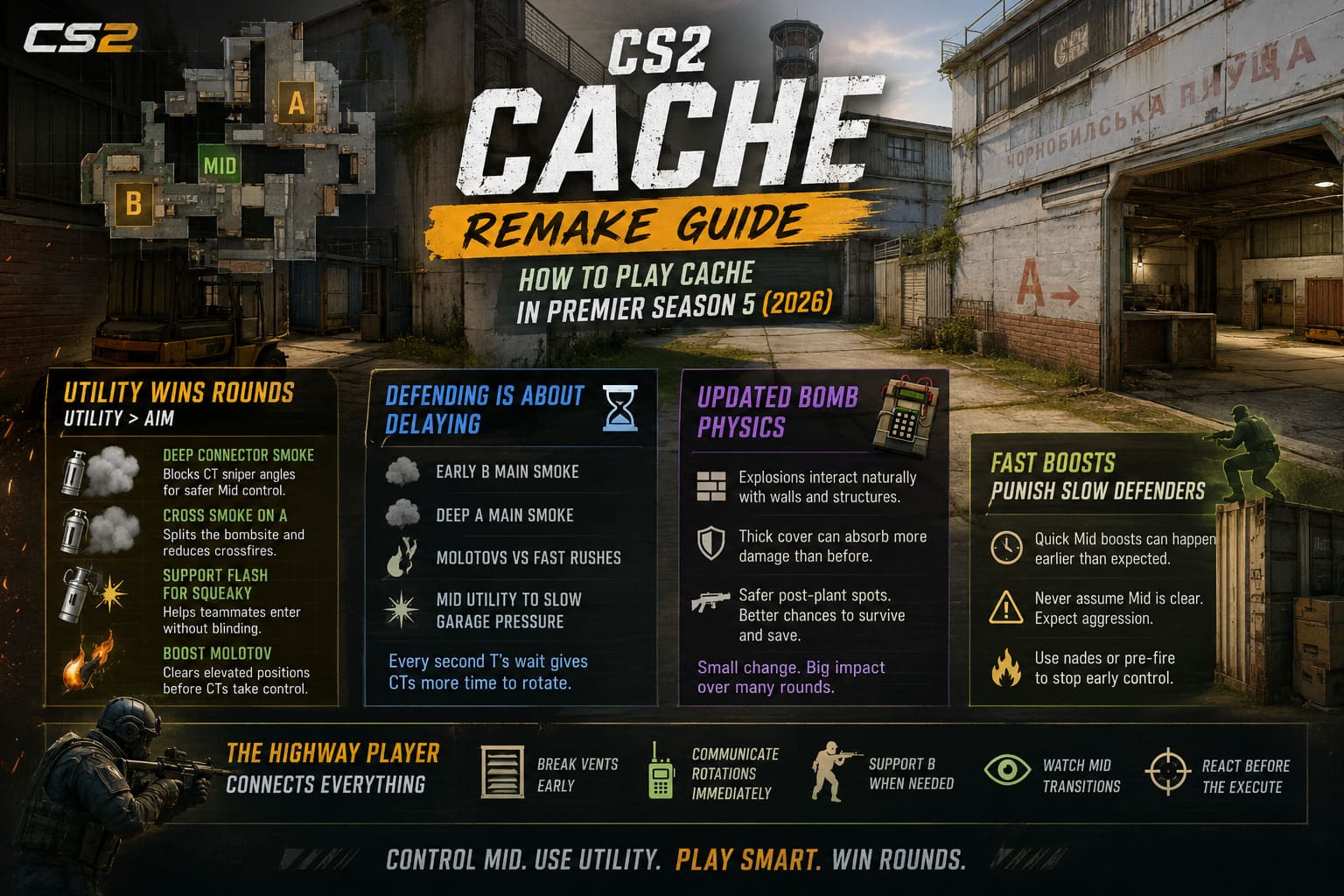
- Deep Connector Smoke — Blocks one of the strongest CT sniper angles and allows safer Mid control.
- Cross Smoke on A — Splits the bombsite and reduces dangerous crossfires.
- Support Flash for Squeaky — Helps teammates enter without blinding each other.
- Boost Molotov — Clears elevated positions before CT defenders can take advantage.
None of these grenades are especially difficult to learn, but together they dramatically increase your team’s consistency.
Defensive Utility Should Focus on Delaying
Counter-Terrorists don’t always need early kills. Sometimes buying just a few extra seconds completely changes the round.
- Early B Main Smoke
- Deep A Main Smoke
- Molotovs against fast rushes
- Mid utility to slow Garage pressure
Every second Terrorists spend waiting gives defenders more time to rotate and prepare.
The Updated Bomb Physics Change Late-Round Decisions
One update that surprised me more than expected is the revised bomb explosion behavior.
Instead of feeling like a perfectly expanding sphere, the blast now interacts more naturally with walls and solid structures.
Because of this, positioning after planting has become much more thoughtful.
Players can sometimes survive in locations that previously guaranteed death simply because thick walls absorb much of the explosion.
Likewise, saving expensive rifles often feels more reliable if you understand where proper cover actually exists.
It’s a subtle mechanic, but over dozens of matches it definitely changes decision-making.
Fast Boosts Can Punish Slow Defenders
Experienced teams have already started abusing the updated timing windows.
One of the biggest examples is the quick Mid boost.
With favorable spawns and good coordination, Terrorists can reach elevated positions surprisingly early.
If you’re defending Mid as a Counter-Terrorist, assuming nobody can be there yet is often a costly mistake.
Whenever I play Highway, I now expect aggressive boost plays almost every round until proven otherwise.
A well-timed Molotov or pre-fire can prevent early disasters.
Why the Highway Player Matters So Much
Highway has always been an important position, but I think it matters even more in the Source 2 version.
This player connects both bombsites while constantly supporting Mid control.
A strong Highway player should focus on:
- Breaking Vents early.
- Communicating rotations immediately.
- Supporting B when necessary.
- Watching Mid transitions.
- Reacting before the execute fully develops.
The role rarely produces flashy highlights, but it often determines whether the defense survives.
Common Mistakes New Cache Players Make
| Mistake | Better Approach |
|---|---|
| Ignoring Mid | Contest it every round. |
| Holding utility too long | Use grenades early to gain map control. |
| Over-rotating after one smoke | Wait for confirmed information. |
| Playing isolated angles | Stay close enough for teammate trades. |
| Saving flashes until late | Use them early to establish control. |
Avoiding these habits alone can noticeably improve your overall win rate.
CS2 VacNet 3.0 Anti-Cheat Status & Cache Remake Map Callouts Guide (2026 Update)
Why Cache Feels Fresh Again
I genuinely wasn’t expecting to enjoy this remake as much as I do.
What impressed me isn’t some revolutionary mechanic.
It’s the fact that the map simply feels cleaner.
- Cleaner visuals.
- Cleaner movement.
- Cleaner firefights.
- Better readability.
- More consistent engagements.
Every duel feels easier to understand, and mistakes usually feel like your own rather than the map’s.
That’s exactly what competitive Counter-Strike should be.
Valve resisted the temptation to redesign Cache into something completely different. Instead, they modernized a classic while respecting everything players originally loved.
In my opinion, that’s why the remake works so well.
Final Thoughts
Premier Season 5 is the perfect opportunity to invest time into learning Cache.
Since everyone’s competitive rating resets, players who understand the map early gain a noticeable advantage over those relying purely on mechanical aim.
Spend time in a private practice server. Learn the grenade lineups. Memorize Mid timings. Understand how rotations flow through Highway and Vents. Practice your positioning until it becomes second nature.
Most importantly, don’t treat Cache like an old map with prettier graphics.
The Source 2 remake rewards smart utility, disciplined positioning, quick decision-making, and strong teamwork more than ever before.
If I had to recommend one map for climbing the Premier ladder this season, Cache would easily be my first choice. It offers one of the best balances between accessibility and strategic depth in Counter-Strike 2, making it rewarding for both experienced veterans and players discovering this legendary battleground for the very first time.