Best Dieselpunk Military Simulators 2026: The Ultimate War Games Guide
The modern wave of tactical simulation games has moved far away from streamlined shooters and arcade-style action. In 2026, the genre has embraced a much heavier identity built around mechanical realism, system complexity, and deliberate pacing. From my perspective as someone who spends most gaming sessions inside control rooms, turrets, and complex machinery interfaces, dieselpunk military simulators feel like a return to something more grounded and demanding. They are not designed for instant satisfaction but for structured interaction, where every action carries weight and consequence.
The appeal of dieselpunk lies in its rejection of futuristic minimalism. Instead of sleek digital systems, players interact with steel plating, fuel systems, analog dials, and overloaded machinery. This aesthetic reinforces gameplay that is slow, physical, and often stressful in a controlled way. What makes these games particularly interesting is how deeply they simulate operational failure. You are not just playing a commander; you are actively keeping a system alive under pressure.
Is Iron Nest Worth Playing? Honest Review of the Heavy Turret Simulator
Core Dieselpunk Military Simulation Landscape
Each major title in this space approaches simulation from a different perspective. Some focus on stationary operation under extreme conditions, while others expand into mobile warfare or large-scale fleet command. Despite these differences, they all share a commitment to realism through interaction rather than abstraction.
| Game Title | Gameplay Focus | Complexity | Simulation Style | Player Role |
|---|---|---|---|---|
| Iron Nest: Heavy Turret Simulator | Stationary artillery control | Extremely High | Mechanical system simulation | Operator / Gunner |
| Sand: Raiders of Sophie | Mobile fortress survival | High | Vehicle-based extraction gameplay | Squad crew member |
| PVKK | Planetary defense systems | Extremely High | Information processing simulation | Defense operator |
| Dieselpunk Wars | Vehicle building and combat physics | High | Engineering and destruction systems | Designer / Commander |
| HighFleet | Fleet strategy and aerial combat | Medium-High | Tactical macro simulation | Fleet admiral |
What unites these games is their focus on operational complexity rather than reflex-based gameplay. Every system interacts with another, and success depends on understanding how these systems behave under stress. This creates a style of play that rewards patience and analysis over speed.
Iron Nest: Heavy Turret Simulator – Precision Under Pressure
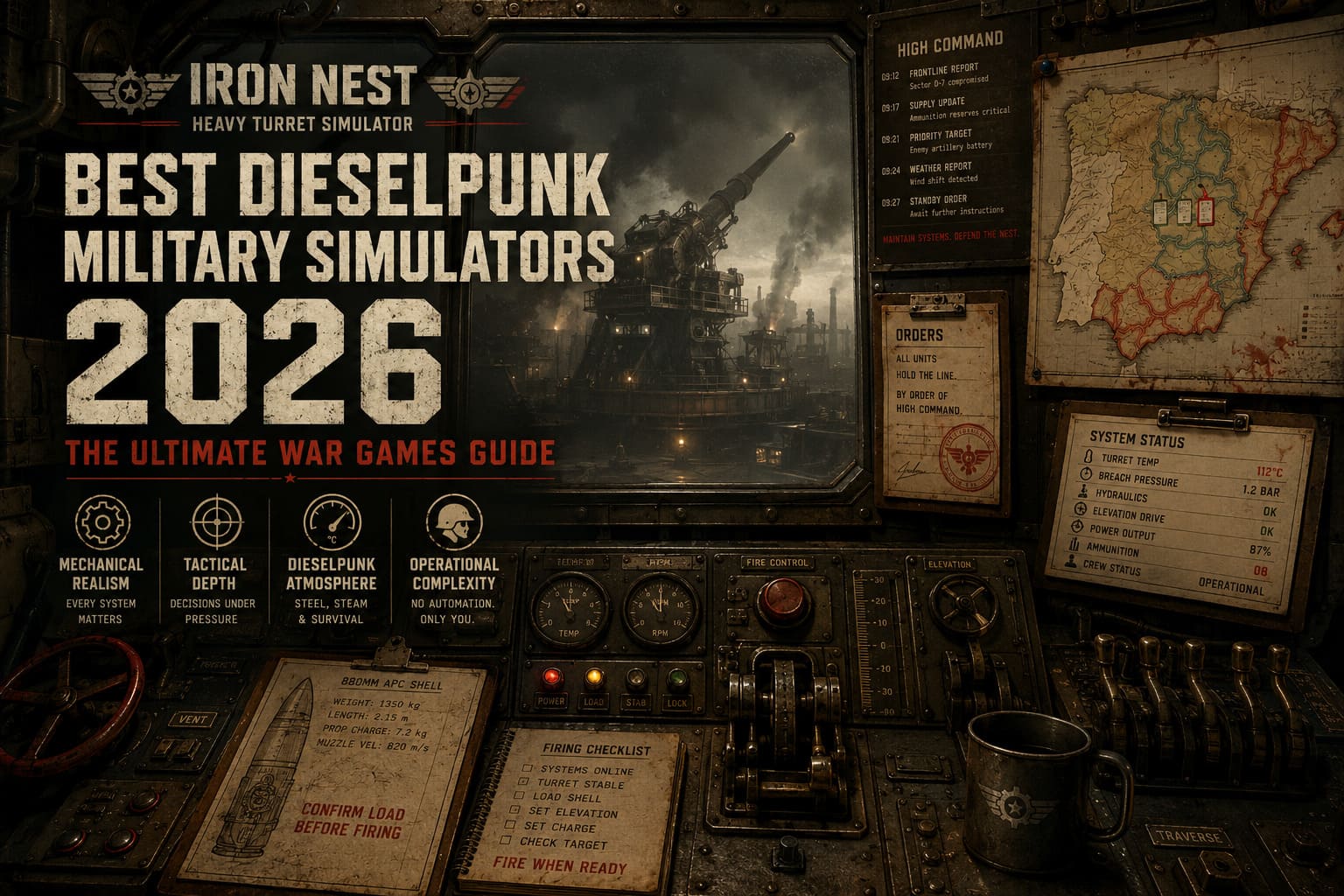
Iron Nest: Heavy Turret Simulator stands out as one of the most intense simulation experiences in recent years. It removes any sense of convenience and replaces it with a fully manual operational structure. Every firing sequence requires preparation, coordination, and continuous monitoring of system conditions.
The gameplay loop is built around direct interaction with machinery. Players adjust analog systems, manage heat levels, load heavy artillery shells, and stabilize firing mechanisms before each shot. Nothing is automated, and mistakes often have cascading consequences that affect the entire system.
What makes Iron Nest particularly compelling is its psychological pressure. You are constantly balancing efficiency with survival, especially when incoming orders from High Command arrive with limited context. This uncertainty forces players to interpret and prioritize information in real time while maintaining full system control.
Sand: Raiders of Sophie – Living Inside a Moving Fortress
Sand: Raiders of Sophie offers a very different experience by focusing on mobility and teamwork. Instead of operating a single system, players live and work inside a massive diesel-powered walking fortress. This structure functions as both transportation and combat unit, creating a layered survival environment.
Players are required to physically move through different sections of the vehicle to maintain functionality. Repairs, ammunition management, and fuel distribution all require active participation. This design encourages constant communication between squad members and creates a strong sense of dependency within the team.
Combat encounters add another layer of tension. PvPvE scenarios force players to manage internal systems while defending against external threats. Resource scarcity and environmental hazards further increase the strategic depth of each mission.
PVKK – Controlled Isolation and System Dependency
PVKK shifts focus toward information-based warfare inside a closed environment. Instead of visual battlefield awareness, players rely on radar systems, printed reports, and limited audio communication. This creates a simulation experience centered on interpretation rather than direct observation.
The core challenge lies in decision-making under uncertainty. Players must calculate trajectories, manage defensive systems, and respond to threats using incomplete data. System failures and environmental limitations add further complexity to every action.
The bunker setting reinforces isolation, making the player feel disconnected from the battlefield while still being fully responsible for its outcome. This design approach transforms gameplay into a slow, deliberate process of analysis and execution.
Dieselpunk Wars and HighFleet – Engineering and Strategic Control
Dieselpunk Wars focuses heavily on engineering and physics-based combat. Vehicles are constructed from modular components, each with distinct physical properties. Armor thickness, weight distribution, and material selection directly affect performance in battle.
Combat in Dieselpunk Wars is highly dynamic due to its detailed destruction system. Structural failures occur based on realistic physics calculations, often resulting in dramatic battlefield outcomes. This makes design choices extremely important, as even minor mistakes can lead to catastrophic failure.
HighFleet expands the scope into strategic fleet management. Players command large airborne warships across hostile environments, where fuel management, momentum, and positioning determine survival. Combat is slow and methodical, requiring careful planning before engagement.
The addition of radio communication, interception systems, and navigation planning adds further depth. Each decision influences not only immediate battles but also long-term fleet sustainability.
Final Thoughts – The Identity of Dieselpunk Simulation
The defining strength of dieselpunk military simulators lies in their commitment to mechanical authenticity. These games refuse to simplify systems for accessibility, instead encouraging players to engage deeply with operational complexity. This creates a learning curve that is steep but rewarding.
From operating artillery systems in Iron Nest to managing mobile fortresses in Sand: Raiders of Sophie, or commanding fleets in HighFleet, each experience shares a common philosophy. The player is not just controlling outcomes but actively maintaining fragile systems under pressure.
In 2026, this genre continues to grow because it offers something rare in modern gaming: structured difficulty rooted in logic and interaction. For players who enjoy depth, tension, and mechanical immersion, dieselpunk simulators remain one of the most compelling directions in game design today.