Agent 64 Spies Never Die Beginner Guide: Essential Tips, Tricks, and Strategies to Survive the Retro Espionage
Agent 64: Spies Never Die is exactly the kind of FPS that feels like it was pulled straight out of a dusty N64 cartridge box and somehow given a modern coat of paint. If you grew up playing games like GoldenEye 007 or Perfect Dark, there is an immediate sense of familiarity here. The chunky weapons, old-school enemy behavior, mission objectives, secret areas, and unforgiving health system all feel deliberately designed to bring back that particular era of console shooters.
But nostalgia alone will not get you through the campaign. Agent 64 can be surprisingly brutal if you approach it like a modern Call of Duty-style shooter. There is no regenerating shield waiting to save you after a bad firefight, no minimap constantly pointing toward your next objective, and certainly no guarantee that the room behind the next door is safe.
After spending time learning how the missions work, experimenting with weapons, and getting punished for making some very avoidable mistakes, I came away with one major conclusion: Agent 64 rewards players who slow down and actually think like a spy. You are not supposed to sprint through every corridor. You are supposed to observe, plan, shoot carefully, and know when to disappear behind cover.
So if you’re just starting the game, here are the Agent 64: Spies Never Die beginner tips I would personally recommend before you dive too deeply into the campaign.
Why Agent 64 Feels Different From Modern FPS Games
The first thing I would tell a new player is to forget most of the habits learned from contemporary shooters. Agent 64 deliberately uses an older design philosophy where mistakes have consequences and the environment matters almost as much as your weapon.
Your health doesn’t magically refill after hiding behind a wall. Enemies can punish careless movement extremely quickly, while objectives can send you back through areas you thought you had already cleared. Even navigation can become part of the challenge.
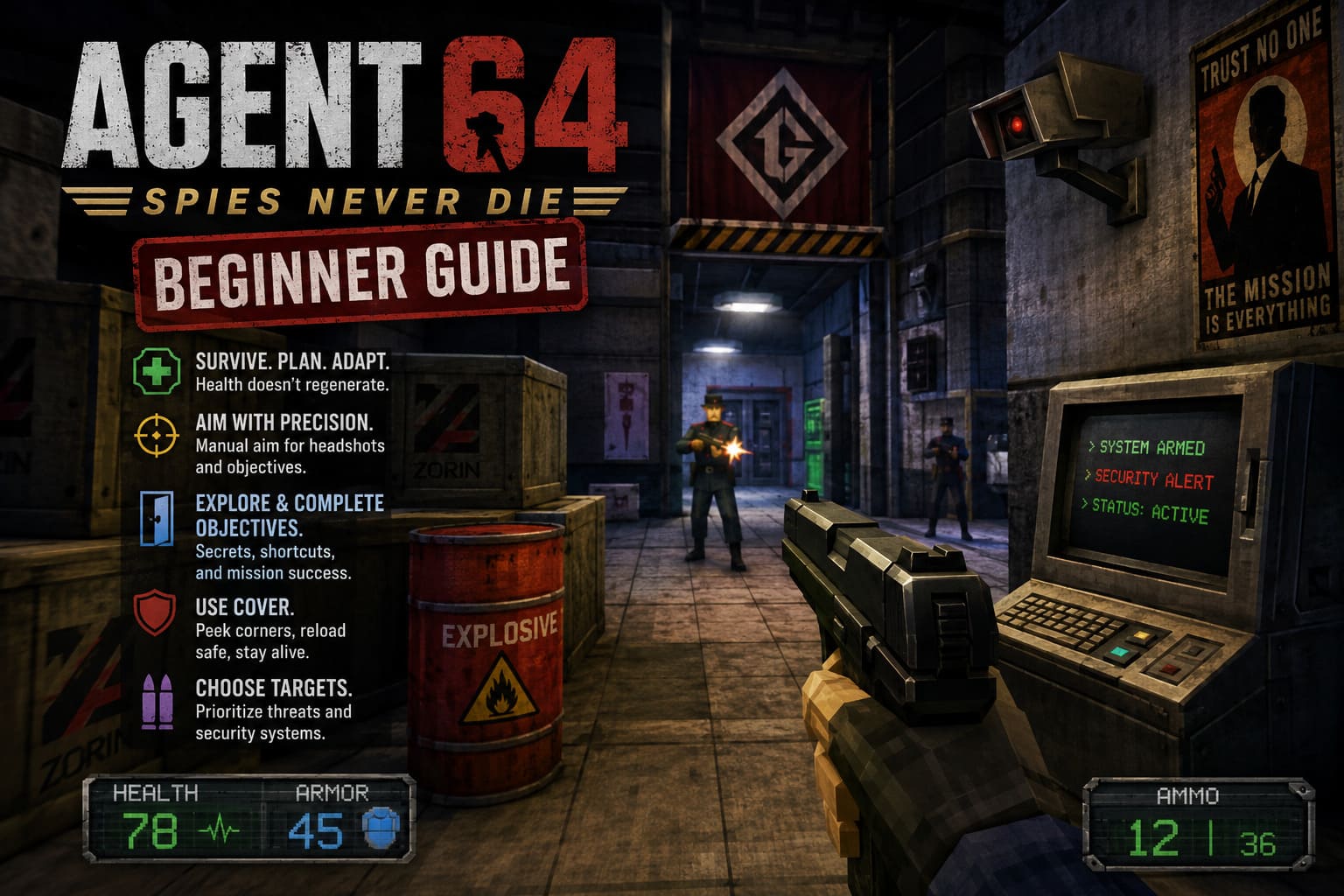
At first, this can feel slightly awkward. Personally, I think that awkwardness is part of the charm. Once the mechanics click, the game starts feeling much more deliberate than a typical modern FPS.
| Mechanic | What Beginners Should Know |
|---|---|
| Health | Damage is permanent until you find healing or protection. |
| Manual Aim | Useful for headshots, distant enemies, and security equipment. |
| Objectives | Completing the mission means more than simply reaching the exit. |
| Difficulty | Higher difficulties can introduce additional objectives and areas. |
| Exploration | Secret rooms and alternative routes can make missions much easier. |
1. Start on Agent Difficulty
There is absolutely nothing wrong with starting on the standard Agent difficulty. In fact, I would recommend it for almost everyone playing through the campaign for the first time.
The reason is simple: you aren’t just learning how to shoot. You’re learning the maps.
Agent 64’s missions become much easier once you know where important doors, computers, guards, cameras, armor, and objectives are located. The first playthrough is basically your reconnaissance operation. Take your time and remember the layout.
The interesting part is that difficulty isn’t simply a matter of giving enemies more health. Higher settings can expand the actual mission structure, adding more complicated objectives and opening areas that may not matter during an easier run.
That makes the difficulty progression genuinely interesting. Once you’ve memorized the basic version of a mission, moving up to Special Agent or eventually 64 Agent can feel like playing a familiar map with a completely different plan.
2. Stop Treating Your Health Like a Regenerating Shield
This is probably the easiest mistake to make if you’ve spent years playing modern FPS games.
In Agent 64, taking unnecessary damage is a serious problem. That tiny burst of bullets you accepted while crossing an open hallway might not seem important at the time, but several similar mistakes can leave you nearly dead before the mission gets interesting.
My advice is simple: make survival your priority rather than speed.
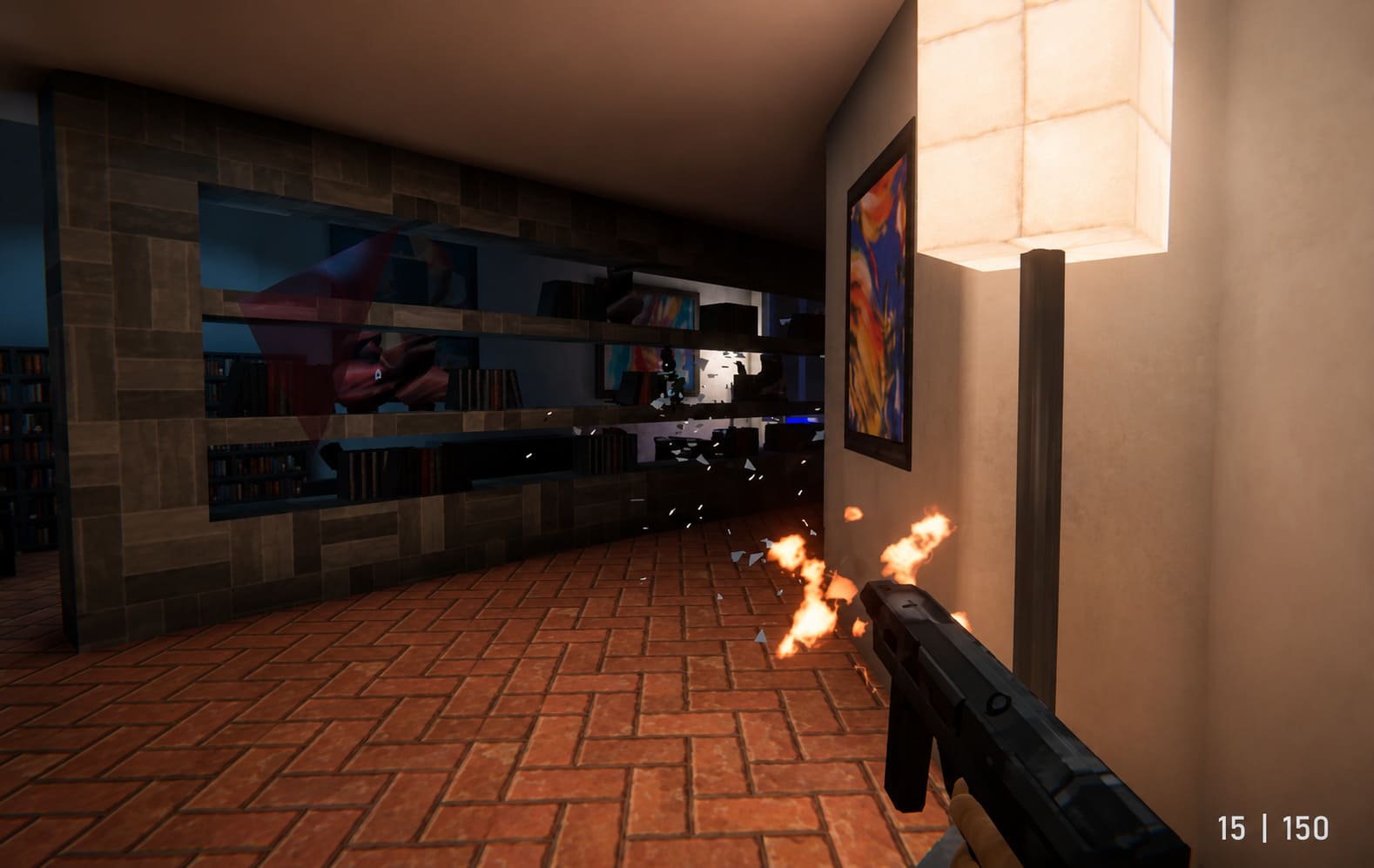
- Use walls and doorways whenever possible.
- Don’t stand in open corridors during firefights.
- Look for armor and medical supplies as you explore.
- Avoid trading damage with enemies when you can reposition instead.
Think of every hit as something that could come back to haunt you ten minutes later.
3. Learn When to Use Manual Aim
The retro aiming system is one of those mechanics that takes a little time to appreciate. Hip-fire is perfectly useful for dealing with enemies at close range, but manual aiming becomes extremely valuable when you need precision.
I found it especially useful for enemies standing farther away and for environmental targets such as security cameras. A controlled shot is almost always better than dumping half a magazine into something because your crosshair isn’t quite where you want it.
Headshots are another obvious reason to practice manual aiming. Once you become comfortable with it, fights that initially felt chaotic become much more controlled.
Don’t rush this skill. Spend some time practicing during easier encounters. Eventually, switching between normal movement and precision aiming starts feeling natural.
4. Peek Around Corners Instead of Charging Rooms
This might be my favorite piece of advice for new players.
Agent 64’s enemies may have that unmistakable old-school FPS behavior, but they can still punish you very quickly when you walk directly into their line of sight. Charging through every doorway is basically asking to get surrounded.
Instead, use the doorway itself as your weapon.
Step out, identify the nearest threat, fire a controlled burst, and move back behind cover. Repeat the process. It might feel slower, but you’re dramatically reducing the amount of damage you take.
There is something strangely satisfying about clearing a room this way. It feels less like an arcade shooting gallery and more like you’re actually working your way through a dangerous facility.
5. Reload Behind Cover Every Time
One of the most embarrassing ways to die is reloading in the middle of a hallway while an enemy walks around the corner.
I’ve made this mistake enough times to put it near the top of my personal list.
After every firefight, check your ammunition. If you’re running low, find a safe position before reloading. A wall, large piece of machinery, doorway, or other solid object can give you the few seconds you need.
It also helps to get into the habit of reloading after a fight rather than waiting until your magazine is completely empty during the next encounter.
6. Pick Your Targets Before You Start Shooting
When several enemies are in the same room, don’t immediately spray bullets at the closest target. Take a second to identify which enemies are actually dangerous.
Shotgun users and automatic weapon carriers should generally be your priority. They can remove a large portion of your health very quickly. Less threatening NPCs can usually wait while you deal with the immediate danger.
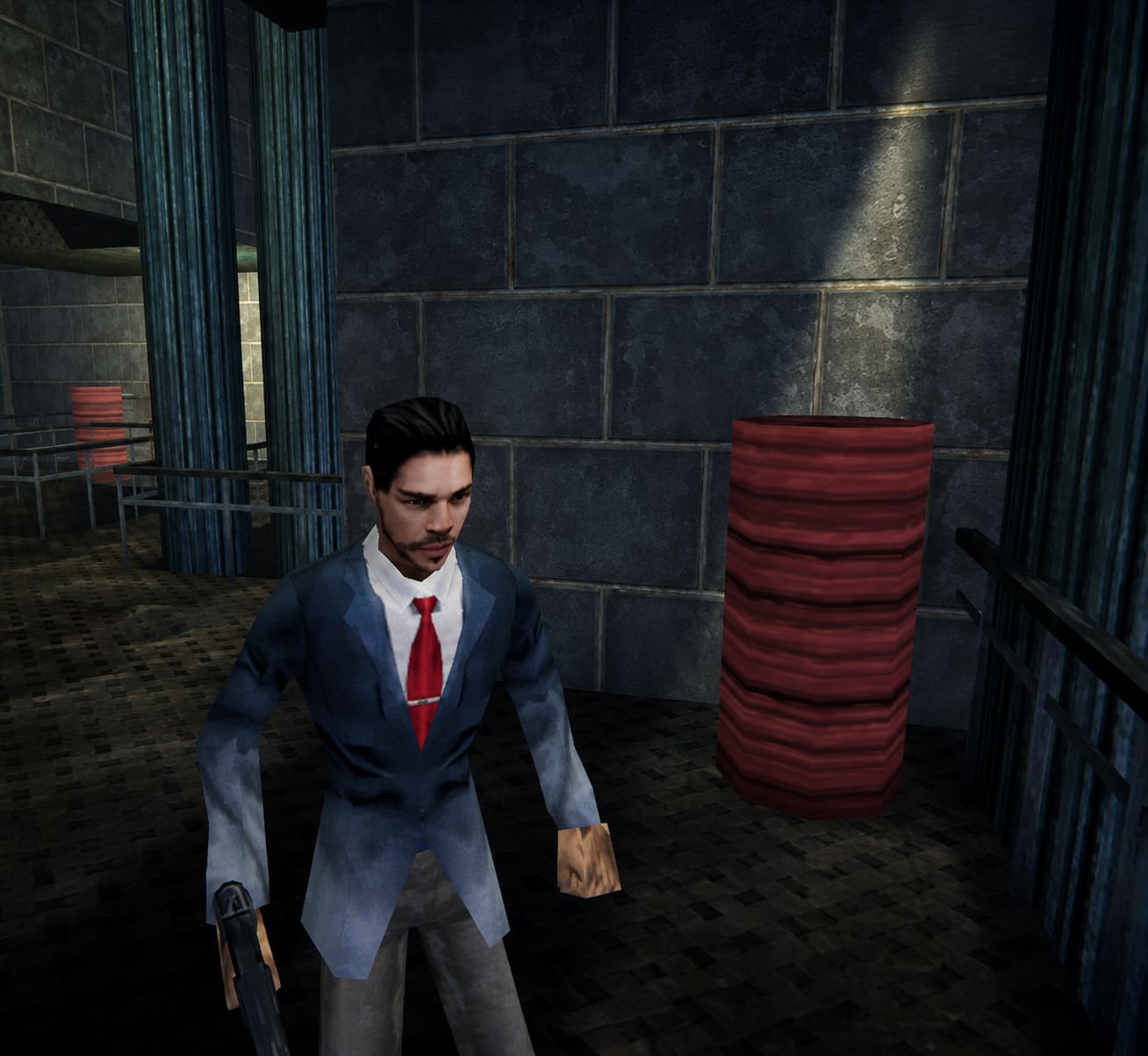
Security equipment deserves attention too. Cameras and alarm systems can turn a manageable firefight into a much bigger problem if you ignore them.
7. Security Cameras Are More Dangerous Than They Look
If you see a security camera, don’t treat it as decoration.
These devices can completely change the situation if they detect you and activate an alarm. Suddenly you’re dealing with additional enemies instead of the handful that were originally guarding the area.
Whenever you’re entering a new hallway or facility, take a second to scan the upper corners of the room. Spotting a camera before it spots you can save a ridiculous amount of ammunition and health.
If possible, destroy security equipment from a safe distance. This is one of those small habits that makes the entire game feel easier.
8. Explosive Barrels Are Free Weapons
Agent 64 gives you plenty of environmental tools, and explosive barrels are probably the most obvious example.
The beginner mistake is shooting them immediately.
Instead, look at the enemy positions first. If several guards are grouped together, you can sometimes lure them toward an explosive barrel before putting a bullet into it. One well-timed explosion can do the work of several magazines.
Just remember that explosives don’t care whose side you’re on. Standing too close to your own trap is a fantastic way to turn a clever strategy into an instant disaster.
9. Explore Suspicious Dead Ends
One of the things I really enjoy about Agent 64 is that exploration can actually pay off.
If a corridor seems strangely empty, a wall texture looks slightly unusual, or a bookshelf appears to be hiding something, investigate it. The game clearly embraces the old-school tradition of secret areas.
Hidden rooms can contain useful equipment, armor, weapons, or shortcuts. Even when they don’t, discovering them gives the levels a much stronger sense of personality.
My rule is simple: if a room looks like it shouldn’t exist, check it.
10. Don’t Ignore Your Objectives
Agent 64 isn’t designed around simply killing everyone and finding the exit. Missions often require you to complete specific tasks before extraction becomes possible.
That means you should regularly check your objective list rather than wandering around wondering why the mission hasn’t ended.
- Hack computers and terminals when required.
- Search for important documents or blueprints.
- Rescue NPCs when the mission calls for it.
- Sabotage specific equipment.
- Return to previously visited areas if a new objective requires it.
This is another reason why memorizing the map becomes so useful. Sometimes the fastest route isn’t a straight line to the extraction point.
11. Treat Arena Mode Like Your Personal Training Facility
Once you’ve spent enough time with the campaign, Arena mode is a fantastic place to sharpen your skills.
Its Trials give you specific scenarios and targets, forcing you to improve things like movement, aiming, weapon selection, and speed. The challenge structure also gives you a reason to replay encounters instead of simply moving on to the next mission.
And there is a nice reward for sticking with it. Completing these challenges can unlock additional multiplayer content, character options, music, and gameplay modifiers.
Personally, I’d recommend returning to Arena mode whenever the campaign starts feeling difficult. Rather than getting frustrated by a mission, use the Trials to practice the mechanical skills that are holding you back.
How to Fix Agent 64: Spies Never Die Crash on Launch on Windows 11 PC
My Biggest Beginner Mistakes in Agent 64
If I had to summarize the mistakes that can make the opening hours unnecessarily difficult, they would be these:
| Mistake | Better Approach |
|---|---|
| Running into rooms | Peek from cover and identify threats first. |
| Reloading in the open | Move behind solid cover before reloading. |
| Ignoring cameras | Scan rooms and destroy security devices early. |
| Wasting ammunition | Use controlled bursts and accurate shots. |
| Ignoring exploration | Investigate suspicious walls, rooms, and dead ends. |
| Rushing objectives | Learn the map and check your mission requirements. |
Agent 64 Spies Never Die Steam Deck Best Settings: Smooth 60 FPS Guide
Final Thoughts: Play Agent 64 Like a Spy, Not a Soldier
What makes Agent 64: Spies Never Die work so well for me is that it doesn’t try to modernize every old-school FPS idea. It understands that some of the things we loved about those games were the limitations themselves.
You have to learn the maps. You have to manage your health. You have to watch your ammunition. You have to remember where enemies appeared. You have to think about objectives instead of simply shooting everything that moves.
And honestly, that’s where the fun is.
If you’re completely new, start with Agent difficulty and don’t worry about playing perfectly. Use your first run to learn the missions. Once the layouts become familiar, increase the difficulty and start looking for the additional objectives and hidden areas. Before long, you’ll find yourself remembering routes, anticipating enemy positions, and instinctively checking ceilings for cameras.
That’s when Agent 64 really starts to click.
My final advice? Slow down, use cover, conserve your ammunition, and explore everything that looks suspicious. You don’t need lightning-fast reflexes to succeed. You need patience, awareness, and just enough old-school FPS instinct to know when a quiet hallway is probably hiding something nasty.
For a game built around retro espionage, that’s exactly how it should be.
Mission accepted. Now go make Dominic Pulp regret bringing John Walter back into the field.