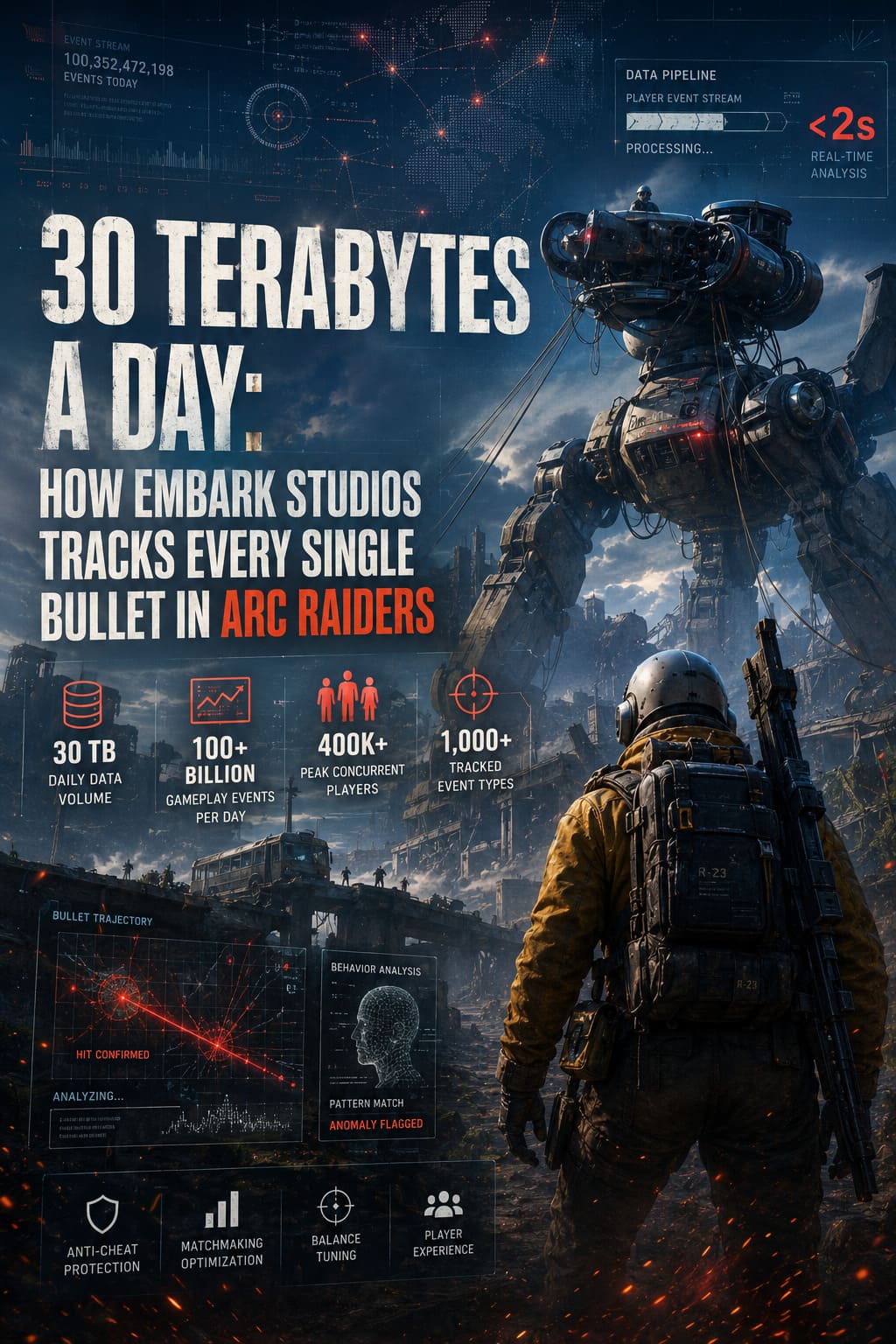
30 Terabytes a Day: How Embark Studios Tracks Every Single Bullet in Arc Raiders
As someone who spends a lot of time in competitive shooters and extraction games, I’m used to hearing developers talk about “data-driven design.” But every once in a while, a number appears that feels almost unreal. 30 terabytes of gameplay telemetry per day in Arc Raiders is one of those moments where you stop and think: this is not just a game anymore, this is an entire data ecosystem running in real time.
At the Nexon Developer Conference, Embark Studios revealed just how deeply their multiplayer world is instrumented. From the outside, Arc Raiders looks like a high-intensity extraction shooter where players fight, loot, and extract. Under the surface, however, every action becomes part of a massive analytical system that records and processes billions of micro-events every day.
How to Fix Neverness to Everness Crashing on Launch on PC (2026 Guide)
Telemetry: The Invisible Layer of Modern Game Design
Telemetry in modern gaming is essentially the “memory” of a live service game. It records everything a player does in a structured, queryable format, allowing developers to reconstruct behavior at any moment. In Arc Raiders, this goes far beyond simple stats like kills or deaths.
The system captures over 1,000 different gameplay events, including movement, weapon usage, bullet trajectories, and collision detection. Every step a player takes and every shot fired becomes a data point stored for later analysis. What feels like instinctive gameplay on the surface is actually a continuous stream of measurable information underneath.
From a player’s perspective, nothing changes. From a developer’s perspective, everything is data.
Breaking Down the 30 Terabytes of Daily Data
It’s easy to underestimate what 30 terabytes per day actually means when it’s presented without context. This is not cinematic footage or high-resolution assets. It is raw structured data made of coordinates, timestamps, and event logs generated by players across the world.
At peak activity, Arc Raiders reportedly processed over 100 billion gameplay events per day. These numbers come from a combination of massive concurrent player counts and extremely granular tracking of in-game interactions. Every bullet fired, every movement adjustment, and every environmental interaction contributes to this growing dataset.
| Metric | Scale |
|---|---|
| Daily Data Volume | 30 TB |
| Gameplay Events | 100+ billion/day |
| Peak Concurrent Players | 400,000+ |
| Tracked Event Types | 1,000+ |
When you combine that level of detail with a fast-paced extraction shooter format, the result is an incredibly dense simulation of human behavior under pressure.

The Engineering Feat: Real-Time Data in Under Two Seconds
Collecting data at this scale is already impressive, but making it usable in real time is where Embark Studios truly pushes the boundaries. Their pipeline is designed to move data from a player’s machine to analytical storage in under two seconds.
This near-instant processing is powered by systems built around Google BigQuery, allowing developers to query live gameplay data almost immediately after events occur. A single firefight can be analyzed moments after it ends, including who fired first, how shots landed, and whether any anomalies occurred.
In practical terms, this means Arc Raiders doesn’t just record gameplay—it allows developers to replay and analyze the game while it is still happening across the world.
Why Every Bullet Matters: Anti-Cheat Through Data
In extraction shooters, cheating is not just an annoyance—it can destroy the entire experience for everyone in a match. One player using aimbots or wallhacks can ruin hours of progression for others, especially when high-value loot is at stake.
Embark Studios approaches this problem with a layered system. Traditional anti-cheat tools like Easy Anti-Cheat and Denuvo Anti-Cheat are combined with machine learning systems developed alongside Anybrain. However, the real power comes from telemetry.
Instead of only detecting suspicious software, the system analyzes behavioral patterns across billions of recorded events. If a player consistently lands statistically impossible shots or reacts faster than human limits allow, the system flags it for further review.
This creates a model of detection that is not just reactive, but predictive. It doesn’t wait for cheats to be confirmed—it identifies behavior that does not align with human gameplay patterns.
Beyond Security: How Data Shapes Player Experience
The same system used to detect cheating also helps refine gameplay balance and matchmaking. Arc Raiders, like many extraction shooters, has drastically different player archetypes. Some players aggressively seek PvP encounters, while others focus on stealth and resource collection.
By analyzing movement patterns, engagement frequency, and combat behavior, the system can categorize playstyles and group players more effectively. This leads to matches that feel more consistent in terms of pacing and expectations.
Rather than forcing all players into the same experience, the system subtly adjusts matchmaking to ensure more balanced encounters between similar behavior profiles.
The Cost and Complexity of a Living Data Ecosystem
Running a system that processes tens of terabytes of data daily is not cheap or simple. It requires constant scaling of cloud infrastructure, careful optimization of streaming pipelines, and ongoing maintenance of analytical systems.
As Arc Raiders evolves, Embark Studios has also adjusted its update strategy, moving toward larger, more impactful seasonal updates instead of frequent smaller patches. This aligns better with the complexity of validating changes against such a massive live dataset.
What emerges is a game that behaves less like a static product and more like a continuously evolving simulation shaped by player behavior.
Conclusion: When Games Become Data Worlds
Arc Raiders represents a shift in how modern multiplayer games are built and understood. On the surface, it is a fast-paced extraction shooter. Beneath that surface, it is a continuously running data system that records, analyzes, and learns from every interaction.
Every bullet fired, every movement made, and every decision in combat becomes part of a larger computational structure. That structure then feeds back into game design, anti-cheat systems, and matchmaking improvements.
As a player, you experience the chaos of survival and extraction. As a system, the game experiences you as data. And in that intersection, modern gaming quietly becomes something much larger than entertainment alone.