33 Immortals Final Boss Guide: A Veteran’s Player Perspective on Beating Rogue Roguelike
After years of playing co-op chaos games—from tightly designed squad shooters to massive multiplayer experiments—I’ve learned that the best ones are never about mechanics alone. 33 Immortals falls directly into that category. It’s not just a roguelike with big numbers and flashy boss fights; it’s a stress test for human coordination on a scale most games don’t even attempt.
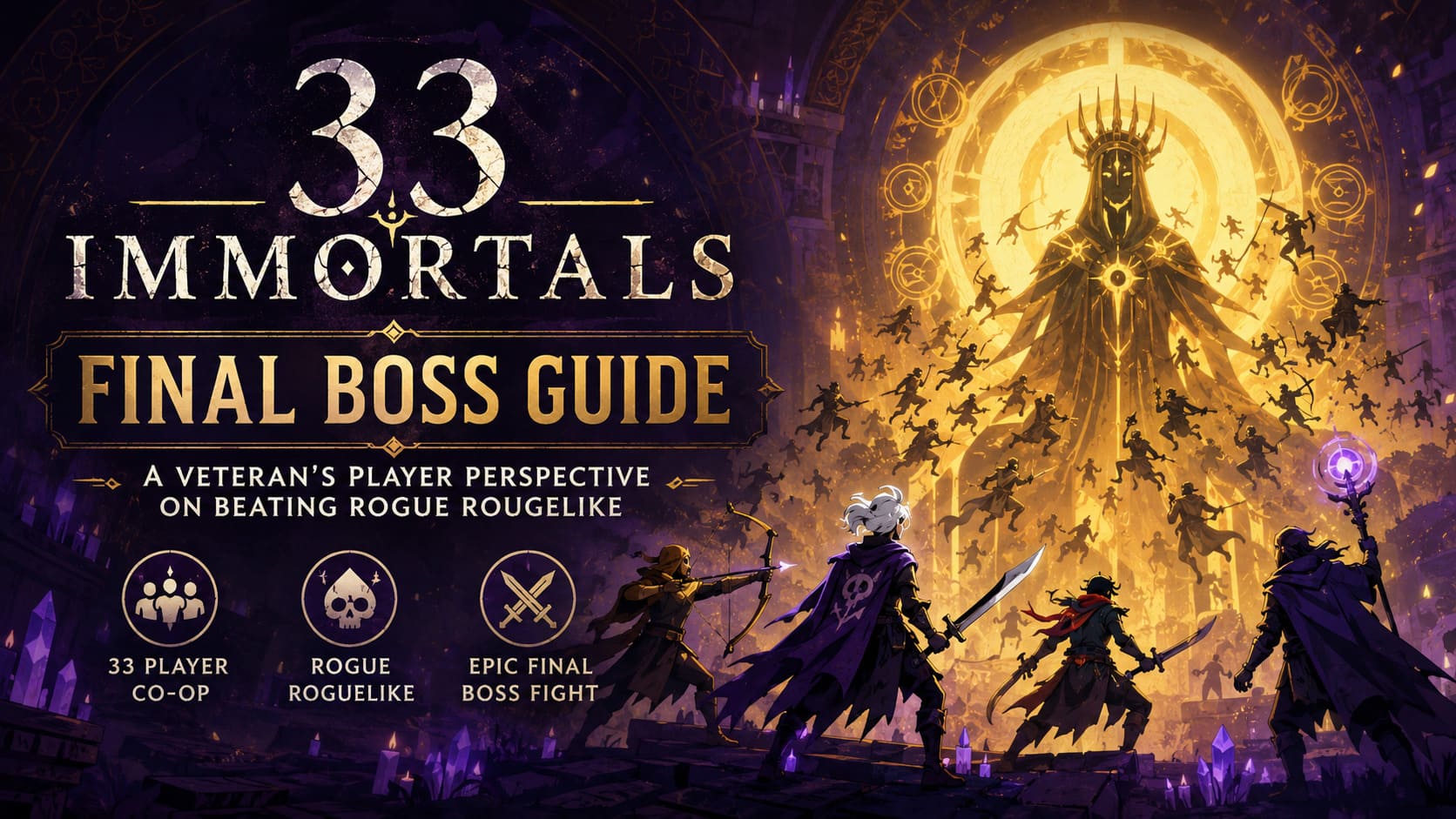
The final bosses especially feel less like traditional encounters and more like controlled disasters. You are not simply learning attack patterns—you are trying to keep 30+ strangers aligned long enough to survive reality-breaking mechanics.
And that’s exactly why it works.
Crossroads of Pride Build Guide — 33 Immortals DPS Scope After Extensive Playtime
The Truth About Endgame Difficulty
The biggest misconception players bring into endgame content is that failure comes from low damage or missed dodges. In reality, most wipes happen because the group stops functioning as a unit. One or two players start chasing personal DPS goals, another ignores mechanics, and suddenly the entire structure collapses.
The final fights are built around shared responsibility. If you try to treat it like a solo ARPG boss, you are already playing it wrong.
Preparation: The Part Most Players Underestimate
Before you even step into the final arena, the run is already being decided. The most consistent successful groups I’ve been part of always followed one principle: efficiency early means survival later.
Core Preparation Priorities
There are a few consistent behaviors that separate successful teams from chaotic ones:
- Constant stat upgrades instead of hoarding resources
- Efficient map routing and objective timing
- Relic and resource awareness throughout the run
- Movement tools prioritized over raw damage
Gothic 1 Remake Permanent Potions Locations: Elixir Guide for Max Stats
Players often underestimate how much early inefficiency snowballs into late-game failure. If you are behind on upgrades, you are effectively entering the final boss underpowered, no matter how well you play mechanically.
Weapons and Roles: How Teams Naturally Form
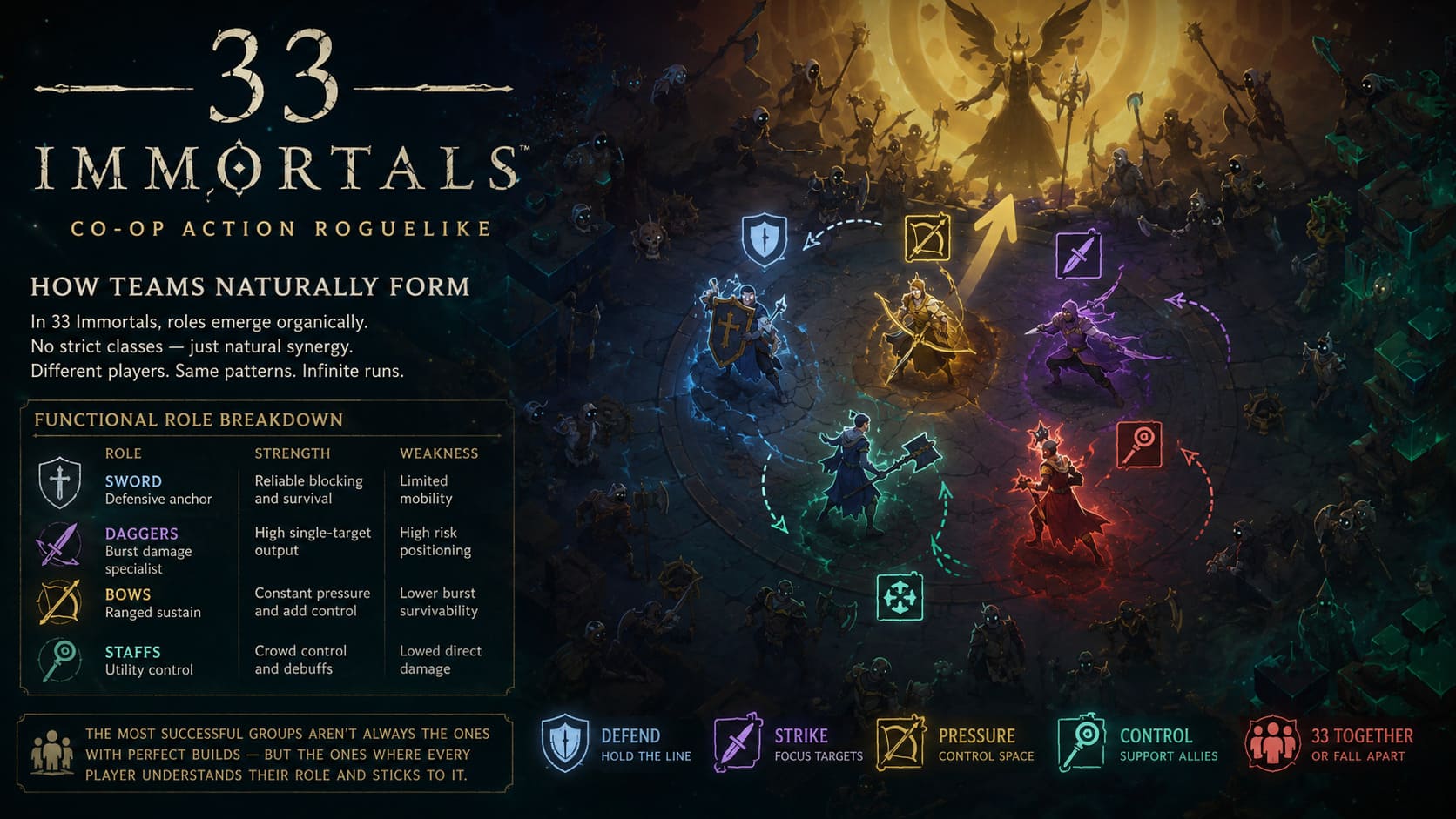
One of the most interesting aspects of 33 Immortals is that roles emerge organically, even without strict class systems. After multiple runs, you start to see the same behavioral patterns repeat across different players.
Functional Role Breakdown
| Weapon Type | Team Role | Strength | Weakness |
|---|---|---|---|
| Sword-style weapons | Defensive anchor | Reliable blocking and survival | Limited mobility |
| Daggers | Burst damage specialist | High single-target output | High risk positioning |
| Bows | Ranged sustain | Constant pressure and add control | Lower burst survivability |
| Staffs | Utility control | Crowd control and debuffs | Lower direct damage |
The most successful groups are not necessarily the ones with perfect builds, but the ones where each player understands their role and sticks to it under pressure.
Final Boss Structure: More System Than Fight
The final encounters are not single battles—they are layered systems. Each phase changes the rules of engagement, forcing teams to adapt constantly rather than repeat the same strategy.
At certain health thresholds, the boss shifts behavior entirely. This is where many teams lose control, because positioning and timing matter more than raw damage during transitions.
Critical Mechanics You Cannot Ignore
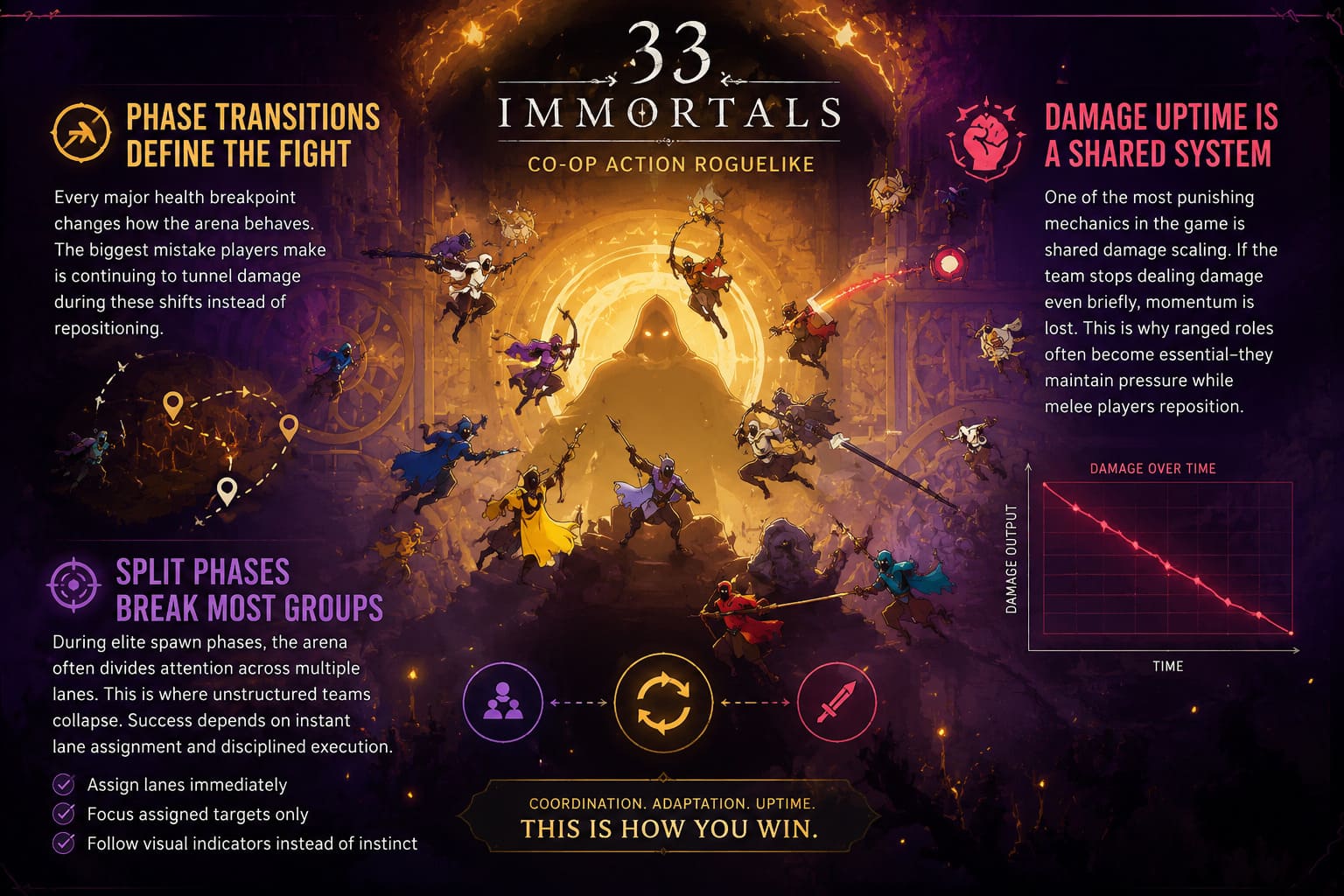
Phase Transitions Define the Fight
Every major health breakpoint changes how the arena behaves. The biggest mistake players make is continuing to tunnel damage during these shifts instead of repositioning. These transitions are where coordination matters most.
Damage Uptime Is a Shared System
One of the most punishing mechanics in the game is shared damage scaling. If the team stops dealing damage even briefly, momentum is lost. This is why ranged roles often become essential—they maintain pressure while melee players reposition.
Split Phases Break Most Groups
During elite spawn phases, the arena often divides attention across multiple lanes. This is where unstructured teams collapse. Success depends on instant lane assignment and disciplined execution.
- Assign lanes immediately
- Focus assigned targets only
- Follow visual indicators instead of instinct
What Guides Usually Get Wrong
Most guides overfocus on mechanical execution and underplay psychology. After many runs, I’ve realized the core difficulty is not the boss—it’s the players’ instincts.
Most people are trained by other games to optimize personal performance. 33 Immortals punishes that mindset. The game rewards coordination over individuality, even when it feels less efficient in the moment.
The best groups I’ve played with were not mechanically perfect—they were simply stable. They communicated implicitly through consistent behavior rather than constant coordination calls.
Practical Veteran Tips
These are the adjustments that actually improved my success rate over time:
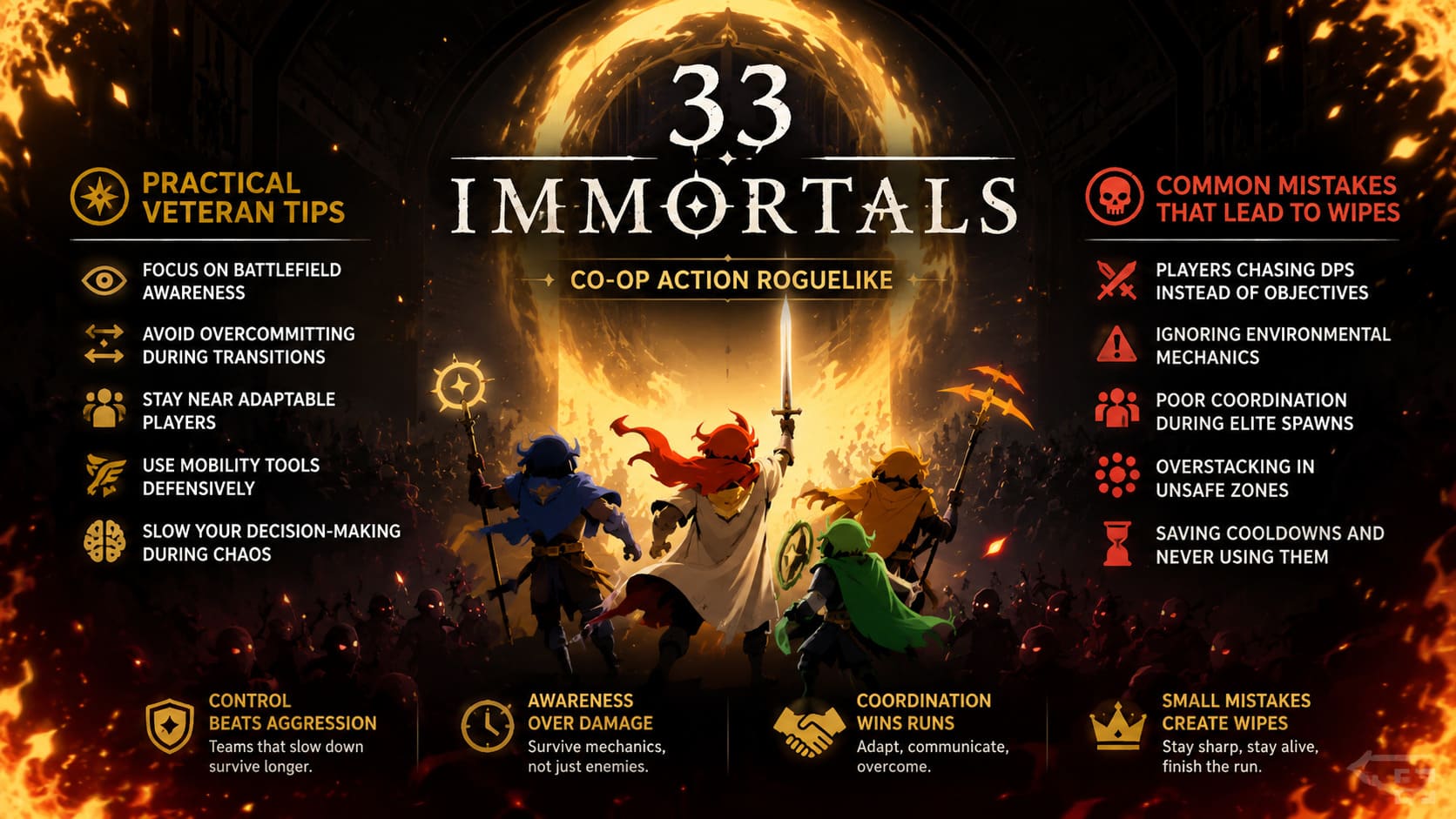
- Focus on battlefield awareness instead of only your character
- Avoid overcommitting during transition phases
- Stay near adaptable players who react quickly to mechanics
- Use mobility tools defensively, not aggressively
- Slow your decision-making during chaos instead of speeding it up
In most cases, control beats aggression. The teams that slow down survive longer than the ones that try to force damage through panic.
Common Mistakes That Lead to Wipes
- Players chasing DPS instead of objectives
- Ignoring environmental mechanics during cleanup phases
- Poor coordination during elite spawns
- Overstacking in unsafe zones
- Saving cooldowns and never using them at the right time
Most wipes are not sudden—they are the result of multiple small misplays stacking together until the system breaks.
Conclusion: Why the Final Boss Actually Works
33 Immortals succeeds where many large-scale co-op games fail because it forces players to unlearn selfish habits. The final bosses are not just mechanical challenges—they are coordination puzzles under pressure with too many variables and not enough time.
Winning does not feel like mastering a boss. It feels like briefly turning a chaotic group of strangers into something unified and functional.
And that’s the real reward.