Solarpunk Lore: The Tragic History and Uplifting Secrets of the Floating Islands
For years, I thought the survival genre had run out of surprises. Every new release seemed to follow the same formula: zombies, radioactive wastelands, endless combat, and a constant struggle just to stay alive. Then Solarpunk arrived, and honestly, it felt like someone finally asked a simple question: what if survival wasn’t built around fear?
After spending dozens of hours exploring its floating islands, building renewable energy networks, and flying between cloud-covered archipelagos, I’ve come to believe that the world of Solarpunk is one of the most interesting pieces of environmental storytelling we’ve seen in recent years. What’s even more impressive is that much of its lore isn’t delivered through lengthy cutscenes or walls of text. Instead, the history of this world is hidden inside the technology, architecture, and gameplay itself.
A World Built After Humanity Learned Its Lesson
One of the things that immediately stood out to me is how different Solarpunk feels from traditional dystopian settings.
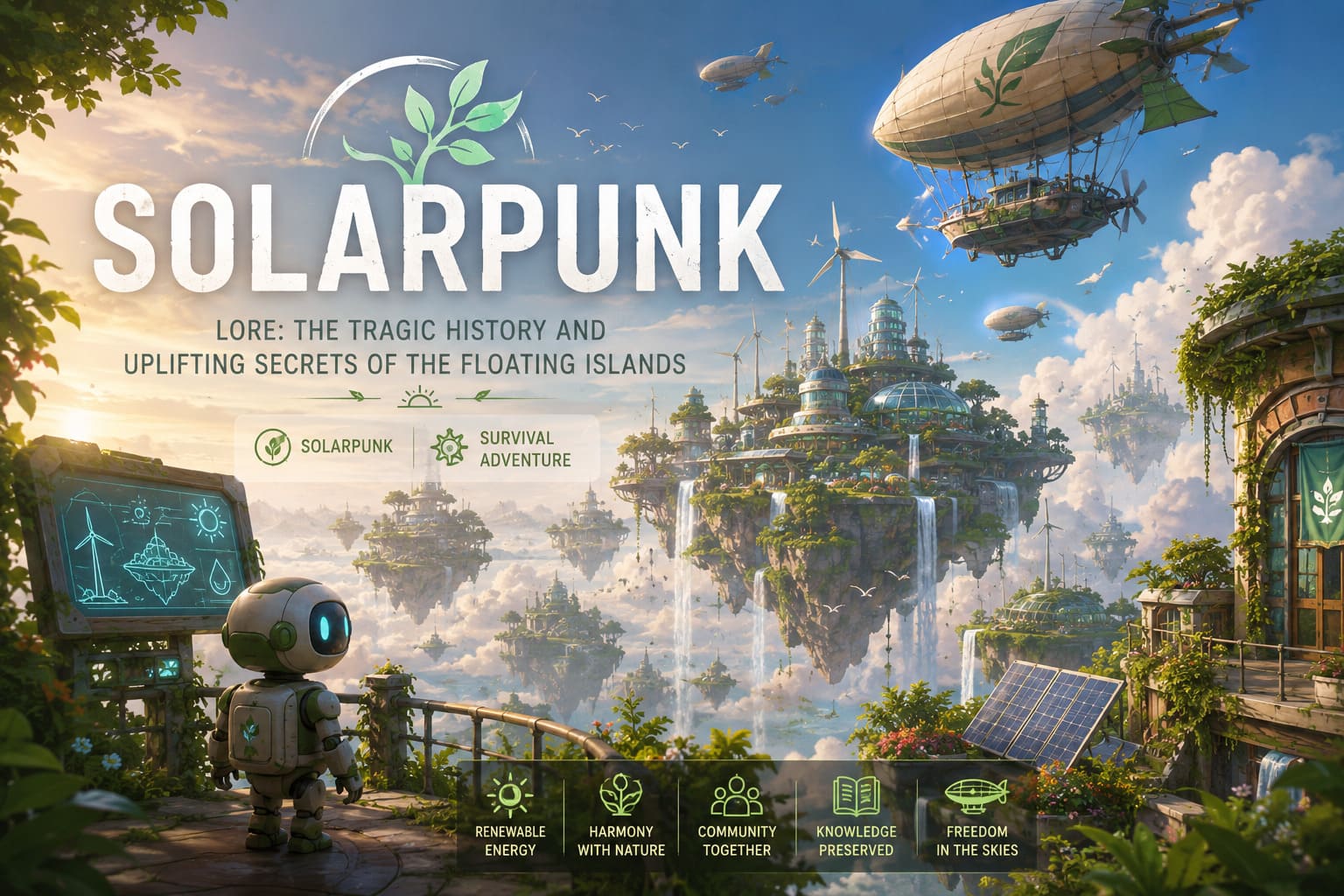
Most science-fiction survival games show humanity repeating the same mistakes over and over again. Solarpunk takes the opposite route. The floating islands appear to be the result of a civilization that nearly destroyed itself through industrial excess and environmental neglect before finally changing course.
While the game never forces a detailed historical timeline onto players, the clues scattered throughout the world suggest that the planet below suffered a devastating ecological collapse. Pollution, resource exhaustion, and climate disasters likely pushed society to its breaking point.
Instead of trying to rebuild the same destructive systems, humanity chose a radical alternative.
They went skyward.
The floating islands seem to represent humanity’s second chance—a complete restart built around sustainability rather than exploitation.
The Floating Islands Feel Like Living History
Every biome in Solarpunk tells part of a larger story.
The islands themselves don’t look like artificial structures created solely for survival. They feel carefully designed to support entire ecosystems. Forests grow naturally beside advanced machinery. Gardens coexist with automated infrastructure. Energy systems are visible everywhere, yet they never dominate the landscape.
This design philosophy creates a fascinating contrast:
| Old World Philosophy | Solarpunk Philosophy |
|---|---|
| Extraction of resources | Regeneration of resources |
| Industrial domination | Environmental harmony |
| Short-term growth | Long-term sustainability |
| Heavy pollution | Renewable energy |
| Centralized control | Community cooperation |
| Survival through conflict | Survival through balance |
As a player, you constantly feel surrounded by evidence that previous generations intentionally built a better future.
That subtle storytelling is one of the game’s greatest strengths.
Renewable Energy Isn’t Just a Mechanic — It’s Part of the Lore
Most games treat power generation as a simple progression system.
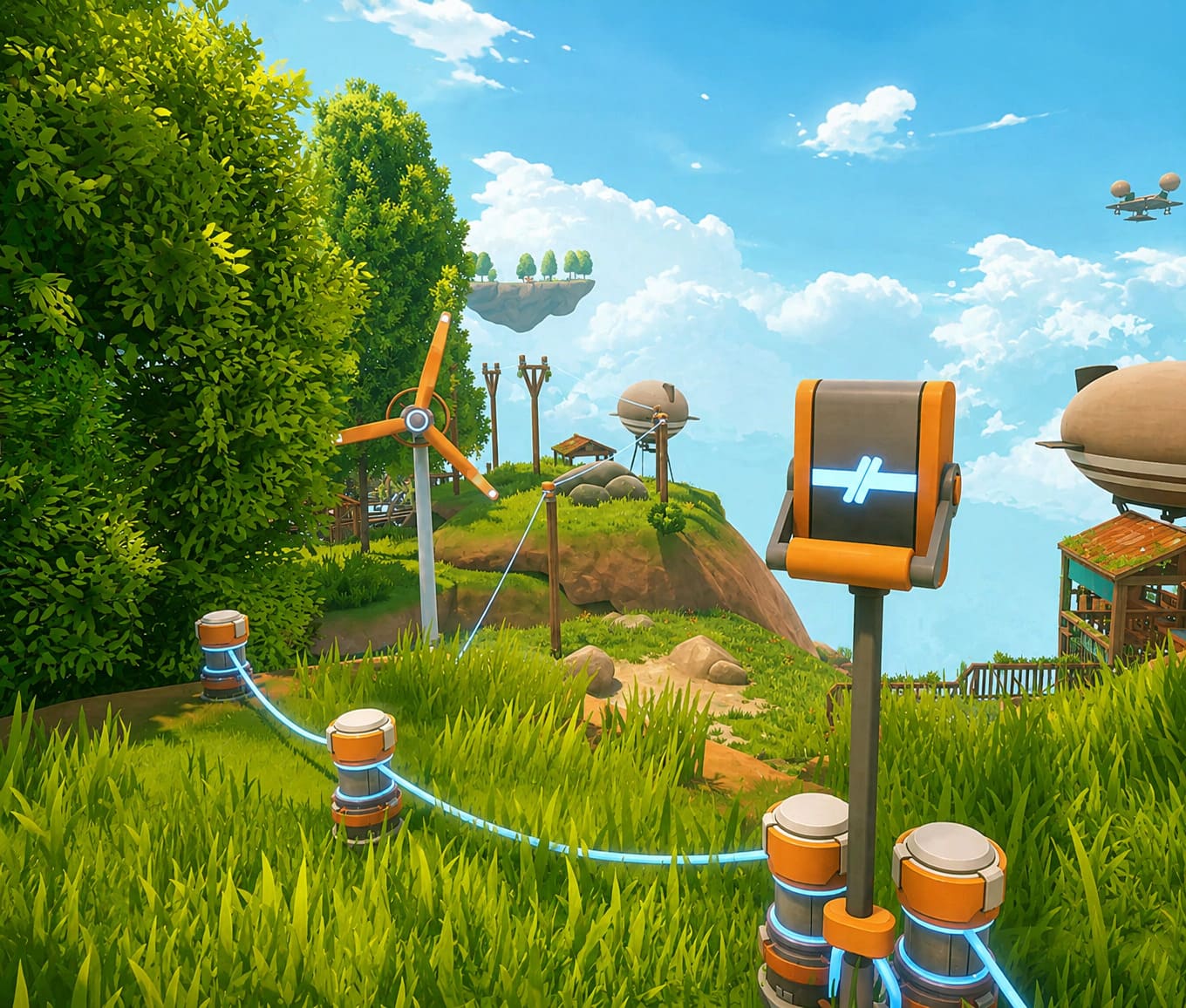
In Solarpunk, renewable energy feels like the foundation of civilization itself.
Solar panels, wind turbines, water collection systems, and automated networks aren’t just gameplay features. They represent the core values of the society that inhabits these islands.
What I particularly enjoy is how the technology never feels cold or sterile. Many science-fiction games portray advanced machinery as intimidating or oppressive. Here, technology feels almost friendly.
- Buildings are surrounded by vegetation.
- Energy systems blend into the environment.
- Automation exists to help people rather than replace them.
That approach perfectly matches the optimistic spirit of the game.
The Most Refreshing Survival Design Choice: No Predatory Mindset
One aspect of Solarpunk that deserves more attention is its treatment of animals.
After years of playing survival games where every creature exists primarily as food, crafting material, or combat experience, Solarpunk feels surprisingly different.
Animals are part of the ecosystem rather than resources waiting to be harvested.
Instead of encouraging players to dominate nature, the game encourages cooperation with it.
Some creatures help gather materials naturally. Others contribute to the environment simply by existing within it. This creates a much more peaceful atmosphere while reinforcing the world’s environmental themes.
It’s a small design choice, but it changes the entire mood of the experience.
The Silent Robot Is More Important Than It Seems
Among all the mysteries hidden in Solarpunk, the robot companion is probably my favorite.
At first glance, it looks like a simple tutorial guide.
The more I played, however, the more it felt like something far more significant.
The robot appears to act as a living archive from an earlier era. Every blueprint it unlocks, every technological upgrade it reveals, and every progression milestone it oversees suggests that it was created to preserve knowledge across generations.
Rather than lecturing players through dialogue, the robot teaches through discovery.
This approach creates a stronger connection between gameplay and narrative. Unlocking new technologies feels less like checking off objectives and more like recovering pieces of humanity’s forgotten history.
The robot never steals the spotlight, yet it quietly becomes one of the most important characters in the game.
Airships Changed Everything
If the floating islands are the heart of Solarpunk, airships are undoubtedly its soul.
The first time I launched my customized airship and sailed across the clouds, I understood why so many players have fallen in love with this game.
Airships represent freedom.
They symbolize humanity’s ability to reconnect after generations of separation.
The lore strongly suggests that many island communities were once isolated due to dangerous weather patterns and vast distances between landmasses. The development of clean-energy airships likely transformed society by reopening trade routes, sharing resources, and allowing cultures to interact once again.
From a gameplay perspective, this creates an incredible sense of adventure.
Every journey feels meaningful because the sky itself becomes part of the world-building.
Instead of crossing empty terrain, you’re navigating a living environment filled with mystery and possibility.
Why Solarpunk’s Optimism Feels So Unique

Modern games often rely on conflict to create engagement.
Solarpunk takes a different path.
The game’s central message seems to be that progress and sustainability don’t have to be opposites. Technology doesn’t automatically lead to dystopia. Automation doesn’t automatically destroy communities. Human advancement doesn’t automatically require environmental sacrifice.
That optimistic vision is surprisingly rare in modern gaming.
In many ways, Solarpunk feels less like a fantasy and more like a hopeful thought experiment about what humanity could become if it learned from its mistakes.
Solarpunk Release Date & Xbox Game Pass Guide: Everything You Must Know
Final Thoughts
After exploring countless survival worlds over the years, I can confidently say that Solarpunk stands out because of its philosophy rather than its mechanics alone.
Yes, the building system is enjoyable.
Yes, the automation tools are satisfying.
Yes, the airship exploration is fantastic.
But what truly makes the game memorable is the world behind those systems.
The floating islands aren’t just beautiful places to build a base. They’re symbols of a civilization that chose cooperation over greed, sustainability over exploitation, and hope over despair.
Whether you’re interested in environmental storytelling, relaxing survival gameplay, or simply discovering one of the most distinctive worlds released in 2026, Solarpunk offers something genuinely refreshing.
And after spending time among its clouds, it’s hard not to wish more survival games were brave enough to imagine a future this optimistic.