Path of Exile 2 King in the Mist Guide: Spirit Rescue and Endgame Farming Strategy
When I first reached the King in the Mist in Path of Exile 2, I assumed he was just another side encounter tucked away in Act 1. After all, ARPG campaigns are full of optional bosses that drop a few items and disappear from relevance once the endgame begins.
That assumption turned out to be completely wrong.
The King in the Mist is one of the most important bosses in the entire progression path of PoE 2. He introduces players to the Spirit system, grants a permanent character upgrade, and later returns as a dangerous endgame encounter that can become a serious source of profit. Whether you’re pushing your first character through the campaign or building an Atlas farming strategy, this is a boss you cannot afford to ignore.
Why Spirit Is One of the Most Valuable Resources in PoE 2
One of the biggest design changes in Path of Exile 2 is the separation of permanent skill reservations from your mana pool.
Veteran PoE players are used to reserving mana for auras and other persistent effects. In PoE 2, those abilities instead use a dedicated resource called Spirit.
Spirit is responsible for maintaining many of the strongest long-term buffs in the game, including permanent summons and reservation-based utility skills. The problem is that your character starts with virtually no Spirit available, meaning you must earn it through progression.
Several bosses throughout the game permanently increase your maximum Spirit. Missing these encounters can significantly weaken an otherwise powerful build.
The King in the Mist is usually the first major source of Spirit that players encounter.
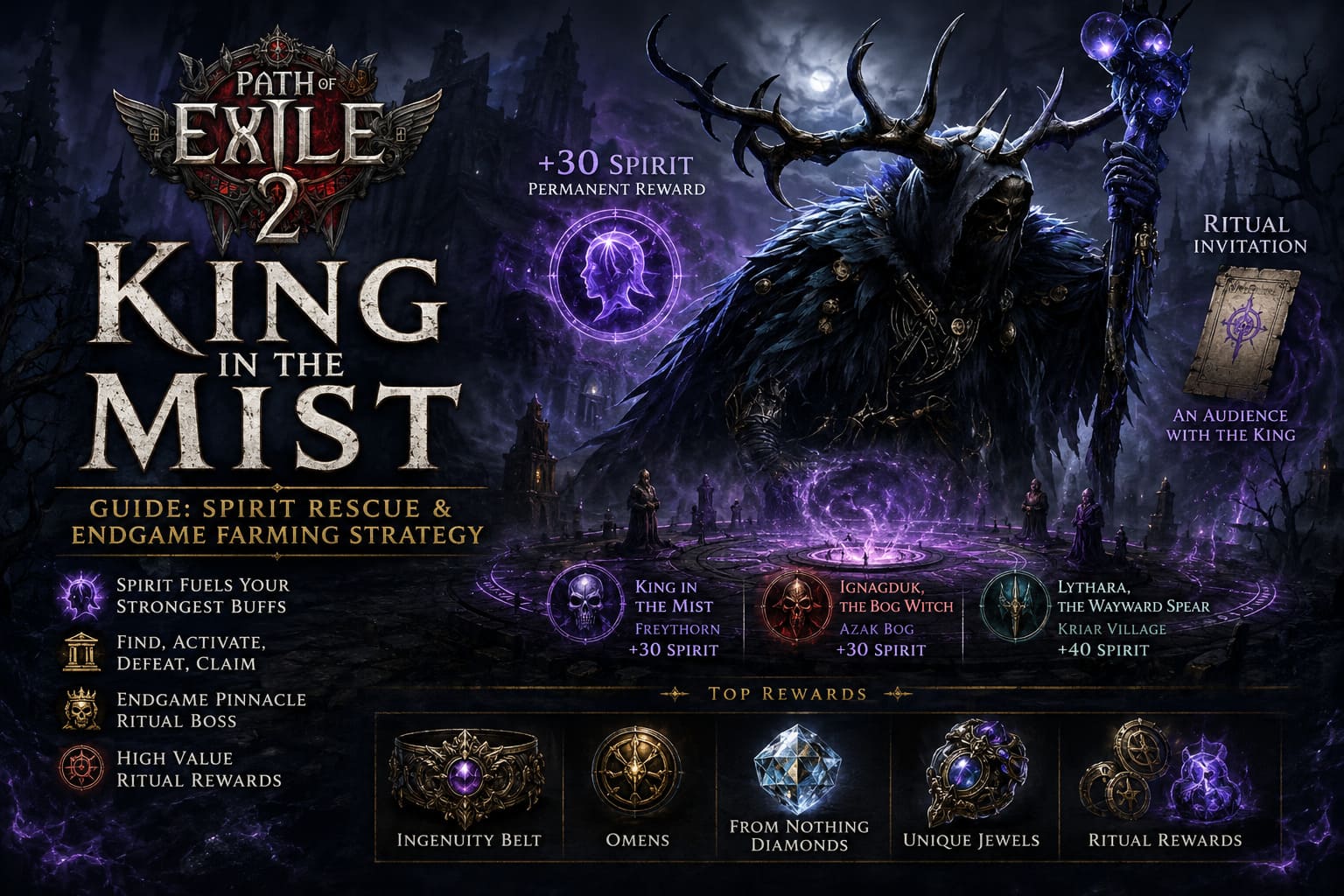
| Boss | Location | Spirit Reward |
|---|---|---|
| King in the Mist | Freythorn (Act 1) | +30 Spirit |
| Ignagduk, the Bog Witch | Azak Bog | +30 Spirit |
| Lythara, the Wayward Spear | Kriar Village | +40 Spirit |
Combined, these encounters provide a substantial portion of your base Spirit pool and help unlock the full potential of many endgame builds.
Finding the King in the Mist During the Campaign
The first version of the encounter takes place in Freythorn during Act 1.
I actually enjoyed this part more than I expected. Freythorn feels different from many early-game zones because it rewards exploration rather than simply rushing toward the exit.
The objective revolves around activating ritual sites hidden throughout the area. Players must locate three ritual altars and complete the combat events associated with each one.
The process is fairly straightforward:
- Explore the outer portions of Freythorn.
- Locate the three ritual altars.
- Defeat the enemy waves that spawn.
- Remove all three barriers.
- Access the central ritual arena.
- Summon and defeat the King in the Mist.
After victory, you’ll receive the Gembloom Skull. Many newer players accidentally leave this item sitting in their inventory, so it’s worth mentioning that you must actually use it to receive the permanent Spirit increase.
Once consumed, the reward becomes a permanent part of your character.
The Return of the King in the Mist During Endgame
What makes this boss especially interesting is that his story doesn’t end after Act 1.
Later in the Atlas, the King returns as a full-fledged pinnacle encounter.
Unlike the campaign version, this fight requires a special invitation item called An Audience with the King.
This item is primarily obtained through Ritual mechanics. Players can either:
- Purchase it using Ritual Favours after multiple deferrals.
- Trade for it through the player economy.
- Acquire it through farming Ritual-focused Atlas strategies.
Once obtained, the invitation is used at the Realmgate, opening access to the Crux of Nothingness, where the true version of the King awaits.
The difficulty jump is enormous compared to the campaign encounter.
The Most Important Mechanics to Learn
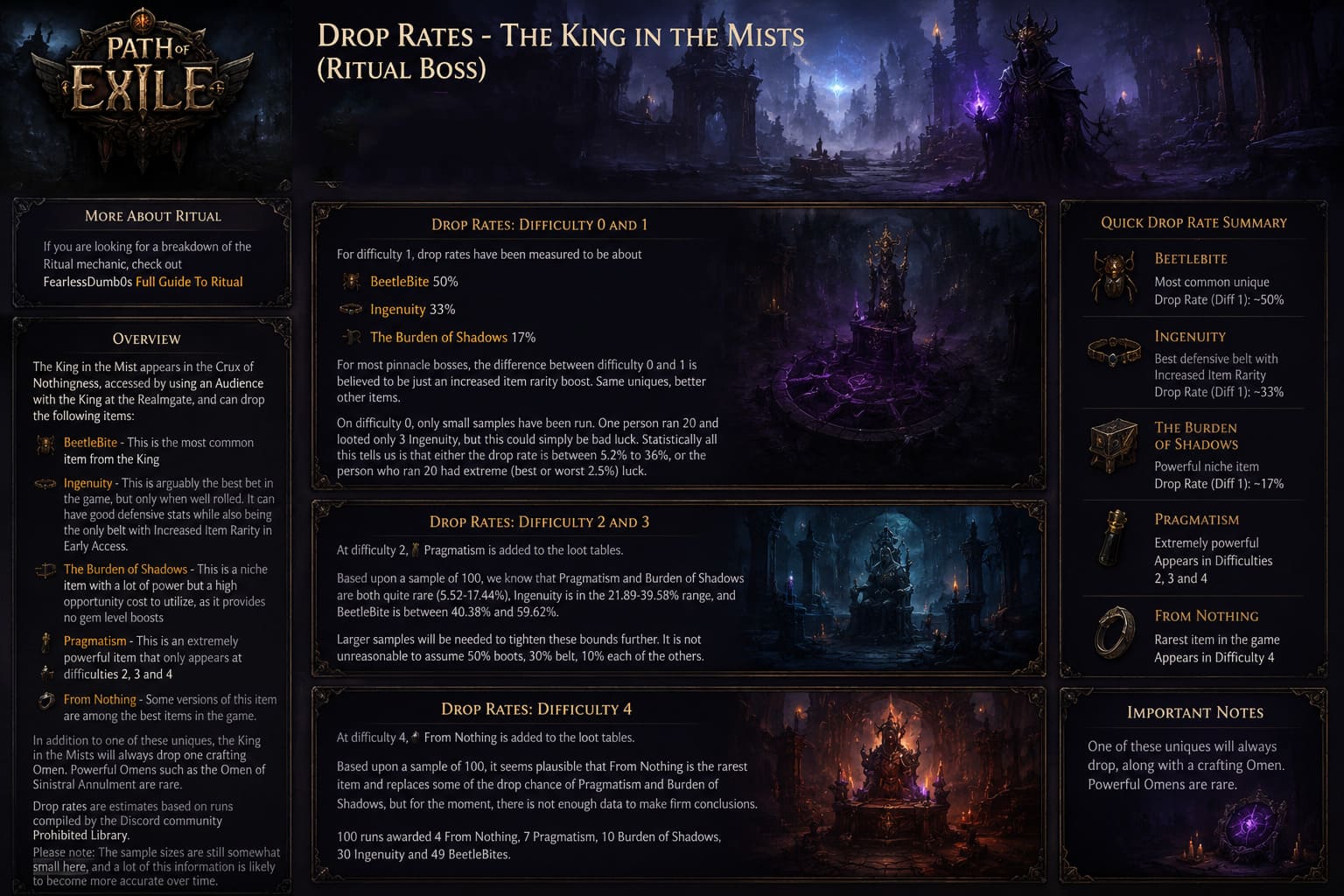
One thing I genuinely appreciate about this fight is that it rewards attention rather than raw damage output.
You can enter the arena with excellent gear and still get eliminated quickly if you ignore the boss mechanics.
Ritual of Dance
This mechanic is marked by a purple visual indicator.
When affected, you must keep moving.
Standing still for too long causes dangerous roots to emerge from the ground, often leading directly into a lethal follow-up attack.
The first few times I encountered this mechanic, I instinctively stopped to cast and immediately paid the price.
Ritual of Meditation
This is the exact opposite mechanic.
A red marker appears above your character, signaling that movement must stop immediately.
The key detail many players miss is that you can still attack, cast spells, and use abilities. You simply cannot reposition while the effect remains active.
The fight becomes dramatically easier once you mentally separate movement from attacking.
Destroy the Fetishes Immediately
Throughout the battle, the King summons ritual fetishes around the arena.
Ignoring them is a mistake.
- Restore the boss’s defenses.
- Create dangerous ground effects.
- Increase pressure during already difficult phases.
Whenever one appears, it should become a priority target.
Phase Two Changes Everything
The real challenge begins when the boss transitions into his second stage.
Once the King reaches the transformation threshold, the encounter becomes significantly more chaotic.
Massive dark orbs begin drifting through the arena while additional hazards appear around the edges of the battlefield.
This phase often feels less like a traditional boss fight and more like a survival challenge.
The safest approach is maintaining a circular path around the arena while carefully monitoring your surroundings.
Getting trapped between multiple hazards is usually what causes deaths here.
In my experience, ranged characters naturally have an easier time during this stage because they can continue dealing damage while focusing almost entirely on positioning.
Melee characters need much tighter timing windows and generally require more familiarity with the encounter.
Chaos Resistance Is Not Optional

If there is one piece of advice I’d give every player attempting the endgame version, it’s this:
Cap your Chaos Resistance.
Many encounters in PoE 2 allow players to get away with mediocre Chaos Resistance values. The King in the Mist is not one of them.
The fight deals substantial chaos-based damage, and even small resistance differences can dramatically affect survivability.
Before spending valuable invitations, make sure your defenses are properly prepared.
A failed run is usually far more expensive than upgrading a few gear pieces beforehand.
Is Farming the King in the Mist Worth It?
For many players, absolutely.
The encounter has developed a reputation as one of the more rewarding Ritual-focused farming strategies available in the current endgame.
Of course, profitability depends on market conditions, build strength, and overall efficiency, but several rewards consistently retain value.
| Reward Type | Why Players Want It |
|---|---|
| Ingenuity Belt | Powerful endgame unique item |
| Omens | Important for advanced crafting and progression |
| From Nothing Diamonds | Valuable crafting and trading components |
| Unique Jewels | Build-defining passive tree customization |
| Ritual Rewards | Additional economic value through Ritual systems |
The Ingenuity belt alone is enough to keep many players repeatedly running the encounter.
Path of Exile 2: How to Reset Passive Skill Tree (Complete Respec Guide)
Best Builds for Consistent Farming
While many builds can clear the encounter, some archetypes tend to perform more comfortably.
Popular choices often include:
- High critical strike caster builds.
- Orb of Storms variants.
- Ritual-focused Magic Find characters.
- Summoner builds with strong minion control.
- Spirit-focused archetypes capable of maintaining constant damage uptime.
Minion builds deserve special mention because they can often handle the boss’s summoned objects more efficiently than traditional damage builds, reducing overall pressure during the encounter.
Path of Exile 2 Spirit Walker Leveling Guide: Best Spirit Gems and Builds for Patch 0.5
Final Thoughts
The King in the Mist is one of the best examples of what Path of Exile 2 does well. He starts as a mysterious early-game boss that teaches important gameplay systems, then evolves into a genuinely dangerous endgame challenge with meaningful rewards.
What makes the encounter memorable isn’t simply the loot. It’s the fact that the fight demands attention. You can’t completely brute-force the mechanics, and success feels earned rather than automatic.
For newer players, defeating him is an important milestone because of the Spirit reward. For experienced Atlas farmers, he remains a boss worth revisiting thanks to his valuable drop pool and Ritual-related rewards.
If you’re planning your PoE 2 progression path, make sure the King in the Mist is on your priority list. Few bosses offer such a strong combination of character power, mechanical depth, and long-term farming potential.