The Witcher 3 Remastered: Best Combat Tree Skills to Unlock First (Next-Gen Guide)
If you are starting The Witcher 3: Wild Hunt again with the Next-Gen update, one thing becomes obvious pretty quickly: Geralt can be surprisingly fragile when you do not invest his early Ability Points wisely. White Orchard may feel harmless once you know the game, but move into Velen and suddenly a few Drowners, a pack of wolves, or a group of bandits can turn a simple contract into a very messy fight.
That is why I still think the red Combat Tree is one of the safest places to put your first serious investment. Signs and Alchemy eventually become huge parts of a strong build, but your swords are always there. You use them against almost everything, and improving the basic attacks you already rely on makes the early game noticeably smoother.
After spending a lot of time experimenting with different Witcher 3 builds, I would not recommend blindly unlocking skills just because they look powerful on paper. Some abilities are fantastic later but don’t do much for you when Geralt is still underleveled. Others provide an immediate benefit every time you enter combat.
So, if your goal is a strong early-game Witcher 3 Remastered build, these are the Combat skills I would prioritize first.

1. Muscle Memory Should Be Your First Serious Investment
Muscle Memory is the skill I would grab first on a fresh character without thinking twice. Fast attacks are the backbone of most early-game combat, and you are going to be using them constantly.
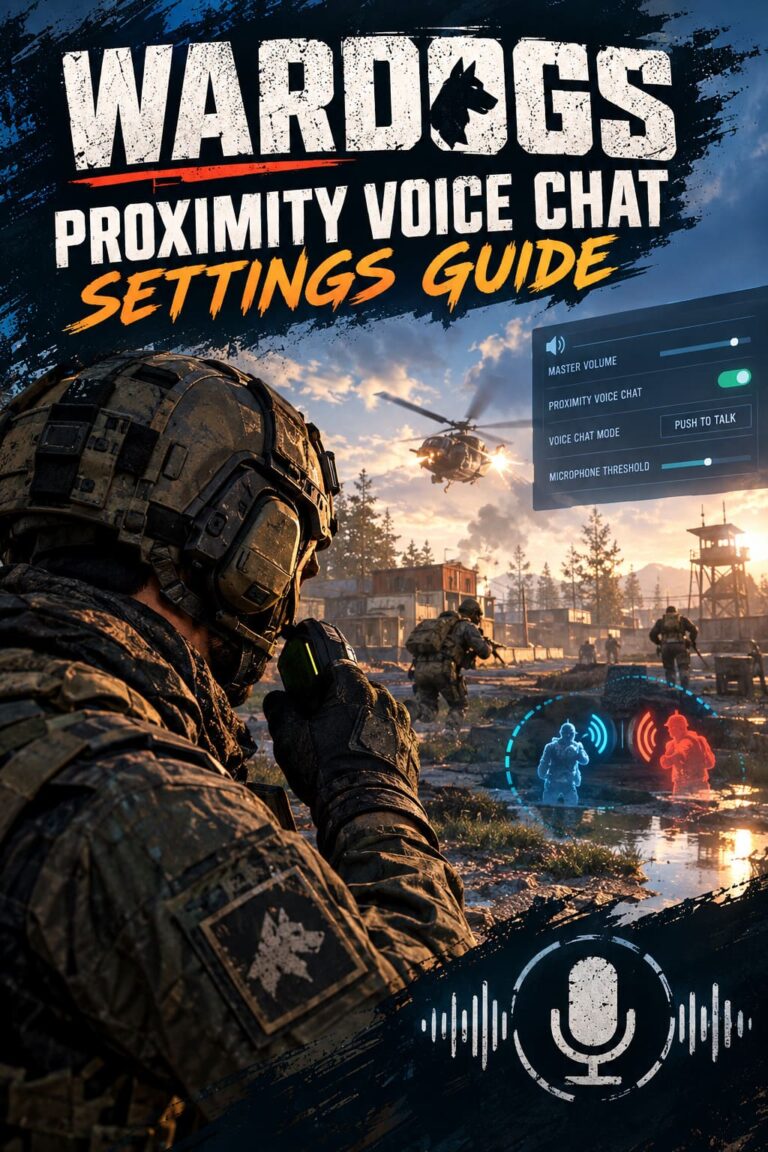
The ability increases fast attack damage by 5% per rank, reaching a 25% bonus when fully upgraded. That may not sound spectacular when you look at the number in isolation, but the important part is how often the bonus applies.
You are not waiting for a special condition. You are not building around a particular monster. You are simply hitting enemies with your sword.
That makes Muscle Memory extremely efficient during the first several levels. Drowners, Ghouls, wolves, Nekkers and human enemies all feel easier to deal with when your basic attacks start hitting harder.
I also prefer fast attacks early because they give Geralt much more room to react. Heavy attacks can hit extremely hard, but committing to a long animation at the wrong moment is an easy way to get punished. Fast attacks let you strike, dodge and reposition without feeling like you have glued Geralt to the floor.
2. Strength Training Gives Your Build Some Necessary Muscle
Strength Training is the natural partner to Muscle Memory. It increases heavy attack damage by 5% per rank, with a maximum 25% bonus.
I would not necessarily rush to max it immediately if fast attacks are your preferred playstyle. Still, putting some points into Strength Training is worthwhile because heavy attacks solve problems that fast attacks sometimes cannot.
Armored enemies, shield users and tougher monsters can make repeated light strikes feel inefficient. When you get an opening, a properly timed heavy attack can take a substantial chunk out of an enemy’s health bar.
There is also something satisfying about having both attack styles available. Witcher 3 combat works best when you stop thinking of Geralt’s attacks as two separate buttons and start treating them as tools for different situations.
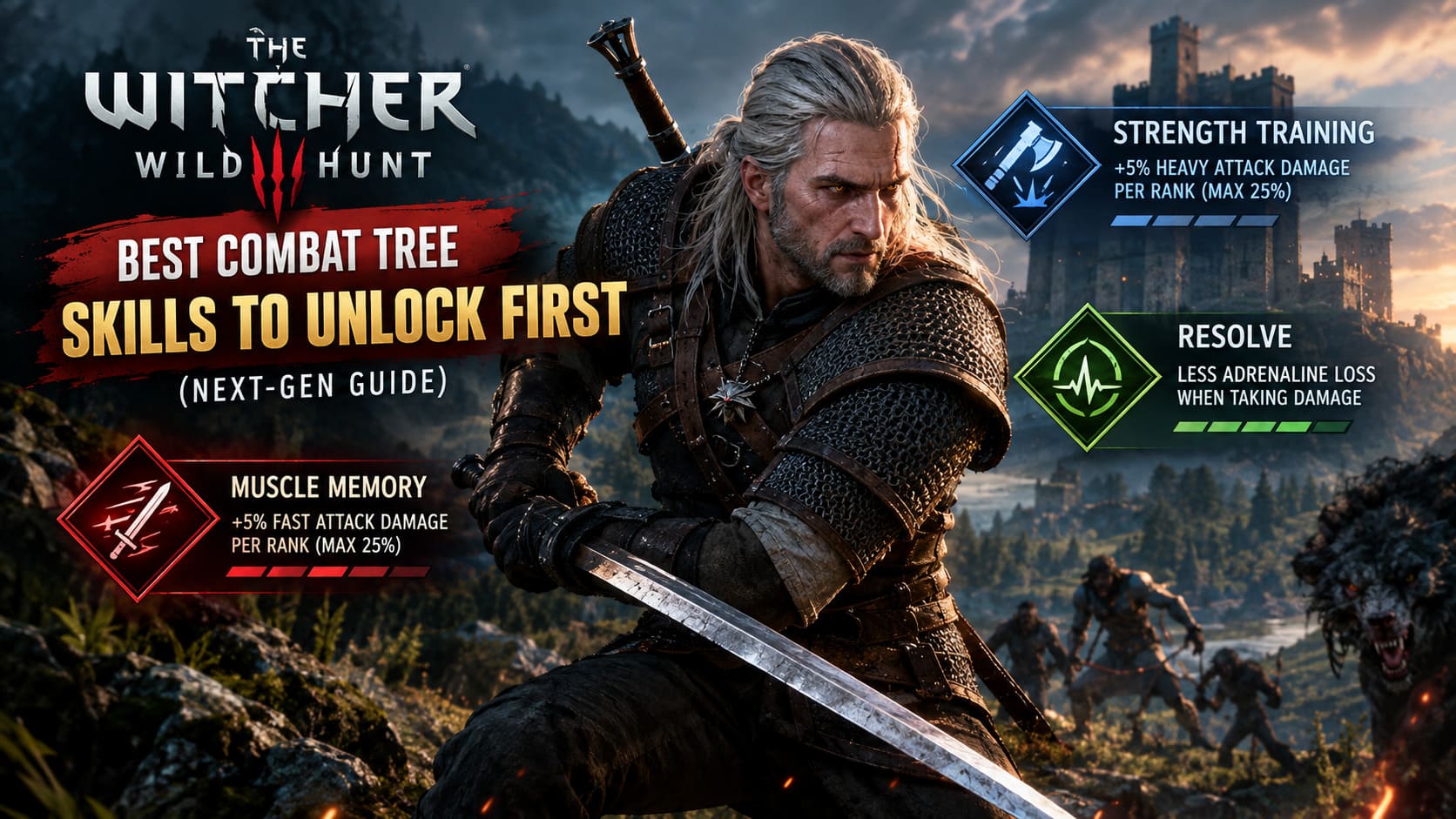
| Skill | Role | Early Value | Best Use |
|---|---|---|---|
| Muscle Memory | Fast Attack | Very High | General DPS and mobile combat |
| Strength Training | Heavy Attack | High | Armored and staggered enemies |
| Resolve | Adrenaline | High | Maintaining combat momentum |
| Arrow Deflection | Defense | Situational | Bandit camps and ranged enemies |
| Fleet-Footed | Defense | Very High | Dodging and difficult encounters |
3. Resolve Is More Useful Than It Looks
Resolve is one of those abilities that is easy to overlook when you are browsing the Combat Tree for flashy damage bonuses. I actually think it becomes increasingly valuable as the difficulty rises.
The skill reduces the amount of Adrenaline you lose when taking damage. At maximum investment, incoming damage no longer removes your stored Adrenaline.
That matters because Adrenaline is more than another little bar beneath your health. It contributes to your combat potential and eventually becomes an important resource for some of Geralt’s strongest abilities.
On lower difficulties, you can get away with being sloppy. On Blood and Broken Bones or Death March, mistakes hurt. You will occasionally get clipped by an attack you thought you dodged, especially when several enemies are surrounding you.
Resolve gives you a little more forgiveness. It will not make Geralt invincible, but it prevents one mistake from completely destroying the momentum you have built during a fight.
4. Arrow Deflection Is a Bandit-Camp Lifesaver
There are few things more irritating in early Witcher 3 combat than finally getting into a good rhythm against a group of enemies, only to hear an arrow fly past Geralt’s head.
Then another one comes.
And another.
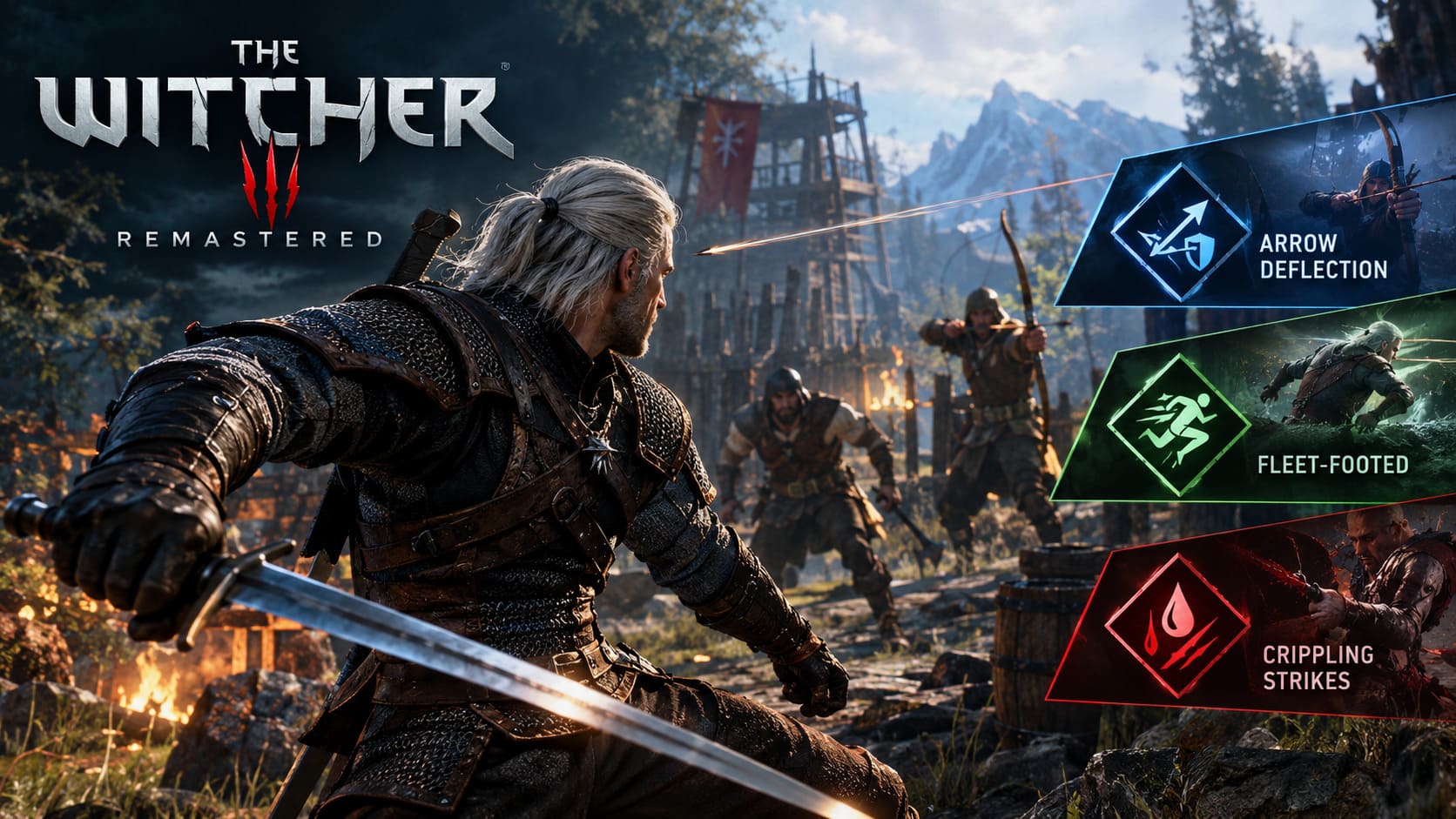
Arrow Deflection addresses that problem directly. The ability lets Geralt deflect incoming arrows while parrying, and further investment improves the way those projectiles can be handled.
I would not necessarily put it ahead of Muscle Memory for every character, but if you are spending a lot of time fighting bandits, this skill can completely change the experience.
Instead of constantly rolling away from archers while trying to deal with melee enemies, you can use your guard to neutralize incoming projectiles. That means fewer interruptions and much better control of chaotic encounters.
For players who hate fighting large human camps, this is one of the first defensive Combat skills I would consider.
5. Fleet-Footed Is Where Dodging Starts Feeling Really Good
Once you have access to the second tier of the Combat Tree, Fleet-Footed deserves serious attention.
Dodging is already one of Geralt’s best defensive tools. Unlike rolling, a quick dodge keeps you close to the enemy and lets you immediately return to attacking. That makes it especially effective against monsters with predictable melee patterns.
Fleet-Footed improves that defensive window by reducing damage taken while dodging, eventually reaching a 100% reduction at maximum rank.
This is one of those upgrades that can make you wonder how you played without it. A dodge that previously looked like a near miss suddenly becomes a reliable defensive maneuver.
And that becomes increasingly important against monsters that have aggressive tracking. The Witcher 3 has plenty of enemies capable of turning toward Geralt during an attack, so simply moving away is not always enough. A well-timed dodge gives you a much safer answer.
6. Crippling Strikes Is a Later Goal, Not an Early Priority
Crippling Strikes is worth keeping in mind, but I would not build your first few levels around reaching it.
This high-tier fast attack ability adds Bleeding to your attacks, giving enemies a damage-over-time effect that continues working after you disengage.
That makes it particularly interesting for tougher enemies and bosses. You can land your attacks, apply the effect, then back away to heal, cast a Sign or simply wait for an opening without completely losing your damage output.
For a fast-attack-focused build, it is an excellent long-term target. Just don’t sacrifice useful early-game abilities to reach it too quickly.
Don’t Ignore Your Other Skill Trees
A strong Combat build does not mean spending every single Ability Point on red skills. Some of the best improvements to Geralt’s combat loop come from other parts of the skill system.
Cat School Techniques
If you are building around fast attacks, Cat School Techniques is one of the most obvious complementary choices. The perk rewards wearing Light Armor and works extremely well with an agile sword-focused playstyle.
This is the direction I would take if you enjoy constantly moving around enemies, attacking quickly and relying on dodges rather than standing your ground.
Griffin School Techniques
Players who want to combine swordplay with Signs have a different option. Griffin School Techniques works with Medium Armor and supports a more balanced playstyle built around stamina regeneration and frequent Sign usage.
It is especially appealing if Quen, Igni and other Signs are already a major part of how you approach fights.
Axii: Delusion
Axii: Delusion is not a Combat Tree skill, but I still recommend grabbing it early if you have a spare point.
Its biggest advantage is outside combat. It can unlock additional dialogue options that help Geralt avoid certain fights and save money in situations where another character might demand a bribe.
It also fits naturally into the early-game progression because it provides utility without forcing you into a completely different combat build.
Witcher 3 Next-Gen Gem Farming: How to Farm Flawless Rubies and Runestones Fast
My Recommended Combat Progression for Levels 2–10
If I were starting another Witcher 3 Remastered playthrough today, I would keep the early progression fairly simple. There is no reason to overcomplicate the first ten levels.
- Levels 2–4: Invest heavily in Muscle Memory to strengthen your primary fast-attack damage.
- Level 5: Consider Axii: Delusion if you want additional dialogue options and utility.
- Levels 6–7: Add Strength Training for heavier damage, or choose Arrow Deflection if ranged enemies are causing problems.
- Level 8: Pick Cat School Techniques for an agile Light Armor setup or Griffin School Techniques for a Sign-heavy Medium Armor build.
- Level 9+: Start working toward Tier 2 Combat skills, with Fleet-Footed being one of the most useful defensive targets.
You do not have to follow this order perfectly. The best thing about Witcher 3’s skill system is that you can adapt to what the game is throwing at you. If you are getting destroyed by archers, take Arrow Deflection. If monsters are punishing your dodges, invest in Fleet-Footed. If everything simply feels too slow to kill, keep pushing your offensive skills.
The Witcher 3 Remastered Best Builds Guide: Geralt Setups For 2026
The Combat Skills I Would Prioritize
The biggest mistake with early Witcher 3 builds is trying to create the perfect endgame character before Geralt even leaves Velen. You do not need that. You need a handful of abilities that make every fight easier right now.
Muscle Memory is my clear starting point because it improves something you will use constantly. Strength Training gives you a powerful alternative when heavy attacks are the better answer, while Resolve helps protect the Adrenaline you build during longer encounters. Arrow Deflection is incredibly useful when ranged enemies become a nuisance, and Fleet-Footed becomes one of the best defensive upgrades once you reach the second tier.
From there, you can start shaping Geralt around your preferred playstyle. Go Light Armor and lean into fast attacks if you want a nimble swordfighter. Mix Medium Armor with Signs if you prefer a more flexible build. Eventually, you can experiment with Bleeding, Whirl, Rend, Adrenaline-focused setups and the more specialized late-game combinations.
But early on, I would keep things practical.
Hit harder. Dodge better. Keep your Adrenaline. Deal with archers.
That simple foundation makes the first major regions of The Witcher 3 Remastered much more comfortable, and it gives you plenty of room to experiment once Geralt has the levels, gear and ability slots to support a more complicated build.