The Witcher 3 Next-Gen Death March Skills Tier List (2026 Guide)
The Witcher 3: Wild Hunt gives you an absurd number of ways to build Geralt. That sounds great until you start playing on Death March and realize that not every skill deserves a precious ability point.
This is where things get interesting.
On lower difficulties, you can get away with throwing points into whatever looks cool. Want to make Igni spit flames everywhere? Go for it. Like crossbows? Sure. Want to experiment with random general skills? Nobody is stopping you.
Death March is different.
A bad skill choice does not necessarily ruin a playthrough, but a string of bad choices can make Geralt noticeably weaker than he needs to be. Enemies hit brutally hard, healing becomes more important, and fights that felt trivial on Normal suddenly demand actual preparation. The Next-Gen version also changed how several systems interact, especially once mutations, upgraded Witcher gear, oils, potions, and mutagens enter the picture.
After spending way too much time looking at skill combinations and trying different builds, I’ve come to a fairly simple conclusion: Death March rewards efficiency more than experimentation.
That doesn’t mean every build has to look identical. It means some abilities give you dramatically more value for the points you spend.
Here is my The Witcher 3 Next-Gen Death March Skills Tier List for 2026, covering Combat, Signs, Alchemy, and General skills.

Death March Skills Tier List
| Tier | Skills | Why They Matter |
|---|---|---|
| S | Acquired Tolerance, Muscle Memory, Strength Training, Gourmet, Exploding Shield | Exceptional damage, survivability, and efficiency |
| A | Synergy, Whirl, Delusion, Sunder Armor | Powerful skills that define specific builds |
| B | Active Shield, Poisoned Blades, Melt Armor, Razor Focus | Useful, but more situational |
| C | Fleet Footed, Puppeteer, Firestream | Niche abilities with questionable point efficiency |
| F | Sun and Stars, Survival Instinct, Steady Shot | Very poor late-game value |
S-Tier: Skills I Would Build Around
These are the abilities that consistently justify their place on a Death March character sheet. Some are universally useful, while others become ridiculous when combined with the right build.
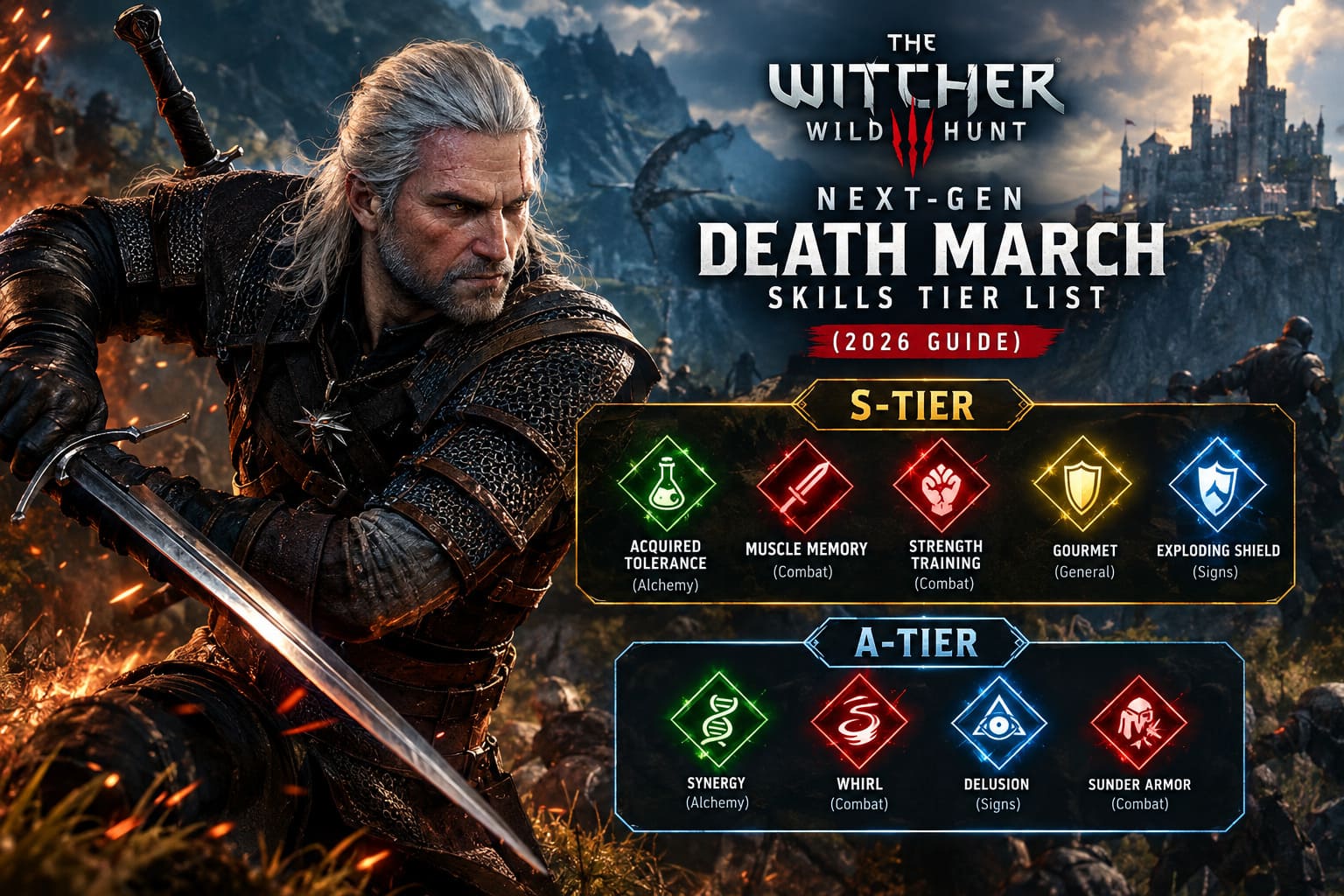
Acquired Tolerance — Alchemy
If you’re playing a serious Alchemy build, Acquired Tolerance is one of the first skills I want.
The reason is simple: Toxicity controls how aggressively Geralt can use potions and decoctions. Acquired Tolerance increases your maximum Toxicity based on the number of alchemy formulas you know, giving an experienced alchemist considerably more freedom.
And this gets silly once your collection of formulas starts growing.
Decoctions can provide enormous passive benefits, while potions fill specific gaps depending on the encounter. Instead of constantly worrying about hitting your Toxicity ceiling, you can build around having multiple effects active at once.
For Death March, that extra flexibility is incredibly valuable.
My take: if Alchemy is part of your endgame plan, don’t sleep on this skill.
Muscle Memory & Strength Training — Combat
These are not flashy abilities. They don’t make Geralt summon lightning or turn into an unstoppable mutant.
They just make his swords hurt more.
And honestly? That’s exactly why I love them.
Muscle Memory improves Fast Attack damage, while Strength Training improves Strong Attack damage. Both provide immediate value without demanding complicated conditions, special positioning, or resource management.
Death March has a very straightforward combat lesson: the less time an enemy spends alive, the fewer opportunities it has to kill you.
That makes raw damage surprisingly important.
These skills also work beautifully with Witcher gear and other bonuses that increase Geralt’s attack power. They are foundational rather than flashy, but foundational skills are often the ones that quietly carry an entire playthrough.
Gourmet — General
I have a soft spot for Gourmet because it is one of those skills that seems almost boring until you actually play Death March.
Then you realize how convenient it is.
Gourmet dramatically extends the duration of food-based regeneration. Instead of eating something and getting a tiny burst of recovery that disappears almost immediately, you can use food as a long-lasting source of healing.
That matters during exploration.
You can finish a nasty fight, eat some food, and keep moving through the world without immediately spending another potion. Over a long playthrough, that convenience adds up.
Is Gourmet still essential once your late-game Alchemy setup becomes completely ridiculous?
Not necessarily.
But during the early and middle portions of a Death March run, I consider it one of the most comfortable investments you can make.
Exploding Shield — Signs
Quen is already one of Geralt’s most important tools.
Exploding Shield makes it even more useful when you’re surrounded.
When the Quen shield breaks, the ability creates a defensive response that can knock enemies away and create breathing room. That sounds simple, but spacing is everything on Death March.
Getting surrounded by several enemies is one of those situations where a fight can go from controlled to disastrous almost instantly.
Exploding Shield gives you a reset button.
You can break the enemy formation, create distance, dodge away, or immediately establish another Quen shield. Against groups, that extra space can be worth considerably more than a small increase to raw damage.
For players who prefer aggressive melee combat but still want a safety net, this is one of the most practical Sign upgrades.
A-Tier: Excellent, But More Build Dependent
A-Tier skills are extremely strong, but I wouldn’t automatically put every one of them into every Death March build.
They become particularly impressive when your entire character is designed around them.
Synergy — Alchemy
Synergy is one of those skills that becomes more impressive the stronger your overall character gets.
It improves the bonuses provided by mutagens in their associated ability slots. Once you’re running powerful Greater Mutagens and a properly developed skill tree, the additional bonuses become substantial.
This is particularly attractive for hybrid builds where you are stacking multiple ability categories and trying to squeeze as much value as possible from every mutagen slot.
The downside is obvious: Synergy is much more attractive later than it is at the beginning.
You have to invest heavily into Alchemy first, so this isn’t something I would rush during the opening hours just because a guide says it is powerful.
Late-game? Excellent. Early-game? There are usually better things to buy first.
Whirl — Combat
Whirl is probably one of the most satisfying abilities in the entire game.
There is just something ridiculously fun about Geralt spinning through a crowd while swords, armor, and body parts go everywhere.
Mechanically, though, Whirl has an important drawback: it consumes resources and can leave you committed to an animation at exactly the wrong moment.
Against weak enemies, that often doesn’t matter.
Against something capable of deleting half your health bar in one attack?
Different story.
Whirl becomes especially nasty when combined with Severance, allowing its range to become much more threatening. Against groups of weaker enemies, it can completely change the pace of a fight.
I wouldn’t blindly spam it against every boss, but for crowd control, it is one of the most entertaining and effective Combat skills available.
Delusion — Signs
Delusion is one of those abilities that doesn’t necessarily look powerful when you’re comparing damage numbers.
Its value comes from everything around the combat system.
Axii dialogue options can unlock alternate solutions, provide additional experience opportunities, and occasionally allow Geralt to bypass a situation that would otherwise turn into a fight.
That makes Delusion particularly useful for players who actually engage with The Witcher 3 as an RPG rather than treating every NPC as another health bar.
It also has practical combat utility by making Axii-based control more effective.
It isn’t a damage monster, but Death March isn’t only about damage.
Sometimes the strongest move is simply not fighting the enemy in the first place.
Sunder Armor — Combat
Heavy enemies can become annoying when your attacks start feeling like you’re hitting a stone wall.
That’s where Sunder Armor comes into play.
The ability reduces enemy resistance when using Strong Attacks, making it particularly attractive against heavily armored targets and creatures that can withstand repeated punishment.
I especially like skills like this because they solve a specific problem instead of simply throwing another generic percentage bonus onto Geralt’s character sheet.
If your build already revolves around Strong Attacks, Sunder Armor becomes much more interesting.
B-Tier: Good Skills With a Catch
B-Tier doesn’t mean bad.
It means I’d think twice before spending the point.
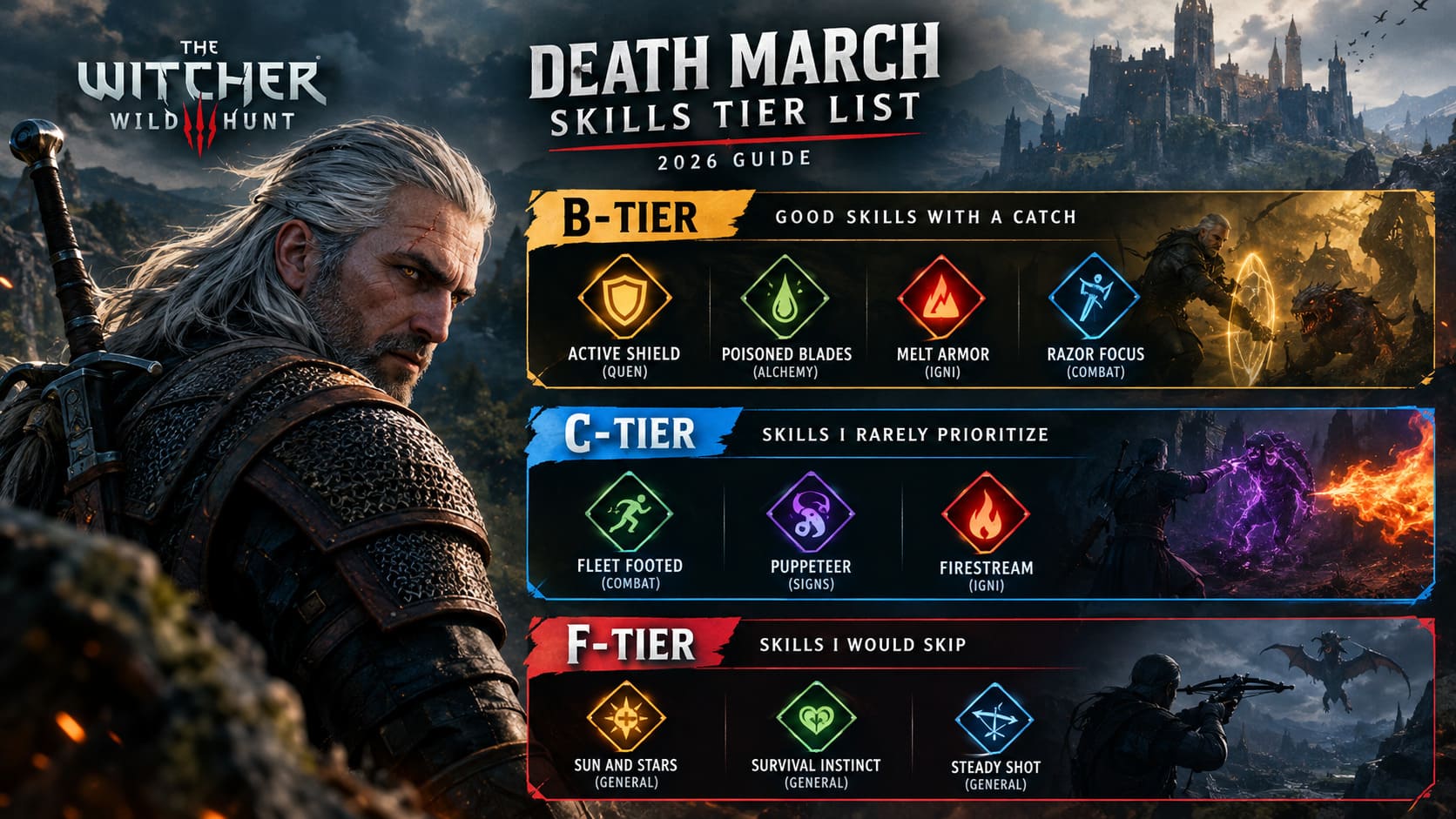
Active Shield — Quen
Active Shield sounds amazing on paper because it allows Quen to absorb incoming damage while restoring Geralt’s health.
The problem is that you’re committing to a defensive stance.
Death March combat often rewards movement. You dodge, reposition, attack, cast Quen, dodge again, and keep the enemy guessing. Standing still and channeling a defensive ability can interfere with that rhythm.
It’s useful.
It’s just not always the kind of useful that I want when a pack of monsters is trying to tear Geralt apart.
Poisoned Blades — Alchemy
Poisoned Blades adds another layer of damage when you’re using the appropriate oils.
Against enemies with enormous health pools, additional damage over time can certainly help. The problem is convenience.
You need the correct oil.
You need to maintain your preparations.
And you need to spend points in a skill whose benefit is largely dependent on how consistently you use oils.
For an Alchemy-heavy player who already prepares for every encounter, this can be very good.
For everyone else, it’s easier to leave it alone.
Melt Armor — Igni
Melt Armor gives Igni additional value against armored targets by reducing their armor.
That’s useful when fighting heavily protected humans and certain armored creatures.
The problem is that not every enemy cares equally about armor reduction. Against enemies where the main challenge is simply a massive health pool, the benefit isn’t nearly as exciting.
A specialist tool, then.
Not something I would build an entire Death March character around.
Razor Focus — Combat
Razor Focus gives Geralt an immediate Adrenaline Point when entering combat and improves Adrenaline generation from sword attacks.
That can be excellent for builds built around Adrenaline mechanics.
If you’re planning to use abilities that constantly consume Adrenaline, the faster generation makes a noticeable difference.
The reason I keep it in B-Tier is that high-end builds can already generate plenty of resources through equipment and other synergies.
It is strong.
It just isn’t universally necessary.
C-Tier: Skills I Rarely Prioritize
These abilities aren’t completely useless. They simply struggle to compete for points when you’re building specifically for Death March.
Fleet Footed — Combat
Fleet Footed reduces damage taken when Geralt is hit while dodging.
The problem is almost philosophical.
If you’re dodging correctly, you shouldn’t be getting hit very often in the first place.
The skill essentially gives you compensation for imperfect timing. That’s not worthless, especially for newer players, but as your mechanical skill improves, its value becomes less convincing.
I’d rather invest the point into something that improves what Geralt does when I’m actually playing well.
Puppeteer — Signs
Puppeteer is fun.
I understand why people love it.
Turning an enemy against its own allies sounds exactly like the kind of weird Witcher magic that should create memorable encounters.
The practical problem is damage output.
The controlled enemy often isn’t dangerous enough to justify waiting around for it to do your work. On Death March, removing the threat yourself is frequently faster and more predictable.
Great for experimentation.
Harder to justify in an optimized build.
Firestream — Igni
Firestream looks fantastic.
That’s the nicest thing I can say about it.
The continuous stream of fire is visually satisfying, but Death March punishes Geralt for standing in one place. The fixed channeling animation can leave you exposed to attacks from enemies outside your immediate field of view.
Against certain targets it can work.
As a general-purpose combat solution, I prefer mobility.
F-Tier: Skills I Would Skip
This is where I get much more ruthless.
If you’re trying to optimize a Death March character, these are the skills I would leave behind unless you’re deliberately doing a challenge or role-playing build.
Sun and Stars — General
The regeneration numbers simply don’t keep pace with the amount of damage Geralt takes later in the game.
A small passive regeneration effect can feel useful during the opening hours, but once enemy damage and Geralt’s maximum health start scaling upward, the benefit becomes increasingly difficult to notice.
There are better ways to recover health.
Survival Instinct — General
A flat increase to maximum Vitality sounds attractive when Geralt is still relatively fragile.
The problem is scaling.
A static health bonus doesn’t become more valuable simply because enemies get stronger. As the game progresses, the extra health represents a smaller and smaller part of your overall survivability.
I’d rather invest in damage mitigation, healing, Quen, Alchemy, or skills that help me avoid damage entirely.
Steady Shot — General
The crossbow is incredibly useful.
The crossbow as Geralt’s primary damage weapon?
Not so much.
You use it to deal with flying enemies, underwater targets, and certain combat situations where swords aren’t practical. Increasing its damage is therefore a very different proposition from increasing sword damage.
A 25% increase sounds impressive until you remember what you’re actually multiplying.
For a Death March sword build, this is one of the easiest points to skip.
My Death March Skill Strategy for 2026
If I were starting a fresh The Witcher 3 Next-Gen Death March run today, I wouldn’t try to unlock every powerful skill immediately.
I’d build in stages.
Early Game
Focus on the basics:
- Muscle Memory
- Strength Training
- Gourmet
- Exploding Shield
The goal here isn’t to create some ridiculous endgame monster. It’s simply to make Geralt reliable.
You want strong attacks, dependable healing, and a defensive tool that can save you when several enemies collapse on you at once.
Mid Game
This is where I would start leaning harder into Alchemy.
Work toward:
- Acquired Tolerance
- Synergy
- Oil and potion improvements
- Mutagen-focused bonuses
Once your Alchemy infrastructure starts coming together, Geralt becomes much more flexible.
Late Game
This is where the build starts becoming genuinely absurd.
Combine your preferred Witcher gear with strong mutagens, upgraded potions, decoctions, mutations, and the Combat skills that complement your chosen playstyle.
An Alchemy/Combat hybrid remains one of the most natural approaches for players who want to make Death March considerably more manageable without turning the game into a completely different experience.
And that’s the important distinction.
You don’t need every S-Tier skill.
You need a group of skills that actually work together.
The Witcher 3 Next-Gen Console Commands List: PC Cheat Guide (2026 Update)
Final Thoughts
The best thing about The Witcher 3’s skill system is that it allows plenty of experimentation. The worst thing about it is that the game doesn’t always make the opportunity cost obvious.
Some skills look fantastic in the menu and then barely matter ten hours later.
Others look boring.
Then you realize you’ve been using them for 40 hours and can’t imagine playing without them.
Witcher 3 Remastered Serpentine Gear Guide: Locations, Stats, and Crafting Strategies
That’s why my Death March priorities lean heavily toward raw sword damage, Quen utility, Alchemy scaling, mutagen bonuses, and reliable healing. These are the mechanics that consistently solve problems rather than simply looking impressive on the character screen.
For a general-purpose 2026 Death March run, I’d start with Muscle Memory, Strength Training, Gourmet, and Exploding Shield, then transition toward Acquired Tolerance and Synergy as the Alchemy side of the build develops.
After that, the details depend on how you actually like playing Geralt.
If you love spinning through groups, build around Whirl. If you prefer Signs, invest accordingly. If you enjoy preparation and potion management, push Alchemy harder. The game gives you room to do all of that.
Just don’t waste half your ability points trying to make the crossbow your main weapon.
Geralt has killed monsters for less.