The Witcher 3 Remastered PC Requirements vs. 2022 Next-Gen Patch: Full Breakdown
I honestly thought I had seen every possible version of The Witcher 3 by now.
The original 2015 release. The endless graphics mods. The 2022 Next-Gen Update. Ray tracing. DLSS. Ultra settings that could make even a powerful gaming PC start sweating.
Apparently, CD Projekt Red wasn’t finished.
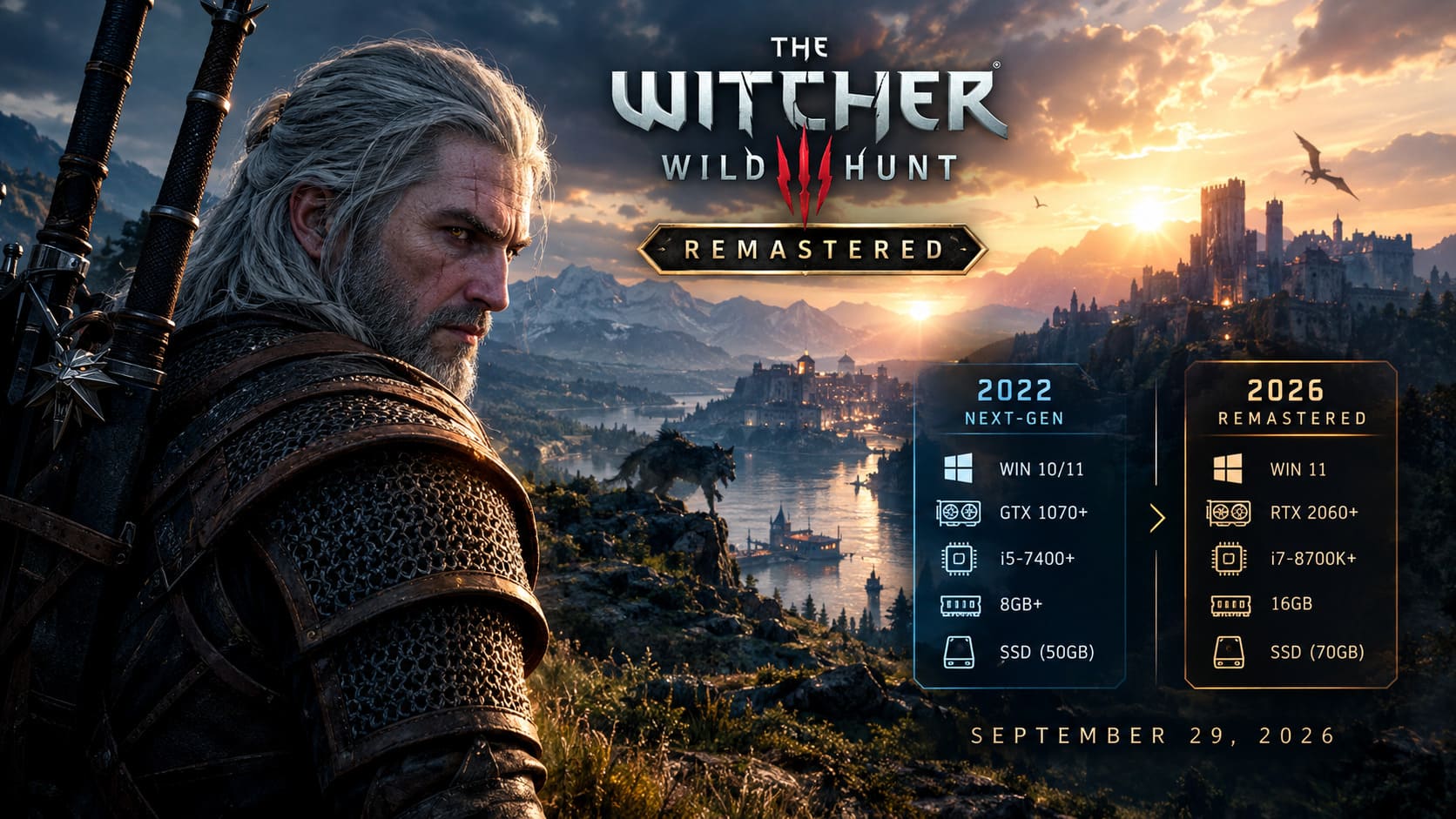
Following the Gamescom Opening Night Live 2026 announcement, The Witcher 3: Wild Hunt – Remastered is set to arrive on September 29, 2026, and this isn’t being treated like another ordinary patch. The new version represents a much more aggressive technical overhaul, and that has one immediate consequence for PC players:
The old hardware requirements are no longer the whole story.
If you’ve been happily playing the 2022 Next-Gen version on an older gaming PC, you may look at the new requirements and wonder whether Geralt has suddenly become much more demanding to run.
After comparing the old baseline with the new 2026 specifications, I think that’s exactly what happened.
The Witcher 3 Has Come a Long Way Since 2015
It’s easy to forget how accessible The Witcher 3 originally was.
Back in 2015, something around an Intel Core i5-2500K, 6GB of RAM, and a GTX 660-class GPU could get you into the game. Obviously, that didn’t mean you were playing at Ultra settings with perfect frame rates, but the hardware barrier was reasonable.
Then came the December 2022 Next-Gen Update, which changed the technical picture considerably.
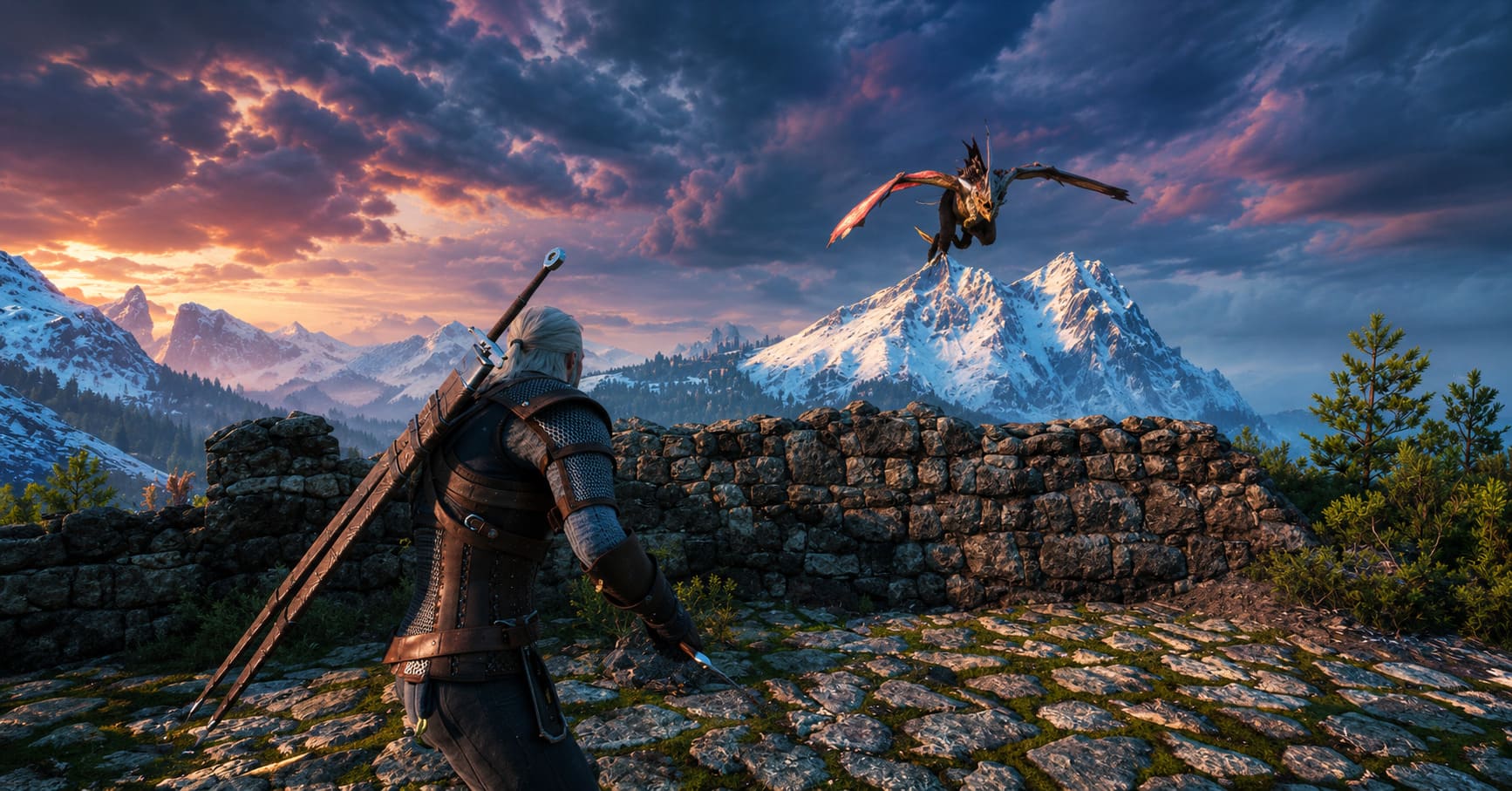
CD Projekt Red introduced ray tracing, upgraded textures, improved lighting, DirectX 12 support, DLSS 2, FSR 2 and a number of other graphical improvements. But importantly, the game still retained a DirectX 11 path.
That distinction mattered.
You could have an older PC, avoid the most demanding graphical features and still enjoy The Witcher 3 without rebuilding your entire system.
The 2026 Remastered version appears to be drawing a much harder line.
2022 vs. 2026: The PC Requirements at a Glance
Here’s the comparison that caught my attention most.
| Specification | 2022 Next-Gen Minimum | 2026 Remastered Minimum |
|---|---|---|
| Operating System | Windows 7/8/8.1/10 64-bit | Windows 11 64-bit |
| API | DirectX 11 / 12 | DirectX 12 |
| CPU | Core i5-2500K / AMD A10-5800K | Core i5-8400 / Ryzen 5 2600 |
| GPU | GTX 660 2GB / Radeon HD 7870 | GTX 1660 6GB / RX 5500 XT 8GB / Arc A580 |
| RAM | 6GB | 12GB |
| Storage | 50GB HDD/SSD | 70GB SSD |
And the recommended specifications move upward as well:
| Specification | 2022 Next-Gen Recommended | 2026 Remastered Recommended |
|---|---|---|
| Operating System | Windows 10/11 64-bit | Windows 11 64-bit |
| API | DirectX 12 | DirectX 12 |
| CPU | Core i5-7400 / Ryzen 5 1600 | Core i7-8700K / Ryzen 5 3600X |
| GPU | GTX 1070 / RX 480 | RTX 2060 Super / RX 6600 XT / Arc B580 |
| RAM | 8GB | 16GB |
| Storage | 50GB SSD | 70GB SSD |
On paper, some of those numbers don’t look outrageous in 2026.
But compared directly with the 2022 requirements, the change is pretty dramatic.
The Biggest Change Isn’t Actually the GPU
The GPU requirements are obviously going to attract most of the attention, but personally, I think the storage and platform requirements tell us more about what CD Projekt Red is trying to do.
The 2026 version reportedly drops support for:
- Windows 10
- DirectX 11
- Mechanical hard drives
That last one is particularly interesting.
In 2022, an SSD was recommended for the best experience, but the game wasn’t built around the assumption that every player had one.
The Remastered version is different.
A 70GB SSD installation is now part of the baseline, suggesting that the new asset-streaming system expects much faster storage access.
And that makes sense when you consider the kind of visual improvements being targeted.
Higher-resolution assets, more complex geometry, more advanced lighting and increasingly detailed environments all create pressure on the streaming pipeline. An HDD can technically store enormous amounts of data, but modern open-world engines aren’t just asking, “Can you store it?”
They’re asking:
“How quickly can I retrieve it?”
That’s a very different question.
12GB RAM Is the New Reality
Another change that’s impossible to ignore is the RAM requirement.
The 2022 minimum was only 6GB.
The 2026 Remastered baseline jumps to 12GB, while the recommended specification reaches 16GB.
For a new PC build, 16GB is hardly shocking. In fact, plenty of gaming PCs already have 32GB.
But if you’re still using an older system with 8GB of memory, this is where the upgrade conversation gets real.
The operating system itself needs memory. Background applications need memory. Launchers, browsers, overlays and recording software all take their share.
That means a machine technically equipped with 12GB isn’t going to have 12GB sitting there exclusively for Geralt.
For that reason, I’d personally consider 16GB the practical starting point, even if you’re aiming for the minimum graphics preset.
The CPU Requirement Is a Bigger Deal Than It Looks
This is probably my favorite part of the comparison because it shows how dramatically PC game engines have changed.
The old minimum CPU was the legendary Core i5-2500K.
That Sandy Bridge chip is practically a gaming museum piece now, but it was once an absolute favorite among PC enthusiasts.
The 2026 minimum moves to a Core i5-8400 or Ryzen 5 2600.
That’s not simply a faster processor requirement. It’s a move toward a more modern multicore baseline.
The Remastered version is expected to lean heavily on DirectX 12 and parallel rendering. More complicated environments, rendering workloads, simulation and asset management can all benefit from additional CPU resources.
So if you’re sitting there with an old quad-core CPU thinking, “My graphics card is still good enough,” don’t automatically assume you’re safe.
The processor could be your actual bottleneck.
Why DirectX 11 Going Away Matters
The removal of DirectX 11 is another major dividing line.
The 2022 version effectively gave PC players two different paths: a more traditional DirectX 11 experience and a more modern DirectX 12 renderer.
The Remastered release is apparently committing entirely to DirectX 12.
That gives developers more freedom to build around modern CPU/GPU architectures instead of maintaining older rendering paths.
It’s one of those changes that doesn’t sound exciting in a trailer, but it can have a huge impact on development.
Maintaining old technology means supporting old assumptions.
Removing it means developers can design around newer hardware from the beginning.
And that’s exactly what appears to be happening here.
What About Ray Tracing and Path Tracing?
This is where the recommended specification becomes slightly misleading if you only look at the numbers.
An RTX 2060 Super or RX 6600 XT as a recommended GPU doesn’t necessarily mean you’re going to run every new graphical feature at maximum settings with high frame rates.
There’s a huge difference between:
“The game runs well at recommended settings”
and
“The game runs beautifully with every advanced rendering feature enabled.”
Path tracing is an especially demanding workload.
If you want to push the Remastered version with advanced ray/path-traced lighting, high resolutions and modern frame-generation technology, you’ll want considerably more GPU horsepower than the basic recommended specification suggests.
That’s where newer RTX 40-series and RTX 50-series hardware becomes much more interesting.
For normal 1080p or 1440p gaming, the recommended-class GPUs should be a much more realistic target.
For the absolute maximum visual experience?
That’s a completely different conversation.
Windows 11 Is Another Potential Problem
The operating system requirement could actually be the most frustrating part for some players.
The 2026 baseline reportedly requires Windows 11 64-bit.
That doesn’t just mean installing a newer operating system.
Windows 11 has its own hardware compatibility requirements, including modern CPU generations and security features such as TPM 2.0 and Secure Boot in supported configurations.
So an older gaming PC can potentially fail the Remastered requirements in multiple places at once:
- The CPU may be too old.
- The motherboard may not provide the required platform features.
- The GPU may fall below the new minimum.
- The system may still be running Windows 10.
- The PC may use an HDD as its primary game drive.
At that point, upgrading one component isn’t necessarily enough.
What Happens If Your PC Can’t Run the Remastered Version?
This is where the reported legacy branch becomes important.
According to the information surrounding the release, players who don’t want—or can’t afford—to move to the new hardware baseline can remain with the 2022-era version, using the final legacy branch associated with the 4.04 generation.
That’s potentially a very sensible option for existing players.
You don’t suddenly lose access to the game you already bought just because a new technical version arrives.
The trade-off is straightforward: staying on the older branch means giving up the new rendering technology, Remastered-specific improvements and future content tied specifically to the new technical foundation.
For someone with a perfectly playable older PC, however, that’s not necessarily a disaster.
So, How Big Is the Upgrade Really?
Looking at the specifications side by side, I think the important thing is not that the Remastered version suddenly requires an outrageous gaming PC.
It doesn’t.
The bigger story is that the floor has moved.
| Hardware Area | 2022 → 2026 Change |
|---|---|
| CPU | Older quad-core → Modern 6-core class |
| GPU | 2GB-era graphics → 6GB+ modern baseline |
| RAM | 6GB → 12GB minimum |
| Storage | HDD acceptable → SSD required |
| API | DX11/DX12 → DX12 only |
| OS | Windows 7–11 → Windows 11 |
| Advanced Graphics | Ray tracing → More extensive ray/path tracing |
That’s a substantial architectural shift.
And honestly, after years of playing The Witcher 3, I’m not particularly surprised.
At some point, developers have to stop designing around hardware that is a decade old.
The interesting question isn’t whether the Remastered version is more demanding.
Of course it is.
The interesting question is whether the visual and technical improvements justify that higher baseline once players actually get their hands on it.
The Witcher 3 Remastered 2026: Release Date, Platforms, and Massive Gameplay Changes Explained
My Take: Check Your CPU and SSD Before Panicking
If you’re wondering whether your PC is ready for The Witcher 3 Remastered, don’t start by looking at the most expensive graphics card you can afford.
Check the fundamentals first.
You want a Windows 11 system, a reasonably modern six-core-class CPU, at least 12GB of RAM, a GPU around the new minimum tier or better, and an SSD.
If your PC has 16GB or 32GB of RAM, a modern six-core processor and a recent mid-range GPU, you’re already in a much more comfortable position.
And if you’re still running a Sandy Bridge CPU, 8GB of RAM and an HDD?
Well… Geralt may have finally found a monster your PC can’t slay.
The good news is that the original game isn’t disappearing.
For players who don’t meet the 2026 requirements, the legacy version provides a way to keep playing the classic Witcher 3 experience. For everyone else, the Remastered release looks like an opportunity to revisit one of gaming’s most beloved open worlds with technology that would have been completely unrealistic back in 2015.
The Continent is getting another upgrade. This time, your PC might need one too.