Graveyard Keeper 12-Skull Corpse Guide: Ultimate Autopsy & Embalming Path
After spending a ridiculous amount of time with management games, survival games, and anything that lets me optimize a system far beyond what the average player probably intended, I can say that Graveyard Keeper has one of those mechanics that starts simple and then becomes weirdly deep. At first, you’re just trying to bury bodies without making your graveyard look terrible. Eventually, you’re standing in the morgue calculating skull values and planning an autopsy like you’re solving a spreadsheet puzzle.
And honestly, that’s part of what makes Graveyard Keeper so addictive.
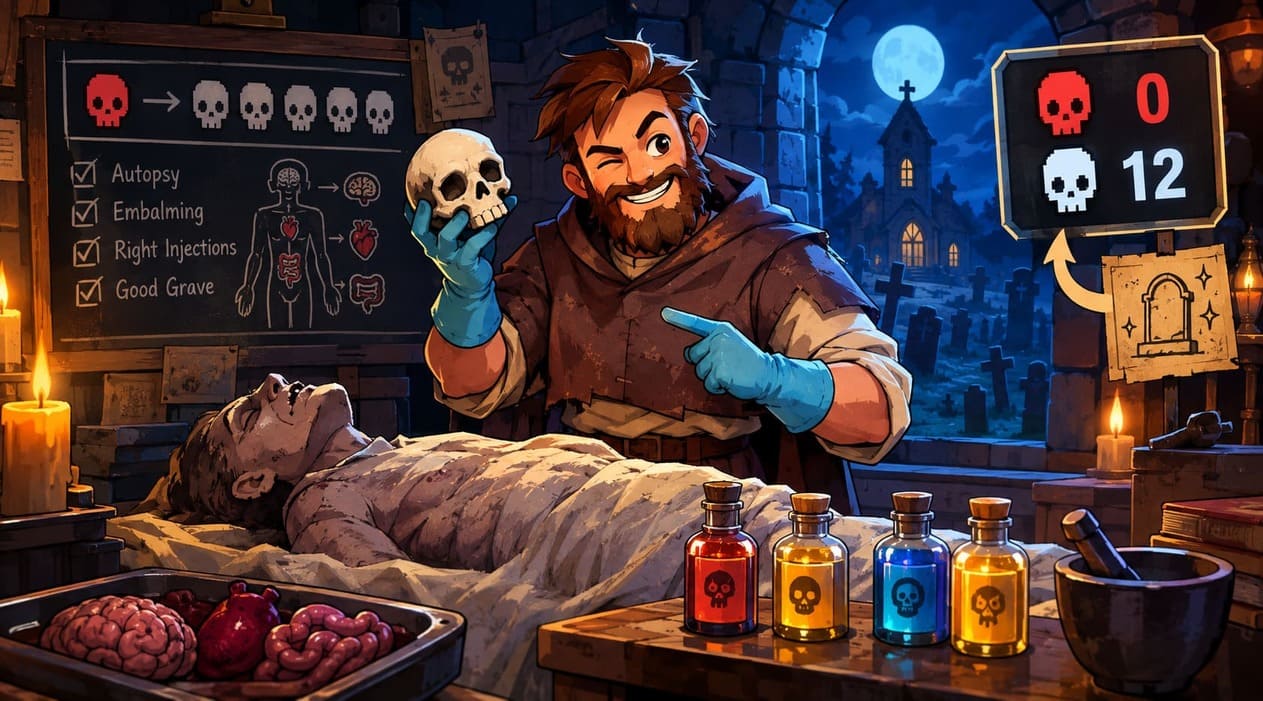
If you’re chasing the 12-skull corpse, you’re already past the casual stage. This is about squeezing every possible point out of a body, combining autopsy decisions with embalming injections, and making sure your final grave decorations actually take advantage of the corpse you’ve prepared. In the vanilla game, a 12 White Skull corpse is basically the benchmark I would aim for when building a high-end graveyard.
The important thing is that you can’t simply throw every injection into every corpse and hope for the best. The order matters, the starting corpse matters, and the organs inside the body matter much more than the game initially makes obvious.
Diablo 4 Fastest Leveling Guide 1-50: Season 15 Meta Route (2026)
How Skull Values Actually Work
Every corpse in Graveyard Keeper has Red Skulls and White Skulls. Red Skulls are the bad part of the equation because they reduce the potential graveyard rating, while White Skulls represent the positive value you want to maximize.
There is a catch, though. White Skulls don’t automatically translate into graveyard points. Your grave decorations have their own rating, so a corpse with more White Skulls than your headstone and fence can support isn’t necessarily giving you additional practical value.
That’s why I generally think of 12 White Skulls as the vanilla target, rather than blindly chasing the highest theoretical number.
| Corpse Feature | What It Does |
|---|---|
| Red Skulls | Reduce corpse/graveyard quality |
| White Skulls | Provide potential graveyard rating |
| Autopsy | Can improve the skull balance |
| Embalming | Can add several White Skulls and remove Red Skulls |
| Grave Decorations | Determine how much of the corpse’s White Skull value is actually useful |
| Cultist Perk | Reveals important organ skull values |
Technically, certain setups can push a corpse beyond 12 White Skulls. In a normal vanilla setup, however, the decoration ceiling makes that extra point less useful. For me, that’s a perfect example of why optimization isn’t always about getting the biggest number possible.
The Most Important Perk: Cultist
If you’re serious about producing perfect corpses, the Cultist perk is one of the biggest upgrades you can make.
Without it, the Heart, Brain, and Intestines become a guessing game. These three organs have randomized properties, and removing the wrong one can turn a promising corpse into something much less useful. With Cultist, you can actually inspect the skull effects and make an informed decision before removing anything.
That changes the entire process.
Instead of thinking, ‘Maybe this organ is bad,’ you can look at the corpse and determine exactly which organ is helping or hurting your target. This is one of those progression upgrades that doesn’t necessarily feel spectacular when you unlock it, but later you realize how much wasted time it eliminates.
You’ll also want the relevant Anatomy, Theology, and Alchemy upgrades, especially access to advanced embalming and the equipment needed to prepare the injections.
The 4 Red / 5 White Starting Point
The corpse I would personally look for when trying to execute the standard 12-skull route is a 4 Red Skull / 5 White Skull body.
That combination gives you enough Red Skulls to use the Silver and Gold injections while also providing enough White Skulls to eventually reach the target. The general theory is straightforward: you need a suitable starting body because embalming and autopsy can only change the numbers by so much.
In total, the main embalming and autopsy mechanics can add enough White Skulls to turn a good starting corpse into an exceptional one. That’s why throwing away every imperfect corpse isn’t necessarily the right strategy. Some bodies that look mediocre at first can be corrected if their internal organs have the right values.
The big three organs are where the real puzzle begins.
The Static Organs
Some organs have predictable effects. Blood, Fat, Skin, Skull, and Flesh aren’t randomized in the same way as the Heart, Brain, and Intestines.
For example:
- Blood contributes a Red Skull and removes a White Skull.
- Fat contributes a Red Skull and removes a White Skull.
- Skin removes a Red Skull and adds a White Skull.
- Skull adds a Red Skull.
- Flesh adds a White Skull.
This makes Blood and Fat particularly interesting because removing them effectively improves the corpse by shifting the balance toward White Skulls.
The Heart, Brain, and Intestines are where you need to pay attention to the Cultist information. A dynamic organ carrying a significant negative Red Skull value can sometimes be exactly what you need to remove before starting the embalming sequence.
My 12-Skull Embalming Sequence
Once I have the right 4R/5W baseline, I use the following order.
1. Use the Lye Injection
Start with Lye.
This changes the corpse by adding one Red Skull and one White Skull.
Result: +1 Red / +1 White
It might look strange to intentionally add a Red Skull, but the important thing is that you’re preparing the body for the later Silver and Gold injections.
2. Apply the Glue Injection
Next comes Glue.
Glue adds another White Skull without increasing the Red Skull count.
Result: +1 White
At this point, the corpse is already moving toward the target.
3. Use Silver
Now use the Silver injection.
Silver removes one Red Skull and adds one White Skull.
Result: -1 Red / +1 White
This is where the corpse starts becoming much cleaner.
4. Use Gold
Gold is the big one.
The Gold injection removes two Red Skulls and adds two White Skulls.
Result: -2 Red / +2 White
When everything has gone correctly, this is the injection that really pushes the corpse toward the ideal state.
5. Remove the Fat
After the injections, remove Fat.
That removes one Red Skull and adds one White Skull.
Result: -1 Red / +1 White
6. Remove the Blood
Finally, remove Blood.
Again, you’re converting one Red Skull into one White Skull.
Result: -1 Red / +1 White
If you started with the correct 4R/5W corpse and execute the sequence without mistakes, the result is:
0 Red Skulls / 12 White Skulls
That’s the number we’re after.
What If You Start With 4R/6W?
This is where things get slightly funny.
A 4 Red / 6 White corpse can also follow essentially the same route. The difference is that you don’t actually need the Glue injection to reach 12 White Skulls.
If you use Glue anyway, you’ll potentially reach 13 White Skulls. That’s not necessarily bad, but in a standard vanilla graveyard, you’re getting into diminishing returns because your available grave decorations aren’t going to make that extra White Skull particularly meaningful.
Personally, I’d save the Glue resources when the starting corpse already gives me enough potential.
Other Starting Corpses You Can Salvage
One thing I really like about Graveyard Keeper is that optimization doesn’t always mean waiting forever for one perfect corpse. There are several other starting configurations that can be manipulated into the baseline.
For example, 3R/5W and 2R/5W corpses can generally proceed through the core sequence, with additional surgical options available depending on the exact organs involved.
A 1R/5W corpse needs more Red Skulls before the full sequence. You can increase the Red Skull count by removing the Skull or using a Dark injection before proceeding.
The more interesting cases are the high-Red bodies.
For a 6R/5W corpse, you want to identify a dynamic organ carrying a -2 Red Skull value and remove it. A 5R/5W corpse can similarly become useful if one of the dynamic organs provides a -1 Red Skull effect.
The same principle applies to bodies such as 6R/4W or 5R/4W, although you’ll need the right combination of Red and White Skull values on the organ you’re removing.
This is why I wouldn’t automatically judge a corpse by its headline numbers. The internal organs can completely change the value of the body.
The Four Embalming Injections You Need
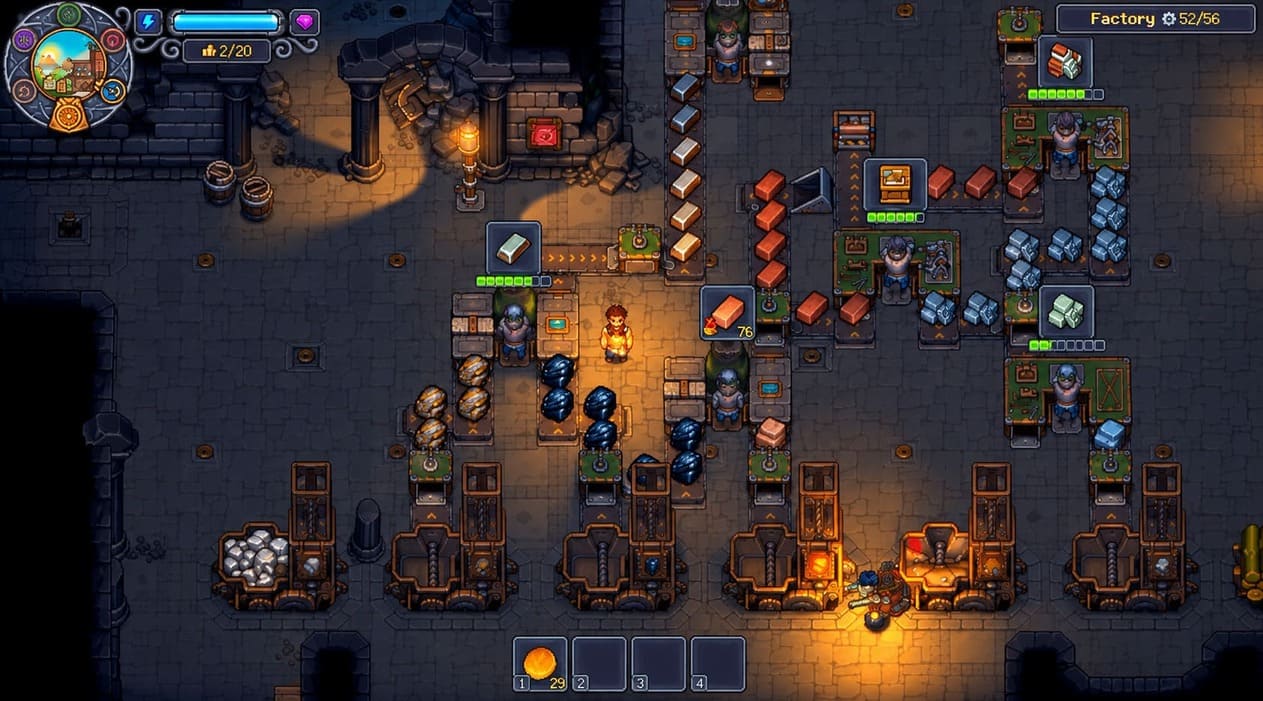
Getting the corpse sequence right is only half the battle. You also need the alchemy infrastructure to produce the injections.
Lye Injection
You’ll need a Conical Flask, Water, and Lye.
Lye itself can be produced through alchemy using Ash and Toxic Solution.
Glue Injection
Glue requires a Conical Flask, Water, and Glue.
The Glue ingredient can be produced using Health Powder and Life Solution.
Silver Injection
Silver requires a Conical Flask, Silver Solution, and Order Elixir.
Silver Solution comes from processing Silver Nuggets, while the Order Elixir involves Health Powder and Order Solution.
Gold Injection
Gold requires a Conical Flask, Gold Solution, and Toxic Elixir.
Gold Solution comes from processing Gold Nuggets. This is naturally more of a late-game resource, which makes sense considering how powerful the injection is.
If you’re planning to mass-produce high-quality corpses, I recommend building your alchemy setup before you start hunting for premium bodies. Otherwise, you’ll end up with a great corpse sitting around while you’re missing one ingredient for an injection.
Don’t Let Your Perfect Corpse Rot
This sounds obvious, but it is incredibly easy to ruin a good corpse because you’re busy doing something else.
Decay is one of the biggest enemies of corpse optimization.
I would avoid leaving a valuable corpse sitting on the floor while running around collecting alchemy materials. Use the appropriate embalming table or a suitable storage solution when possible.
If you don’t have the right setup yet, plan your corpse handling carefully. A perfect 5R/5W body isn’t much use if you’ve accidentally allowed its freshness to deteriorate before you finish preparing it.
The same goes for autopsy mistakes. A surgical error can permanently lock out part of the corpse’s potential. If I make a serious mistake on an otherwise excellent body, I’d rather redirect that corpse toward another purpose than continue wasting resources trying to rescue it.
What About More Than 12 Skulls?
This guide is primarily about the vanilla Graveyard Keeper experience, because that’s where 12 White Skulls are such a useful target.
The DLC changes the ceiling considerably. Expansions such as Game of Crone and Better Save Soul introduce additional mechanics and allow much higher graveyard optimization.
That means you shouldn’t treat 12 as a universal maximum across every version of the game. It’s better to think of it as the practical vanilla benchmark.
For a standard playthrough, though, I still think 12 is the sweet spot. It gives you a clear target without turning every corpse into an endless optimization project.
Finishing the Grave
Once you’ve created your 0 Red / 12 White Skull corpse, the job isn’t finished.
You need a grave that can actually take advantage of those White Skulls.
Use high-level decorations such as a Marble Cross II and Marble Fence II to bring the grave’s decoration value up to the appropriate level. Otherwise, you’ll have spent all that time creating a perfect corpse only to leave some of its potential sitting unused.
That’s probably my biggest advice for new players: don’t separate corpse quality from grave quality. They’re two halves of the same system.
My Take on the 12-Skull Grind
After playing a lot of games with unnecessarily complicated crafting and progression systems, I actually appreciate what Graveyard Keeper does here. The corpse system looks confusing at first because the game doesn’t explain every interaction particularly well, but once you understand the numbers, it becomes a satisfying little optimization puzzle.
The Cultist perk is the turning point for me. Before that, you’re experimenting. After that, you’re actually engineering corpses.
The basic formula I would keep in mind is simple: look for a suitable starting body, inspect the dynamic organs, preserve your corpse’s freshness, and then execute the injection and removal sequence carefully. For the classic vanilla target, a 4R/5W corpse followed by Lye, Glue, Silver, Gold, Fat removal, and Blood removal is the core route to 12 White Skulls.
And honestly, there’s something strangely satisfying about seeing 0 Red / 12 White appear after all that work. Graveyard Keeper turns what should be a grim little corpse-processing mechanic into one of the most entertaining optimization systems in the game.