Does R.I.P. Reincarnation Insurance Program Have Multiplayer? Co-Op Status Explained
If you have been following R.I.P. – Reincarnation Insurance Program, there is a good chance you have asked the same question many players are asking right now: can you jump into the zombie-filled chaos with a friend? With its huge enemy hordes, ridiculous weapons, Diablo-inspired loot, and increasingly powerful character builds, the game almost feels designed for co-op.
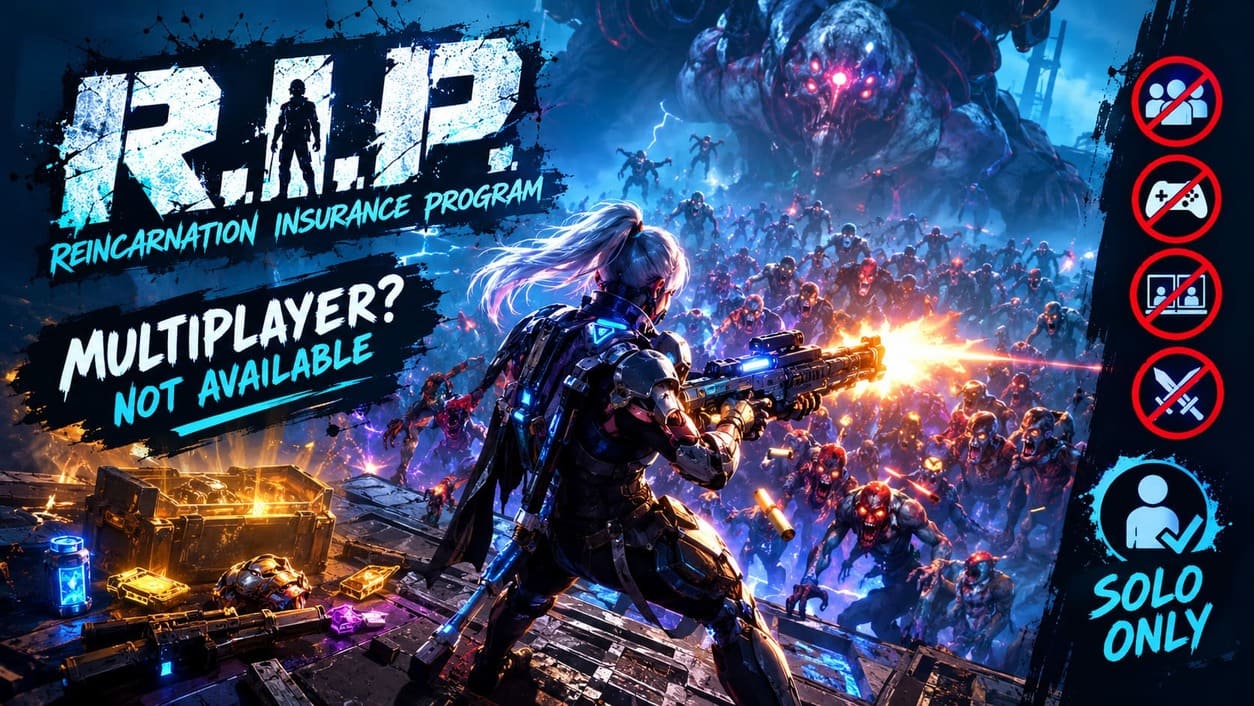
The short answer, however, is no. As of the game’s full 1.0 release on September 15, 2026, R.I.P. – Reincarnation Insurance Program is a single-player-only experience. There is no online multiplayer, local co-op, split-screen mode, or PvP available. After spending plenty of time with games that mix roguelite progression and action-RPG systems, I can understand why players expected multiplayer here, but the solo-focused design actually makes more sense once you get deeper into the game.
Is R.I.P. – Reincarnation Insurance Program Multiplayer?
At launch, R.I.P. – Reincarnation Insurance Program does not support multiplayer. The game is designed around one player controlling an elite agent and surviving increasingly dangerous waves of mutants, zombies, and other hostile creatures.
There is no option to invite friends into your run, no shared online campaign, and no couch co-op mode. If you were considering buying the game specifically because you wanted something similar to Diablo that you could play cooperatively, it is important to know that R.I.P. takes a very different approach despite borrowing some familiar ideas from the action-RPG genre.
| Multiplayer Feature | R.I.P. – Reincarnation Insurance Program |
|---|---|
| Online Co-Op | Not Available |
| Local Co-Op | Not Available |
| Split-Screen | Not Available |
| PvP | Not Available |
| Single-Player | Fully Supported |
| Shared Progression | Not Available |
For me, this is one of those games where the lack of co-op is noticeable precisely because the underlying systems would seem to work so well with another player. There is something inherently appealing about combining wildly overpowered builds with a friend and watching an entire screen of enemies disappear.
What Kind of Game Is R.I.P.?
To understand the multiplayer question, it helps to look at what R.I.P. – Reincarnation Insurance Program actually does differently.
Developed by WarmCore Studio and published by 2P Games, R.I.P. combines the wave-survival structure popularized by games such as Vampire Survivors with a much deeper loot system. Instead of simply picking a few upgrades during a run and calling it a day, you are constantly looking for better equipment, modifying your loadout, and trying to create increasingly ridiculous combinations.
The result is a top-down action roguelite with a strong ARPG-style progression system. You fight through massive enemy groups while moving around the battlefield, dodging attacks, collecting equipment, and turning your character into a walking disaster.
That combination is probably the biggest reason the multiplayer question keeps coming up. Games with loot, builds, bosses, and overwhelming enemy waves naturally make people think about co-op.
A Loot System That Feels More Like Diablo
One of the things that separates R.I.P. from a straightforward bullet-heaven game is its emphasis on equipment.
Enemies can drop weapons, armor, attachments, and other pieces of gear with different rarities and statistics. Instead of simply becoming stronger because you picked up a passive upgrade, you can spend considerable time optimizing your equipment and searching for combinations that completely change how your character performs.
There are also set bonuses, randomized attributes, modular attachments, and special traits to experiment with. The deeper you get into the progression systems, the more the game starts feeling like a strange meeting point between a survival shooter and a loot-heavy action RPG.
Personally, this is where R.I.P. becomes much more interesting than its initial premise suggests. At first, killing thousands of enemies is the obvious attraction. Eventually, however, you start thinking less about individual enemies and more about how to squeeze another few percent of power out of your entire build.
Why Co-Op Sounds Like Such a Natural Fit
It is easy to imagine a four-player R.I.P. run.
One player could focus on elemental damage, another could build around critical hits, while someone else specializes in defensive abilities. You could have one ridiculous fire-based build covering half the screen while another player freezes enemies and a third sends chain lightning through an entire horde.
That sounds fantastic on paper.
The game already contains systems that encourage experimentation with different combinations of damage types and abilities. Fire, ice, lightning, defensive effects, Divine Tech, blessings, and specialized weapons can all contribute to the feeling that you are creating your own personal destruction machine.
And that is exactly why I understand the community requests for multiplayer. After playing plenty of co-op games, I know how satisfying it can be when two completely different builds complement each other instead of simply doubling the same damage.
Unfortunately, making that work properly would be considerably harder than it sounds.
Why Multiplayer Would Be Difficult to Add
1. The Screen Can Already Become Completely Insane
The biggest problem is probably visual and technical density.
R.I.P. can put enormous numbers of enemies on the screen simultaneously. Add explosions, projectiles, status effects, damage numbers, environmental effects, and several powerful abilities, and the battlefield can become extremely busy.
Now imagine doubling or quadrupling the amount of player-generated chaos.
A second player would not simply mean another character on the screen. The game would also have to handle additional weapons, abilities, projectiles, effects, interactions, and potentially different movement patterns.
For a bullet-heavy game, keeping everything readable is already a balancing act. With four players, it could become difficult to tell which effects are yours, which belong to teammates, and which are attacks you actually need to dodge.
2. Balancing Would Become Much More Complicated
The game’s power curve is another issue.
R.I.P. is built around the satisfying feeling of becoming absurdly powerful. You start relatively vulnerable, collect better equipment, create synergies, and eventually reach a point where ordinary enemies are being erased almost instantly.
That works beautifully in a single-player environment.
With multiplayer, developers would need to decide how enemy health, damage, spawn rates, boss mechanics, and rewards scale with additional players. Simply giving enemies more health is rarely an elegant solution because it can turn powerful enemies into tedious bullet sponges.
On the other hand, if enemies do not scale enough, a coordinated team could potentially destroy the game’s intended progression far too quickly.
3. The Technical Scope Would Be Significant
There is also a fundamental technical challenge involved in turning a primarily single-player experience into a networked game. Multiplayer requires systems for synchronization, player state, enemy behavior, combat events, inventories, progression, connection stability, and many other interactions that do not have to be handled in the same way during a solo run.
For a game already built around large numbers of enemies and constantly changing combat effects, introducing networked synchronization could become a major development project. It would not simply be a matter of adding an invite button and allowing another character to enter the map.
This is particularly important for an indie project. Development resources are limited, and every major multiplayer feature would potentially mean fewer resources available for new content, balancing, optimization, bug fixes, and improvements to the existing single-player systems.
The Void Spire Makes the Solo Design Even More Interesting
One of the more interesting parts of R.I.P.’s endgame is Void Spire, a mode built around increasingly difficult floors and long-term progression.
The concept fits the game’s philosophy perfectly. You take your carefully constructed build and push it into an environment designed to test just how far that build can go.
There is something particularly satisfying about this kind of endgame when playing solo. You know exactly why your character became powerful, which item combinations made the difference, and where a run started to fall apart.
A multiplayer version could certainly be fun, but it would also change the character of the mode considerably. Instead of asking, ‘How far can I push this build?’ you would potentially be asking, ‘How well does our team composition scale?’
Neither approach is inherently better, but they create very different experiences.
Will R.I.P. Get Multiplayer in the Future?
This is where expectations should be kept realistic.
As of the September 2026 1.0 release, there has been no official announcement confirming that WarmCore Studio is developing online co-op, local multiplayer, split-screen, or PvP for the game.
The current direction is focused on expanding and improving the existing single-player experience rather than transforming R.I.P. into a multiplayer title.
That does not mean multiplayer can never happen. Games evolve, development plans change, and successful titles sometimes receive features that were not available at launch. However, there is an enormous difference between saying something is technically possible and having an official confirmation that developers are actually working on it.
For now, I would not buy R.I.P. expecting a future co-op update. Buy it because you like the single-player gameplay that is available today.
Is R.I.P. Worth Playing Without Multiplayer?
If you primarily play games with friends, the answer depends heavily on what you are looking for.
If your main requirement is a cooperative zombie shooter, R.I.P. obviously is not going to fill that role. There is no way around that limitation.
But if you enjoy roguelites, bullet-heaven games, ARPG loot systems, build crafting, and increasingly ridiculous power progression, the absence of multiplayer does not prevent the core game from working.
In fact, I think the solo format complements the game’s progression surprisingly well. You can stop and examine equipment, experiment with different combinations, test unusual builds, and slowly develop a setup that feels uniquely yours.
The game also works well for the kind of ‘one more run’ sessions that make roguelites so addictive. You finish a run, notice an interesting weapon or synergy you have not tried, and suddenly another hour has disappeared.
Final Verdict on R.I.P. Multiplayer
R.I.P. – Reincarnation Insurance Program is currently a single-player game with no online co-op, local multiplayer, split-screen, or PvP. Despite the game’s impressive loot mechanics and chaotic combat making it look like a natural candidate for cooperative play, WarmCore Studio has built the current experience around one player.
Personally, I think that is both the game’s biggest limitation and one of the reasons its design works as well as it does. The developers can focus entirely on creating an increasingly ridiculous power curve without having to account for multiple players breaking the balance or overwhelming the battlefield with even more effects.
Would I like to see co-op eventually? Absolutely. The thought of combining different Divine Tech abilities, ridiculous weapons, and specialized builds with a friend is extremely tempting. But until the developers officially announce such a feature, R.I.P. should be approached as a solo roguelite rather than a multiplayer ARPG.
For players who are happy playing alone, that is not necessarily bad news. There is already plenty here to experiment with, especially once you start chasing better gear and pushing your builds through the game’s tougher endgame content.