Aniimo Crafting and Homeland Guide: How to Craft Aniipods and Automate Your Base
There is a point in Aniimo where simply catching creatures stops being enough.
At first, the game feels like a familiar creature-collecting adventure. You explore Idyll, throw Aniipods at wild creatures, pick up resources, fight stronger enemies, and slowly expand your collection. Then the Homeland system starts opening up, and suddenly you realize that half of your progression is happening while you’re not even looking at it.
That is where Aniimo gets interesting.
Your Homeland is not just a decorative base. It is basically the engine behind your entire progression loop. The right workers can keep resources moving, crafting stations can produce materials while you’re out exploring, and a properly maintained supply chain means you spend far less time running back to gather basic ingredients.
And honestly, this is one of the parts of Aniimo I think players can underestimate early on.
You don’t need a perfect industrial setup immediately. What you need is a sensible progression path that gets your important stations online without wasting rare materials. This guide breaks down Aniimo crafting, Aniipods, Homeland automation, worker traits, and late-game infrastructure so you can build a base that actually supports your adventure instead of becoming another chore.
Aniipods Are More Important Than They Look
Catching Aniimo is obviously one of the game’s main activities, but your success isn’t determined by simply finding a creature and throwing whatever capture device you have equipped.
Several factors matter, including the target’s health, Break status, environmental conditions, and the quality of the Aniipod itself.
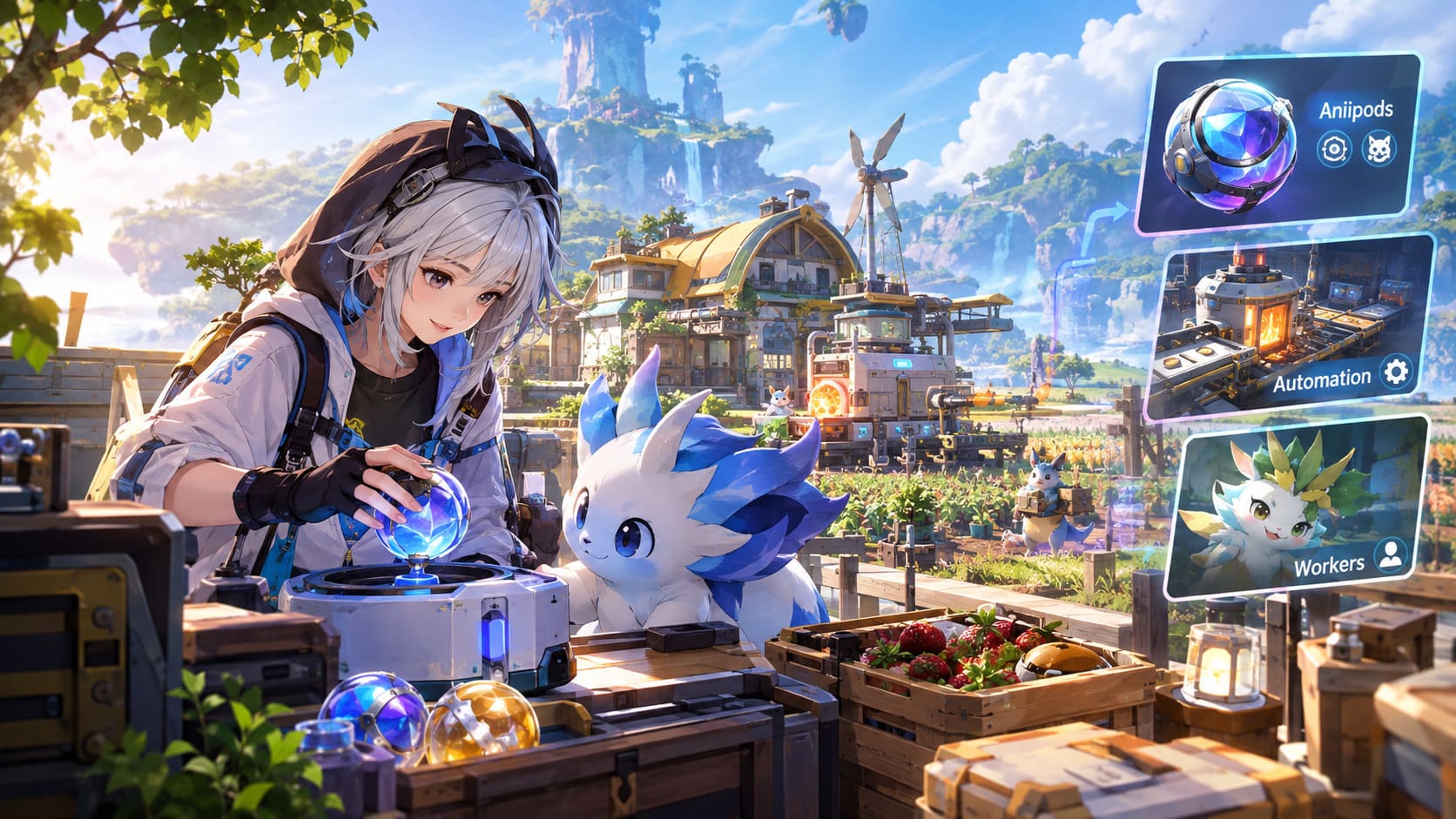
Early on, Standard Aniipods are perfectly adequate. If you’re wandering through areas such as Sunlit Meadow and grabbing common low-level creatures, there isn’t much reason to burn expensive capture equipment.
Things change once you start moving into tougher areas.
| Aniipod Type | Main Use | Best Situation |
|---|---|---|
| Standard Aniipod | Basic captures | Early-game creatures |
| Aniipod Ultra | High-value captures | Alpha and high-Potential Aniimo |
| Tumbler | Multi-target capturing | Farming groups and workers |
| Sparkling Cube | Rare variants | Sparkling Aniimo hunting |
Aniipod Ultra should become one of your major crafting priorities once you’re regularly hunting stronger creatures. Alpha variants, high-Potential targets, and unusual regional forms can justify the extra investment.
You may receive some advanced capture devices through events and milestone rewards, but eventually your Homeland crafting infrastructure becomes the reliable source.
And that’s exactly why base progression and catching progression are connected.
You can’t really optimize one without eventually optimizing the other.
The Tumbler Is Surprisingly Useful for Base Building
The Tumbler deserves special attention because it isn’t simply another stronger Aniipod.
Its big advantage is multi-target capturing.
That sounds like a niche mechanic until you’re trying to assemble a proper workforce. Suddenly you’re not hunting one specific creature. You’re looking for several creatures with useful work attributes, carrying ability, or personality traits.
Instead of stopping after every successful capture, the Tumbler lets you deal with groups much more efficiently.
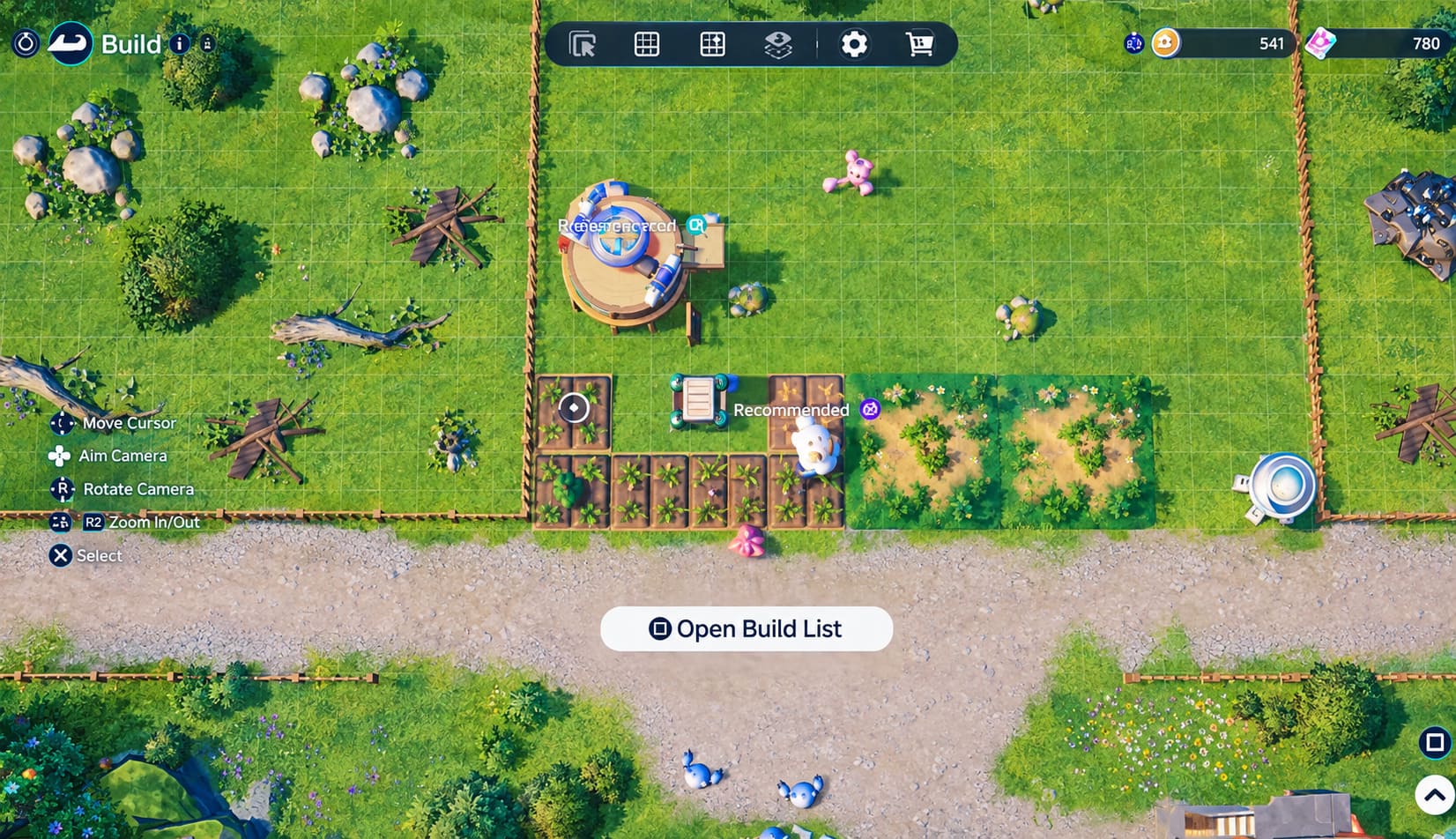
I found this particularly useful when farming common creatures for materials or looking for potential Homeland workers. You don’t necessarily care about perfect combat stats for these creatures. You care about what they can actually do back at home.
That’s an important mindset shift in Aniimo:
Not every Aniimo needs to be a fighter.
Some are much more valuable standing next to a production station.
Your RV Is the Gateway to the Homeland System
Every Pathfinder gets an RV, and it functions as a mobile base that can be parked at designated campsites throughout Idyll.
The RV is useful on its own, but the real progression starts when you connect it with your Homeland.
Your Homeland is where you build production facilities, grow crops, process materials, manage workers, and eventually create a semi-automated resource network.
The best part is that the system continues generating value while you’re away exploring.
That means your base should never be treated as something you visit only when your inventory is full.
Don’t Ignore RV Expeditions
One of the easiest passive systems to forget is RV dispatching.
Before logging off, send available Aniimo on expeditions and set up an appropriate long-duration cycle. An eight-hour rotation is particularly convenient if you’re leaving the game for the night.
These expeditions can provide:
- Upgrade materials
- General loot
- Useful crafting resources
- Progression items
- Potential rare Aniimo eggs, including chances at Prismana
It takes almost no effort, so there really isn’t much reason to leave the system idle.
Homeland Progression: What to Build First
The biggest mistake I would avoid is trying to build everything immediately.
Homeland upgrades are resource-hungry, and early materials are better spent on infrastructure that actually improves your production.
Early Homeland: Establish the Basics
Your first goal should be resource generation.
Mining piles, basic woodland nodes, crop production, and worker recovery facilities form the foundation of the entire system.
The Nimbus Bed is particularly useful because workers need somewhere to recover their energy. An automated station is not very automated if its worker is constantly exhausted.
This is also the point where Shrubclaw becomes extremely valuable.
Look for Aniimo with the P personality trait, then work toward Shrubclaw. Its usefulness in soil-related work makes it an excellent early Homeland worker.
You should also consider building the Joy Wheel Loom once the required materials become available.
Raw wool is only useful up to a point. Processing it into yarn gives you access to additional crafting options, and a worker with the F personality trait can provide a meaningful crafting-speed advantage.
Mid-Game Homeland: Clay, Bamboo, and Strawberries
Once your Homeland reaches around Rank 5, your resource priorities begin changing.
Basic wood and stone aren’t going to carry your crafting economy forever.
At this stage, I would focus heavily on:
Strawberries + Bamboo + Clay
Your farming plots should increasingly prioritize strawberries, while upgraded woodland nodes can begin producing bamboo for mid-tier blueprints.
Clay becomes another important part of your crafting chain.
Once your mining infrastructure can supply enough refined clay, you can start producing pottery, which combines refined clay with scales obtained from Flutternim.
Pottery isn’t just another random crafting material. It feeds into secondary facility upgrades and higher-level decorations, including items that can improve your Homeland’s comfort rating.
The important thing here is to think in terms of production chains rather than individual recipes.
If a recipe requires clay, don’t wait until you need pottery before starting clay production.
Build the supply before the demand hits.
Late-Game Homeland: Turn the Base Into a Factory
This is where Homeland automation becomes much more satisfying.
Eventually, you’re no longer just maintaining a cozy little camp. You’re building a functioning production network.
The major milestone is bringing your power grid online.
Heavy generators allow you to run specialized manufacturing stations, while advanced cooling infrastructure supports more demanding crafting operations and preservation mechanics.
Then you start unlocking stations such as the perfumery, which can convert plant-based materials like petals into useful passive progression items.
At this point, worker assignment becomes extremely important.
You don’t want your strongest combat Aniimo sitting beside a crafting station simply because it looks impressive.
You want the creature with the right work capability.
Best Homeland Workers in Aniimo
Worker management is one of those systems that looks simple until your base becomes large.
Each creature has different strengths, and personality traits can further influence efficiency.
Here are some of the workers worth building around:
| Aniimo | Homeland Role | Why It Matters |
|---|---|---|
| Shrubclaw | Farming / Soil Toiling | Excellent early agricultural worker |
| Greywing | Airborne Facilities | Useful for elevated and specialized stations |
| Dewey | Honey Production | Becomes valuable around Homeland Rank 8 |
| Bone Sky | Cooling | Useful for advanced cooling infrastructure |
| Balty | Power | Early electric worker for generators |
| Celestis / Stellarys | Transport | Strong carrying capabilities |
Dewey deserves some planning because its usefulness increases as your Homeland develops. Once you reach the later ranks, passive honey production becomes important for cooking and consumable buffs.
Bone Sky is another creature worth grabbing early. It’s the first naturally occurring ice-type Aniimo many players encounter, and having one ready before your cooling infrastructure becomes operational can save you from scrambling for a worker later.
Then there’s Balty.
Balty isn’t necessarily exciting compared with some late-game electric Aniimo, but that’s exactly why it’s useful. It arrives early enough to become your practical generator worker while you’re still building toward the stronger options.
Don’t Let Your Workers Starve
This sounds obvious, but it’s one of those mechanics that can quietly wreck an otherwise efficient base.
Your workers need food.
Keep the feed box stocked, and don’t assume that because you have plenty of crops stored somewhere else your workforce is automatically fine.
Strawberries are especially useful during the mid-game because they can support your agricultural loop while also serving as a reliable food source.
If the feed supply runs dry, workers stop working.
At that point, every fancy automated station in your Homeland becomes a very expensive decoration.
Carrying Capacity Can Become Your Hidden Bottleneck
Production speed isn’t the only thing that matters.
Resources still need to move from harvesting nodes to storage.
This is where carrying-oriented Aniimo can make a surprisingly large difference.
Creatures such as Celestis, Stellarys, Pawney, and Rookey can help move materials around your Homeland, preventing production stations from becoming clogged.
Think of your base as a factory.
Mining creates the material.
Workers process it.
Transport moves it.
Storage collects it.
If one part of that chain is too slow, the entire system suffers.
That’s why a perfectly optimized crafting worker won’t necessarily improve your base if nobody is moving the finished materials.
Resonance and Awakening: The Other Side of Crafting
Homeland crafting isn’t the only progression system that consumes resources.
As you advance through Aniimo’s growth system, you’ll also begin collecting materials used for Resonance and Awakening.
The major growth stages include Lumin, Gamma, and Nova, with progression tied to resonance training and evolution materials.
You’ll encounter different resources across multiple rarity levels, including items such as Blaze Stone, Common Shards, and Dark Shards.
Then there is the Awakening system.
Each Aniimo has six core attributes that can be awakened up to 20.
The catch is that the price isn’t identical for every creature.
Save Star Essence for Good Aniimo
Star Essence is scarce, so spending it randomly is one of the easiest ways to waste a valuable resource.
The cost of awakening a stat is influenced by the creature’s Innate Potential.
A high-potential stat can require dramatically less Star Essence to maximize than a poor one.
For example, a stat with 9 Innate Potential may need only a small amount of Star Essence, while a stat sitting around 3 Potential can demand a much larger investment.
That makes high-Potential captures far more attractive for serious end-game investment.
I would especially avoid dumping Star Essence into mediocre creatures just because they happen to be your current favorite.
Save it for something you’re genuinely planning to keep.
Preparing Your Homeland for Egg Heist
Once your base is producing materials consistently and your strongest Aniimo are approaching their Nova progression, you can start preparing for end-game activities.
Egg Heist pushes Aniimo into a much more competitive PvEvP environment.
Teams of three Pathfinders enter dangerous areas, gather valuable resources, and attempt to extract their cargo while dealing with both creatures and opposing players.
That means your Homeland suddenly becomes extremely important again.
You need a steady supply of:
- High-tier Aniipods
- Healing and combat supplies
- Upgrade materials
- Crafting components
- Consumable buffs
A strong base won’t automatically make you win an Egg Heist run. But arriving without the resources you could have produced passively is just making the mode harder for yourself.
Aniimo Twitch Drops Guide 2026: How to Link, Claim, and Fix Rewards Instantly
Legendary Aniimo Events and High-Tier Captures
The same principle applies to Legendary Aniimo events.
These encounters are designed around creatures that aren’t going to fall over after one ordinary capture attempt.
You’ll want your best equipment ready before the event starts.
That means Aniipod Ultra production should be part of your long-term Homeland plan, rather than something you scramble to manufacture after discovering a Legendary encounter is active.
The combination of strong workers, automated material generation, and stocked crafting stations gives you something incredibly useful: preparation.
And in a creature-collecting game, preparation usually beats panic.
Aniimo Fast Leveling Guide: How to Level Up Your Pathfinder and Aniimo Quickly (2026)
Final Homeland Checklist
If you want a simple progression roadmap, keep these priorities in mind:
- Build basic resource nodes first.
- Get the Nimbus Bed running early.
- Develop Shrubclaw for farming and soil work.
- Use the Joy Wheel Loom and assign an efficient crafting worker.
- At Homeland Rank 5, transition toward strawberries, bamboo, and clay.
- Keep pottery production running once the recipe becomes available.
- Start building your power infrastructure before late-game factories demand it.
- Capture dedicated workers for cooling, electricity, transport, and specialized stations.
- Keep your feed box stocked at all times.
- Save Star Essence for high-Potential Aniimo.
- Keep Aniipod production running before major events.
- Use RV expeditions whenever they’re available.
The best thing about Aniimo’s Homeland system is that it rewards planning without completely removing the adventure from the game.
You’re still going out into Idyll. You’re still hunting rare creatures, chasing Alpha variants, looking for Sparkling Aniimo, and preparing for Egg Heist. But now every expedition has a second purpose.
You’re bringing something back to the machine.
And that machine makes the next expedition easier.
Once the pieces start working together, Aniimo stops feeling like a creature collector with a house attached and starts feeling like a proper progression sandbox. Your Aniimo gather the materials, your Homeland processes them, your Aniipods put better creatures in your collection, and those creatures eventually become the workers powering the whole operation.
That’s the loop I’d build around from the start.