WARDOGS Beginners Guide Tips & Tricks: Everything You Need to Know
If you’ve played enough tactical shooters, you probably know the usual routine: grab a rifle, find a good position, shoot anything that moves, and worry about the scoreboard later. WARDOGS takes that formula and throws a persistent economy, base building, huge battles, vehicles, and three-way warfare into the mix. After spending time with different military shooters, I immediately noticed that WARDOGS rewards players who think beyond the next gunfight.
Developed by BULKHEAD and published by Team17, WARDOGS enters Steam Early Access on September 10, 2026. The game puts 100 players onto a massive, destructible battlefield inspired by the industrial mountains of Eastern Europe. There are three factions competing for control of the battlefield, with the main objective being the Control Zone rather than simply eliminating everyone.
What makes WARDOGS interesting is that your survival has an actual financial consequence. Kills, captures, revives, construction, spotting, and other useful actions can earn money, but dying can erase the gear you brought into battle. That creates a very different mentality from a standard shooter. Sometimes the smartest play is not chasing another kill—it’s knowing when to stay alive and protect your investment.
How to Fix Halloween: The Game Compilation Stutter: Best Nvidia & AMD Settings
Understanding the Control Zone and Hot Zone
The Control Zone (CZ) is the heart of every WARDOGS match. Your faction needs to control this enormous area and accumulate 100 team points, but simply standing somewhere inside the CZ isn’t always the best way to maximize your contribution.
Inside the larger objective is the constantly moving Hot Zone. This smaller area is where things get especially dangerous because it increases the rewards for players willing to take the risk. Team scoring is boosted while the Hot Zone is active, and actions performed there can generate significantly more cash.
From my experience with objective-based shooters, this is the kind of mechanic that creates natural hotspots without forcing every player into one tiny circle. The Hot Zone becomes a risk-versus-reward decision. If your squad has a strong defensive position, holding it can be incredibly profitable. If you’re outnumbered, blindly rushing into it is usually just an expensive way to visit the respawn screen.
Drill Towers Can Change the Objective
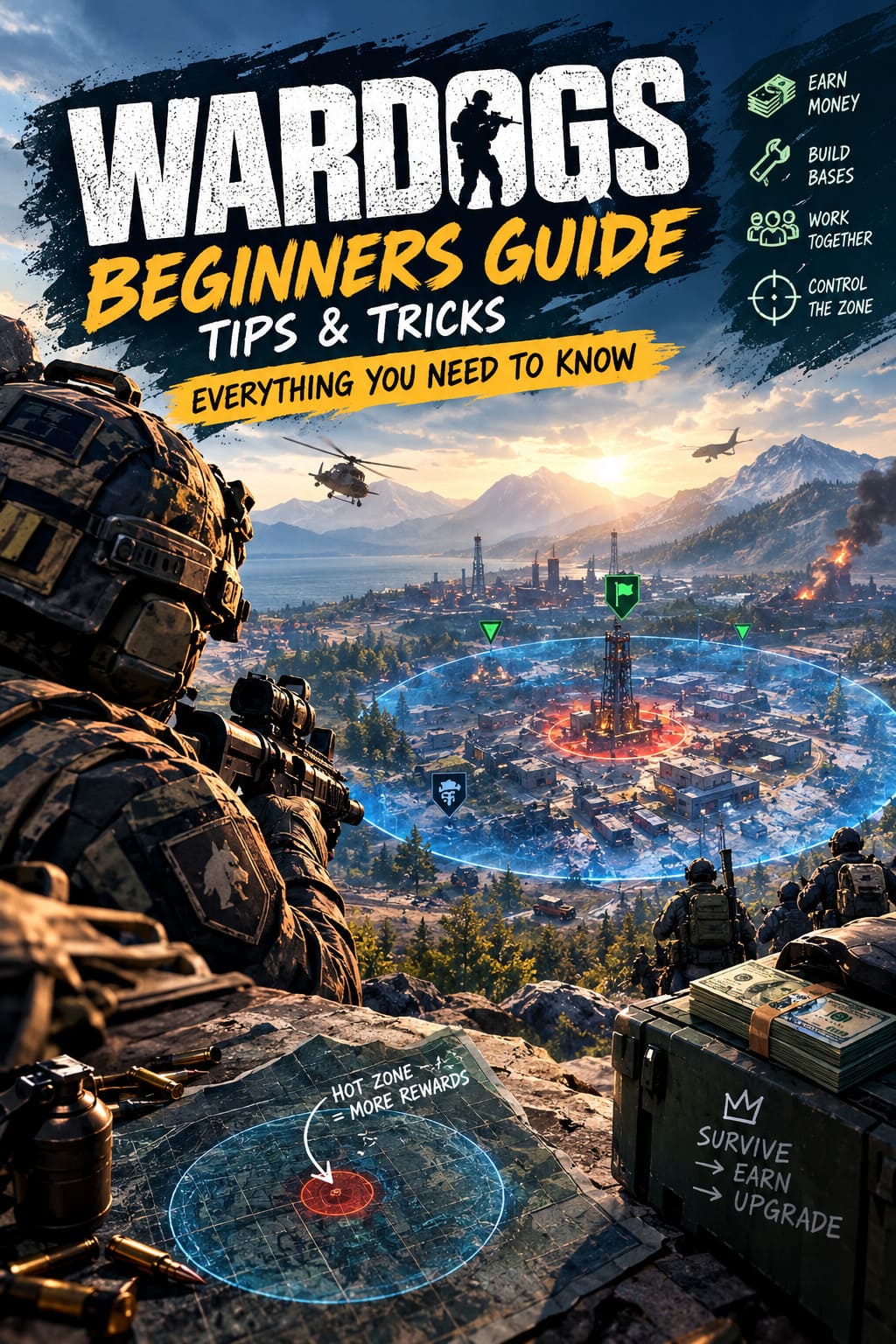
The massive Drill Towers scattered around the Control Zone are more than just impressive landmarks. They can become critical strategic positions because teams can hack their control terminals to obtain pieces of a larger code.
A successful hack takes around 30 seconds and produces a very noticeable audio signal. In other words, you’re practically announcing to the entire neighborhood that someone is standing still inside the tower.
Each captured tower provides part of the code. If your team collects enough pieces and enters the complete sequence into a tower console, the Hot Zone can be moved directly to that location. This opens up some fascinating defensive strategies.
Imagine building a fortified position around a tower and then dragging the objective straight to your doorstep. That’s the kind of play that can turn a chaotic battlefield into a carefully prepared fortress.
Don’t Go Broke: The WARDOGS Economy Matters
One of the biggest beginner mistakes is treating your starting $10,000 like free money.
It isn’t.
Your cash is persistent, and your equipment isn’t protected from death. If you are killed and cannot be revived, you lose your physical loadout and have to purchase replacement equipment.
That means buying the most expensive armor, helmet, rifle, and attachments immediately isn’t necessarily smart. A spectacular loadout is worthless if you cannot afford to replace it.
I strongly recommend treating your first matches almost like economy rounds in a competitive shooter. Use affordable equipment, learn the map, understand the objectives, and build a cash cushion before spending heavily.
| Situation | Smart Approach |
|---|---|
| Learning the map | Use cheap equipment |
| Low cash balance | Avoid expensive loadouts |
| Strong squad support | Consider better gear |
| Defending a fortified position | Invest more heavily |
| Carrying valuable equipment | Prioritize survival |
The important thing is to stop thinking only about your current weapon. Think about your next three deployments as well.
WARDOGS Has No Traditional Classes
WARDOGS doesn’t lock you into a Medic, Engineer, Scout, or Assault class at the character-selection screen. Your equipment determines what kind of soldier you become.
That’s one of the systems I like most because it gives players freedom to adapt. Your squad might need a medic at one moment and an engineer five minutes later.
Medic and Support
A Medic/Support setup revolves around healing and reviving teammates. Medical equipment can be extremely profitable because supporting your squad isn’t just useful—it can generate serious income.
Combat Engineer
The Combat Engineer focuses on construction, FOBs, defensive walls, and battlefield infrastructure. If you’re the kind of player who enjoys turning an exposed position into an ugly concrete nightmare, this is probably your calling.
Saboteur
A Saboteur specializes in rockets, explosives, anti-vehicle equipment, and IEDs. This role is especially valuable when an enemy faction has invested heavily in defensive structures or armored vehicles.
Scout and Marksman
The Scout/Marksman can use binoculars, rangefinders, and powerful optics to gather information and engage targets from long distances. You’re not necessarily expected to lead the assault; sometimes your most important contribution is telling everyone else where the enemy is.
The best part is that these aren’t permanent identities. Your inventory is your class.
FOB Building: Your Base Can Become a Fortress
Forward Operating Bases are one of WARDOGS’ most important systems. Before constructing defensive structures, you need to purchase and deploy an FOB.
Once placed, the FOB creates a designated construction area around itself. You can build walls, gates, cover, and other structures inside this perimeter, turning an exposed location into a defensive stronghold.
However, construction isn’t free. Your FOB depends on several supply types:
- Build Supplies for structures and defensive cover.
- Ammo Supplies for defensive weapons such as turrets and mortars.
- Fuel Supplies for generators and vehicle-related infrastructure.
- Mechanical Parts for technical structures and drones.
This makes logistics surprisingly important. A beautiful fortress with no ammunition or fuel isn’t much of a fortress.
Pick the Right Hammer
Construction hammers determine what you can build and upgrade. Smaller hammers are useful for basic structures and repairs, while larger ones unlock heavier defensive options.
If your squad is preparing for a serious objective defense, don’t underestimate construction speed and structural upgrades. A few well-placed walls can completely change how an enemy has to approach a position.
IEDs Are a Nightmare for FOB Owners
Every good defensive system needs a counter, and WARDOGS gives attackers a particularly nasty one.
IEDs can destroy an enemy FOB structure in a single devastating attack. If an infiltrator manages to get inside your defensive perimeter and place one, all those walls and resources can disappear extremely quickly.
So if you’re defending an FOB, don’t focus exclusively on enemies outside the walls. Someone sneaking through the back door can be far more dangerous than a sniper on the opposite mountain.
Combat Tips: WARDOGS Is Not an Arcade Shooter
The gunplay is one of the first things new players will notice. Weapons have substantial vertical recoil, and sustained automatic fire becomes difficult to control.
The good news is that the recoil is comparatively predictable. Pull your mouse downward while firing, and practice short bursts instead of holding the trigger forever.
At longer distances, controlled fire is much more reliable. Full-auto spraying may feel comfortable in a casual shooter, but WARDOGS punishes that habit.
ADS Takes Time
Aiming down sights isn’t instant. Your weapon has noticeable handling weight, so sprinting around a corner and expecting to immediately win a close-range duel is a recipe for frustration.
When clearing buildings, aim before exposing yourself. Get your weapon ready while you’re behind cover, then move through the doorway.
This small change can make a surprisingly large difference once you stop treating WARDOGS like an arcade FPS.
Experiment With Lean Controls
Leaning is extremely useful around cover. One popular setup is swapping the default lean keys so that E handles leaning left and Q handles leaning right.
It may feel strange at first, but the arrangement can make simultaneous movement and leaning more comfortable during firefights. Give it a few matches before deciding whether it works for you.
Learn to Use Zeroing
The battlefield isn’t flat, and bullet drop matters. Weapons generally start with a 100-meter zero, but you can adjust your zeroing with Page Up and Page Down when engaging targets at different ranges.
If an enemy is sitting across a valley, don’t automatically assume your aim is wrong. Your scope may simply be zeroed for a much shorter distance.
Inventory Management Can Save Your Life
A tactical shooter with persistent equipment demands smarter inventory management.
Carrying huge numbers of fully loaded magazines can eat through your backpack capacity. Instead, consider carrying a couple of spare magazines while keeping additional ammunition as loose ammo where appropriate.
You can reload magazines from loose ammunition when you’re safely behind cover, giving you more flexibility without filling your entire backpack with magazines.
It’s also worth checking enemy bodies for compatible ammunition. Every spare round becomes more valuable when dying means losing your entire kit.
Reviving Teammates: Don’t Waste Time
Getting a teammate back on their feet is one of the best ways to help your squad and earn money, but the basic revive animation is relatively slow.
Medical equipment such as an Emergency Resuscitator or Defibrillator can make the process dramatically faster. If you’re regularly playing support, carrying one is an easy decision.
And don’t get annoyed if another player starts helping with a revive you’ve already begun. The reward can be distributed according to the amount of revive progress contributed, so multiple players can work together rather than arguing over who gets credit.
APCs Are More Than Armored Vehicles
Armored Personnel Carriers can function as mobile spawn points, making them incredibly valuable strategically.
Instead of parking one in the middle of an open field, hide it somewhere protected but reasonably close to the objective. Your teammates can then use it to return to the fight without traveling across the entire map.
I’ve seen similar mechanics in large-scale shooters, and the difference between a well-hidden mobile spawn and a badly positioned one can be enormous. Underneath suitable structures around the Drill Towers can provide additional protection from enemy attacks.
There’s also a useful trick when an APC is being watched. If you spawn into a vehicle that appears to be surrounded, jumping directly out can get you killed. Take the driver’s seat first and use the third-person camera to inspect the area. Sometimes seeing the enemy before exposing yourself is all you need.
Be Careful With Helicopters
Helicopters are incredibly useful for moving squads across the map, but they aren’t taxis.
A bad pilot can turn a perfectly good deployment into a financial disaster. Crashing with passengers aboard can result in significant friendly-fire penalties, while everyone on board may also lose expensive equipment.
If you’re carrying a valuable loadout, don’t casually climb into a helicopter without knowing whether the pilot actually understands the flight mechanics.
Communication Is a Weapon
WARDOGS is built around large-scale teamwork, so communication matters almost as much as shooting.
Use squad VOIP or a dedicated team radio channel for important information. Proximity chat works differently because nearby enemies can potentially hear what you’re saying.
That creates some fun tactical possibilities. Whispering about an ambush while standing inside an enemy position isn’t particularly clever if the enemy can hear you.
Good callouts don’t need to be complicated. Give your squad a direction, landmark, enemy count, and important information such as vehicle type. Clear information saves more lives than dramatic speeches.
You Can Make Money Without Shooting
Here’s one of my favorite ideas in WARDOGS: you don’t have to be the guy getting kills to be useful.
If you’re struggling with the recoil or simply don’t have enough cash for expensive equipment, grab binoculars or a rangefinder and become the squad’s eyes.
Find an elevated position, stay alive, identify enemy infantry and vehicles, and provide useful spotting information. When your teammates capitalize on your intelligence, you can earn cash and XP without constantly exposing yourself to gunfire.
This is especially useful for players who enjoy the tactical side of shooters more than raw mechanical aim.
Final Thoughts
WARDOGS looks like a game that rewards smart players rather than simply aggressive players. The massive battles are obviously the headline feature, but the persistent economy, flexible equipment system, construction mechanics, vehicles, and information gathering are what give the game its personality.
My biggest advice for beginners is simple: don’t play every match like you have something to prove. Learn when to fight, when to defend, when to build, and when to walk away from a bad engagement.
Keep your early loadouts affordable, stay near teammates, learn the Control Zone, understand how the Hot Zone moves, and start thinking about money as part of your combat strategy. Once you stop measuring success purely by kills, WARDOGS starts making much more sense.
And honestly, that’s what makes the game interesting to me. A player with a rifle isn’t necessarily the most valuable person on the battlefield. Sometimes it’s the medic who keeps a squad alive, the engineer who builds the fortress, the scout who spots an incoming attack, or the logistics player who keeps the whole machine running.
In WARDOGS, surviving is profitable—but being useful is even better.