Halloween: The Game (2026) – Best Michael Myers Meta Abilities and Loadout Guide
Playing Michael Myers in Halloween: The Game is a completely different experience from playing one of the civilians. You are not running around trying to survive the night, searching drawers for useful items, or desperately looking for a way to contact the police. You are the reason everyone is running.
And honestly, that is what makes Michael so much fun.
At first, his kit can seem fairly straightforward. You have your tracking tools, your supernatural movement ability, and a few customizable Special Action Abilities. But once you start playing against coordinated civilian teams, it becomes obvious that simply chasing whoever you see first is not enough.
The strongest Michael players are constantly thinking about lighting, escape routes, objectives, NPCs, cooldowns, and civilian resources. The goal isn’t just to get kills. It is to control Haddonfield so well that the survivors eventually have nowhere safe left to go.
After spending time looking at the current meta, these are the Michael Myers abilities, builds, and strategies I’d personally prioritize in Halloween: The Game.

Michael Myers’ Core Abilities Explained
Before talking about the best loadouts, there is something important that new players need to understand.
Michael does not use the same progression system as civilians. Civilian characters rely heavily on their randomized Perk Card system, while Michael has two permanent Core Traits and three slots for Special Action Abilities.
That distinction matters because your entire playstyle is built around those two core powers.
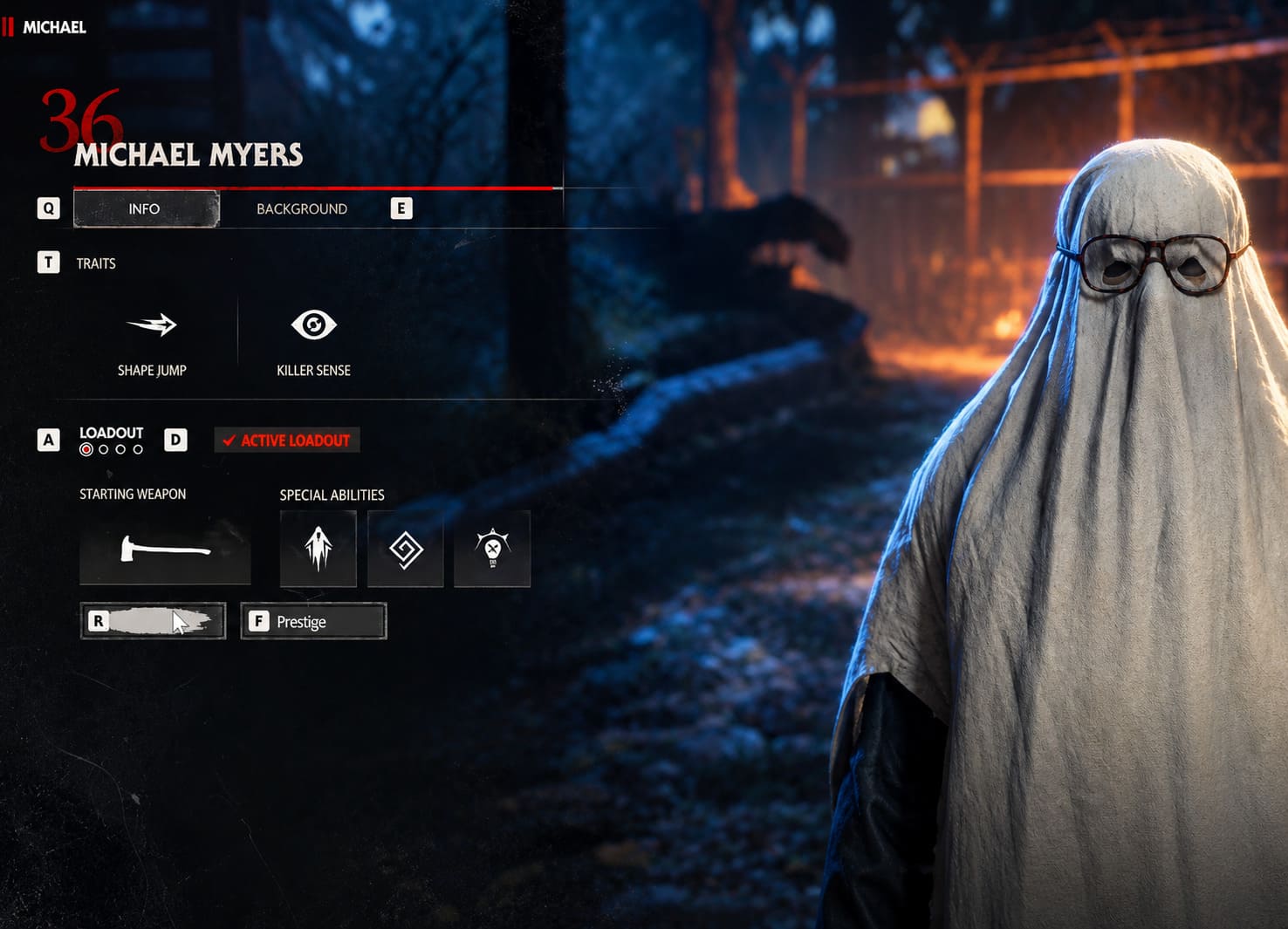
Killer Sense – Your Main Tracking Tool
Killer Sense is essentially the foundation of Michael’s hunting game.
It helps you notice disturbances and activity caused by civilians throughout Haddonfield. Rather than blindly checking every building, you can use the information provided by Killer Sense to determine where players are actually moving and searching.
For me, this is one of those abilities that becomes more valuable the better you understand the map.
A newer Michael player might see tracking information and immediately sprint toward it. A more experienced player starts asking questions:
- Where is the civilian likely heading?
- Are they moving toward an objective?
- Is there another player nearby?
- Can I approach without revealing myself?
- Is the area illuminated?
That extra decision-making is what turns Killer Sense from a simple tracking mechanic into a proper hunting tool.
Shape Jump – The Ability That Makes Michael Terrifying
If there is one part of Michael’s kit that you absolutely need to master, it is Shape Jump.
This is not simply a movement ability. It completely changes how Michael interacts with the map.
Shape Jump lets Michael temporarily disappear, gain increased movement speed, and move through obstacles that would normally force other characters to take a long route. Doors and window frames stop being meaningful barriers when you use it correctly.
That’s exactly why I think Shape Jump is arguably Michael’s strongest mechanical advantage.
But there is a catch.
Lighting and civilian awareness can prevent you from ending Shape Jump exactly when you want. If you try to exit the ability directly beneath a light source, you can be denied. Likewise, a civilian actively watching your position can interfere with the surprise attack you are trying to set up.
This means you shouldn’t think of Shape Jump as “teleport to survivor and attack.”
Think of it as a positioning tool.
Get around the building. Cut off the escape route. Approach from an unexpected direction. Then choose the moment when the civilian has the least chance of reacting.
That is when Michael becomes scary.
The Best Michael Myers Special Abilities
Your three Special Action Ability slots are where the real build customization begins.
There are different ways to approach Michael, but if you’re asking me which abilities I would build around first, Blackout and Detection Pulse are the two I’d have a very hard time removing.
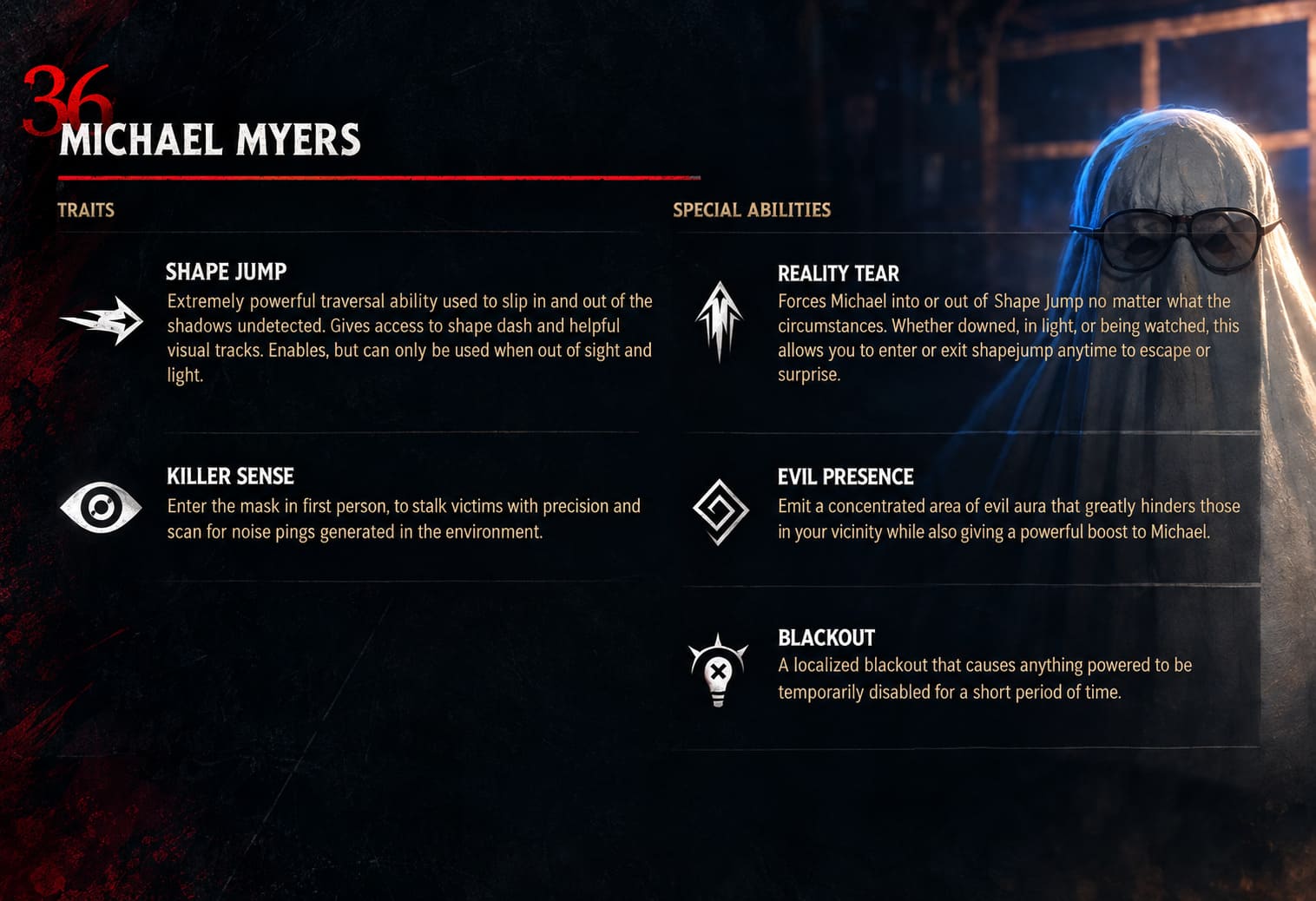
| Ability | Main Purpose | Best Use |
|---|---|---|
| Blackout | Disable electricity | Escape denial and Shape Jump setups |
| Detection Pulse | Reveal activity | Finding civilians and objectives |
| Reality Tear | Disrupt awareness | Chase pressure and confusion |
| Shadow Cloak | Improve stealth | Ambush-focused builds |
| Sabotage | Objective disruption | Aggressive objective control |
| Heavy Strike | Direct pressure | Combat-focused playstyles |
1. Blackout
Blackout is my personal first choice for a serious Michael build.
Its value goes far beyond simply making the map darker.
Civilian teams depend on electrical systems and vehicles for progression and escape opportunities. When Blackout shuts down powered equipment in a large area, suddenly plans that looked safe can fall apart.
And then there is the obvious synergy with Shape Jump.
Remember how lighting can interfere with Shape Jump?
Exactly.
A dark area gives Michael much more freedom to move and prepare an ambush. Instead of trying to work around every streetlamp and illuminated building, you can temporarily change the conditions of the entire encounter.
Blackout is especially nasty when civilians are already committed to an escape route.
If someone starts preparing a vehicle getaway, don’t necessarily waste Blackout immediately. Sometimes it is much more valuable to keep the cooldown available and punish the escape attempt at the worst possible moment.
That is the kind of small decision that can completely change a match.
2. Detection Pulse
If Blackout controls the environment, Detection Pulse controls information.
Michael can waste a ridiculous amount of time searching buildings that nobody is actually using. Detection Pulse helps solve that problem by revealing nearby civilian activity and giving you a better idea of where the action is happening.
This is particularly useful during the early stages of a match.
Instead of wandering around Haddonfield hoping to stumble across someone, use Detection Pulse to identify areas worth investigating.
I also like it because it works beautifully with Shape Jump.
Find the target first. Position second. Attack third.
That is much more reliable than randomly jumping around the map and hoping somebody happens to be standing behind the next wall.
3. Reality Tear
Reality Tear is the ability I would choose when I want my Michael to feel especially unpredictable.
It interferes with the information civilians normally rely on during a chase, particularly their ability to understand exactly where Michael is and how he is approaching.
This makes it particularly useful around strong loops and complicated structures.
A good civilian player will often use the environment to force Michael into predictable movement patterns. Reality Tear helps disrupt that rhythm.
Personally, I don’t think it is quite as universally useful as Blackout or Detection Pulse, but in the right hands it can be extremely annoying for a coordinated team.
My Favorite Michael Myers Meta Loadouts
There isn’t really one “correct” Michael build. Your choice should depend on whether you prefer methodical map control, stealth, or aggressive pressure.
These are the three setups I’d experiment with first.
Build #1 – The Haddonfield Lockdown
Blackout + Detection Pulse + Reality Tear
This is the build I’d recommend to most players.
It gives Michael a little bit of everything: information, environmental control, and chase disruption.
The basic game plan is simple:
- Use Detection Pulse to locate civilian activity.
- Approach without immediately revealing your position.
- Use Shape Jump to create an unexpected angle.
- Save Blackout for important objectives, lights, or vehicle escapes.
- Use Reality Tear when a chase starts becoming predictable.
The biggest mistake with this build is treating every ability like something you need to activate immediately.
Cooldown management matters.
Sometimes the best use of Blackout is not the first opportunity you see, but the escape attempt that you know is coming five minutes later.
Build #2 – The Jumpscare Myers
Reality Tear + Detection Pulse + Shadow Cloak
If you play Michael because you enjoy making people panic, this is probably the build for you.
The idea is to reduce the amount of information civilians receive while using Shape Jump to attack from bizarre angles.
Detection Pulse tells you where to go. Reality Tear makes it harder for the target to understand what is happening. Shadow Cloak gives you even more room to approach unnoticed.
This setup is especially attractive on maps with plenty of buildings, walls, windows, and other line-of-sight blockers.
You don’t want a long chase.
You want the civilian to turn around and realize Michael is already there.
Build #3 – The Objective Destroyer
Blackout + Sabotage/Heavy Strike + Detection Pulse
This one is for players who don’t want to give civilians any breathing room.
Instead of focusing primarily on stealth, you constantly attack their ability to make progress.
Use Detection Pulse to identify where players are gathering, then pressure the relevant objectives. Blackout becomes your big disruption tool while the additional aggressive ability helps you punish civilians who refuse to abandon the area.
This can be particularly effective against teams that become too comfortable around a single objective location.
Don’t let them establish a safe routine.
Break their rhythm before they can turn it into progress.
The Most Important Michael Myers Strategies
Having the best abilities doesn’t automatically make you a good Michael player. The strongest improvement comes from learning how civilians think.
Hunt NPCs When It Makes Sense
One of the easiest mistakes is focusing exclusively on human-controlled civilians.
NPC residents can contribute to the opposing team’s progression, so ignoring them completely can allow the civilian side to build momentum while you chase one player across the map.
I wouldn’t blindly hunt every NPC either. The important thing is understanding when removing them will disrupt the opposing team’s plans.
If civilians are spending time rescuing or escorting NPCs, that can create predictable movement patterns.
Use those patterns against them.
Respect Pocket Knives and Defensive Items
Never assume that grabbing a civilian automatically means you have won the encounter.
Civilians can find defensive items, including pocket knives and other rare equipment, which can give them a way to escape a grab.
This is where patience pays off.
If you know someone has a defensive item, forcing them to waste it before committing to a grab can be much safer than immediately going for the pickup.
In other words, don’t give civilians a free opportunity to turn your successful attack into a stun.
Use the Darkness Properly
Lighting is one of the most interesting parts of Michael’s gameplay because it directly affects how Shape Jump works.
Good civilian players will naturally gravitate toward illuminated areas when they understand how dangerous Michael becomes in darkness.
So don’t just think about lights as scenery.
Treat them as part of the battlefield.
If a particular house, street, gas station, or objective is brightly illuminated, consider whether you can disable the relevant power source before attacking.
This is one reason Blackout has such strong synergy with Shape Jump.
Don’t Waste Shape Jump Just to Travel Faster
This is probably my biggest tip for newer Michael players.
Yes, Shape Jump is excellent for crossing the map quickly. But using it purely as a sprint button can leave you without the positioning advantage you actually need.
Try to think one step ahead.
If the civilian is inside a building, where will they run when they hear you?
If they know you’re coming from the front door, can you approach from another direction?
If the area is illuminated, can you disable the lights first?
If they are near a vehicle, should you save Blackout?
Those questions are much more important than simply asking, “Can I reach them right now?”
How to Fix Halloween: The Game Black Screen on Launch – Troubleshooting Guide 2026
Killer XP, Weapon XP and Prestige
Michael’s progression also gives you another reason to keep experimenting with different playstyles.
Playing as the Killer contributes toward Killer XP and Weapon XP, helping you unlock additional progression options, execution styles, weapons, and cosmetic rewards.
For players who enjoy grinding progression, Prestige eventually becomes another long-term goal.
Personally, I like systems like this when they encourage you to keep playing without completely replacing the importance of mechanical skill. A highly upgraded Michael is nice, but knowing when to attack, when to disappear, and when to save your cooldowns is ultimately what wins matches.
How to Fix Halloween The Game Matchmaking Issues and Long Queue Times (2026 Guide)
Final Thoughts
Michael Myers in Halloween: The Game is at his best when you stop playing him like a traditional chase-focused killer and start thinking like a hunter.
His power isn’t just damage.
It is control.
Killer Sense gives you information. Shape Jump gives you terrifying mobility. Blackout changes the environment. Detection Pulse tells you where the civilians are. Reality Tear makes their response less reliable.
Put all of those pieces together and Michael can turn Haddonfield into a trap.
If I had to pick only one general-purpose loadout right now, I’d go with Blackout + Detection Pulse + Reality Tear. It gives you the most flexibility and doesn’t force you into one specific playstyle.
The most important thing, though, is learning to use your abilities together rather than individually.
Find them with Detection Pulse. Position with Shape Jump. Kill the lights with Blackout. Break their awareness with Reality Tear. Then strike when they think they finally have a safe route.
That’s the version of Michael I enjoy the most.
Patient, unpredictable, and always one step closer than the civilians realize.