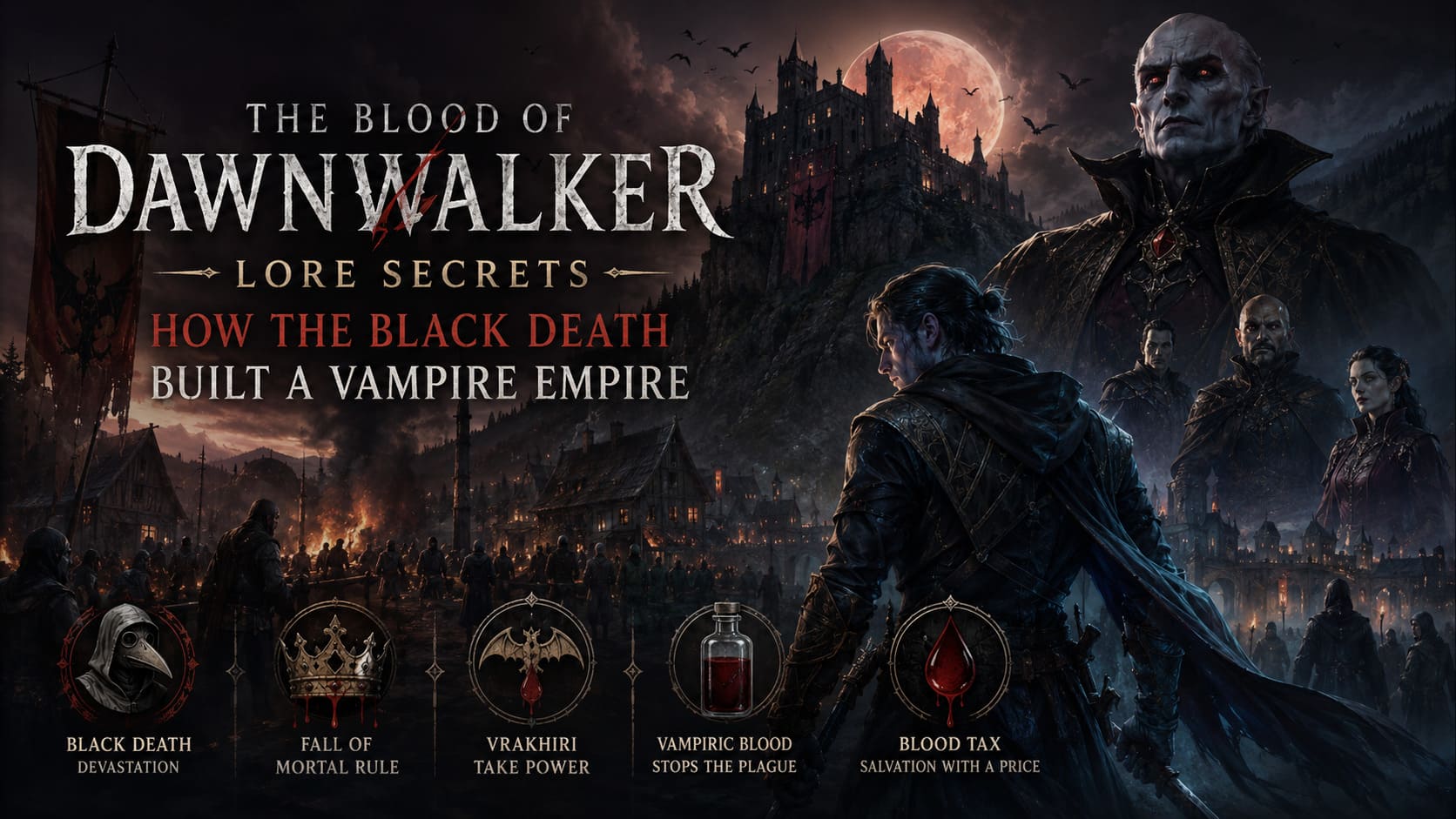
The Blood of Dawnwalker Lore Secrets: How the Black Death Built a Vampire Empire
The Blood of Dawnwalker immediately caught my attention because it takes one of the darkest periods in European history and asks a genuinely fascinating question: what if the Black Death did not simply destroy medieval society, but gave something ancient and monstrous the perfect opportunity to take control?
That is the idea at the heart of Rebel Wolves’ dark fantasy RPG. Instead of treating vampires as creatures living separately from ordinary people, the game builds an entire society around them. The plague, political collapse, human desperation, and supernatural power all become parts of the same story. The result is a setting where the vampires are not simply villains hiding in castles. They are rulers, administrators, soldiers, and, in their own twisted way, providers of security.
What makes The Blood of Dawnwalker lore particularly interesting is that the vampires did not create the crisis. Humanity created the conditions that allowed them to inherit it. The Black Death weakened Vale Sangora, the mortal rulers responded with brutality, and the Vrakhiri arrived at exactly the right moment to present themselves as the only force capable of restoring order.
Vale Sangora: A Kingdom That Was Already Dying
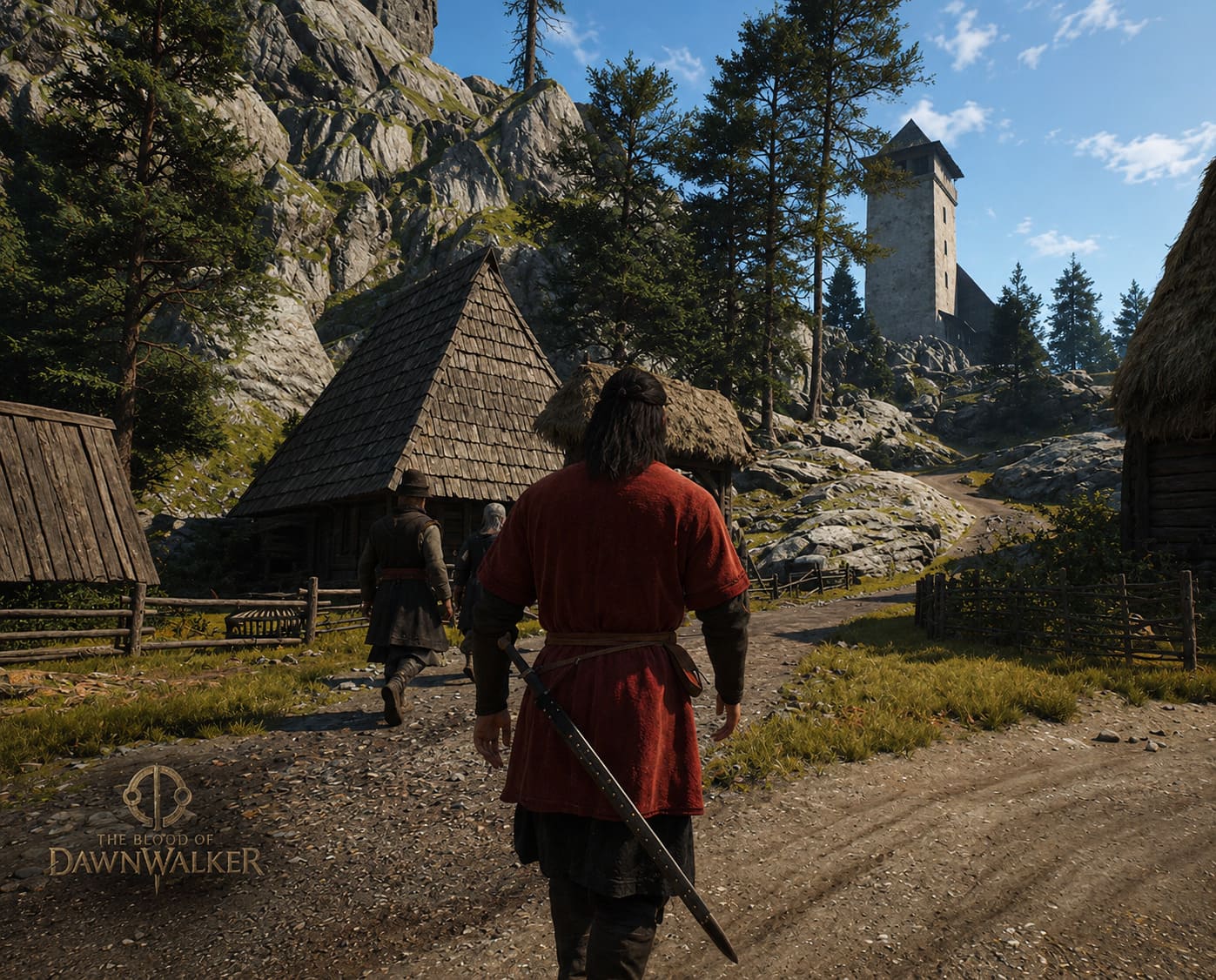
The fictional valley of Vale Sangora, hidden among the Carpathian Mountains, is the perfect location for this kind of story. It feels isolated from the rest of Europe, surrounded by forests, mountains, ruined settlements, and places where old folklore can still feel believable.
Before the vampire takeover, the region was ruled by the mortal Knyaz Skender Dragosti. When the Black Death reached the valley, however, his authority began to collapse. The disease killed people faster than the existing medieval institutions could respond, and fear quickly became more powerful than law.
Skender’s answer was not compassion. According to the game’s lore, he attempted to contain the plague through brutal purges, burning villages and executing people suspected of being infected. From a purely practical perspective, these actions were supposed to stop the disease. From the perspective of the surviving population, they made their own ruler almost as terrifying as the plague itself.
This is one of the smartest foundations of the setting. When the vampires eventually appear, they are not taking a healthy kingdom away from its rightful rulers. They are walking into a society that has already been shattered.
| Event | Impact On Vale Sangora |
|---|---|
| Black Death Arrives | The population is devastated and society begins to collapse. |
| Skender’s Purges | Fear and resentment toward the mortal ruling class increase. |
| Vrakhiri Intervention | The ancient vampires exploit the chaos and seize power. |
| Vampiric Blood | The plague is stopped, creating a strange dependence on the vampires. |
| Blood Tax | Surviving humans become a controlled resource for the new regime. |
The Vrakhiri Did More Than Conquer the Valley
The ancient vampire clan known as the Vrakhiri is what makes this setting different from a conventional vampire apocalypse. Their goal is not simply to kill everyone. They want to rule.
Their leader, Brencis, recognizes that Vale Sangora’s greatest weakness is also its greatest opportunity. People are terrified, hungry, sick, and desperate for someone to restore stability. Brencis eliminates Knyaz Skender, breaks the old political order, and establishes a new regime from Shrike’s Crag in Svartrau.
And here is the part I find especially effective: the vampires actually give the population something in return.
Vampiric blood can cure the Black Death and protect humans from the disease. That means the population is not simply conquered by monsters. Many people have a legitimate reason to accept the new rulers.
Imagine surviving a plague that has killed much of your family, only to discover that the creatures everyone told you were monsters can make you immune to it. Would you really refuse their protection?
That question makes the politics of The Blood of Dawnwalker much more interesting than a basic humans-versus-vampires conflict.
The Blood Tax: Salvation With a Price
Of course, the vampires do not provide their miraculous protection for free.
The surviving population is subjected to the Blood Tax, a mandatory system in which humans regularly surrender part of their blood to the vampire authorities. Healthy adults may survive the process, but elderly, weak, and vulnerable people can suffer enormously from repeated extraction.
That creates a horrifying contradiction at the center of Vale Sangora.
- The vampires protect humans from the plague.
- Their government provides security and stability.
- Humans are protected from certain external threats.
- At the same time, the population is effectively treated as livestock.
For me, this is probably the strongest piece of the game’s worldbuilding. The vampire empire is evil, but it is not completely irrational. Its system works. That makes resistance much more complicated.
If the vampires are defeated, what happens to the plague immunity they provide? What happens when the old human political order disappears? And how many people are willing to risk returning to a world where the Black Death could once again become a threat?
Coen and the Meaning of a Dawnwalker
The story becomes personal through Coen, the game’s protagonist. He is not introduced as some legendary warrior destined to save the world. He begins as an ordinary young man whose primary concern is his family.
One of the most memorable details about Coen is his unusual bluish-grey skin. His appearance is connected to argyria, a real-world condition associated with prolonged exposure to silver. His background as a miner provides the explanation for his distinctive appearance and gives him a visual identity that immediately separates him from the typical fantasy hero.
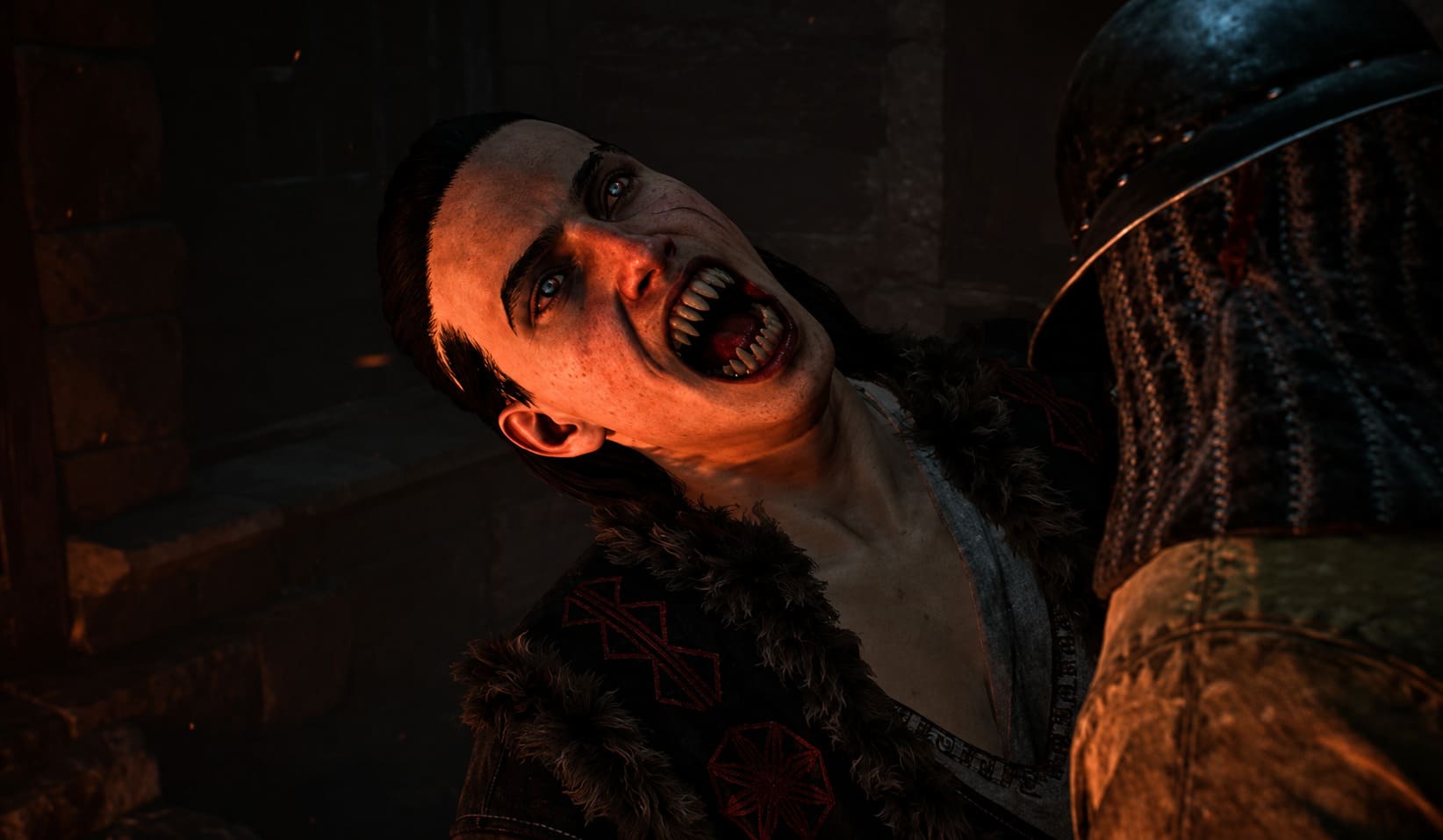
Everything changes when vampires attack his home and his family is taken. Coen is bitten by Brencis, but the transformation does not proceed normally. Instead of becoming a conventional vampire, he becomes something caught between humanity and the undead.
That is where the name Dawnwalker becomes important.
Day and Night Are Two Sides of Coen
During the day, Coen remains closely connected to his human identity. He can interact with ordinary people, investigate locations, trade, gather information, and move through human settlements without being completely consumed by his curse.
At night, however, the vampire inside him becomes much more powerful.
His supernatural abilities, senses, mobility, and combat potential increase, but the cost is his hunger. The stronger Coen becomes, the more the player has to think about what that power is doing to him psychologically and morally.
This duality is much more than a gameplay gimmick. It is essentially the central theme of Coen’s story: how much of yourself are you willing to sacrifice when the power to save the people you love is sitting right in front of you?
The 30-Day Clock Changes Everything
One of the mechanics I am most curious about is the game’s 30-day and 30-night structure. Coen has a limited amount of time to find his kidnapped family, which means exploration is no longer completely harmless.
In many open-world RPGs, you can spend dozens of hours clearing caves, collecting equipment, completing side quests, and wandering around without worrying about the main story. The world politely waits for you.
Vale Sangora apparently does not.
Time continues to pass. NPCs follow schedules. Certain events happen at particular times. Different enemies and opportunities can appear after sunset. Most importantly, Coen’s family situation continues to evolve while the player explores.
This creates an interesting strategic dilemma:
- Move quickly and risk entering dangerous situations underprepared.
- Explore extensively and potentially lose valuable time.
- Use human abilities to preserve Coen’s identity and approach problems carefully.
- Embrace vampiric power and become stronger while risking the consequences of the curse.
I particularly like the idea that the player cannot simply “solve” the game by becoming overpowered through endless grinding. If the clock is genuinely meaningful, every unnecessary detour could become part of the story.
Brencis and the Vampire Court
Brencis may sit at the top of the vampire hierarchy, but he relies on powerful lieutenants to maintain control over Vale Sangora. These figures give the regime a much more recognizable political structure.
| Character | Role | What Makes Them Interesting |
|---|---|---|
| Ambrus | Regional Governor | A former human mercenary transformed after suffering under Skender. |
| Bakir | Military Lord | An ancient warrior whose love of violence shaped his vampiric identity. |
| Xanthe | Blood Guard Leader | A mysterious figure connected to the regime’s elite military forces. |
Ambrus is particularly tragic because his history connects the old and new regimes. Once a human mercenary serving Skender, he was brutally punished by his former master. Brencis later offered him power and a new existence, creating a servant whose loyalty was born partly from hatred of the old order.
Bakir represents a completely different type of vampire. He is associated with warfare, destruction, rewards, punishment, and the more openly brutal side of the regime. His control over the southwestern territories shows that the vampire government is not just a collection of aristocrats sitting in dark castles.
Then there is Xanthe, perhaps the most mysterious member of the court. Her association with the Blood Guards and the deeper secrets surrounding the Vrakhiri makes her exactly the kind of character I expect players to spend hours theorizing about.
Humans Are Not Automatically the Good Guys
This is where The Blood of Dawnwalker has the potential to become genuinely memorable.
The obvious assumption would be that Coen should join the human resistance, destroy the vampires, and restore the old kingdom. But the game’s world does not make that decision particularly simple.
Some humans genuinely support Brencis. They have food, protection, stability, and immunity from the plague. From their perspective, the vampire regime may be horrible, but it is still better than the nightmare that existed before it.
Others cannot accept the Blood Tax and see the Vrakhiri as supernatural occupiers who have turned human beings into a renewable resource.
Coen therefore enters a world where every faction has something to offer and something to hide.
The Characters Who Can Shape Coen’s Journey
Several important figures can influence the direction of Coen’s story and the alliances he makes throughout Vale Sangora.
- Marat leads the armed human resistance and wants to overthrow the vampire court.
- Anca, Coen’s childhood friend, represents his emotional connection to the human life he is desperately trying to preserve.
- Lacra operates from the shadows and appears to possess knowledge of ancient folklore, magic, and the weaknesses of the Vrakhiri.
What I like about these characters is that they can represent different answers to the same question. Should Coen fight to destroy the vampire system, cooperate with it when necessary, or use its power against itself?
Why You Can’t See Everything in One Playthrough of The Blood of Dawnwalker
Why the Lore of The Blood of Dawnwalker Stands Out
There are plenty of fantasy games featuring vampires, but the premise here has a surprisingly strong historical foundation. The Black Death is not simply used as atmospheric decoration. It is the event that allows the entire supernatural political system to exist.
The plague destroys the old order. The mortal ruler responds with cruelty. The vampires offer salvation. Salvation creates dependence. Dependence becomes taxation. Taxation becomes oppression. And eventually someone like Coen appears in the middle of it all.
That chain of events gives the setting a believable internal logic even though the world itself is obviously supernatural.
More importantly, the story does not seem interested in telling players that there is always an easy moral answer. If vampires really can prevent another devastating plague, destroying them might save human freedom while simultaneously putting thousands of lives at risk.
That is exactly the kind of dilemma I want from a dark fantasy RPG.
The Blood of Dawnwalker Efficiency Path Walkthrough: 30-Day Strategy Guide
Final Thoughts: A Vampire Story With More Than Fangs
The Blood of Dawnwalker looks most interesting to me when it focuses on the uncomfortable space between survival and freedom. The Vrakhiri are terrifying, but their empire did not appear from nowhere. It was built on the ruins left behind by disease, fear, political failure, and human cruelty.
Coen’s story mirrors that world perfectly. He is neither completely human nor completely vampire, and the player gets to decide how far that transformation goes in practical and moral terms. The 30-day clock adds another layer of pressure because saving his family may require choices that would be unacceptable under normal circumstances.
For fans of dark fantasy, vampire mythology, branching RPG narratives, and lore-heavy worlds, The Blood of Dawnwalker has one particularly promising advantage: its monsters are not simply monsters. They have built a functioning society, created political institutions, established their own economy, and convinced part of the human population that living under vampire rule is preferable to dying without it.
And honestly, that is the part of the lore I find hardest to forget. The scariest thing about Vale Sangora is not that vampires won.
It is that, after everything humanity suffered, some people may actually believe the vampires were the better choice.