Darkest Dungeon The Fire’s Edge DLC & 2026 Patch Notes: Full Original Game Guide
There are games you finish once and move on from. Then there is Darkest Dungeon.
You can delete the save. You can swear that you have finally had enough of stress, disease, terrible rolls, greedy decisions, and heroes who somehow manage to miss an attack on a nearly dead enemy. You can even convince yourself that you are done.
Then Red Hook Studios gives you another reason to return.
That is basically what The Fire’s Edge feels like. Coming as a major anniversary addition to the original game, the expansion brings ideas from Darkest Dungeon II back into the 2016 classic while keeping the grim, deliberate structure that made the first game so memorable.
And honestly? I love the idea.
I have always preferred the original Darkest Dungeon‘s slower campaign structure to the sequel’s road-trip format. The Hamlet, the roster, the permanent consequences and that horrible feeling when you realize you have sent the wrong four heroes into a dungeon — that is the heart of the game for me.
The Fire’s Edge doesn’t try to replace that identity. It adds new toys to an already brutal machine.
The Fire’s Edge: A Surprisingly Good Fit for the Original Game
The biggest question surrounding an expansion like this is simple: Will mechanics from Darkest Dungeon II actually work in the original?
That could have gone badly.
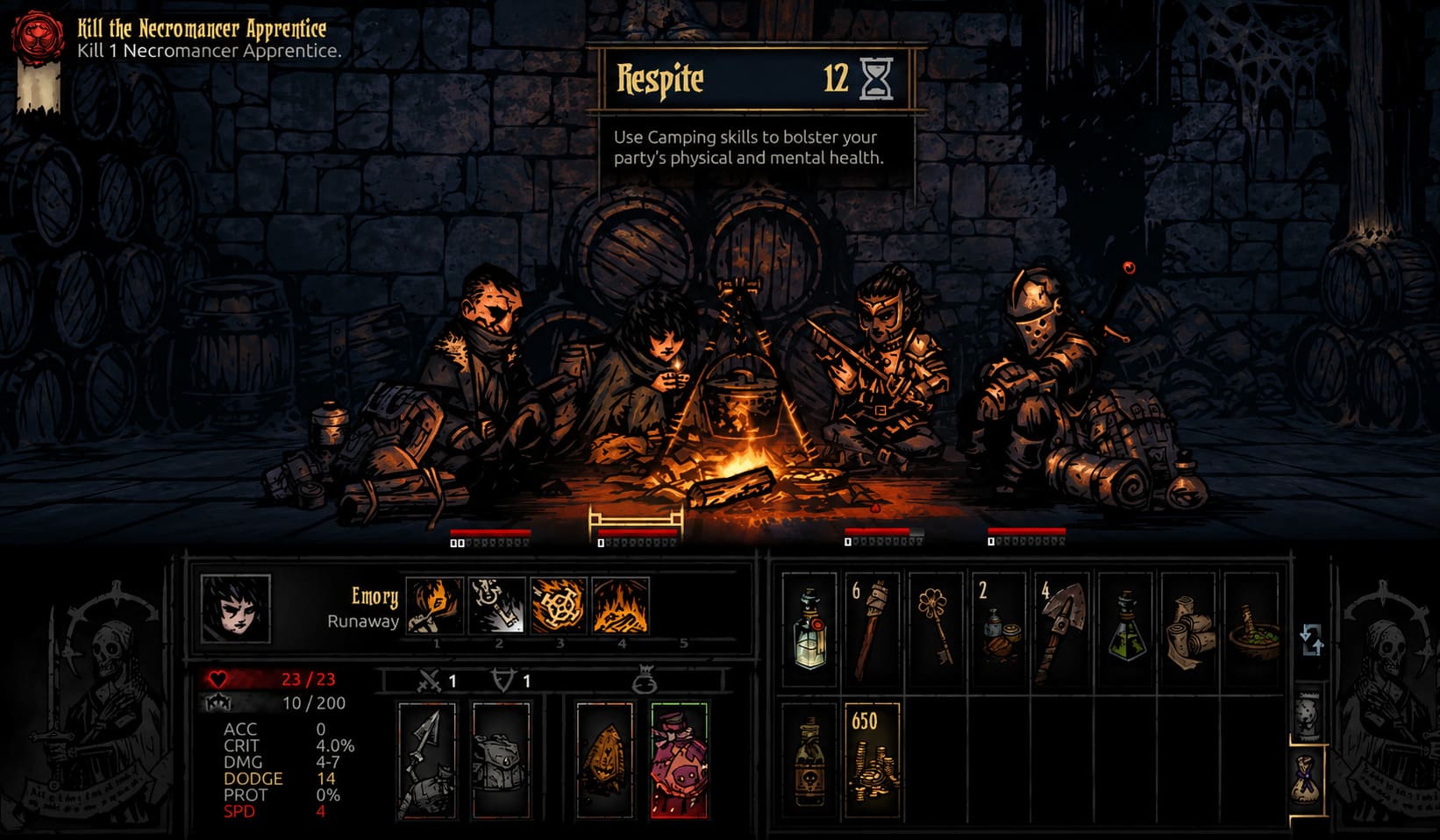
The two games share DNA, but they are structured differently. Darkest Dungeon is about managing an estate and building a roster over time. Darkest Dungeon II focuses much more heavily on individual runs, relationships, movement and its modernized combat systems.
Yet the new content makes a surprisingly convincing transition.
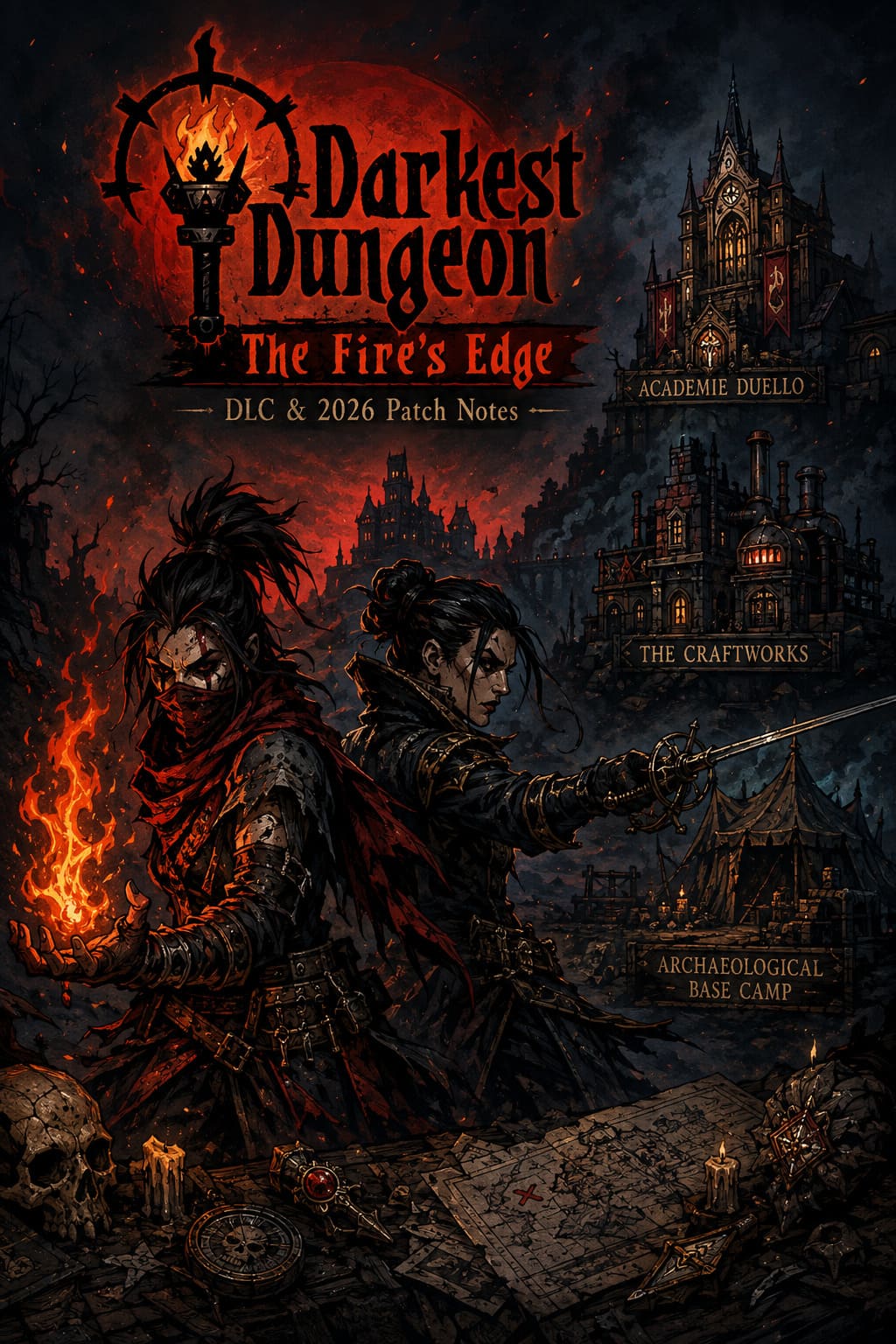
The expansion introduces two major hero classes — the Runaway and the Duelist — while also adding Burn, new Hamlet districts and a more complicated approach to trinkets.
For longtime players, that means the basic game is still recognizable. You still make questionable decisions. You still watch a critical hit destroy your carefully planned strategy. And you still wonder why the hero with 80% resistance somehow contracted another disease.
But now there are more ways to build a party.
The Runaway Brings Fire to the Estate
The Runaway is probably the character that immediately makes the most sense as part of this expansion.
She arrives with her distinctive fire-based combat style and gives the original game’s roster something it never quite had before: Burn-focused damage over time.
Her design is also a natural fit for Darkest Dungeon. She looks like someone who has survived something terrible and is probably one bad hallway encounter away from making an even worse decision.
Gameplay-wise, the Runaway works particularly well around the middle and back ranks. Her abilities reward players who understand positioning and who are willing to manipulate enemy formations.
That makes her especially interesting alongside heroes capable of:
- Stunning enemies
- Pulling or pushing targets
- Shuffling enemy ranks
- Controlling dangerous back-line opponents
- Creating opportunities for damage-over-time effects
I particularly like the idea of building a party around her rather than simply treating her as another generic damage dealer.
The Runaway is more interesting when the entire party helps create the conditions for her attacks.
And that is exactly what Darkest Dungeon does best.
The Duelist Might Be the Real Star
The Duelist is where things get considerably more complicated.
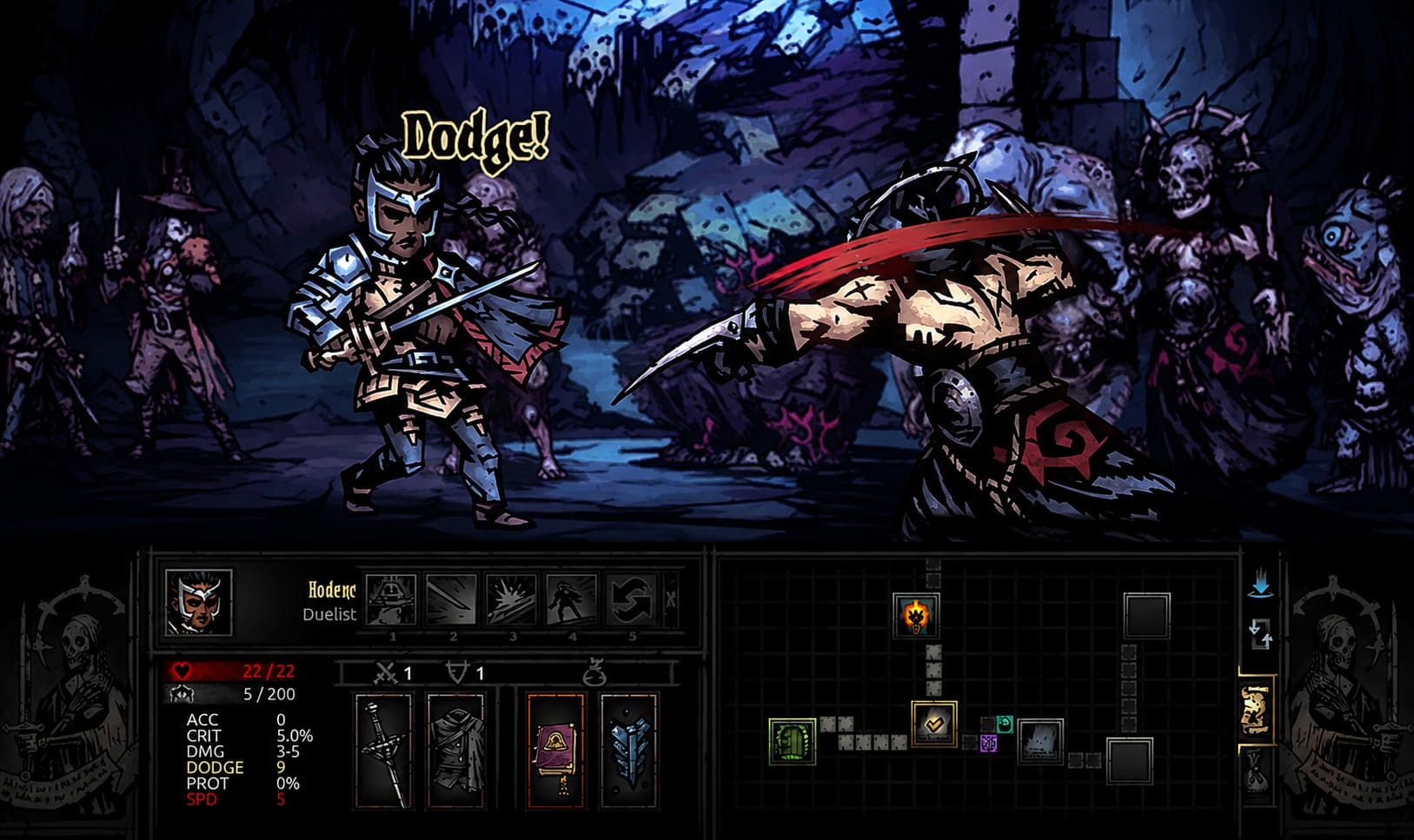
She is fast, aggressive and built around movement between ranks. Rather than standing in one position and repeatedly using the same handful of attacks, the Duelist can constantly alter her approach depending on what is happening on the battlefield.
Her biggest advantage is the amount of tactical freedom she brings.
The Duelist enters the roster with all seven of her core combat skills available, and she can equip all seven simultaneously. That immediately makes her feel different from the traditional heroes of the original game.
Her combat revolves heavily around stances and Riposte, meaning that understanding when to attack and when to prepare for retaliation becomes just as important as raw damage.
This creates something I genuinely enjoy in Darkest Dungeon: a character who rewards experience.
A new player can use the Duelist and think, “Okay, she hits things.”
A veteran can start asking much more interesting questions:
Where should she be next turn? What stance should she use? Which enemy is most likely to attack her? Can I turn their next action against them?
That second layer is where the character becomes exciting.
Burn Finally Gets Its Moment
For years, Darkest Dungeon divided damage-over-time effects primarily between Bleed and Blight.
That distinction was part of the game’s strategic language.
Some enemies were vulnerable to Bleed. Others practically laughed at it. Certain areas encouraged one type of damage while making another feel nearly useless.
The introduction of Burn adds a third major DoT option.
Mechanically, Burn operates separately from Bleed and Blight and gives the Runaway a clear specialty. Its standard duration is three rounds unless modified by other effects.
That sounds like a relatively simple addition.
It isn’t.
Damage-over-time effects become extremely powerful when you start thinking several turns ahead. A direct attack might kill something immediately, but a properly applied Burn effect can continue working while your party focuses on another target.
That is especially useful against enemies with high protection.
Instead of trying to smash through a huge PROT value with repeated physical attacks, you can let the fire do part of the work.
The real strength of Burn isn’t the number itself. It’s the pressure it creates over multiple turns.
Three New Hamlet Districts Change Progression
The Hamlet has always been one of my favorite parts of Darkest Dungeon. It is not just a menu between expeditions. It feels like a place you are desperately trying to rebuild while everything around you is falling apart.
The Fire’s Edge expands that system with three new districts.
Academie Duello
This district is closely connected to the Duelist and her combat style. It adds additional support for fencing-focused builds and makes the new hero feel more integrated into the estate rather than simply dropped into the roster.
The Craftworks
The Craftworks focuses on technical improvements, equipment-related systems and specialized preparation.
It fits nicely into the existing Hamlet philosophy: spend resources now so that future expeditions become slightly less miserable.
Archaeological Base Camp
This district leans into exploration and research. It provides additional preparation and exploration benefits while opening another avenue for gathering valuable resources and curiosities.
None of these districts fundamentally reinvent the Hamlet.
And I think that is the right choice.
Darkest Dungeon didn’t need a new progression system. It needed more reasons to care about the one it already had.
Trinkets Are Becoming More Interesting
Trinkets have always been one of the most entertaining parts of character building.
You find something incredible and immediately start thinking about which hero deserves it. Then you find something even better and realize that your previous “perfect” build was actually terrible.
The newer systems introduced alongside the anniversary content make trinkets less straightforward.
Some items now rely on specific triggers rather than providing the same benefit constantly. A condition might involve health, stress or another combat threshold.
Other high-value trinkets use limited quest charges, which prevents players from repeatedly exploiting powerful effects throughout an entire expedition.
Then there are progressive trinkets, which can change depending on circumstances during a run.
This is one of the changes I am most interested in watching over the long term.
The original game already has an impressive amount of build experimentation. Adding items that react to what happens during a dungeon crawl could create some genuinely strange combinations.
And strange combinations are exactly what I want from Darkest Dungeon.
2026 Patch Notes: The Important Fixes
Of course, no major expansion arrives without a few things catching fire besides the monsters.
The post-launch updates addressed several issues involving bosses, crashes, localization, controllers and mod support.
Some of the more notable fixes include:
| Area | 2026 Update |
|---|---|
| Drowned Crew | Fixed a progression softlock involving the Flickering Lamplight trinket |
| Butcher’s Circus | Addressed a crash connected to PvP prize boxes |
| GOG Version | Fixed activity-log stability issues during Gladiator matches |
| Duelist | Corrected missing trinket localization in certain DLC ownership situations |
| Controllers | Fixed input problems affecting some PC players |
| Mod Audio | Restored compatibility with custom modded audio |
| Map UI | Restored the auto-center map option |
| PC Builds | Continued the move toward unified 64-bit binaries |
These aren’t glamorous additions, but they matter.
A new hero is exciting for about five minutes when your game crashes during a dungeon run. Stability, controller support and mod compatibility are the boring parts of a patch that players only notice when they are broken.
For a game with such a dedicated modding community, keeping the ecosystem intact is especially important.
Has The Fire’s Edge Changed the Meta?
Yes, but probably not in the way some players might expect.
The original rules of Darkest Dungeon remain surprisingly powerful.
Stun is still incredibly valuable.
Accuracy still matters more than players sometimes want to admit.
Speed can completely change an encounter.
And perhaps most importantly, waiting around for reactive healing is rarely the best strategy.
The safest enemy is the enemy that is already dead.
That philosophy becomes even more interesting with the Runaway and Duelist.
A Runaway-centered team can focus on applying Burn while controlling enemy formations. A Duelist party can revolve around movement, stance management and Riposte. Combining these ideas with classic heroes opens up plenty of room for experimentation.
I can already imagine players spending hours trying to create the “perfect” Burn composition, only for one unlucky hallway fight to destroy the entire plan.
Which, frankly, sounds exactly like Darkest Dungeon.
My Take: This Is the Kind of DLC the Original Game Deserves
There is something oddly satisfying about seeing an older game receive meaningful attention instead of being treated as a forgotten product sitting in a publisher’s archive.
Darkest Dungeon did not need a giant graphical overhaul.
It did not need to become a completely different game.
It needed new reasons to start another campaign.
The Fire’s Edge provides those reasons.
The Runaway adds a completely different damage-over-time identity. The Duelist introduces a flexible combat style that can challenge players who thought they had mastered party positioning. Burn expands the game’s tactical vocabulary, while new districts and trinket mechanics give the Hamlet another layer of progression.
Are all of these systems going to make every veteran happy? Probably not.
Some players will prefer the purity of the original roster. Others will probably discover combinations that feel ridiculously strong. And, as always, balance will determine whether some of these mechanics become permanent staples or niche curiosities.
But that uncertainty is part of the fun.
Ten years later, Darkest Dungeon still has the ability to make me stare at a combat screen and think, “This is a terrible idea.”
Then I click the button anyway.
That is the magic of this game.
How to Fix Brigandine Abyss Crashing on Startup on PC (2026 Guide)
Final Verdict
The Fire’s Edge feels less like an attempt to reinvent Darkest Dungeon and more like a celebration of everything that made the original special.
It takes selected ideas from Darkest Dungeon II, rebuilds them around the structure of the first game and gives veteran players another excuse to return to the Estate.
The Runaway and Duelist are the obvious stars, but Burn, the new districts, evolving trinkets and the accompanying technical fixes are what make the update feel like a proper anniversary package rather than a simple character drop.
If you have not played Darkest Dungeon in years, this is a particularly good excuse to reinstall it.
Just remember the most important rule:
The dungeon does not care how confident you feel.
And neither does the RNG.
Bring enough food. Upgrade your roster. Watch your stress.
And when the game gives you a terrible decision, make sure you choose the least terrible one.
Because there is always another torch to light.