VHOLUME Beginner Guide: 7 Essential Tips and Tricks to Master Dystopian Parkour
If there is one thing that immediately grabbed me about VHOLUME, it is how confidently the game commits to movement. There is no giant combat system trying to steal the spotlight, no endless inventory management, and no pile of RPG mechanics thrown in just because modern games apparently need them. VHOLUME wants you to run, jump, climb, slide, improvise, and gradually develop an almost instinctive understanding of its brutalist playgrounds.
Set inside the decaying concrete capital of Afro-Eurasia, VHOLUME follows Robert, an ordinary citizen caught in the machinery of an oppressive Ministry. His goal sounds painfully mundane: reclaim his family’s revoked ration tickets. The journey to accomplish it, however, sends him through enormous architectural nightmares filled with vertical shafts, abandoned structures, fog-covered drops, and deliberately strange routes.
That contrast is what makes the game work. The story is bleak, but actually playing VHOLUME can feel incredibly liberating.
The soundtrack is subdued and hypnotic, the architecture is massive and oppressive, and the movement has that satisfying “one more run” quality that can keep you glued to a level far longer than you planned. You start by simply trying to reach the finish. Then you notice a shortcut. Then you beat your previous time. Then you see another player’s ghost absolutely destroy your route and suddenly you’re spending an hour trying to understand how the hell they crossed a gap that looked impossible.
After putting serious time into the game’s movement systems, these are the mechanics and habits I would recommend learning first.
1. Learn the Movement System Before You Chase Speed
The biggest mistake a new player can make in VHOLUME is treating it like a conventional platformer.
You are not supposed to stop constantly and calculate every jump.
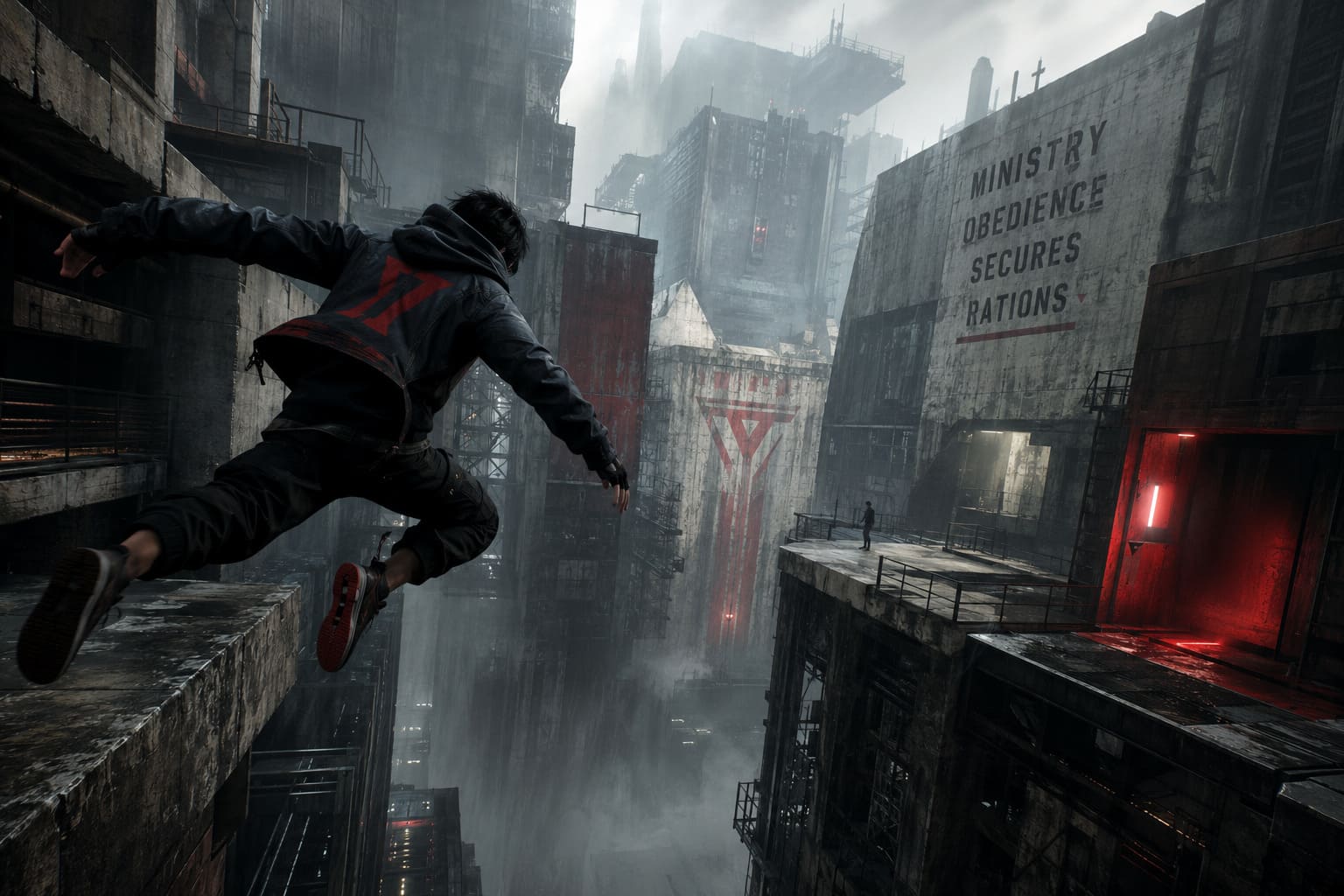
Robert’s basic movement kit includes running, jumping, wall-running, sliding, and climbing, but the interesting part is how these actions interact with momentum and level geometry.
Running itself is straightforward, but movement becomes much more interesting when you start chaining actions together. A wall-run can reposition you while preserving your forward flow. A slide can carry you through a low opening without completely killing your speed. A well-timed jump can turn what looks like a dead end into an entirely different route.
The important mindset is to think about your next movement before your current one ends.
If you land and immediately stop to look around, you’ve probably already lost valuable momentum. When you’re learning a map, that’s perfectly fine. When you’re trying to improve your time, it’s one of the first habits you need to eliminate.
Climbing Is Your Safety Net
Climbing deserves special attention because it is easy to underestimate.
Missed a jump? Don’t instantly restart.
Dropped onto a lower platform? Look for a climbable surface.
Found yourself staring up at a giant concrete wall after completely botching a route? Try climbing before giving up.
Climbing is slow compared with optimized movement, so you will not see serious speedrunners casually scaling every building. But during exploration, it is incredibly useful. Think of climbing as your recovery tool rather than your primary transportation method.
It can also help you discover areas that are easy to miss when you’re flying through a level at full speed.
2. Fix Your Graphics Settings Before Blaming Your PC
This is one of those technical issues that can completely change how VHOLUME feels.
If you’re experiencing sudden frame drops, inconsistent GPU usage, or ugly stuttering during fast movement, check your anti-aliasing settings before spending hours tweaking Windows, drivers, or random launch options.
The game’s Temporal Super Resolution (TSR) implementation has been criticized for its performance impact. On some systems, enabling TSR can push GPU utilization extremely high while causing a substantial drop in frame rate.
And in a game where your entire success depends on movement precision, that’s not a minor inconvenience.
A beautiful 4K image means absolutely nothing if your frame rate collapses while you’re trying to wall-transfer over a 50-meter drop.
Recommended Performance Approach
| Setting | Beginner Recommendation | Why |
|---|---|---|
| Anti-Aliasing | Avoid TSR if performance suffers | Helps stabilize frame rate |
| Resolution | Native or a sensible lower resolution | Keeps image quality balanced |
| Frame Rate | Prioritize consistency | Smooth movement matters more than visual extras |
| V-Sync | Test Off first | Can reduce input latency |
| Graphics Quality | Medium/High depending on hardware | Avoid unnecessary GPU load |
My biggest recommendation is simple: prioritize stable frames over visual perfection.
VHOLUME’s atmosphere is fantastic, but you’re going to appreciate that atmosphere much more when your movement isn’t stuttering every few seconds.
3. Stop Following the Obvious Route
This is where VHOLUME starts becoming genuinely addictive.
The first time you enter a level, your brain naturally searches for the intended path. You see a wall, so you wall-run across it. You see another platform, so you jump toward it. You see another wall, so you repeat the process.
That’s fine for learning.
It’s terrible for speed.
The best routes often come from asking a different question:
“Do I actually need to touch that platform?”
A level’s geometry might appear to create a chain of mandatory movements, but those structures are frequently opportunities rather than requirements.
If a wall-run sends you sideways while your destination is directly ahead, that’s a clue. Maybe you can launch from a lower surface. Maybe you can angle your jump differently. Maybe there is a vault that skips the entire sequence.
The strongest VHOLUME players aren’t simply moving faster. They’re eliminating movement.
Every unnecessary wall-run, correction, landing, or change of direction is potentially wasted time.
4. Think in Straight Lines
This connects directly to route optimization.
When you’re looking at a section of a level, mentally draw a line between your current position and your next major objective.
Then ask yourself how closely your movement follows that line.
A beginner might take five separate actions to reach the destination. An experienced player might find a way to do it in two.
That’s where shortcuts become so satisfying.
You may discover that a wall everyone uses is actually slower because it forces your character away from the next checkpoint. A lower ledge might provide a cleaner launch angle. A carefully positioned slide-jump may let you bypass an entire section of architecture.
VHOLUME rewards direct thinking.
Don’t automatically assume that the route that looks most intentional is the fastest route.
5. Put Jump on Your Mouse Wheel
If you’re playing on PC, this is one of the first control changes I’d test.
Spacebar works perfectly well for normal exploration, but mouse-wheel jumping can give you much more control when you’re practicing repeated jumps and momentum-based movement.
The advantage isn’t magic. You’re essentially giving yourself multiple rapid jump inputs by scrolling, making it easier to catch a jump window without relying on one perfectly timed Spacebar press.
This becomes especially useful when you’re experimenting with:
- Bunny-hop style movement.
- Rapid jump chains.
- Ledge launches.
- Wall-run transitions.
- Momentum-preserving movement.
I wouldn’t tell a brand-new player to immediately obsess over scroll-wheel techniques. Learn the maps first.
But once you’re chasing better times, your keyboard bindings suddenly become part of the strategy.
6. Don’t Ignore Controllers, but Watch for Stick Drift
VHOLUME feels surprisingly good on a controller.
Analog movement can make the game’s fluid traversal feel more natural, particularly when you’re exploring rather than trying to shave milliseconds off a leaderboard run.
There is, however, an annoying issue for players with older controllers: stick drift.
VHOLUME demands precise positioning in certain sections. Even a tiny unwanted movement can throw off a jump setup or cause you to start drifting away from a platform while lining up your camera.
If your controller is already showing signs of drift, you may have a rough time.
Some PC players may also prefer a hybrid setup: controller in the left hand for analog movement and mouse in the right for camera control. It sounds weird until you try it, and for certain movement-heavy sections it can feel surprisingly comfortable.
For serious time trials, I’d still lean toward mouse and keyboard. For relaxed exploration, though, the controller is absolutely viable.
7. Treat Ghosts Like Free Coaching
This is easily one of VHOLUME’s smartest features.
The asynchronous multiplayer system turns other players’ performances into interactive lessons.
Your first clear gives you a baseline to compare against, and as you improve, you can begin studying faster ghosts and leaderboard runs.
Don’t just watch them pass you.
Study what they do.
Where do they jump?
Which walls do they completely ignore?
Where do they land?
When do they slide?
Do they take a route that seems completely ridiculous until the final two seconds suddenly make sense?
That’s the good stuff.
If a top player’s ghost appears to float through an impossible section, don’t immediately assume it’s some mysterious exploit. Watch the movement carefully. There may be a hidden launch point, a specific corner, a speed boost, or a very precise jump timing involved.
Ghosts turn speedrunning from something intimidating into something you can gradually reverse-engineer.
A Simple Ghost-Learning Method
- Run the level normally.
- Identify the sections where you lose the most time.
- Watch a faster ghost specifically through those sections.
- Recreate the movement without worrying about the rest of the run.
- Repeat until the sequence becomes muscle memory.
- Put the new technique back into a complete run.
Don’t try to copy an entire world-record route in one sitting. Steal one trick at a time.
That’s how the game starts opening up.
8. Explore Before You Become Obsessed With Medals
VHOLUME’s speedrunning potential can make beginners feel like they’re playing incorrectly if they aren’t immediately flying through every level.
Ignore that pressure.
Your first run should be about understanding the environment.
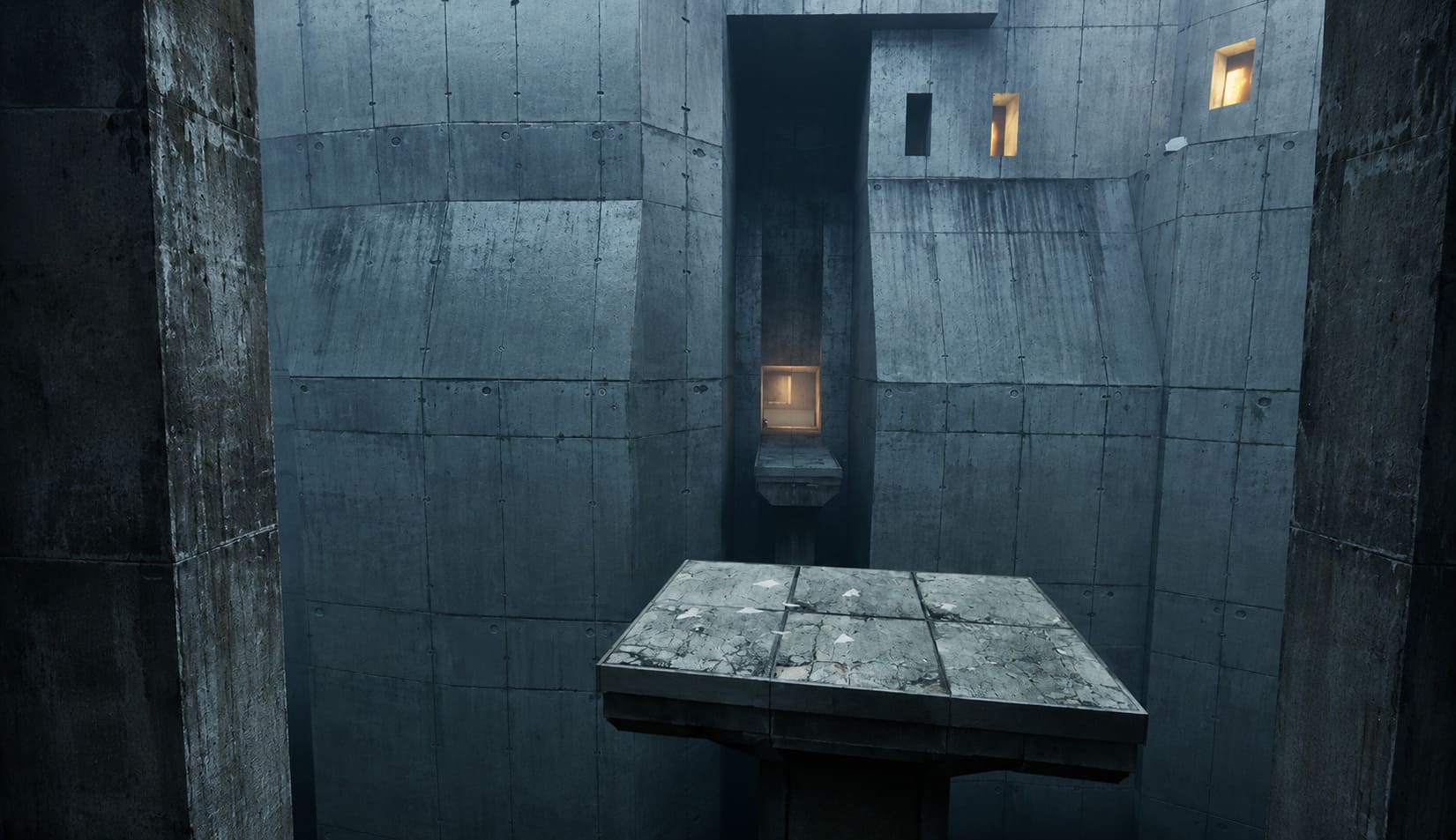
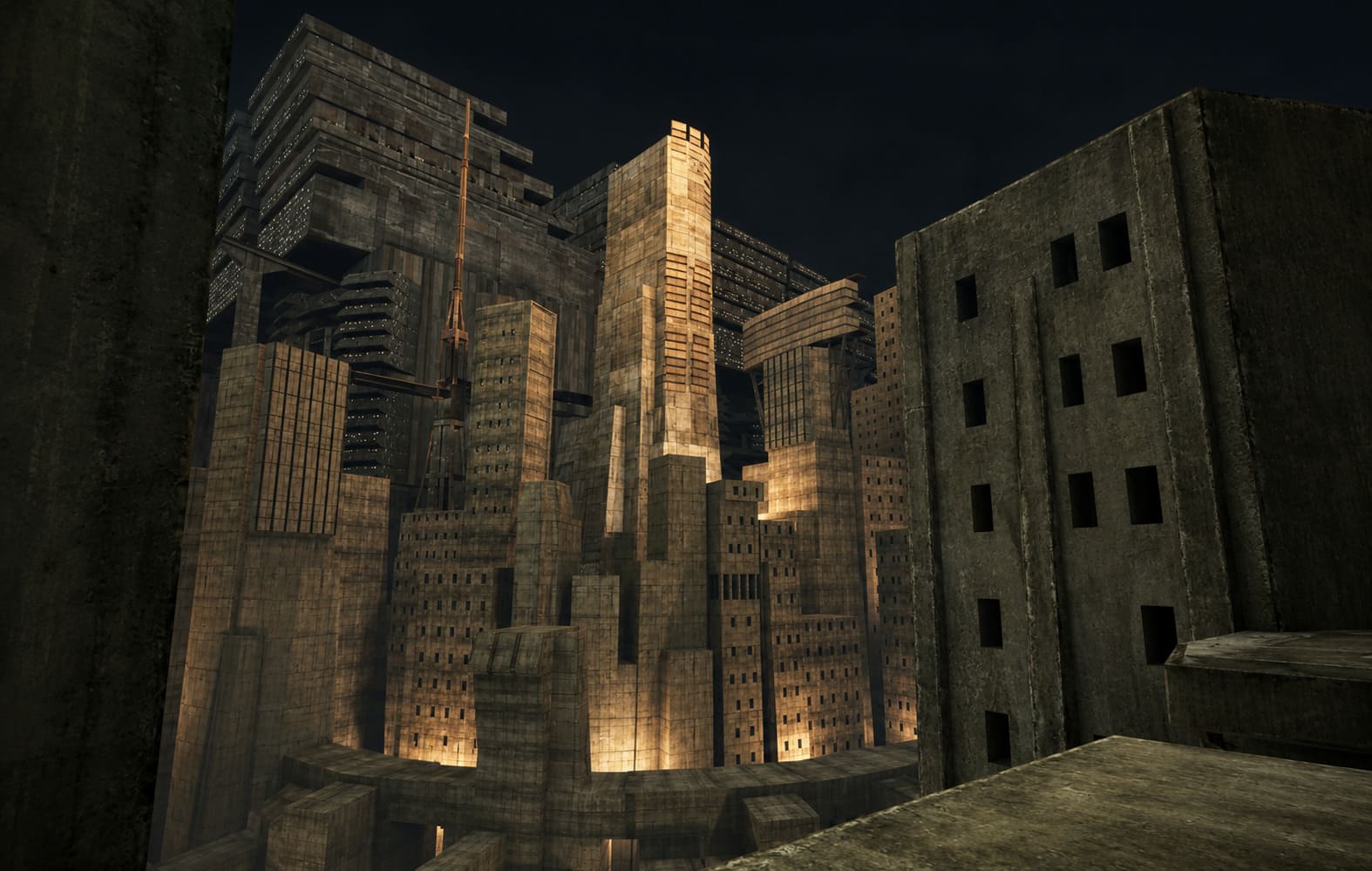
Maps such as Conapt and Jungle deserve to be explored properly. Look around. Check strange corners. Climb things that don’t immediately seem necessary. Investigate isolated structures.
The game’s brutalist environments aren’t just decorative backdrops. They are effectively giant movement puzzles.
And exploration pays off later.
When you eventually return to a level for a serious time attempt, you’ll already know where the awkward geometry is. You’ll remember the dead ends. You’ll know which surfaces are climbable and which routes look promising but ultimately waste time.
That knowledge is incredibly valuable.
Exploration First, Optimization Second
| Run Type | Main Goal | What to Focus On |
|---|---|---|
| First Run | Understand the level | Exploration and navigation |
| Second Run | Improve consistency | Clean movement |
| Practice Run | Learn shortcuts | Geometry and momentum |
| Time Trial | Beat your record | Direct routes |
| Ghost Run | Study experts | Advanced techniques |
Trying to speedrun a map you don’t understand is usually just frustration wearing a stopwatch.
9. Momentum Is More Important Than Raw Speed
This is probably the single most important lesson I would give someone starting VHOLUME.
Speed is temporary. Momentum is what keeps the run alive.
A flashy jump that launches you forward but leaves you facing the wrong direction isn’t necessarily useful. A slightly slower movement that puts you perfectly into the next section can actually produce a better overall time.
Think of the level as a continuous chain.
Run into jump.
Jump into wall-run.
Wall-run into landing.
Landing into slide.
Slide into launch.
Launch into the next section.
The goal is to make those transitions feel almost automatic.
Whenever you slam into a wall, stop dead, or have to perform a huge camera correction, ask yourself what caused it.
Was your angle wrong?
Did you jump too late?
Did you take the wrong wall?
Did you sacrifice too much momentum for a shortcut that wasn’t actually faster?
This kind of self-analysis is where the difference between casual completion and serious mastery begins.
How to Fix Lord of Mysteries Crashing on Startup on PC (2026 Guide)
10. Don’t Restart Every Time Something Goes Wrong
Speedrunning instincts can be toxic when you’re learning.
You miss one jump and immediately hit restart.
You make a bad landing and restart.
You lose three seconds and restart.
That’s fine once you’re practicing a polished route. During early learning, though, it can prevent you from understanding how the game behaves when things go wrong.
Sometimes the most useful runs are the messy ones.
You fall onto a lower platform and discover a recovery route.
You miss a wall and realize another structure is climbable.
You take a completely unintended path and find a shortcut.
VHOLUME is built around movement experimentation.
Let yourself make mistakes.
The game is much more interesting when you stop treating every failed jump like a disaster and start treating it like information.
How to Play VHOLUME with Friends: 2026 Online Multiplayer Guide
Final Thoughts
VHOLUME is the kind of game that looks simple until you actually start chasing mastery.
At first, you’re just trying to reach the end of a level without falling into the fog. A few hours later, you’re staring at another player’s ghost, wondering how they somehow skipped half the map.
That’s the hook.
The game’s minimalist design works because every mechanic matters. Running, jumping, wall-running, sliding, climbing, camera control, geometry, and momentum all feed into the same central idea: keep moving.
For beginners, I’d focus on the fundamentals before worrying about leaderboard perfection. Learn how the movement feels. Explore every level. Fix performance problems early, especially if TSR is hurting your frame rate. Experiment with mouse-wheel jumping on PC. Use ghosts as free coaching. And when you start optimizing routes, stop thinking about which platforms the developers expect you to use.
Think about where you actually want to go.
Keep your trajectory clean. Preserve momentum. Cut unnecessary movement.
Once VHOLUME clicks, the concrete labyrinths stop feeling like intimidating obstacle courses and start feeling like gigantic pieces of kinetic machinery. And honestly, that’s when this game gets dangerously hard to put down.