Happy’s Humble Burger Cult Lore Explained: The Full Story and Deep Dark Secrets Revealed
When I finished my first few sessions of Happy’s Humble Burger Cult, I realized something that surprised me: the monsters weren’t what stayed in my head. It was the world itself.
On the surface, you’re just another exhausted worker trying to survive another impossible shift. Burgers need to be cooked, fries can’t burn, customers won’t wait forever, and every mistake feels like it could cost your life. But anyone who has followed the Scythe Saga knows the restaurant has never been the real story.
The kitchen is only the stage.
What makes this universe fascinating is how it slowly reveals a much larger narrative involving unethical corporations, psychological experiments, reality distortion, and ancient entities that don’t play by human rules. Unlike many horror games that explain everything through collectibles, Happy’s Humble Burger Cult prefers to leave pieces scattered everywhere, encouraging players to build the timeline themselves.
After spending time comparing the newer game with Happy’s Humble Burger Farm, reading hidden notes, replaying certain sequences, and discussing theories with other fans, here’s how I interpret the bigger picture.
More Than a Horror Game About Burgers
One thing I appreciate about this series is that it never relies solely on jump scares.
Instead, it mixes several horror styles together:
- Corporate horror
- Psychological manipulation
- Cosmic horror
- Simulation theory
- Body horror
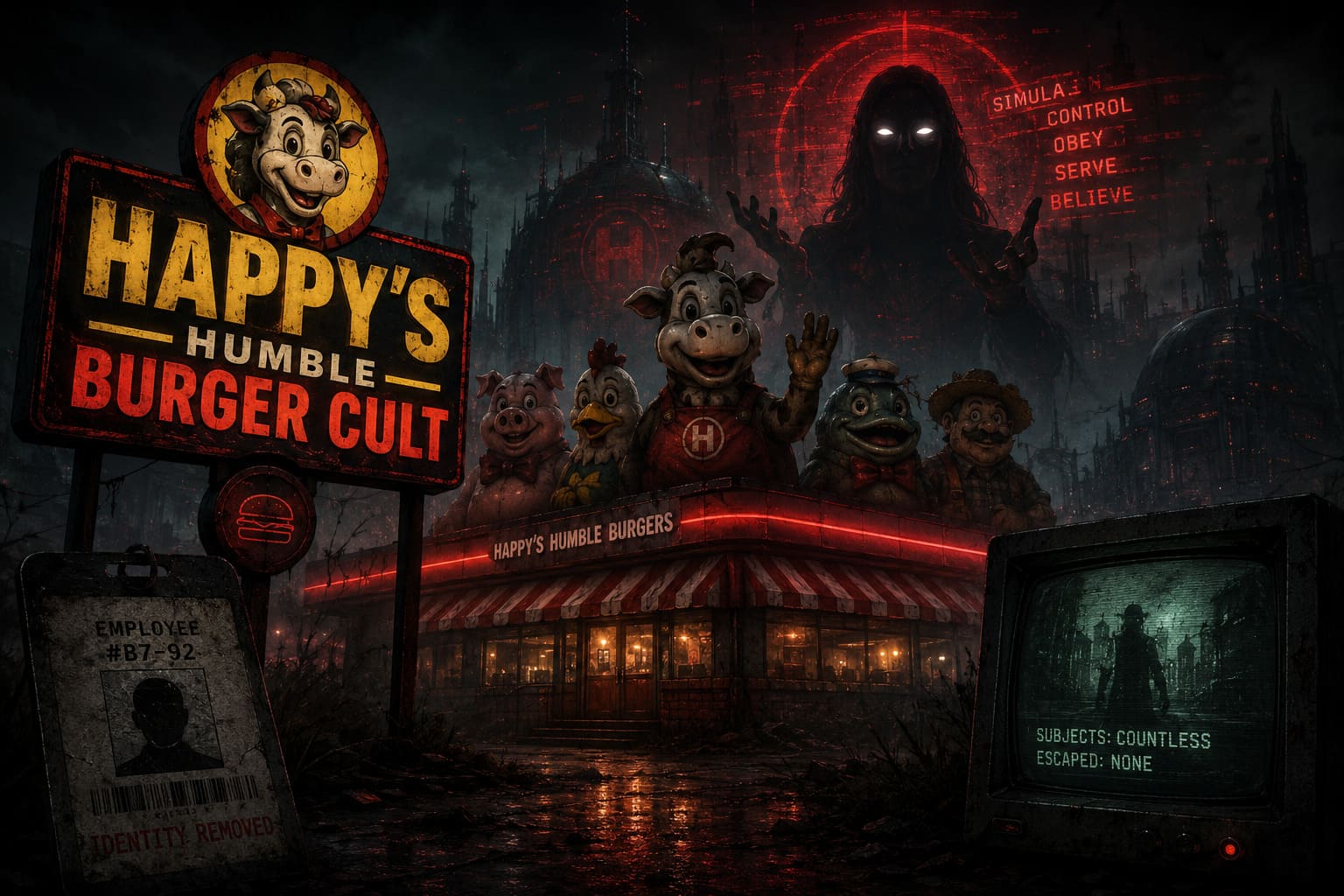
That combination gives the franchise its own identity. The restaurant isn’t simply haunted. It’s part of a much larger system designed to erase individuality while feeding something far older than humanity.
Even during ordinary gameplay, the feeling never disappears that you’re participating in a ritual instead of running a business.
The Companies Behind the Nightmare
The central conflict begins long before players ever touch a grill.
Two powerful organizations dominate the background lore:
| Organization | Role in the Story |
|---|---|
| Obscura Biotechnology | Conducts psychological research and develops human conditioning programs. |
| Paragon Corporation | Corporate partner connected to advanced technology, containment efforts, and classified research. |
Neither company feels heroic.
Both appear willing to sacrifice human lives in exchange for technological progress and complete behavioral control.
That immediately makes the setting more unsettling because the greatest evil doesn’t initially come from monsters—it comes from ordinary corporations treating people like disposable assets.
As someone who enjoys horror games, I think this is one of the strongest parts of the writing.
The Simulation Was Never Meant to Be Safe
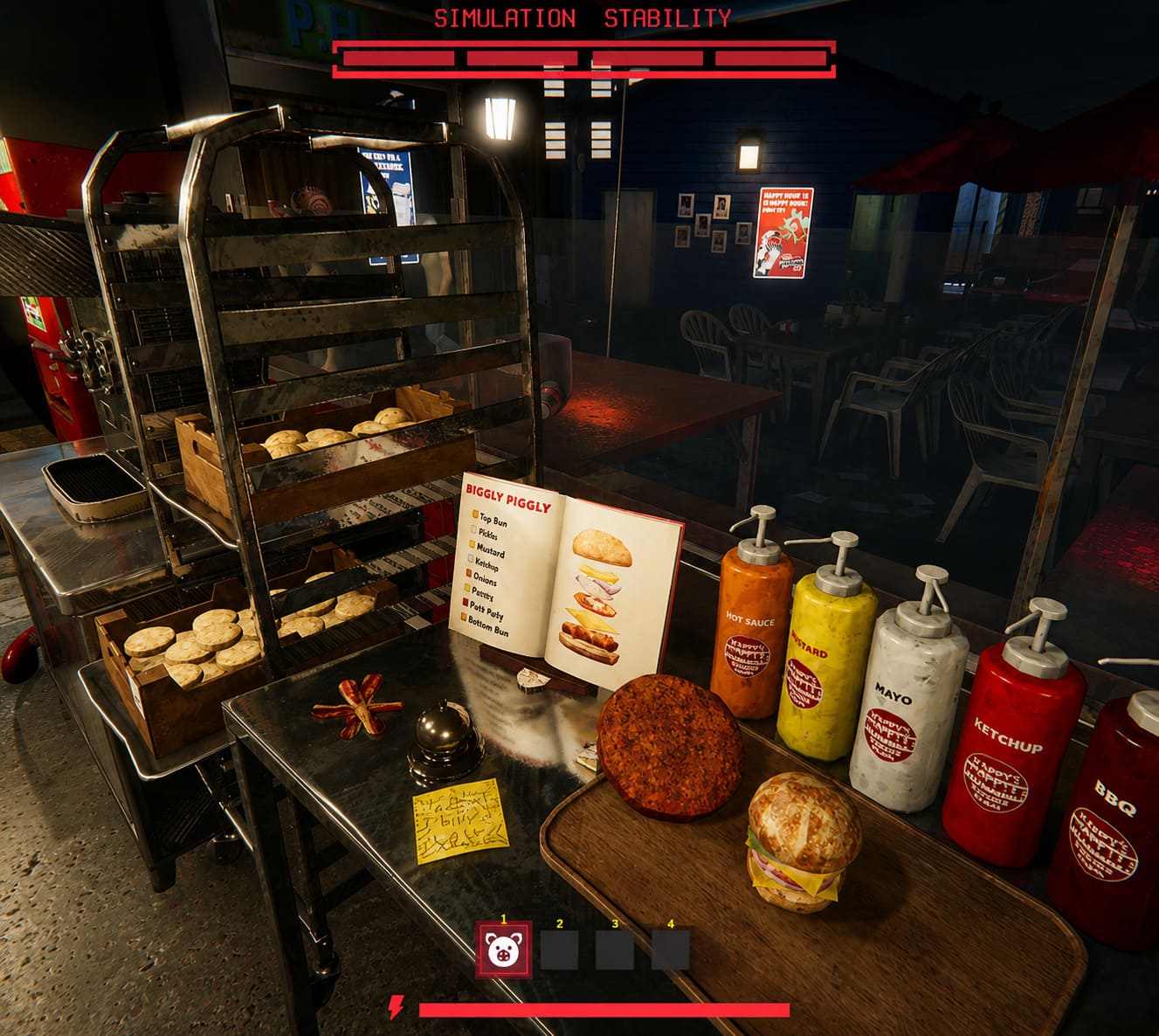
The simulated city is one of my favorite concepts in the entire franchise.
People aren’t simply hired.
They’re stripped of their identities.
Their memories disappear.
Their names become meaningless designations.
Their lives are reduced to repetitive work schedules inside a nostalgic fast-food restaurant.
At first glance, this almost resembles a strange parody of everyday employment.
Then you realize the workers are trapped inside a psychological experiment where every routine has been carefully engineered.
Even the apartments feel intentionally empty, reinforcing the idea that individuality has been erased.
The simulation doesn’t just test obedience.
It manufactures it.
Why the Barnyard Buds Are So Much More Than Mascots
Most mascot horror games introduce creepy characters because they look unsettling.
The Barnyard Buds feel different.
Their cheerful designs are intentionally misleading.
Characters like:
- Happy the Humble Heifer
- Petey the Portly Pig
- Charlie the Chillin’ Chicken
- Sammy the Surly Salmon
- Farmer
all represent familiar children’s entertainment.
That nostalgic appearance makes their transformations significantly more disturbing once reality begins collapsing.
Instead of becoming ordinary monsters, they seem to function as vessels for something much older and far less understandable.
Personally, I think that’s why they remain memorable long after finishing a play session.
Asset Joy Changes Everything
If there’s one figure connecting nearly every major mystery, it’s Asset Joy.
Rather than acting like a traditional horror villain, Joy feels almost like a force of nature.
She bends reality.
She ignores physical limitations.
She influences both digital environments and the real world.
Most importantly, multiple pieces of lore suggest that even the corporations responsible for creating this nightmare eventually realized they couldn’t control her.
That’s an important detail.
Normally, evil corporations believe they can contain whatever dangerous project they create.
Here, they’re completely wrong.
Instead of mastering the anomaly, they become terrified of it themselves.
That reversal makes the story much stronger in my opinion.
Failure Has Consequences Beyond Gameplay
One mechanic I always liked from Happy’s Humble Burger Farm is how mistakes aren’t simply “game over.”
Repeated failures gradually destabilize reality.
Miss too many orders.
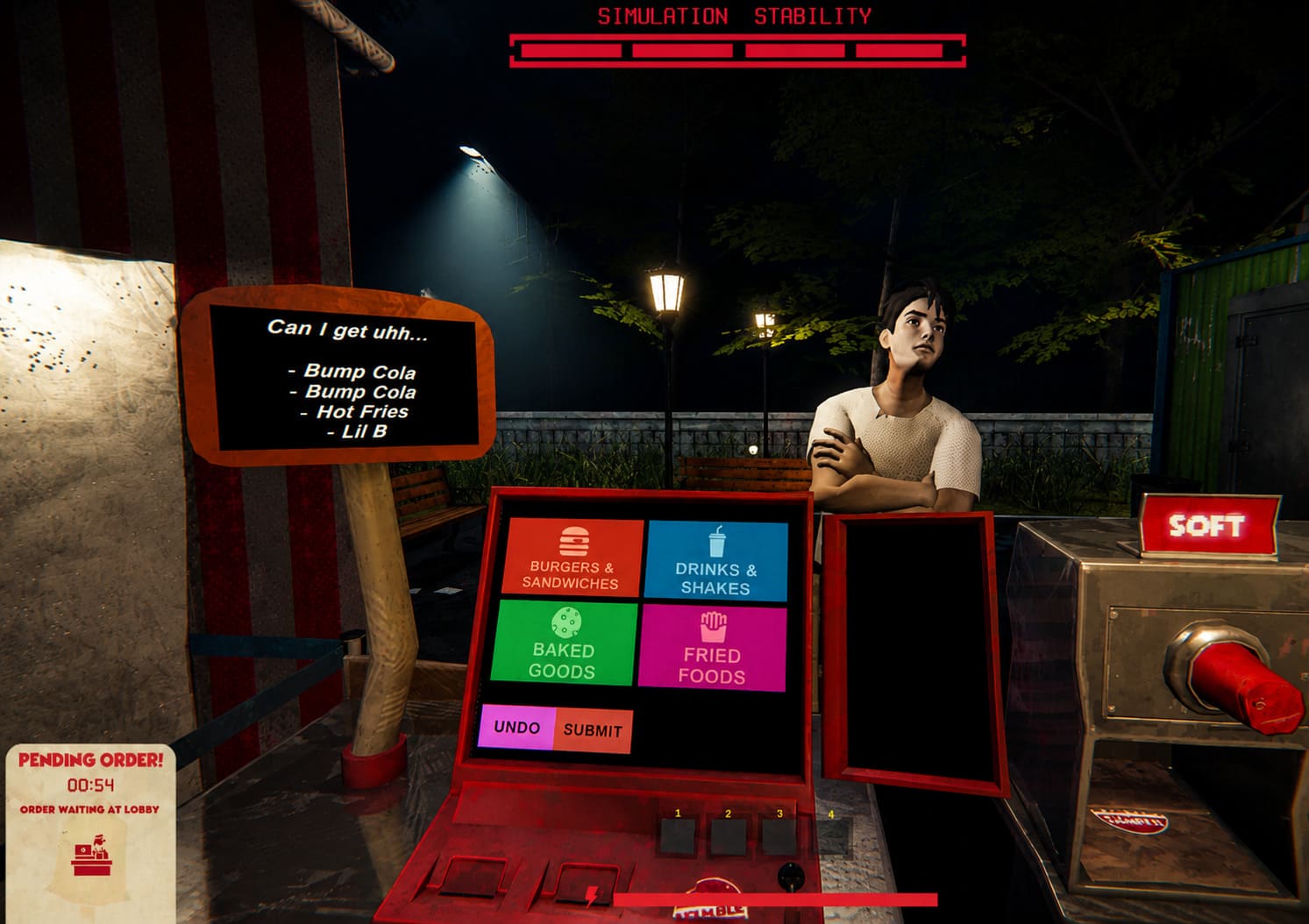
Burn too much food.
Ignore customer demands.
Eventually the simulation begins breaking apart.
That’s clever because the gameplay itself becomes part of the storytelling.
The player isn’t just managing restaurant efficiency.
They’re unknowingly holding reality together.
Every successful order delays something much worse waiting beneath the surface.
Burger Farm vs Burger Cult
The newest game doesn’t simply continue the previous story.
It expands its scale dramatically.
Here’s how I see the progression:
| Happy’s Humble Burger Farm | Happy’s Humble Burger Cult |
|---|---|
| Focus on one trapped subject | Focus on multiple survivors |
| Escape from a simulation | Survive after containment fails |
| Corporate experiment | Cult-like global influence |
| Isolation | Cooperative survival |
| Local horror | Expanding worldwide threat |
This shift makes the sequel feel much larger without abandoning the original atmosphere.
The horror has escaped the laboratory.
Now everyone is living with the consequences.
The Corporate Cult Is a Clever Evolution
The title change isn’t just cosmetic.
The word Cult perfectly reflects how the world has evolved.
Instead of forcing obedience through scientific experiments alone, the influence now spreads through belief, ritual, and organized survival.
The endless work shifts almost resemble religious ceremonies.
Every completed order feels like an offering.
Every paycheck becomes another chance to survive.
It’s a subtle commentary on how people can become trapped inside systems that demand constant sacrifice while promising security they never truly deliver.
That’s one reason the setting sticks with me more than many recent indie horror games.
Small Details That Reward Curious Players
Scythe Dev Team has always hidden interesting information away from the main objectives.
Some of my favorite environmental storytelling moments include:
- Television broadcasts that quietly expand the world’s history.
- Radio advertisements that make the restaurant chain feel frighteningly normal.
- Hallucination sequences that completely alter the tone without fully explaining themselves.
- Secret locations that hint at events predating the simulation.
None of these scenes hand players definitive answers.
Instead, they encourage discussion.
And honestly, that’s half the fun.
Some of the best conversations I’ve seen on community forums come from people comparing completely different interpretations of the same environmental clues.
The Strange World Beyond the Restaurant
One sequence that really stood out to me involves the surreal volcanic landscapes.
Without spoiling every detail, these moments feel intentionally disconnected from ordinary reality.
Rather than resembling another simulation layer, they seem almost mythological.
Whether these places represent another dimension, the birthplace of the anomalies, or symbolic visions is still open to interpretation.
That’s exactly why they’re effective.
Good cosmic horror leaves room for uncertainty.
Once everything is fully explained, the fear usually disappears.
The Human Cost Behind the Horror
One detail that’s easy to overlook is how many victims exist before the monsters even appear.
Researchers.
Employees.
Test subjects.
Failed experiments.
Everyone becomes disposable.
Even the mutated creatures wandering hidden facilities seem less like enemies and more like tragic evidence of experiments that should never have happened.
That tragedy gives the world emotional weight beyond simple survival horror.
Why the Lore Works So Well
For me, the biggest strength of Happy’s Humble Burger Cult isn’t any single monster.
It’s the layered storytelling.
The game constantly blends several ideas together:
- Corporate greed replacing basic morality
- Technology pushing beyond ethical limits
- Loss of personal identity
- Psychological conditioning
- Ancient horrors existing beyond human understanding
None of those themes are entirely new on their own.
Combined together, though, they create a setting that feels surprisingly original.
Even after several hours, I found myself thinking less about surviving another shift and more about what was actually happening behind the scenes.
That’s usually a sign of effective world-building.
Dead Weight Black Screen on Startup on PC: Fix Guide for 2026
Final Thoughts
I don’t think Happy’s Humble Burger Cult succeeds because it’s the scariest horror game ever made.
It succeeds because it creates a universe that players genuinely want to investigate.
Every hidden document, abandoned corridor, distorted broadcast, and strange hallucination feels like another piece of a puzzle that’s intentionally incomplete. The developers trust players to connect the dots themselves instead of delivering every answer through long exposition scenes.
As a longtime fan of indie horror, that’s something I always appreciate.
The restaurant may be the setting, but the real story is about control—who has it, who loses it, and what happens when something ancient begins rewriting the rules entirely.
Whether future entries confirm today’s community theories or introduce even stranger revelations, one thing seems certain: the nightmare surrounding Happy’s Humble Burger is far from over, and every new shift reveals another layer of one of indie horror’s most intriguing modern universes.