WoW Forever Profession Changes: Guide to Classic Plus Tradeskills
World of Warcraft: Forever is not simply taking Vanilla professions and throwing a few extra recipes at them. The entire philosophy behind tradeskills is changing. Crafting is being pushed into the center of the leveling experience, open-world exploration, dungeon progression, character optimization, and even group survival.
After the 2026 BlizzCon reveal, one thing became pretty obvious to me: professions might end up being one of the systems that makes WoW Forever feel genuinely different from both Vanilla WoW and modern Retail. Blizzard is keeping the old-school crafting structure, but it is adding more reasons to actually care about what your character can make.
There are more than 600 new recipes, profession-specific combat perks, upgraded classic items, new gathering mechanics, and the Camping system, which could completely change how groups move through Azeroth.
If you are planning your first character for WoW Forever, choosing professions based purely on what sells well on the Auction House may be a mistake. Your profession can now directly affect your character’s power, utility, and role inside a group.

WoW Forever Profession Overhaul: What Actually Changed?
The biggest difference is simple: professions are designed to matter from level 1 through level 60.
Classic WoW had plenty of fantastic crafting moments, but it also had a mountain of recipes that felt obsolete before you even learned them. You could spend hours gathering materials only to craft something that was immediately replaced by a dungeon drop.
WoW Forever is attacking that problem from several directions.
| Profession System | WoW Forever Change |
|---|---|
| Crafting | 600+ new recipes and more leveling-focused equipment |
| Dungeon Rewards | Bosses can drop exclusive Blueprint recipes |
| Camping | Professions contribute structures, buffs, and utilities |
| Crafting Perks | Primary professions provide direct gameplay benefits |
| Gathering | Skill-based combat bonuses and rare resource encounters |
| Secondary Professions | Cooking and First Aid receive major utility upgrades |
| Alts | Certain progression systems interact with account-wide features |
That last point is especially interesting. Blizzard isn’t completely removing the old-school grind, but Legacy perks and account-wide systems should make maintaining multiple characters less painful.

For players who enjoy alts, that’s a pretty big deal.
The Camping System Could Change Open-World WoW
This is probably the profession feature I am most curious about.
The new Camping system takes the traditional Cooking Fire concept and turns it into an actual gameplay mechanic. Instead of dropping a fire because somebody needs to cook, players can establish a campsite while traveling through the world or during dungeon runs.
The professions of the players around the camp determine what it can provide.
Think of it as a temporary field headquarters.
A well-organized group could potentially turn a random location in Azeroth into a useful staging area complete with crafting functionality, maintenance tools, and long-duration buffs.
That creates a completely different reason to care about profession diversity.
A dungeon group isn’t simply asking, “Who has food?”
They may be asking:
- “Who has the Blacksmithing upgrade?”
- “Do we have an Alchemist?”
- “Can someone activate the high-tier campsite?”
- “Who can provide the group utility we need before the next boss?”
That kind of interaction is exactly what made old-school WoW professions interesting in the first place.
Blacksmithing: From Expensive Grind to Serious Group Utility
Blacksmithing looks like one of the biggest winners in the profession overhaul.
Classic Blacksmithing was often a painful investment unless you knew exactly which recipes mattered. WoW Forever is giving Blacksmiths a much clearer identity: equipment support, utility, upgrades, and specialized gear.
Repair All
Blacksmiths gain a new baseline ability called Repair All.
Instead of hunting down an NPC every time your equipment is falling apart, a Blacksmith can repair equipped gear for themselves and nearby party members.
Rank 1 has an 8-hour cooldown, while Rank 2 cuts that down to 4 hours.
For casual leveling, that is convenient. For long dungeon sessions and progression raids, it could be genuinely useful.
Belt Buckles
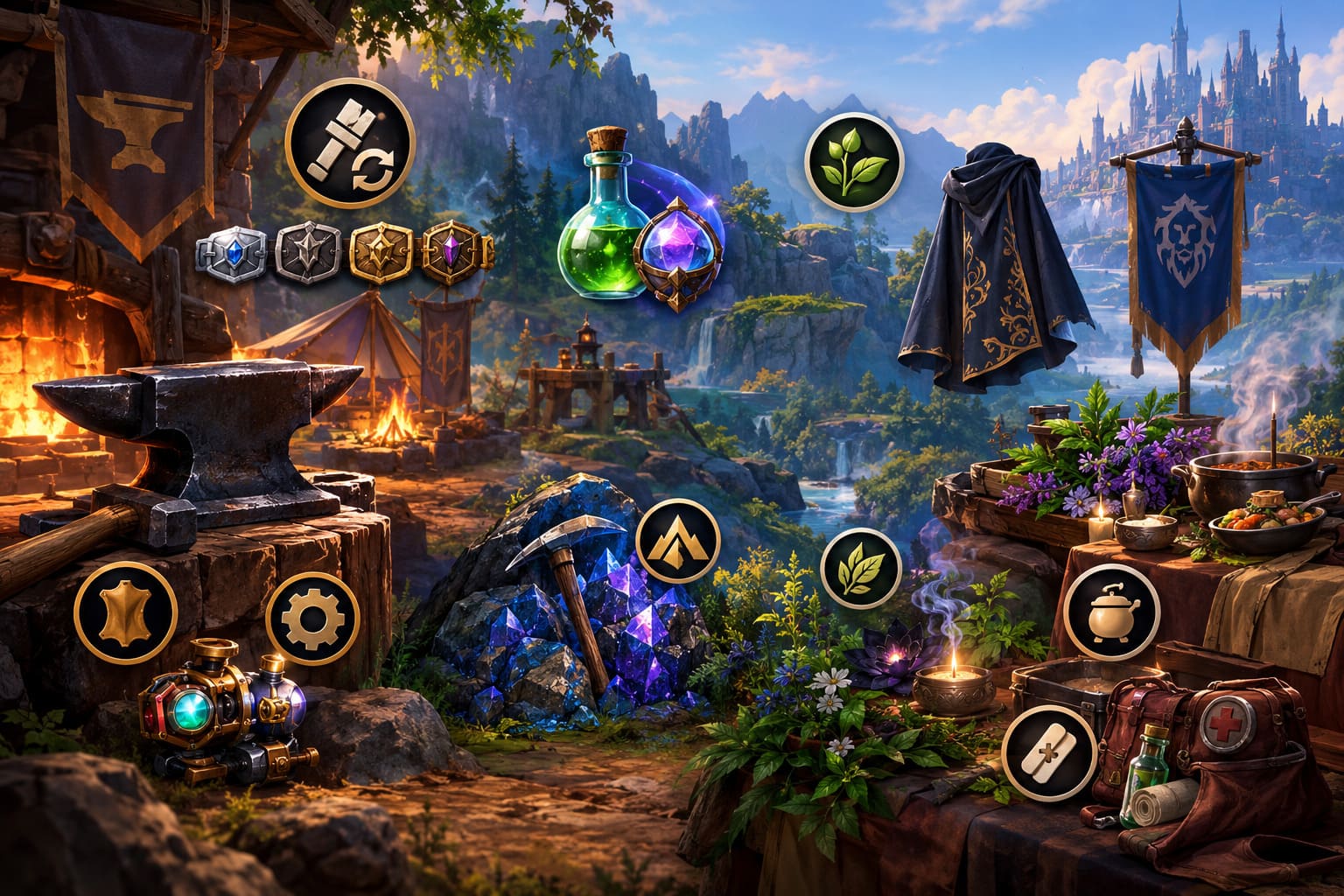
Blacksmiths can also produce Belt Buckles, which permanently improve waist armor with additional stats.
There are four major tiers:
- Silver
- Iron
- Mithril
- Arcanite
The progression stretches from leveling content into endgame, giving Blacksmithing another reason to remain relevant after hitting 60.
Blacksmithing Campsite Tools
Blacksmiths also contribute heavily to the Camping system.
Their campsite progression includes:
- Sharpening Wheel — provides temporary melee damage or critical strike bonuses.
- Anvil — enables local crafting and equipment maintenance.
- Master Forge — unlocks advanced recipes that require a high-level outdoor crafting setup.
This is exactly the kind of feature that makes a profession feel like part of the world rather than another menu you open in a capital city.
The expanded Blacksmithing recipe pool also targets some of Vanilla’s itemization holes, including early tanking weapons, shields, thrown weapons, plate and mail leveling sets, and other equipment that should make leveling characters more self-sufficient.
Alchemy: Mixology Finally Gives Alchemists a Reason to Keep Their Profession
Alchemy is still the king of consumables, but WoW Forever adds something that Vanilla Alchemists desperately needed: a reason to keep the profession for personal progression rather than simply making potions for everyone else.
The new Mixology passive increases the duration of consumed elixirs and flasks by 100% while also increasing their effects by 25%.
That is a massive personal benefit.
Raiders who already spend piles of gold on consumables will immediately understand why this matters. An Alchemist can potentially stretch their consumable supply much further while receiving stronger effects.
Then there is the reworked Philosopher’s Stone.
Instead of being little more than a utility item associated with transmutation, it becomes an upgradeable equippable trinket.
Players begin with a Crude Philosopher’s Stone and improve it through multiple stages using increasingly rare ingredients.
Higher versions, including the Inlaid Philosopher’s Stone, unlock more advanced elemental and metal transmutations.
The equipped stone also improves the healing received from health potions.
For solo players, PvPers, and anyone who enjoys squeezing every bit of survivability out of a character, that is much more interesting than the old Philosopher’s Stone ever was.
Tailoring: More Cloth, Better Cloaks, Stronger Camps
Tailoring is getting a particularly interesting combination of farming utility and character customization.
Cloth Scavenging
The new Cloth Scavenging passive increases the amount of cloth Tailors can obtain from humanoid enemies.
That becomes even more interesting when paired with classes that already manipulate humanoid loot.
Rogues are the obvious example because of Pickpocket. A Rogue with Tailoring can potentially extract additional value from humanoid enemies before killing them and then benefit from the improved cloth collection afterward.
That is exactly the sort of profession synergy theorycrafters love.
Cloak Embroideries
Tailors can also apply powerful permanent Cloak Embroideries to their own cloaks.
These aren’t simply cosmetic alternatives to normal enchants. They can provide specialized effects and stats for different roles.
Examples include:
- Attack Power for physical DPS
- Spell Power for casters
- Stamina for tanks
- Specialized triggered effects
Tailoring also contributes a Faction Banner to the Camping system. When deployed, the banner provides nearby allies with Spirit and resource regeneration benefits.
So yes, that random Tailor standing around in your group might actually be useful now.
Engineering and Leatherworking Still Have Their Own Identity
The available details for Engineering and Leatherworking are not as extensive as those for Blacksmithing or Alchemy, but Blizzard has confirmed several important directions.
Engineering retains its classic reputation for strange gadgets and PvP-oriented utility while gaining new components connected to the Camping system.
That means Engineering should continue to appeal to players who enjoy unconventional tools rather than straightforward stat optimization.
Leatherworking receives new armor kits and additional leather and mail equipment. Its upgrades are designed to compete with other crafting improvements while supporting new hybrid class configurations and the Skyborne race.
The important takeaway is that neither profession appears to be getting reduced to a pile of filler recipes.
Gathering Professions Finally Get Combat Value
This might be one of the smartest changes in the entire profession overhaul.
Vanilla gathering professions were often abandoned at endgame because a second crafting profession could provide much more direct value.
WoW Forever flips that model.
Mining and Herbalism now provide combat-related passive bonuses tied to gathering progression.
That means you don’t necessarily have to choose between “useful in combat” and “good at gathering.”
Mining: The Tank Profession?
Mining receives a passive called Toughness, providing a flat 5% increase to maximum health.
For tanks, that’s immediately relevant.
Five percent may not sound spectacular while leveling, but once you start looking at raid gear, defensive builds, and large health pools, the bonus becomes much more meaningful.
Mining also introduces Arcanite Lodes in high-level areas such as renewed Mount Hyjal, Silithus, and the Eastern Plaguelands.
These rare nodes require additional effort or specialized tools but can reward miners with:
- Arcane Crystals
- Pristine ores
- High-end crafting materials
- Resources used in epic Blueprint recipes
That creates a nice loop: explore dangerous areas, discover rare nodes, and bring valuable resources back to the crafting economy.
Herbalism: Resistance and Better Black Lotus Hunting
Herbalism gets Natural Talent, a scaling passive that provides resistance to all schools of magic as your Herbalism skill increases.
That gives Herbalism a surprisingly broad defensive role.
It can help against caster-heavy PvP encounters and provide additional protection against elemental and magical raid mechanics.
Blizzard is also addressing one of Vanilla’s most infamous gathering headaches: Black Lotus competition.
Traditional spawns remain, but high-level Herbalists gain a small random chance to discover Black Lotus while gathering other high-level herbs in level 50–60 areas.
Certain plant-based and elemental creatures can also provide herbalism materials after being defeated.
It’s not a complete replacement for classic Black Lotus farming, but it should make the profession feel less dependent on a handful of contested spawn locations.
Herbalists also gain Incense Candles for campsites. These create a smoke cloud that grants nearby resting players an Intellect bonus.
Cooking Becomes Part of the Leveling Meta
Cooking has been quietly transformed into one of the most useful secondary professions.
Food isn’t just about recovering health or gaining a small Spirit bonus anymore.
High-level recipes provide primary combat stats, along with an additional percentage-based XP bonus.
That changes the value of food during leveling considerably.
If you are trying to reach 60 efficiently, keeping a good supply of food isn’t just about surviving between pulls. Your cooking choices can become part of your overall leveling route.
For alt players, this could be particularly useful.
A stocked Cooking setup could make repeated leveling journeys considerably more efficient.
First Aid Becomes Actual Field Medicine
First Aid is also getting a substantial makeover.
The old “bandage yourself after taking damage” gameplay is being expanded into a much broader medical toolkit.
New recipes include:
- Specialized curatives
- Anti-venoms
- Minor healing tinctures
- Tools for handling dangerous debuffs
- Consumables that operate independently from standard Alchemy potion cooldowns
This gives non-healer classes more ways to handle poison, curses, and other problems while exploring the world.
For solo leveling, that matters.
For PvP, it could matter even more.
How Professions Could Shape Your Character
The interesting part of WoW Forever’s profession system isn’t any individual recipe. It’s the way all of these mechanics start overlapping.
A tank Blacksmith has repair utility, belt upgrades, campsite tools, and additional equipment options.
A Mining tank gains the 5% maximum-health bonus and can hunt Arcanite Lodes while exploring high-level zones.
An Alchemist raider gets stronger and longer consumables while progressing an upgraded Philosopher’s Stone.
A Tailoring Rogue can combine Pickpocket with improved cloth gathering.
An Herbalist caster can benefit from scaling magical resistance while providing Intellect support through campsite Incense Candles.
Those combinations make professions feel much closer to actual character-building choices.
WoW Forever Profession Strategy: What Players Should Prepare For
If the current information holds through beta and launch, I would approach professions very differently from Vanilla.
Don’t choose purely based on Auction House value.
Look at the entire character.
Class + Profession + Group Role + Leveling Route now matters much more.
A profession can provide stats, survival bonuses, consumable efficiency, crafting access, campsite utility, or rare resource gathering.
That means the “best” profession is going to depend heavily on what you actually want to do.
A hardcore raider, solo world player, PvPer, gold farmer, and alt-focused player can all have completely different reasons to pick the same profession.
And honestly, that’s a much healthier design for a Classic-style MMO.
WoW Forever Beta Black Screen on Startup: 7 Ways to Fix Launch Crashes
Final Thoughts
World of Warcraft: Forever is making one of the boldest attempts yet to fix the biggest weakness of classic professions: the feeling that crafting eventually stops mattering.
The solution isn’t simply giving Blacksmithing another hundred swords or dumping a pile of recipes into Tailoring.
Blizzard is connecting professions to combat, exploration, campsites, character progression, dungeon rewards, rare world resources, and group utility.
The result could make Azeroth feel much more interconnected.
A Blacksmith isn’t just somebody who crafts gear. They can maintain the group’s equipment and improve a campsite.
A Miner isn’t just gathering ore. They bring a permanent health advantage and can discover rare Arcanite resources.
An Alchemist isn’t just producing raid potions. Their own consumables become more efficient and their Philosopher’s Stone becomes a progression item.
That’s the part of WoW Forever that has my attention.
The game is still built around the familiar level-60 Vanilla framework, but these systems could give players reasons to leave the capital, cooperate with strangers, build profession networks, and actually care about the person standing next to them at a campsite.
With the November 4, 2026 launch approaching and the closed beta already underway according to the supplied development timeline, now is the time to start thinking about profession combinations rather than treating tradeskills as an afterthought.
If Blizzard gets the balance right, professions won’t feel like optional side content anymore.
They’ll be part of what your character actually is in Azeroth.