Valheim End-Game Meta 2026: Lightning vs Frost Damage Analysis
If there is one thing I have learned after spending far too much time fighting through the Mistlands and Ashlands in Valheim, it is this: raw physical damage is no longer the whole conversation.
Once you reach the real endgame, the question stops being “Which weapon has the biggest number?” and becomes “How do I control the fight?”
That is where the current Lightning vs Frost debate gets interesting.
On paper, Lightning looks like the obvious winner. It is aggressive, spectacular, excellent against groups, and perfectly suited to players who enjoy charging into a crowd and turning everything around them into a pile of loot. Frost, meanwhile, feels almost boring by comparison. It slows enemies, creates breathing room and lets you dictate the pace of an encounter.
But after using both approaches, I don’t think Frost deserves to be written off as the “safe but weaker” option.
My personal take? Lightning is more exciting. Frost is more reliable. And when the fight goes horribly wrong, reliability is worth a lot more than another flashy damage proc.
Lightning Damage: The “Just Hit Everything” Build
Lightning has exactly the kind of personality I want from an endgame Valheim build.
It is loud. It is violent. It looks ridiculous in the best possible way.
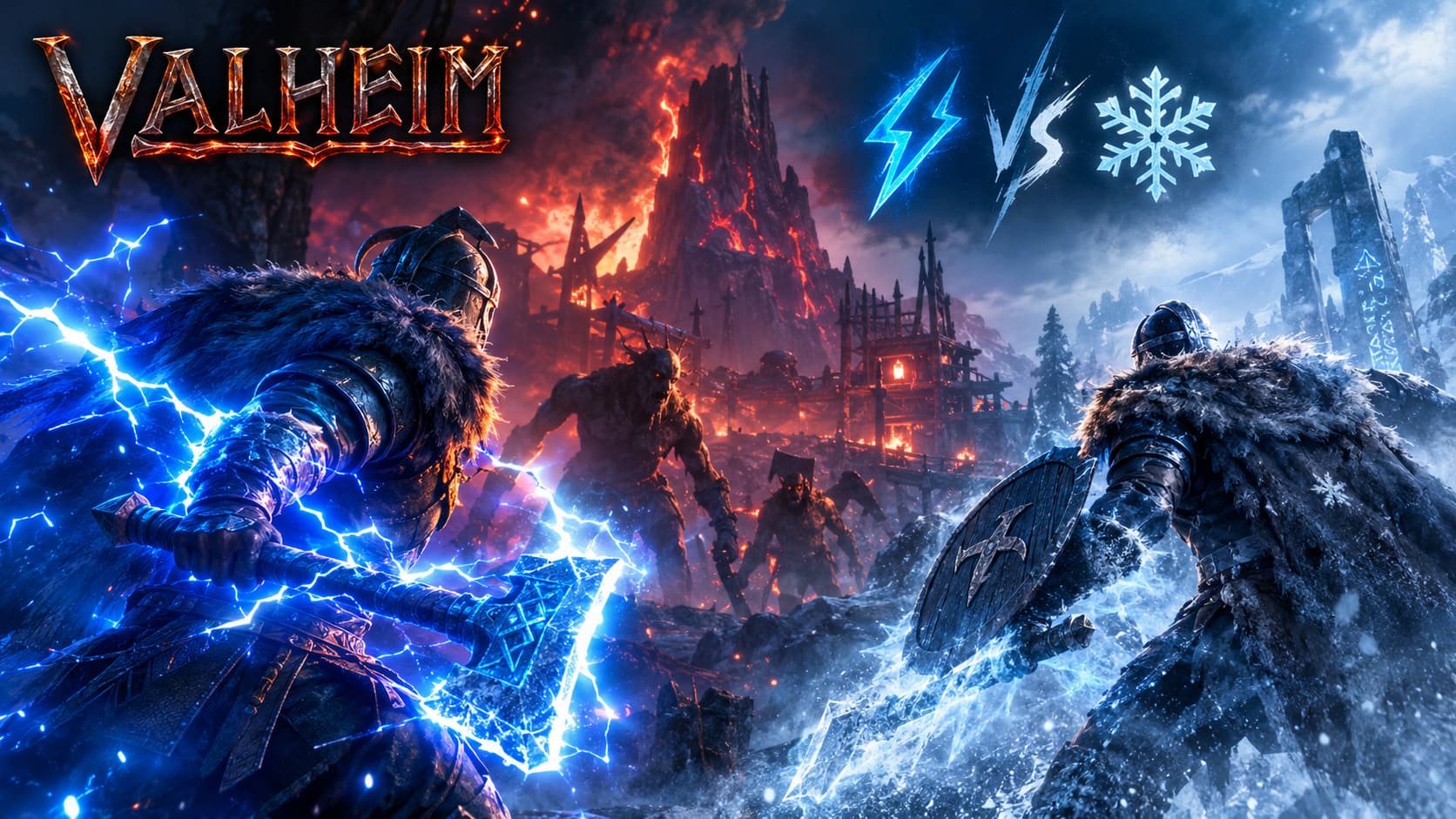
The biggest advantage of a Lightning-focused setup is how naturally it rewards aggressive play. Fast weapons become especially attractive because you’re constantly attacking, constantly looking for another opening, and potentially triggering additional electrical damage while you’re doing it.
In a crowded fight, this can snowball incredibly quickly.
Imagine entering an Ashlands battlefield where several enemies are already closing in. Instead of carefully picking one target and waiting for the perfect opening, a Lightning build encourages you to keep swinging. Every additional hit has the potential to create another burst of pressure.
That’s why fast-attacking Flametal weapons are so attractive for players who care primarily about clear speed.
Why I Like Lightning
There are three things that make Lightning particularly appealing in the Valheim endgame:
- Aggressive damage output — it rewards constant attacking rather than defensive play.
- Excellent crowd pressure — additional electrical effects can make groups much easier to handle.
- Fantastic synergy with fast weapons — the more frequently you attack, the more opportunities you have to trigger your elemental effects.
And then there is the stagger factor.
Valheim combat is often about more than simply draining an enemy’s health bar. If you can disrupt an enemy at the right moment, the entire fight can change. A staggered opponent gives you a window to punish them before they can recover.
That’s where Lightning feels particularly satisfying.
You aren’t simply dealing damage. You’re forcing the battlefield to move at your pace.
But Lightning Has One Really Annoying Problem
Here is the part that doesn’t get enough attention in “Lightning is OP” discussions:
Lightning is not exactly subtle.
This matters much more in Valheim than it might seem.
When you’re fighting around Dvergr structures or other neutral NPCs, uncontrolled area effects can turn a manageable encounter into complete chaos. Accidentally involving a neutral character can create an entirely new fight that you absolutely did not ask for.
And let’s be honest: Valheim already has enough ways to turn a five-minute expedition into a disaster.
The visual and audio impact of Lightning can also work against stealth-oriented players. If your strategy involves quietly approaching enemies, setting up a perfect shot and eliminating targets before they know you’re there, an explosive elemental effect is not exactly your best friend.
So I would describe Lightning as a “commitment” damage type.
Once you start using it, you’re basically announcing:
“We’re fighting. And we’re fighting everybody.”
For speed-focused players, that’s fantastic.
For careful explorers, maybe not so much.
Frost Damage: The Endgame Safety Net
Frost has always felt different to me.
It doesn’t have the same wow factor as Lightning. You don’t walk into a group of enemies and immediately feel like Thor has taken over your Viking.
Instead, Frost quietly makes enemies worse at being enemies.
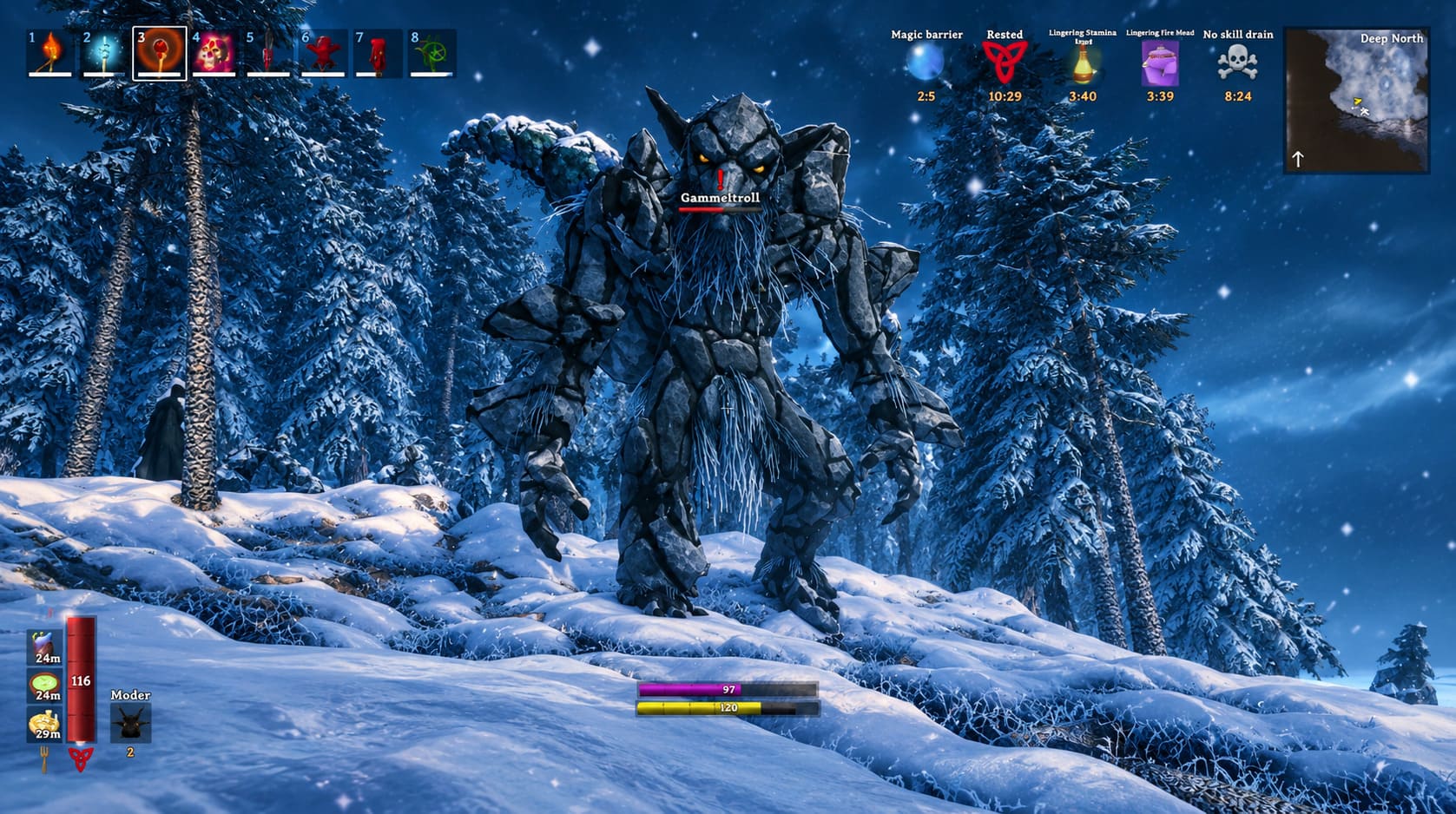
And that is incredibly powerful.
The defining advantage of Frost damage is its ability to slow targets and control their movement. In a game where positioning, stamina and timing are everything, reducing an enemy’s ability to reach you quickly is a massive defensive advantage.
This becomes especially valuable against enemies that are aggressive enough to punish even one bad dodge.
With Frost, you have more time.
More time to reposition.
More time to recover stamina.
More time to heal.
More time to decide whether you actually want to continue the fight.
That last one is underrated.
Frost Turns Combat Into a Positioning Game
This is why I personally enjoy Frost more when I’m exploring dangerous areas alone.
With a Lightning build, my instinct is usually:
Attack. Attack again. Keep moving. Commit.
With Frost, I play differently.
I hit an enemy, create distance, watch its movement and decide where I want the next engagement to happen.
Suddenly the fight isn’t just about DPS.
It’s about space.
And Valheim rewards players who understand space.
A slowed enemy is easier to kite. It’s easier to circle around. It’s easier to separate from a group. It’s also easier to punish with a heavy attack when you know exactly where it is going to be a second from now.
That makes Frost incredibly forgiving when something goes wrong.
Mistwalker vs Lightning Weapons: Which One Would I Actually Use?
This is where the debate becomes much more practical.
The Mistwalker remains one of those weapons that is difficult to hate. It combines useful damage types with excellent utility, and its ability to provide light in the Mistlands makes it feel like more than just another sword.
For general exploration, I still love it.
It doesn’t demand that you completely commit to a hyper-aggressive playstyle. You can use it to control a fight, create distance and methodically work through dangerous enemies.
A Lightning-focused Flametal weapon is a different beast.
It feels built for players who already know the combat system and want to push it harder.
When you’re comfortable with enemy attack patterns, stamina management and positioning, the extra offensive pressure becomes much more valuable.
If I’m speed-clearing an area, I want Lightning.
If I’m exploring somewhere dangerous and don’t know what I’m about to find, I’m much happier with Frost.
That’s probably the simplest way I can put it.
Berserkir Axes vs Frostner: Chaos vs Control
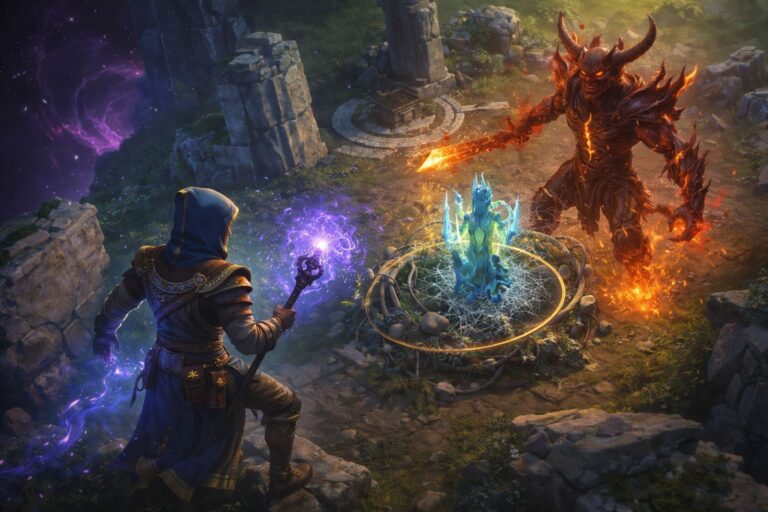
The Berserkir Axes are probably the clearest example of the Lightning philosophy.
Fast attacks + elemental effects + aggressive positioning = absolute chaos.
If you like dual-wielding and don’t mind managing stamina aggressively, Lightning-infused axes can turn ordinary enemies into a blender.
The important thing here is that the weapon doesn’t ask you to slow down.
It asks you to lean into the violence.
Frostner, on the other hand, feels like an old veteran that refuses to retire.
It may not have the same endgame glamour as the newest Flametal options, but its combination of blunt, Frost and Spirit damage gives it a surprisingly respectable place in a wider arsenal.
And there is something satisfying about using an older weapon against newer enemies.
Frostner isn’t trying to impress you.
It just works.
For undead-heavy encounters, that mixed damage profile can still make it a useful option, especially for players who don’t want their entire build to revolve around one elemental effect.
Staff of Frost vs Lightning for Magic Builds
Magic changes the conversation completely.
If you’re playing an Eitr-focused character, Staff of Frost gives you one of the most useful forms of battlefield control available to a mage.
Instead of waiting for a melee enemy to enter your range, you can continuously pressure it from a safer position.
This is especially useful when you’re fighting something that you absolutely do not want standing next to you.
And that’s the key difference between Frost magic and a Lightning-heavy melee build.
Lightning generally makes me want to move toward the problem.
Frost makes me want to keep the problem away from me.
That’s a surprisingly important distinction.
A good mage can use Frost to maintain distance while allies attack from another angle. Even in solo play, slowing an enemy can create enough breathing room to manage Eitr, stamina, healing and positioning without constantly panicking.
It isn’t necessarily the fastest way to kill everything.
But it can be one of the safest.
Lightning vs Frost: My Endgame Breakdown
| Category | Lightning | Frost |
|---|---|---|
| Raw Aggression | Excellent | Good |
| Crowd Control | Excellent | Excellent |
| Enemy Slow | Low | Excellent |
| Clear Speed | Excellent | Good |
| Defensive Utility | Moderate | Excellent |
| Stealth-Friendly Play | Poor | Excellent |
| Solo Reliability | Good | Excellent |
| Group Combat | Excellent | Excellent |
There isn’t really a universal winner here.
And honestly, I think that’s a good thing.
If one elemental type completely dominated every situation, Valheim’s endgame would become much less interesting.
Instead, the two approaches reward completely different players.
Valheim Deep North Crossbow Build: 1.0 Endgame Stealth Guide
So, Which Is Better in Valheim Endgame?
If you force me to choose one for pure damage and fast clearing, I’m taking Lightning.
There is simply something extremely satisfying about an aggressive build that tears through groups before they have time to organize themselves. If you know the terrain, understand enemy patterns and are comfortable managing stamina, Lightning can feel absurdly powerful.
But if you ask me which element I trust more when I’m carrying valuable gear through an area where one mistake could ruin the entire expedition?
Frost. Every time.
That’s because Valheim isn’t a traditional action RPG where DPS is the only stat that matters.
Survival matters.
Positioning matters.
Stamina matters.
Knowing when not to attack matters.
And Frost helps with all of those things.
Best Valheim Graphics Settings for High FPS on RTX 40 Series (2026 Guide)
My Ideal 2026 Endgame Setup
Personally, I wouldn’t build my entire character around only one elemental damage type.
I’d rather use them as complementary tools.
Frost for control. Lightning for execution.
Open the fight with ranged Frost damage, slow the most dangerous target, create some distance and remove the immediate threat. Once the battlefield is under control, switch to a Lightning-focused melee weapon and start cleaning up.
That approach feels much more “Valheim” to me than blindly chasing the highest possible damage number.
The best Vikings aren’t necessarily the ones who kill enemies the fastest.
They’re the ones who still have their equipment, food and sanity when the fight is over.
And that’s ultimately why I think the Lightning vs Frost debate is so interesting.
Lightning is the weapon you pick when you want to feel unstoppable.
Frost is the weapon you pick when you want to stay alive.
For speedruns, aggressive solo players and experienced melee fighters, I’d give Lightning the edge. For exploration, difficult solo encounters and players who value control, Frost remains incredibly hard to beat.
And for the truly nasty endgame fights?
Why choose?
Slow them down with Frost.
Then bring the storm.