Scrap Mechanic 1.0 Optimization Update: How Axolot Games Solved the Physics Lag Rabbit Hole
After years of waiting, experimenting, and countless community discussions, Scrap Mechanic has finally reached its long-awaited 1.0 release, bringing not only the massive Chapter 2 “Drilling Thunder” expansion but also one of the most important improvements in the game’s entire history: a complete engine optimization overhaul.
As someone who has played plenty of sandbox games where creativity often fights against technical limitations, I know exactly how frustrating it feels when an amazing idea gets destroyed by performance issues. Building a giant mobile base, a complex automated factory, or a ridiculous vehicle should be the best part of a physics sandbox, not the moment when your FPS drops into single digits and your world starts falling apart.
For years, Scrap Mechanic players joked that building advanced machines required a gaming PC powerful enough to run a space program. Massive creations were impressive, but they came with a price. Too many moving parts, bearings, pistons, and mechanical systems could push the engine into chaos. With the Scrap Mechanic 1.0 optimization update, Axolot Games finally tackled the technical problems that held back the game’s biggest ideas.
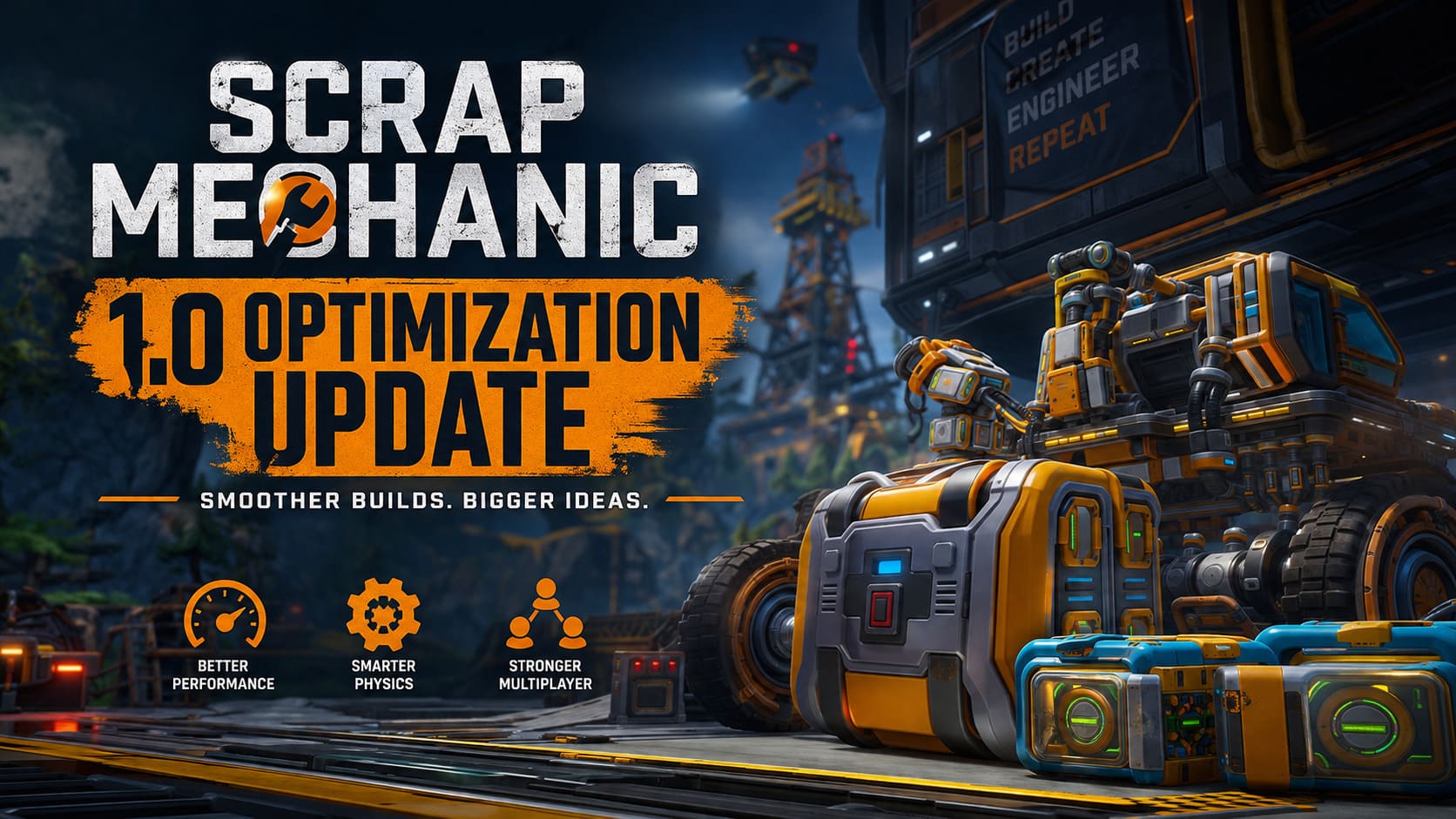
This update is not just a small performance patch. It represents a deeper rebuild of how the game handles physics, multiplayer synchronization, and large-scale creations. The result is a much smoother experience where players can finally build closer to their imagination instead of designing around engine limitations.
Scrap Mechanic 1.0 Netcode Fix How to Stop Multiplayer Lag and Fix Corrupted Long Playtime Saves
Why Scrap Mechanic Had Performance Problems For So Long
To understand why the Scrap Mechanic 1.0 optimization update matters so much, it is important to look at the game’s complicated development history. Scrap Mechanic always had a unique advantage compared to many sandbox games: its physics system allowed players to create machines that felt like real mechanical inventions. Suspension systems, rotating parts, pistons, bearings, and logic connections gave players almost unlimited freedom.
The problem was that this freedom came with a huge technical cost. Every moving component required calculations. A simple vehicle with a few wheels was easy to handle, but when players created walking robots, automated factories, or enormous flying machines, the engine had to process hundreds or thousands of physical interactions at the same time.
Older versions of Scrap Mechanic often struggled because the physics workload could overwhelm the CPU. A huge creation sitting inside a player’s base could still consume processing power because the game continued calculating objects that were not actually doing anything important.
This created many of the issues players remember from Early Access:
- Massive FPS drops when using complex machines.
- Physics glitches where creations would randomly explode or behave incorrectly.
- Multiplayer desynchronization where vehicles and objects appeared differently for each player.
- Server instability during large survival sessions.
Axolot Games eventually admitted that solving these problems required much more than normal bug fixing. The developers had to go deep into the engine itself and rewrite important systems that had been built years earlier.
The Biggest Improvements In The Scrap Mechanic 1.0 Engine Update
The 1.0 release changed the way Scrap Mechanic manages physics objects. Instead of constantly calculating everything, the engine now works smarter by focusing resources where they are actually needed.
Smart Bearing Freezing System
One of the biggest improvements comes from the new way bearings are handled. Before the update, every bearing attached to a creation could continue consuming processing power even when the machine was completely stationary.
Imagine leaving a giant factory vehicle parked at your base. In older versions, the game still treated many of those mechanical parts as active physics objects. That meant your computer was working even when nothing was happening.
The 1.0 update introduces a smarter system where inactive bearings can enter a frozen state. When a part is not moving and does not receive a command, the engine treats it almost like a solid object. Once the player activates the mechanism, the physics simulation wakes up again.
This small technical change has a huge impact on large builds. Massive factories, storage systems, and multi-wheel vehicles can now exist in the world without constantly draining performance.
Improved Multi-Core CPU Usage
One of the biggest complaints from experienced players was that Scrap Mechanic often failed to properly use modern processors. Many gaming PCs have multiple CPU cores, but older versions placed too much pressure on a single core.
The 1.0 optimization update improves how physics tasks are distributed. Instead of forcing one processor thread to handle everything, the engine can now divide calculations more effectively.
| Before 1.0 | After 1.0 Optimization |
|---|---|
| Large creations caused sudden FPS drops | Physics calculations are distributed more efficiently |
| Explosions and destruction could freeze gameplay | Debris handling is smoother |
| Complex machines overloaded the CPU | Modern processors are used more effectively |
For players with newer hardware, especially multi-core gaming CPUs, this improvement makes large-scale engineering much more enjoyable.
Multiplayer Netcode Improvements
Anyone who played Scrap Mechanic multiplayer knows that technical problems could sometimes ruin an otherwise amazing session. A machine that worked perfectly for the host could behave completely differently for another player.
The 1.0 update focuses heavily on improving multiplayer synchronization. The game now uses a more efficient prediction system that reduces unnecessary network traffic and improves how player actions are shared between clients.
The biggest improvements include:
- Better synchronization of moving creations.
- Reduced rubber-banding during multiplayer sessions.
- Improved stability for large survival worlds.
- Fixes for older saves with massive amounts of progress.
For groups that enjoy building together, this might be one of the most important upgrades in the entire update.
How Optimization Changes Creative And Survival Mode
The real test of any Scrap Mechanic update is not the technical details. It is what players can actually build afterward.
The biggest difference is that players no longer have to constantly ask, “Will the engine survive this?” Instead, they can focus more on creativity.

Large moving bases are now much more practical. Players can create walking structures, mobile homes, and vehicles with complex mechanical systems without instantly destroying performance. A giant machine that would have been a nightmare before now feels like a realistic project.
Chapter 2’s new areas and drilling mechanics also benefit from these improvements. Automated mining systems, conveyor networks, and resource-processing factories fit perfectly with the updated engine.
Multiplayer survival also receives a major boost. Defending a base with several friends against Farmbots while running complicated machines feels far more stable compared to the Early Access experience.
Performance Tips For The Best Scrap Mechanic 1.0 Experience
Even with major optimization improvements, Scrap Mechanic remains a demanding physics sandbox. Players who want the smoothest experience should still optimize their worlds.
Here are a few useful adjustments:
- Adjust physics settings: Large multiplayer worlds can benefit from slightly reducing physics quality if huge machines are active at the same time.
- Clean old cache files: Players upgrading older worlds may improve stability by removing outdated cached files so the game can rebuild optimized data.
- Control view distance: Extremely large creations combined with maximum draw distance can still challenge your graphics card.
- Avoid unnecessary moving parts: Even with improvements, efficient designs will always perform better than chaotic builds.
Final Thoughts: Scrap Mechanic 1.0 Finally Delivers The Sandbox It Always Promised
After spending years in Early Access, Scrap Mechanic 1.0 feels like the version the game was always trying to become. The new content from Chapter 2 is exciting, but the real victory happens behind the scenes.
Axolot Games did something many developers avoid: they returned to the foundation and fixed the difficult technical problems instead of simply adding more content on top of unstable systems.
The physics optimization, improved multiplayer performance, and smarter resource management completely change how players approach building. The game still rewards creativity, but now creativity is not constantly punished by performance issues.
For returning veterans, Scrap Mechanic 1.0 is a reason to pick up the wrench again. For new players, it is finally the best version of the game to experience. The dream of creating enormous machines, automated factories, and impossible inventions is now closer than ever.
Scrap Mechanic 1.0 is not just an update. It is the moment when the sandbox finally catches up with the imagination of its community.