Nightwater Early Game Tips: The Ultimate Guide to Crafting and Automation
Nightwater is the kind of survival game that looks deceptively simple during its first few minutes. You wake up alone on a strange floating island, surrounded by an enormous liquid void, and your first tasks are about as primitive as they get: collect sticks, break rocks, craft basic tools, and figure out what on earth is happening. But after spending some time with it, the game reveals that survival is really just the starting point.
What makes Nightwater interesting is the way it gradually turns a humble gathering camp into a sprawling automated production system. If you’ve played games such as Forager, Satisfactory, or other progression-heavy factory builders, some of the ideas will feel familiar, but Nightwater puts its own spin on them. You aren’t simply building machines for the sake of building machines; you’re constantly moving through technological eras, improving your production methods and expanding an island that initially feels far too small for your ambitions.
After playing plenty of survival and automation games, I’ve learned that the early hours usually determine whether a factory becomes satisfying or turns into an ugly maze of pipes and machines. Nightwater is no different. A little planning early on can save a ridiculous amount of rebuilding later, so here are the Nightwater early game tips I wish every new player knew before placing their first serious production line.
Nightwater Game Guide: Factory Automation, Ages Progression, and Biome Strategy
Don’t Treat Nightwater Like a Traditional Survival Game
The biggest mistake is approaching Nightwater as if your only goal is to gather enough resources to survive another day. That works for a while, but it misses the point of the progression system. Almost every resource has its own development path, and repeatedly collecting materials contributes toward milestones that unlock new blueprints, buildings, upgrades, and useful passive bonuses.
In other words, even repetitive gathering has a purpose. If you’re waiting for a machine to finish processing something, don’t just stand around staring at it. Go collect stone, wood, ore, or another material you haven’t progressed far enough with yet. Your inventory may fill quickly, but those actions are still contributing toward future unlocks.
This is one of those systems that can feel insignificant at first and surprisingly important later. The more milestones you complete, the more efficiently your character can gather resources, and that eventually makes the transition from manual work to automation much smoother.
Turn Manual Work Into Automation as Quickly as Possible
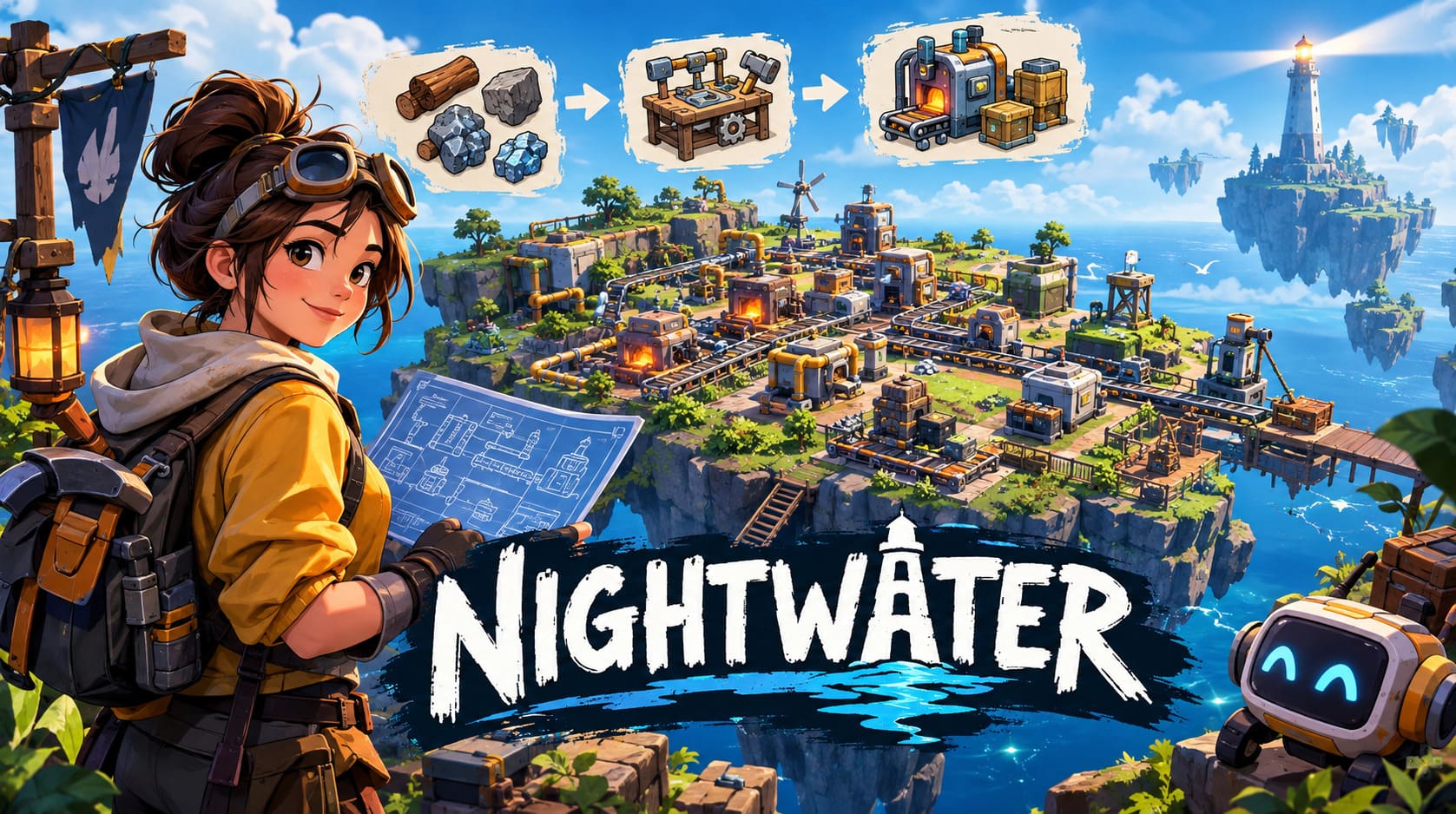
If you’ve played factory games before, you already know the golden rule: if you are doing the same task over and over, there should eventually be a machine doing it instead. Nightwater strongly encourages this mentality. Manual crafting and gathering are perfectly normal during the opening phase, but they quickly become inefficient once production requirements start increasing.
Don’t spend a huge chunk of your play session personally collecting the same resource just because you haven’t technically reached the point where you ‘need’ automation. Start building toward it. Once automated structures become available, prioritize the resources that feed several different production chains rather than automating something you’ll barely use.
Energy and basic raw materials deserve particular attention. A production line can look impressive with several machines running simultaneously, but if the machines constantly run out of fuel or raw inputs, you’ve created an expensive collection of decorations rather than a functioning factory.
Plan Your Floating Island Before It Gets Crowded
One of the most interesting limitations in Nightwater is also one of the easiest to underestimate: space matters. Your starting island isn’t exactly a giant industrial continent, and the surrounding terrain doesn’t give you unlimited room to place whatever you want wherever you feel like it.
As you progress, you’ll be able to expand your territory using materials produced during the early technological eras. When that happens, resist the temptation to scatter new buildings randomly across every available piece of land. Expansion should give you room to create a better factory, not simply give you more places to put machines.
I’ve made this mistake in enough factory games to know how quickly it becomes painful. You start by putting a furnace wherever there’s an empty patch, then a storage box beside it, then an assembler behind it, and eventually a dozen pipes are crossing through the middle of everything. It works until it doesn’t.
A Simple Factory Layout That Makes Sense
A straightforward zoning system works extremely well for the early game. You don’t need to create a perfect Satisfactory-style mega-factory immediately; you simply want to know what each section of your island is supposed to do.
- Raw materials: Keep basic extraction and gathering operations toward one side of the island.
- Processing: Place furnaces and refining equipment in a dedicated production area.
- Assembly: Keep assemblers and component production together so common parts are easy to route.
- Storage: Create a central storage area that can serve several production lines.
This doesn’t have to be perfectly symmetrical. The goal is simply to make your factory understandable at a glance. When something stops working later, you’ll appreciate being able to follow a production line without having to mentally reconstruct where every pipe and machine goes.
Build Around the Materials You Actually Use
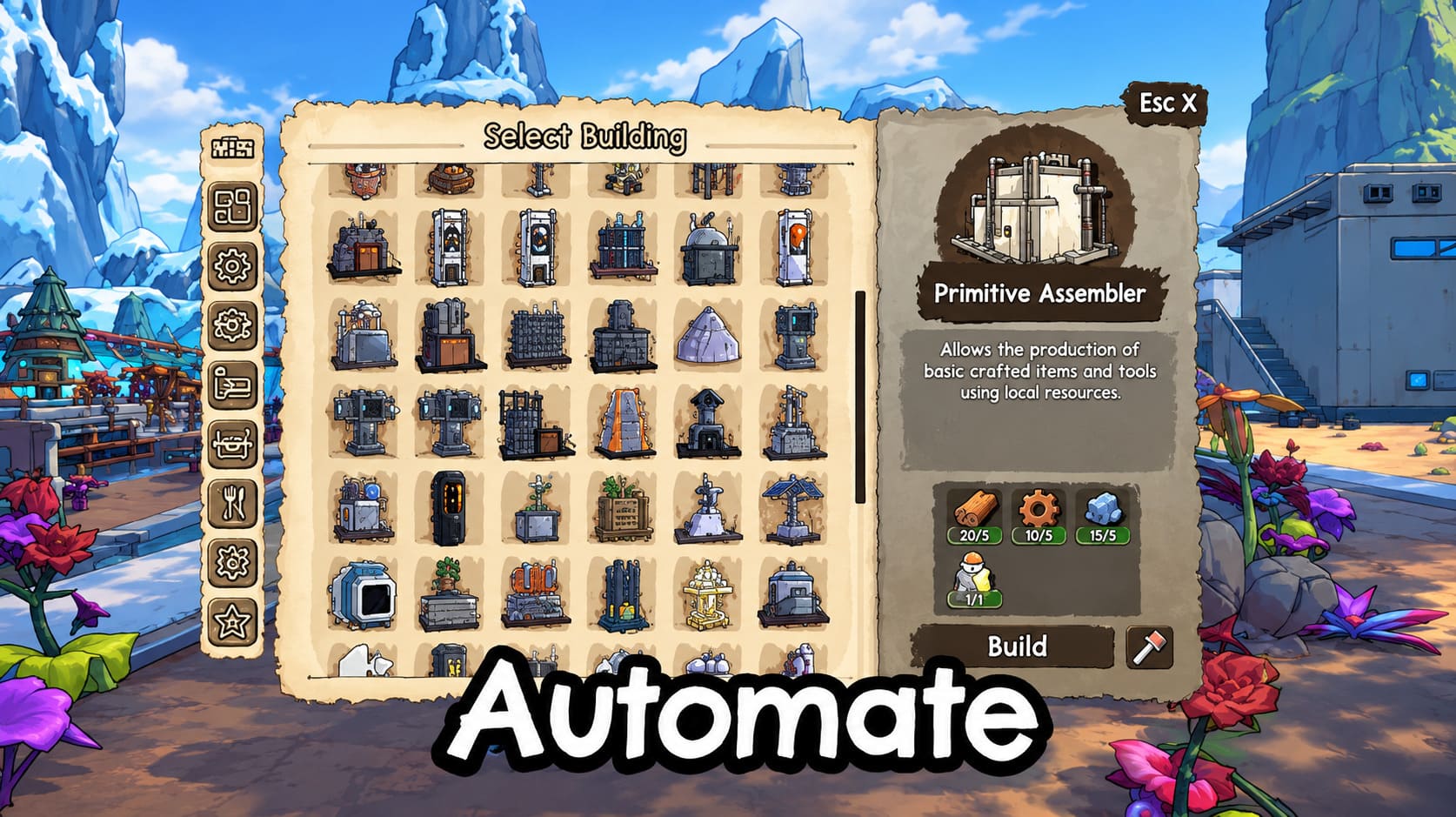
Nightwater eventually gives you access to a surprisingly large selection of buildings and upgrades. That can make the technology tree feel exciting, but it can also tempt you into building everything as soon as it becomes available. I wouldn’t recommend it.
Instead, watch what your recipes are constantly demanding. Basic components such as gears, plates, rods, and similar processed materials tend to become the backbone of more advanced construction. If you’re repeatedly opening the crafting menu to produce another batch, that’s usually a sign that the item deserves its own automated production line.
Set up an assembler, give it a reliable supply of ingredients, and attach appropriate storage. Suddenly, the next time you return from exploring, you aren’t starting from zero. Your factory has quietly been producing the components you need while you were somewhere else.
Storage Is More Important Than It Looks
Storage might not be the most exciting part of factory construction, but ignoring it is one of the easiest ways to cripple an otherwise functional setup. Automated machines need somewhere to put their output. Once that space is full, production can stop even though every other part of the system is working correctly.
For that reason, connect storage to important automated production buildings whenever possible. Think about where the finished material is going before you start the machine. A farmer producing resources continuously is only useful if those resources have somewhere to go.
I also recommend keeping a central stockpile of commonly used construction materials. Nothing feels worse than having a beautiful automated factory ready for expansion and realizing you’re missing a handful of basic components because you used every last one during construction.
Explore New Biomes With a Purpose
Eventually, your starting island won’t contain everything required for the next stage of technological development. That’s when Nightwater begins pushing you outward into new biomes. These areas aren’t simply larger versions of your starting zone; they introduce new resources, ingredients, machinery requirements, and environmental discoveries.
When you arrive somewhere new, resist the urge to immediately run around collecting everything you can see. First, identify the local resource types. Start working toward their early milestones, because those milestones can unlock the technology needed to process the new materials efficiently.
There’s also a very practical exploration tip that is easy to overlook: empty your inventory before leaving your factory. It sounds obvious, but carrying a backpack full of old construction materials into a new biome means you’ll have less room for the resources that actually matter. Exploration becomes much more efficient when you treat your inventory as temporary cargo space rather than a permanent junk drawer.
Moving From the Stone Age to the Industrial Era
One of Nightwater’s strongest ideas is its sense of technological progression. The game begins with primitive tools and simple production, then gradually moves through eras such as the Stone Age, Bronze Age, Industrial Era, and eventually futuristic technology.
Each transition changes how you approach resource production. Early systems are intentionally basic and often require more manual intervention, while later technology allows you to build increasingly sophisticated production chains. The temptation is to spend hours perfecting your Stone Age setup, but that can actually slow down your overall progression.
Don’t confuse optimization with permanence. Your early factory is supposed to become obsolete. Build it well enough to support your current needs, then move forward when the next technological tier becomes available.
| Progression Stage | Main Focus | Best Approach |
|---|---|---|
| Early Game | Manual gathering and basic crafting | Push resource milestones and unlock automation |
| Bronze Age | Improved processing and expansion | Organize production zones and increase storage |
| Industrial Era | Large-scale automation | Build reliable interconnected production chains |
| Future Technology | Advanced manufacturing | Optimize existing systems and expand intelligently |
Don’t Be Afraid to Destroy Your Own Factory
This deserves its own section because new players often become emotionally attached to their first layout. Don’t. Your first factory will probably be terrible compared with what you build later, and that’s completely fine.
As you unlock better buildings, new recipes, and more efficient transportation options, your understanding of the production system changes. A layout that made perfect sense two hours ago might suddenly be blocking a much better design. Deconstruction is part of progression, not a sign that you failed.
I’ve always preferred games that let players rebuild without making every mistake feel permanent, and Nightwater benefits from that philosophy. Experiment with layouts. Move machines. Try different production chains. If something is clearly inefficient, tear it down and build something better.
The Lighthouse May Be More Important Than You Think
Not everything in Nightwater is about numbers, machines, and production rates. The mysterious Lighthouse gives the world a larger purpose beyond simply reaching another technological milestone. It’s the kind of distant landmark that naturally makes you wonder what you’re eventually going to find there.
The main progression can be followed by players who are primarily interested in building their factory, but explorers have another layer of content to discover. The game is designed around multiple possible conclusions, with four distinct endings planned. Reaching the deeper outcomes requires more than simply following the obvious progression path.
Pay attention to environmental details, unusual locations, written logs, strange changes in the world, and anything that seems deliberately out of place. If you’ve played games with environmental storytelling before, you’ll recognize the philosophy: sometimes the game isn’t going to put a giant quest marker over the thing you actually need to investigate.
Five Early Game Mistakes Worth Avoiding
There are plenty of ways to play Nightwater, but a few mistakes consistently make the opening hours more frustrating than they need to be.
- Ignoring resource milestones. Don’t only gather materials when you desperately need them. Early milestone progress can unlock useful permanent bonuses and new technology.
- Creating messy transportation networks. Keep pipes and item routes as clean as possible. A few minutes of planning now can save a painful troubleshooting session later.
- Underestimating storage. Full output containers can bring an automated production chain to a complete stop.
- Overbuilding outdated technology. Don’t spend forever perfecting an early-era factory when the next technology tier can dramatically improve production.
- Refusing to rebuild. Your factory is going to evolve. Accept that some machines and layouts are temporary.
My Approach to the First Few Hours
If I were starting Nightwater from scratch, I’d keep the opening relatively simple. I’d gather aggressively at first, focusing on resource milestones while unlocking the first useful production buildings. Once automation becomes available, I’d immediately start replacing the most repetitive manual tasks instead of trying to automate everything simultaneously.
From there, I’d expand the island with a rough zoning plan and establish a dependable stockpile of basic components. Only after that would I start spending serious time on factory aesthetics or complicated optimization. There is no point making a beautiful production line if you unlock a new technology tier twenty minutes later and have to tear half of it apart.
For exploration, I’d keep my inventory empty before entering a new biome and make the first trip primarily about discovery. Once I know what resources are available, I can decide whether that area needs a dedicated extraction setup or whether I simply need to bring a limited amount of material back home.
Final Thoughts on Nightwater
Nightwater works best when you stop thinking like a survival-game character and start thinking like an engineer. The early game teaches you to gather, but the larger progression is about finding ways to make gathering unnecessary. Every automated machine is effectively another task you no longer have to perform yourself, and watching those small systems eventually connect into a much larger factory is where the game becomes genuinely satisfying.
The floating island setting also gives the usual automation formula a nice sense of identity. You’re not just building another factory in an ordinary open world; you’re expanding a tiny piece of land suspended over something mysterious while gradually pushing civilization from primitive technology toward futuristic industry.
My biggest advice is simple: don’t chase perfection too early. Build enough to progress, automate the repetitive work, keep your logistics readable, and accept that you’ll rebuild things later. Once you understand that rhythm, Nightwater’s progression becomes much more enjoyable, and that strange Lighthouse in the distance starts feeling less like scenery and more like a destination you’re genuinely curious to reach.