Nightwater Game Guide: Factory Automation, Ages Progression, and Biome Strategy
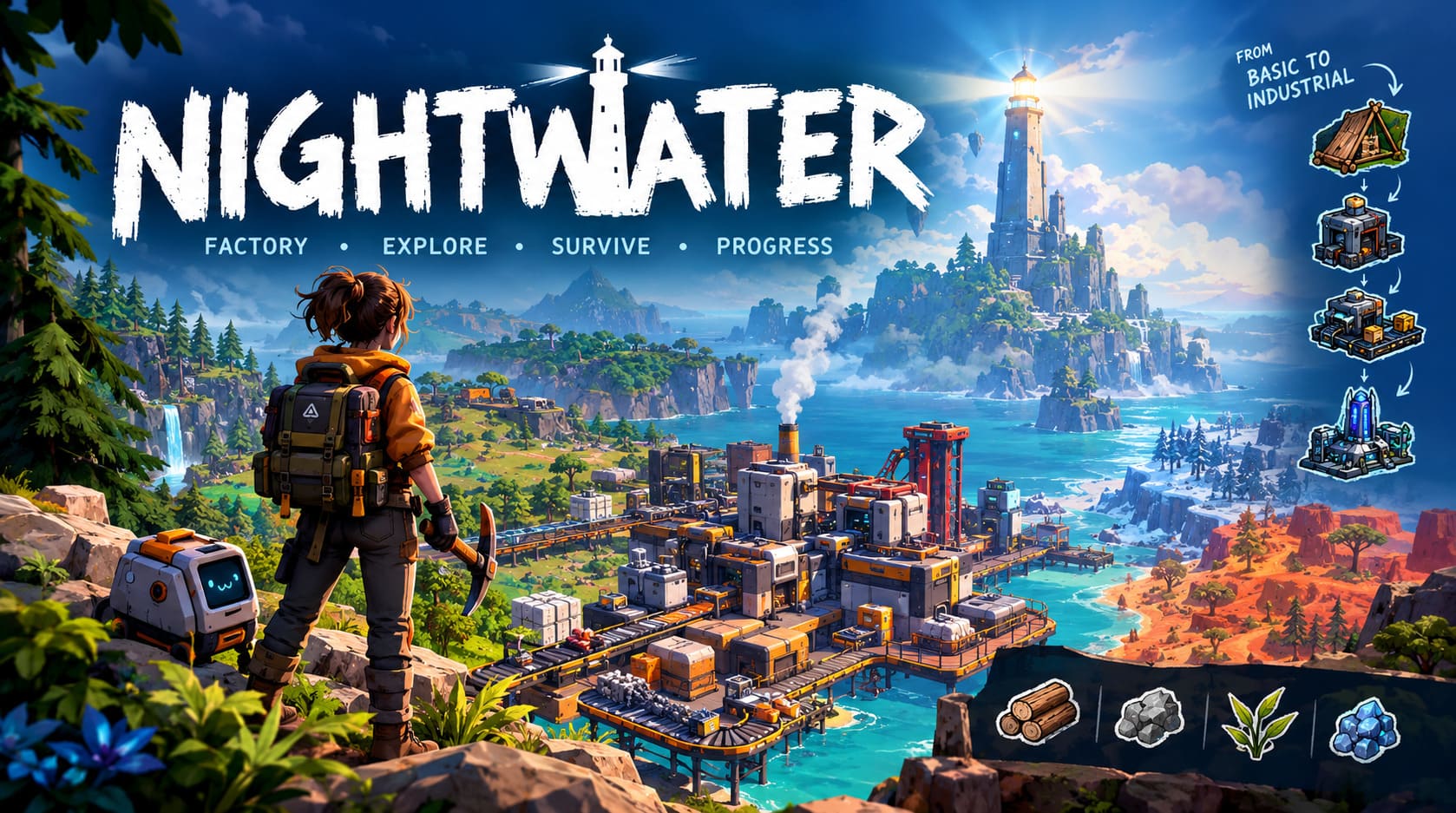
Nightwater caught my attention for a fairly simple reason: it looks like the kind of factory game that actually wants you to earn your automation. I have played more than a few games where you are throwing down conveyor belts within minutes of starting, and while that can be fun, the early struggle often feels like a tutorial that exists only to get out of the way. Nightwater seems to take a different approach. You begin with practically nothing, explore a strange isolated island, gather materials by hand, and slowly turn a primitive camp into a sprawling industrial machine.
Developed by Studio Ashty and co-published with Irox Games, Nightwater is scheduled to launch on September 18, 2026. It combines factory automation, survival mechanics, exploration, resource management, and a mysterious narrative centered around a gigantic Lighthouse. What makes the concept particularly interesting is the way technological progression is tied directly to exploration: if you want better machines, you need new resources, and if you want those resources, you have to push deeper into the island.
Nightwater Guide How to Play, Forage, and Automate Your Base
What Is Nightwater?
At its core, Nightwater is a single-player simulation and strategy game built around the familiar but incredibly addictive loop of gathering, processing, manufacturing, and expanding. The twist is that your factory does not exist in a comfortable open field where every resource is conveniently nearby. Instead, you are working with an isolated world divided into different biomes, each bringing its own materials, terrain problems, and logistical challenges.
The opening hours appear deliberately hands-on. You collect branches, stones, vegetation, and other basic materials yourself before you can even think about proper industrial production. If you have played games such as Factorio, Satisfactory, or Dyson Sphere Program, you will recognize the satisfaction of turning raw resources into increasingly complicated products. Nightwater, however, appears to place much more emphasis on the feeling of building a civilization from scratch.
That progression is important because the island itself becomes part of your factory. A distant resource deposit is not simply another icon on a map. It represents another logistical problem that eventually needs roads, transport systems, conveyor infrastructure, or something much more advanced.
The Early Game: When Everything Is Manual
The beginning of Nightwater is intentionally humble. Your character arrives with virtually nothing, meaning that every useful object has to be collected or crafted. Wood, stone, plants, and other primitive materials become the foundation for your first tools and workstations.
This is the part of the game where patience matters. Instead of immediately worrying about perfect ratios and enormous production chains, you are learning how the island works. You collect materials, experiment with crafting recipes, unlock blueprints, and gradually increase the number of things you can produce without personally standing next to every resource node.
For me, this kind of opening can be much more satisfying than being handed a fully functional industrial system. There is something rewarding about looking at a machine later in the game and remembering that you once had to carry every piece of material yourself.
Why Resource Progression Matters
Nightwater ties progression closely to resource gathering. Different materials contribute to progression milestones, and reaching those milestones opens access to new blueprints, processing options, and machines. This creates a natural reason to explore rather than simply encouraging players to build a bigger factory in one location.
- Gather basic materials to unlock early crafting options.
- Process increasingly advanced resources as better tools become available.
- Expand into new areas when your current biome can no longer provide what you need.
- Automate repetitive work once manual production becomes inefficient.
The important distinction is that automation feels like a reward for progression rather than an immediate solution to every problem.
From Stone Tools to Industrial Machinery
One of Nightwater’s biggest selling points is its progression through technological eras. Rather than simply giving you stronger versions of the same machines, the game gradually changes the way you interact with the world.
The earliest stage is dominated by primitive survival and manual crafting. Eventually, metalworking introduces a completely different mindset. Smelting ore and establishing reliable material flows means you can stop spending quite so much time collecting individual resources and start thinking like an engineer.
| Era | Main Focus | Gameplay Shift |
|---|---|---|
| Primitive | Gathering and survival | Manual collection and basic crafting |
| Bronze & Iron | Metalworking and early automation | Smelting, machinery, and resource delivery |
| Industrial | Large-scale manufacturing | Power systems, conveyors, and complex production chains |
| Future | Advanced technology | Teleportation, high-speed transport, smart logistics, and exotic resources |
This is where Nightwater could become particularly compelling for players who love watching a game evolve underneath them. Your factory is not just getting larger; its entire visual and mechanical language changes as you move from primitive tools to futuristic infrastructure.
Automation Is Where Nightwater Gets Serious
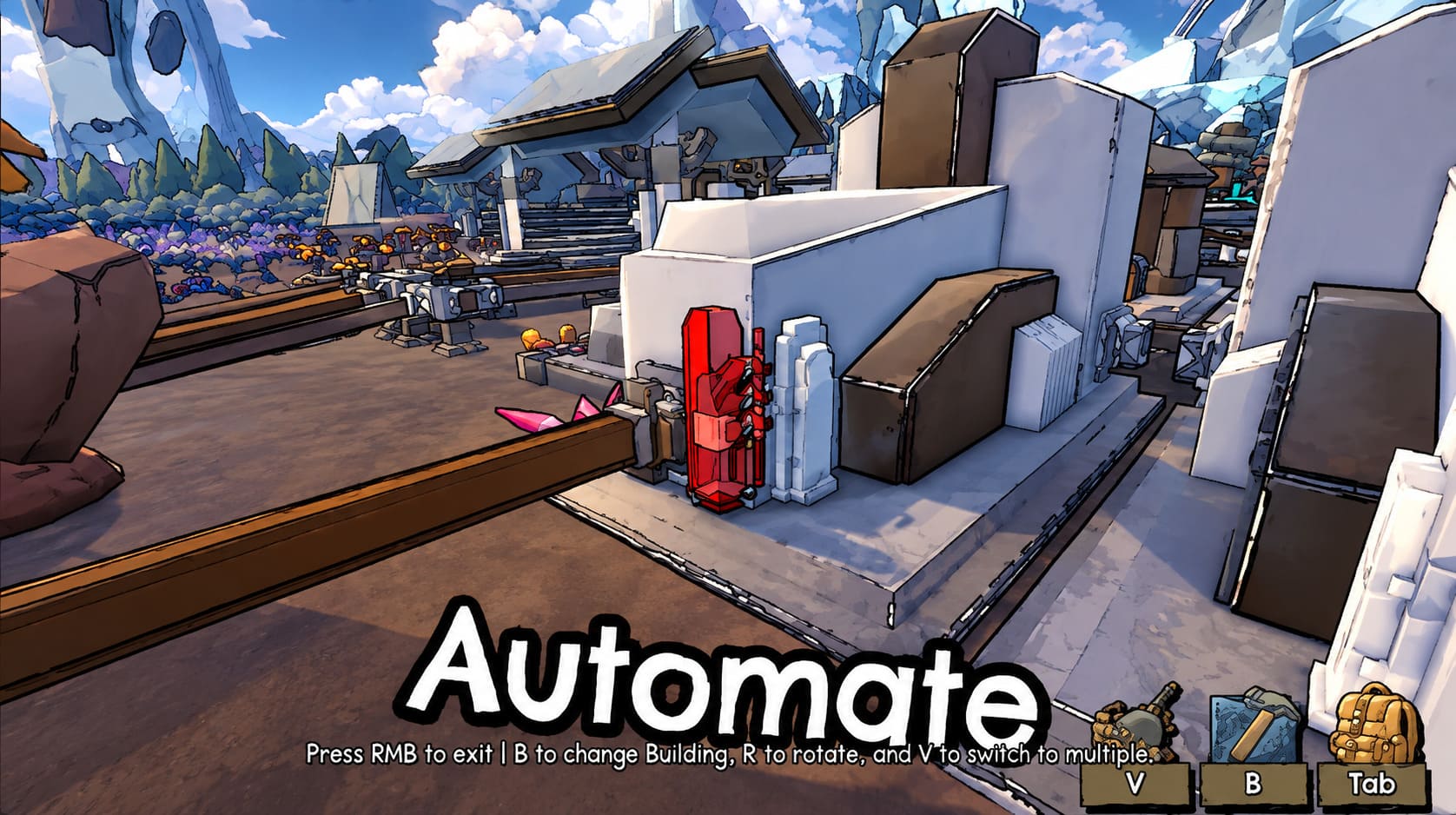
Eventually, manual gathering simply stops making sense. Once production chains become more complicated, the game shifts toward conveyors, machines, splitters, mergers, and carefully planned layouts. The grid-based construction system should make it easier to create organized production areas instead of ending up with the classic factory-builder nightmare of belts crossing each other in every possible direction.
Conveyors form the backbone of the logistical system. Raw ore can move toward processing facilities, processed materials can be sent to assembly machines, and finished components can then be routed toward research or the Lighthouse. Smart splitters and mergers add another layer of control, especially when several production lines depend on the same resource.
This is the point where I expect Nightwater to appeal most strongly to people who enjoy optimization. Building something that works is one thing. Building something that works without wasting resources, power, space, or transport capacity is a completely different challenge.
Production Statistics and RPM Management
Nightwater also puts considerable emphasis on production analytics. Instead of relying entirely on guesswork, players can monitor production rates and identify areas where their factories are struggling.
Imagine an iron plate production line that looks perfectly organized but keeps running below capacity. The analytics system can help identify whether the problem is insufficient ore, slow furnaces, inadequate conveyor throughput, or another part of the chain. From there, you can increase supply, upgrade machinery, change belt configurations, or adjust processing capacity.
The use of Resource Per Minute (RPM) measurements is especially useful for players who enjoy the mathematical side of factory games. You do not necessarily need to calculate every ratio on paper, but understanding how much material your machines consume and produce becomes increasingly important as your factory grows.
Biomes Are More Than Just Pretty Scenery
One thing I particularly like about the concept is that exploration is connected directly to factory design. Nightwater’s island contains multiple biomes, and each one can provide resources that are unavailable elsewhere. That means expansion is not optional if you want to reach the later technological eras.
Unfortunately, moving between these areas is not always convenient. Terrain can interfere with construction, long journeys consume stamina, and transporting resources from remote locations creates additional logistical problems. A resource that looks fantastic on the map can become surprisingly annoying once you realize how far it is from your main production hub.
This creates an interesting strategic question: Should you bring the resource to the factory, or bring the factory to the resource? Factory-building games are often at their best when they force players to make exactly these kinds of decisions.
Transportation Evolves With Technology
Transportation begins relatively simply, with paths and basic carts helping you move around the island. Later, technology opens the door to much more efficient solutions, including faster vehicles and teleportation infrastructure.
That progression should make the world feel dramatically different in the late game. A journey that once required a long walk can eventually become almost instantaneous, allowing enormous factories to operate across multiple biomes without forcing the player to constantly run back and forth.
The Lighthouse and Nightwater’s Mystery
There is more to Nightwater than production numbers. Standing at the center of the game’s mystery is a massive Lighthouse, which appears to be both a narrative landmark and one of the most important functional structures in the game.
The Lighthouse requires increasingly sophisticated manufactured components as you advance. Supplying it becomes part of the larger progression loop, with each technological milestone bringing you closer to understanding the island and potentially finding a way out.
I like this approach because it gives the factory a purpose beyond simply producing more stuff. In many automation games, the endgame can eventually become an exercise in making bigger numbers because you can. Nightwater appears to provide a narrative reason for all that industrial expansion: you are building because you are trying to escape.
Nightwater System Requirements
The PC requirements listed for Nightwater are relatively accessible compared with what you might expect from a game designed to support increasingly large factories. The minimum specifications currently listed include Windows 10 or later in 64-bit, 8 GB of RAM, and graphics hardware around the GTX 1650, GTX 1050 Ti, or Radeon RX 470/RX 570 level.
| Requirement | Minimum Specification |
|---|---|
| Operating System | Windows 10 or later, 64-bit |
| Processor | Intel Core i5-3570 3.4 GHz 4-Core or equivalent AMD CPU |
| Memory | 8 GB RAM |
| Graphics | NVIDIA GTX 1650 / GTX 1050 Ti or AMD RX 470 / RX 570 |
| Storage | 10 GB available space |
The interesting part will be seeing how performance behaves once players start creating enormous production networks. Factory games can be surprisingly demanding when hundreds or thousands of items are moving simultaneously, so the real test will come from ambitious late-game bases rather than the opening hours.
Who Is Nightwater For?
Nightwater seems designed for players who enjoy several genres at once. If you like the optimization of factory simulators but also want exploration, survival mechanics, progression, and an actual mystery to investigate, the combination is certainly worth watching.
It should particularly appeal to players who enjoy the gradual transformation of a world. There is a satisfying difference between starting with a tiny crafting station and eventually standing in the middle of a huge automated complex where resources are constantly moving through interconnected production lines.
At the same time, players who dislike micromanagement may find the later stages more demanding. Once multiple biomes, power systems, transport networks, and advanced production chains become interconnected, keeping everything balanced could require considerably more attention than the relaxed opening suggests.
Final Thoughts on Nightwater
Nightwater has the ingredients of a factory game that could be surprisingly easy to lose an entire weekend to. Its strongest idea is not simply automation; it is the feeling of progression from primitive survival to industrial engineering and eventually futuristic technology. The island, biomes, transportation systems, production analytics, and Lighthouse mystery all appear to feed into the same central gameplay loop.
Having played plenty of automation and survival-building games, I always look for one thing: does the progression make me want to build the next machine, or am I just building because the game tells me to? Nightwater’s era system gives it a good chance of making those upgrades feel meaningful. Going from carrying basic materials by hand to managing a huge interconnected factory is exactly the sort of transformation that can make this genre so addictive.
The September 18, 2026 release date will ultimately be the real test. If the production chains, biome progression, performance, and exploration systems work together as intended, Nightwater could offer a refreshing spin on the automation formula. For anyone who enjoys watching a humble collection of machines slowly turn into a ridiculous industrial monster, this is definitely a game worth keeping on the radar.