Guns of Eschaton Lore Explained: What Is The Burning Apocalypse?
There are plenty of upcoming games promising dark worlds, difficult combat, and mysterious stories. After playing countless action RPGs, immersive sims, Soulslikes, and first-person shooters over the years, I’ve become pretty skeptical whenever developers describe their universe as “unique.” Most of the time, it ends up feeling like another variation of familiar ideas. Guns of Eschaton, however, immediately caught my attention for a different reason. It isn’t just trying to create another post-apocalyptic setting—it feels like it’s building an entirely different mythology.
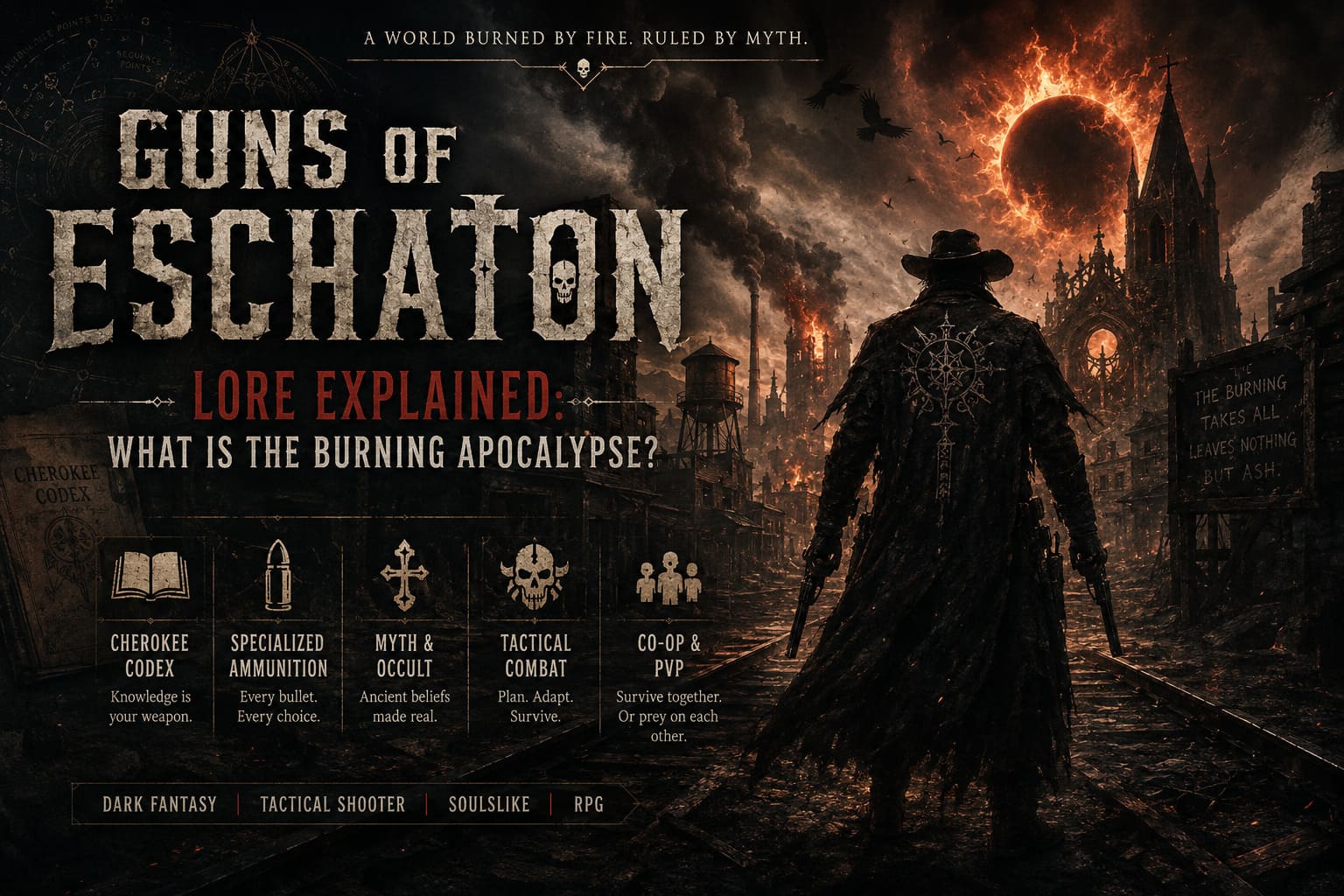
The gameplay certainly looks promising, mixing tactical gunfights with Soulslike mechanics, but the real star of the reveal is the world itself. Every frame of the trailer suggests a universe where every ruined building, every enemy, and every dusty road has its own history. Instead of relying on endless exposition, the game appears to invite players to uncover its secrets naturally, and that’s exactly the kind of environmental storytelling I’ve always appreciated.
Cat Mail Co. Release Date, PC System Requirements, and Cozy Gameplay Guide
The Burning Is More Than Just Another Apocalypse
Most games treat the apocalypse as a single catastrophic event. Nuclear war, alien invasions, zombie outbreaks—you know the formula. The Burning immediately feels different because it isn’t simply the destruction of civilization. It’s the complete collapse of reality as people once understood it.
In this alternate version of nineteenth-century America, the laws of nature have stopped behaving normally. Ancient beliefs, forgotten myths, and supernatural powers have become inseparable from everyday life. Fire is everywhere, landscapes appear scarred beyond recognition, and entire regions seem trapped between life and death.
What makes this premise especially interesting is that the apocalypse isn’t explained through science fiction. Instead, it leans heavily into occult horror, religious symbolism, and folklore. Personally, I find that approach much more memorable because it creates uncertainty. You never know whether you’re facing a monster, a curse, or something far older than humanity itself.
A Journey Across a Broken America
Unlike traditional western games that stay focused on deserts and frontier towns, Guns of Eschaton appears to take players across a dying version of America from west to east. That wider scope makes the setting feel much larger than a typical frontier adventure.
The protagonist is trapped in an endless cycle of death and resurrection. Instead of treating death as a simple gameplay mechanic, the story embraces it as part of the world’s rules. Every defeat becomes another chapter in the character’s journey rather than a simple checkpoint reload.
One mysterious figure seems to connect everything together—the Black Rider. Rather than acting like a conventional villain, this character appears to exist almost as a force of nature. Whether he’s hunting the player, guiding them, or representing something even more symbolic remains one of the biggest mysteries surrounding the game.
Why The World Already Feels Alive
One thing I noticed immediately while watching the reveal was how much information the environment communicates without a single line of dialogue.
Instead of empty ruins designed purely for combat encounters, every location seems to tell its own story.
- Burned churches hiding forgotten rituals.
- Ghost towns overtaken by impossible architecture.
- Industrial machinery fused with religious imagery.
- Landscapes that look permanently wounded by supernatural fire.
This style of environmental storytelling reminds me of the games that trust players to connect the dots themselves. Those are often the worlds that stay in your memory the longest because discovering their secrets feels personal instead of scripted.
Mythology Shapes Every Enemy
Another aspect that makes the lore stand out is the way enemies are designed.
Rather than filling the world with generic demons or undead creatures, the developers have built factions inspired by real-world mythology and religious traditions. These beliefs have been twisted by The Burning, transforming familiar legends into horrifying new forms.
That approach opens the door to incredible variety. Instead of simply learning attack patterns, players are encouraged to understand where these creatures come from and why they exist.
Here’s a quick overview of how the game’s factions differ from traditional Soulslike enemies.
| Traditional Soulslike Enemies | Guns of Eschaton Creatures |
|---|---|
| Mostly fantasy monsters | Inspired by real mythology |
| Weaknesses learned through combat | Weaknesses discovered through lore |
| Standard undead and demons | Corrupted saints, ancient spirits, twisted folklore |
| Combat-first design | Story and combat deeply connected |
For someone who enjoys reading item descriptions and piecing together hidden stories, this is one of the game’s strongest ideas.
The Cherokee Codex Makes Lore Matter
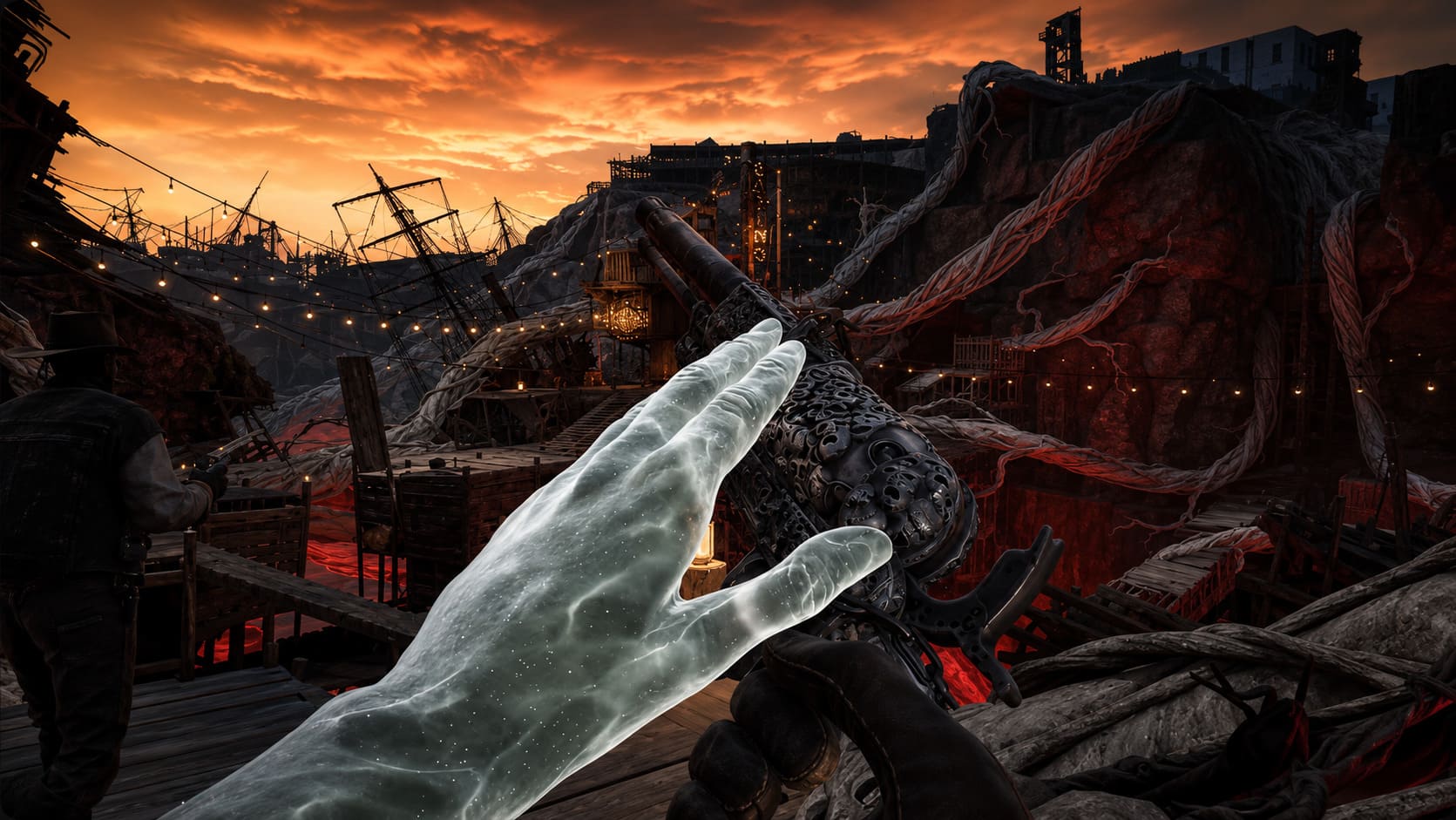
Perhaps my favorite feature revealed so far is the Cherokee Codex.
Many games include encyclopedias that players ignore after unlocking them. Guns of Eschaton appears to do something much smarter. Instead of treating lore as optional reading, it transforms knowledge into a gameplay mechanic.
The Codex helps players understand:
- Enemy anatomy.
- Supernatural rituals.
- Hidden weaknesses.
- Behavioral patterns.
- Mysterious Sequence Points.
That means reading isn’t just for completionists—it becomes essential for survival. If a monster can only be harmed after understanding its supernatural origin, then curiosity becomes just as valuable as mechanical skill.
I’ve always enjoyed games that reward observation, and this system has the potential to make exploration feel genuinely meaningful.
Magic, Gunpowder, and Tactical Combat
Although Guns of Eschaton is a shooter, it doesn’t appear interested in mindless run-and-gun action.
Resources are limited, every shot matters, and ammunition becomes almost ritualistic. Ordinary bullets aren’t enough to defeat the horrors created by The Burning. Players must prepare specialized rounds designed specifically for particular enemies.
This creates an unusual blend of mechanics.
- Choosing the right weapon.
- Crafting specialized ammunition.
- Combining mystical talismans.
- Planning encounters before pulling the trigger.
I like this direction because it makes firearms feel deliberate rather than disposable. Every encounter looks closer to solving a deadly puzzle than clearing another room full of enemies.
Building Your Own Gunslinger
Character progression also seems more interesting than a simple skill tree.
Players can develop their own style through three distinct Sacramental Paths, combining passive bonuses, active abilities, equipment upgrades, and supernatural powers.
One of the trailer’s most striking visuals shows the protagonist wielding multiple firearms with six arms, suggesting that supernatural mutations become part of character progression rather than just cosmetic effects.
Customization appears to include several interconnected systems.
| Progression System | Purpose |
|---|---|
| Sacramental Paths | Core abilities and specialization |
| Armor | Survivability |
| Talismans | Occult enhancements |
| Weapon upgrades | Combat efficiency |
| Mystical mutations | Powerful supernatural skills |
That combination could encourage a wide variety of builds instead of forcing everyone toward the same optimal setup.
Multiplayer Fits Naturally Into The Story
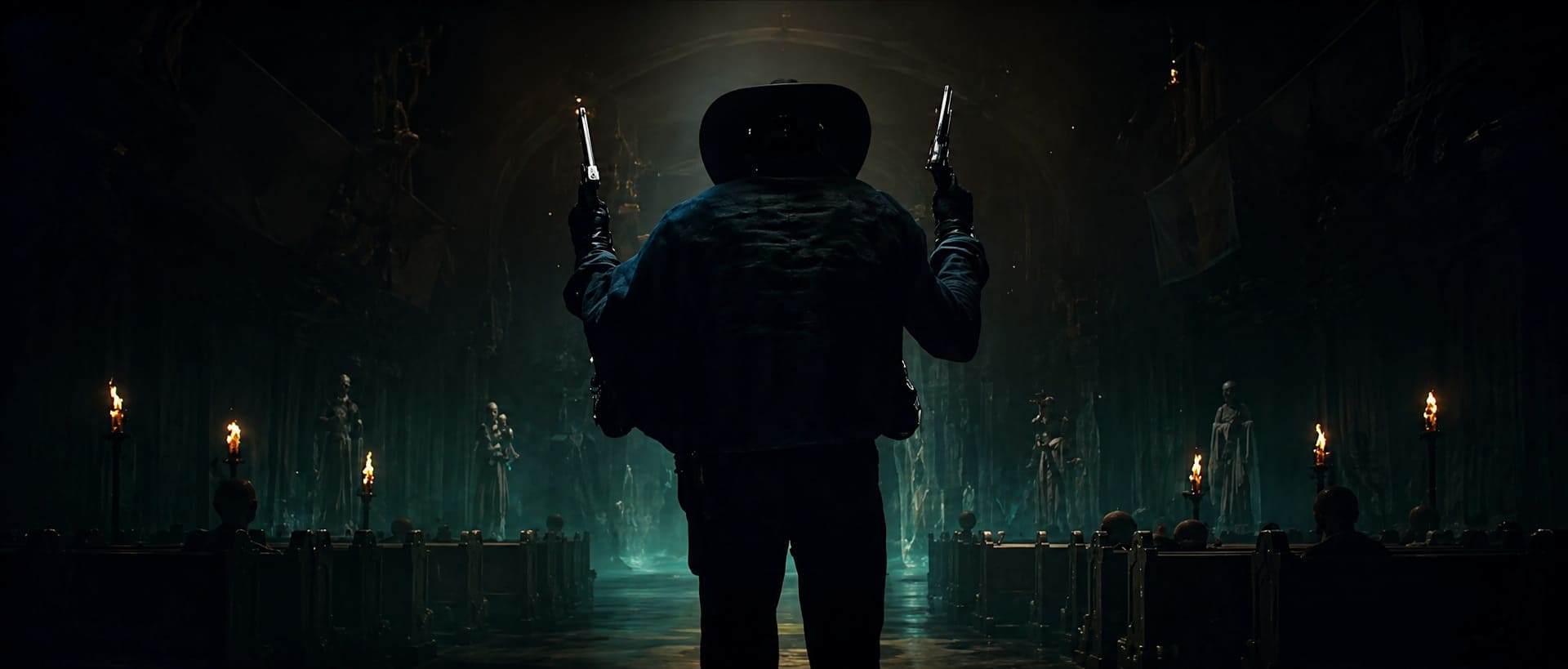
Co-op has become almost expected in modern Soulslike games, but Guns of Eschaton seems to integrate multiplayer directly into its lore.
Players can explore together throughout the campaign, tackling dangerous regions and enormous bosses as a team. At the same time, PvP isn’t presented as a disconnected arena mode. Instead, hostile players become another consequence of living in a collapsing world where survival often outweighs morality.
I always appreciate when multiplayer supports the game’s narrative rather than interrupting it. If invasions or PvP encounters feel like natural parts of the universe, they become far more memorable than simple competitive matches.
Viktor Antonov’s Final Creative Legacy
It’s impossible to discuss Guns of Eschaton without mentioning the artistic influence behind it.
Viktor Antonov helped create some of gaming’s most recognizable locations, and that experience is immediately visible here. The environments don’t simply look beautiful—they communicate emotion through architecture, decay, and atmosphere.
There is a strange melancholy running through every scene. Burned cathedrals, collapsing factories, haunted settlements, and endless plains combine western imagery with gothic horror in a way that feels surprisingly original.
As someone who has spent years exploring game worlds simply to admire their environmental design, I think this artistic direction could become one of the game’s greatest strengths.
Final Thoughts
After following dozens of game announcements every year, it takes something genuinely different to hold my attention. Guns of Eschaton isn’t exciting simply because it’s another difficult shooter or another Soulslike. It’s exciting because it treats its world as the main character.
The Burning feels like more than a background event—it shapes every mechanic, every enemy, every location, and every decision the player makes. The Cherokee Codex encourages curiosity, specialized ammunition adds tactical depth, and mythology transforms combat into something more thoughtful than memorizing attack patterns.
Of course, trailers can only reveal so much, and the final game will need to deliver on these ambitious ideas. Still, if the developers manage to combine challenging gameplay with the rich environmental storytelling they’ve shown so far, Guns of Eschaton could become one of the most memorable dark fantasy shooters in recent years. For players who enjoy uncovering hidden lore as much as mastering difficult combat, this is definitely a game worth keeping an eye on.