G-Rebels Skyblade Upgrade Guide: Best Loadouts for Daevos & Atlas Archipelago
When I first jumped into G-Rebels, I expected another arcade flight shooter with a few cosmetic upgrades and some flashy explosions. After spending hours flying through Daevos, weaving between skyscrapers, and getting destroyed by better-equipped enemies more times than I’d like to admit, I realized the game is much deeper than it looks.
Your Skyblade isn’t just a vehicle—it’s your entire playstyle. Every upgrade changes how the aircraft behaves, how aggressively you can fight, and even which missions become enjoyable instead of frustrating.
After experimenting with multiple builds and comparing notes with other players in the community, I’ve found several upgrade paths that consistently perform well. These aren’t the only viable options, but they’re the ones I personally keep coming back to.
Why Skyblade Upgrades Matter More Than Raw Aim
One thing that surprised me is how much the game’s physics influence combat.
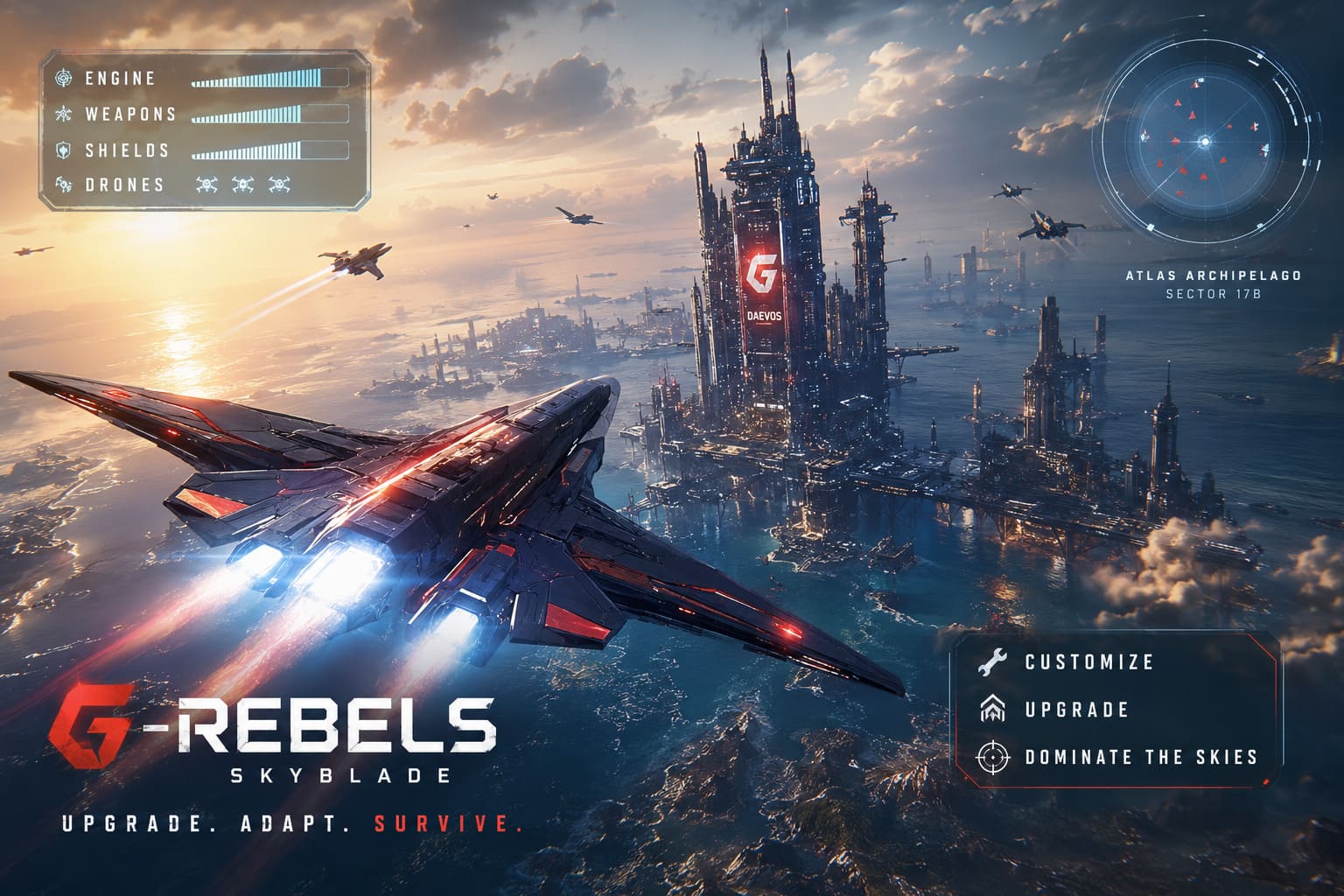
Unlike many aerial shooters where faster weapons automatically solve every problem, G-Rebels rewards aircraft balance. A powerful weapon means very little if your engine can’t keep you behind an enemy, and huge shields won’t help much if you’re too slow to escape concentrated fire.
I started enjoying the game much more once I stopped upgrading random components and instead focused on creating complete builds where every system worked together.
The three pillars I always prioritize are:
- Engine
- Weapons
- Shield System
Ignoring one usually creates weaknesses that enemies quickly exploit.
My Upgrade Priority
If someone asked me where to spend their first credits, this would be my recommendation.
| Upgrade | Priority | Why It Matters |
|---|---|---|
| Engine | ★★★★★ | Improves speed, mobility, escape potential |
| Weapons | ★★★★☆ | Faster kills and more reliable damage |
| Shields | ★★★★☆ | Essential for longer engagements |
| Drone Systems | ★★★☆☆ | Great during larger battles |
| Stealth Modules | ★★★☆☆ | Excellent for exploration and smuggling |
| Missile Upgrades | ★★★☆☆ | Strong against groups of enemies |
Personally, I think mobility is the strongest stat in the current Early Access version.
If you can control positioning, you naturally avoid a huge amount of incoming damage.
Engine Upgrades Should Come First
The first improvement I noticed after upgrading my engine wasn’t maximum speed—it was how much easier it became to fly.
Tight turns between buildings suddenly felt natural.
Boosting out of danger became consistent.
Even simple missions became less stressful.
Better engines usually provide:
- Faster acceleration
- Higher top speed
- Better turning response
- Improved boost recovery
- Stronger vertical movement
One trick I constantly use is saving boost for defensive situations instead of spending it immediately.
Breaking enemy lock-ons with a quick burst often saves more repairs than any shield upgrade ever could.
Don’t Chase Damage Numbers Alone
When I unlocked heavier weapons, my first instinct was to equip the biggest guns available.
That turned out to be a mistake.
Heavy weapons are powerful, but they often generate more heat, reload slower, and make long engagements feel clunky.
Instead, I found myself preferring weapons that let me stay aggressive.
The upgrades that consistently felt worthwhile included:
- Reduced weapon heat
- Faster projectile velocity
- Better targeting assistance
- Larger ammunition reserves
- Improved lock-on speed
Landing consistent shots always outperformed chasing massive damage numbers.
Shields Become More Valuable Later
Early missions let you survive with fairly basic defensive systems.
Later missions are a different story.
Enemy groups become larger.
Missiles arrive from multiple directions.
Corporate patrols become far more aggressive.
That’s when stronger shields start paying for themselves.
A larger energy pool combined with faster recharge allows you to disengage behind buildings, recover safely, and immediately return to the fight.
I also like how the game’s environments naturally support defensive flying.
Breaking line of sight behind massive structures feels much more rewarding than simply tanking incoming fire.
Auxiliary Systems That Are Actually Worth Buying
Some secondary upgrades initially looked unnecessary to me.
After spending more time with the game, several became permanent parts of my favorite builds.

AI Drones
These surprised me the most.
They’re excellent distractions.
While enemies chase your drones, you gain valuable seconds to reposition or finish another target.
Multi-Warhead Missiles
These really shine against larger enemy formations.
Instead of wasting time chasing every small fighter individually, you can pressure several targets simultaneously.
Stealth Modules
I originally ignored stealth entirely.
Later, during exploration-focused sessions, it became one of my favorite systems.
Avoiding unnecessary combat simply means more time collecting resources and completing objectives.
The Three Builds I Keep Using
Rather than constantly swapping individual parts, I eventually settled on three specialized Skyblade configurations.
1. High-Speed Interceptor
Main focus
- Maximum engine upgrades
- Energy weapons
- Lightweight shields
- Boost improvements
The aircraft feels incredibly responsive.
Perfect for races, bounty hunting, and dogfights where movement wins battles.
Its only real weakness is prolonged fights against heavily armored opponents.
2. Heavy Assault Platform
Whenever missions involve escorting convoys or destroying larger ships, this build comes out.
Main focus
- Heavy shields
- Railguns
- Missile upgrades
- Attack drones
It isn’t fast.
It isn’t elegant.
But it survives situations where lighter aircraft simply explode.
Watching drones keep enemy fighters occupied while railguns punch through larger targets is extremely satisfying.
3. Exploration Specialist
This is easily the most relaxing setup I’ve played.
Instead of chasing combat, I focus on discovering hidden locations and collecting valuable resources.
Priority upgrades include:
- Long-range scanners
- Efficient engines
- Stealth technology
- Mining equipment
Exploration becomes surprisingly rewarding once you stop treating every radar contact as something that needs to be destroyed.
My Favorite Loadouts
| Playstyle | Best Engine | Best Weapons | Best Support |
|---|---|---|---|
| Dogfighting | High-Speed Engine | Energy Cannons | Boost Modules |
| Heavy Combat | Reinforced Engine | Railguns | Attack Drones |
| Exploration | Efficient Engine | Light Cannons | Stealth + Scanner |
| Resource Farming | Economy Engine | Defensive Weapons | Mining Laser |
| Smuggling | Silent Engine | Compact Weapons | Scan Dampener |
Small Settings That Improved My Experience
One thing I rarely see people mention is input calibration.
If your aircraft constantly feels like it’s drifting or pulling in one direction, don’t immediately blame the flight model.
I had this exact problem until I checked the Axis Debug option.
After recalibrating my controller, flying instantly became smoother.
It’s a tiny setting that can completely change how the game feels.
For HOTAS users, I’d also recommend putting these actions directly on your stick:
- Boost
- Target Scan
- Weapon Swap
- Countermeasures
Reaching for the keyboard during a surprise attack usually ends badly.
G-Rebels HOSAS Raw Input Settings: Space Sim Configuration Guide
Tips I Wish I Knew Earlier
Here are a few lessons that saved me countless failed missions.
- Speed is often better than armor.
- Never waste boost at the beginning of a fight.
- Upgrade targeting before buying expensive weapons.
- Use city buildings as natural cover whenever possible.
- Carry missiles for groups, not individual enemies.
- Experiment with different builds instead of trying to create one “perfect” aircraft.
The game rewards flexibility much more than specialization.
G-Rebels PC Price, Steam Early Access Release Date, and Gameplay Overview (2026)
Final Thoughts
After dozens of flights across Daevos and the Atlas Archipelago, I think G-Rebels succeeds because it makes every upgrade feel meaningful.
Instead of simply increasing numbers, improvements genuinely change how your Skyblade flies and fights. A fast interceptor feels completely different from a heavily armored assault platform, and switching to an exploration-focused build almost turns the game into a different experience.
If I had to give one piece of advice to new pilots, it would be this: invest in mobility before chasing firepower. A well-handled Skyblade can avoid danger, choose favorable engagements, and escape situations that would destroy slower aircraft. Once your movement feels comfortable, you can begin tailoring weapons, shields, and auxiliary systems to match your preferred style.
Early Access will almost certainly bring balance updates, new equipment, and additional tuning options, but the core philosophy already feels clear—build an aircraft that complements the way you fly, not just the one with the highest stats. That approach has made every mission more enjoyable for me, and it’s the reason I keep coming back for one more flight through the dangerous skies of 2684.