Diablo 4 Codex of Power Guide: How to Extract, Upgrade, and Max Out Legendary Aspects (2026 Update)
If there is one system in Diablo 4 that can quietly make or break a build, it is the Codex of Power. You can have great stats, strong weapons, and plenty of Paragon progress, but the wrong Legendary Aspect can still make a build feel painfully weak.
The good news is that the Codex of Power has become much easier to understand than it was during Diablo 4’s earlier seasons. The old routine of extracting an Aspect, keeping a physical Aspect item in your stash, and constantly worrying about whether you were wasting a good roll has largely disappeared. Instead, salvaging Legendary gear can permanently improve your Aspect library, giving you a much cleaner progression system.
I’ve always liked this direction because it makes Legendary loot feel useful even when the item itself is terrible for your character. You no longer have to stare at a full inventory wondering which pieces deserve to be kept “just in case.” If the Aspect is an upgrade, salvage it and move on.
This Diablo 4 Codex of Power guide explains how the system works in 2026, how to upgrade Legendary Aspects, when Ancestral gear matters, and how to get the most out of your best powers.
What Is the Codex of Power in Diablo 4?
The Codex of Power is essentially your permanent library of Legendary Aspects. It stores the powers you’ve unlocked and allows you to apply them to compatible Rare and Legendary equipment through the Occultist.
You can access the Codex through the Collections interface, where you can browse different Aspect categories and search for specific powers.
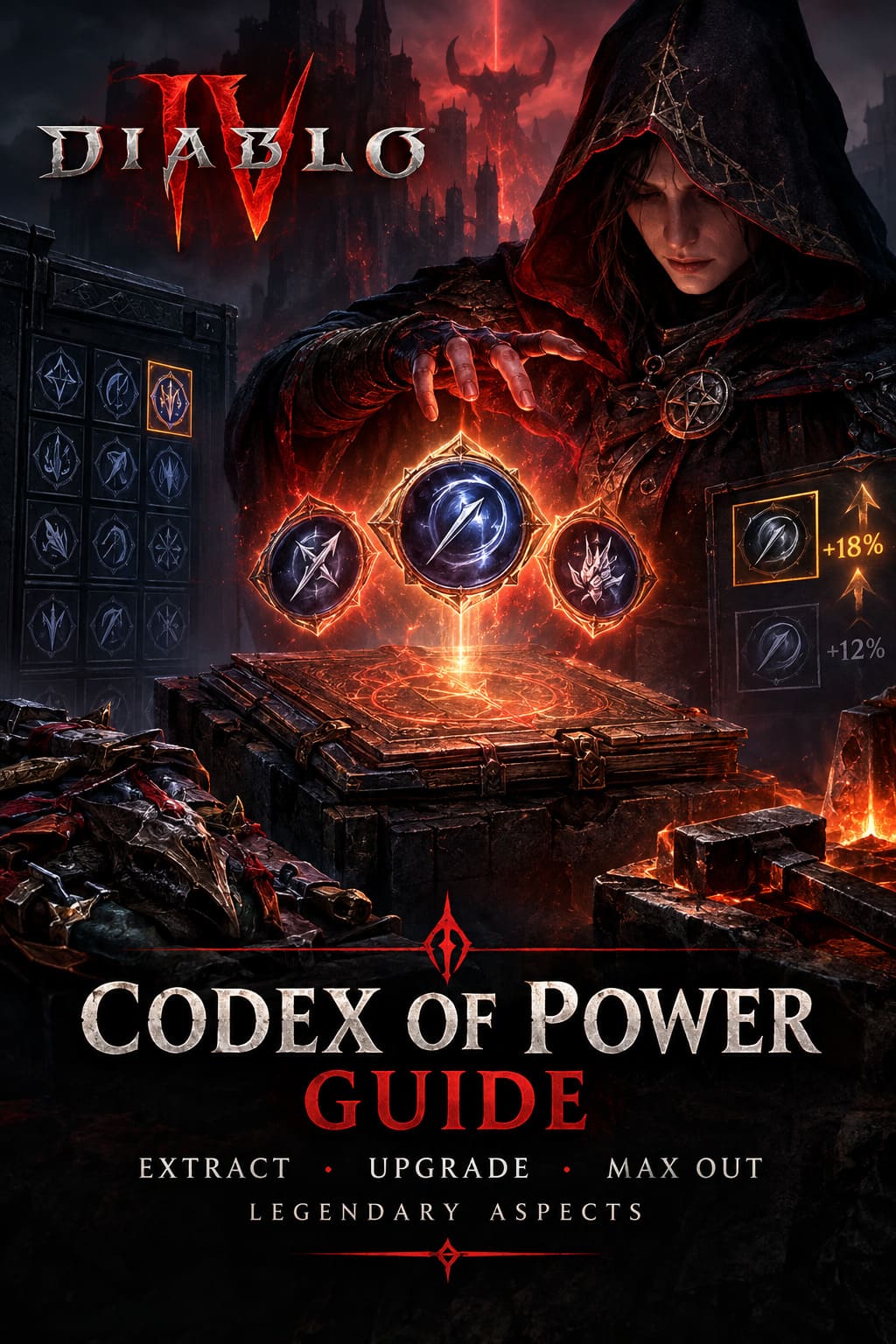
The important thing to understand is that your Codex isn’t simply a list of Aspect names. Each Aspect has its own progression, and finding stronger versions can improve the power you are able to imprint.
That changes how you should look at Legendary loot.
A Legendary item isn’t necessarily valuable because you want to equip it. Sometimes the item is useless for your build, but its Aspect has a better roll than the one currently stored in your Codex. In that situation, the item is basically a permanent upgrade waiting to be salvaged.
And honestly, this is one of the better quality-of-life changes Diablo 4 has made.
How to Upgrade Legendary Aspects in the Codex
The basic process is surprisingly simple:
- Find a Legendary item with an Aspect you care about.
- Check whether its Aspect represents an upgrade to your current Codex value.
- Take the item to a Blacksmith.
- Salvage the Legendary item.
- If its Aspect is better, your Codex is permanently upgraded.
You don’t receive a physical Aspect item that sits in your stash. The Legendary itself is destroyed, while the improved Aspect information is added to your Codex.
You’ll also receive the normal crafting materials associated with salvaging the item.
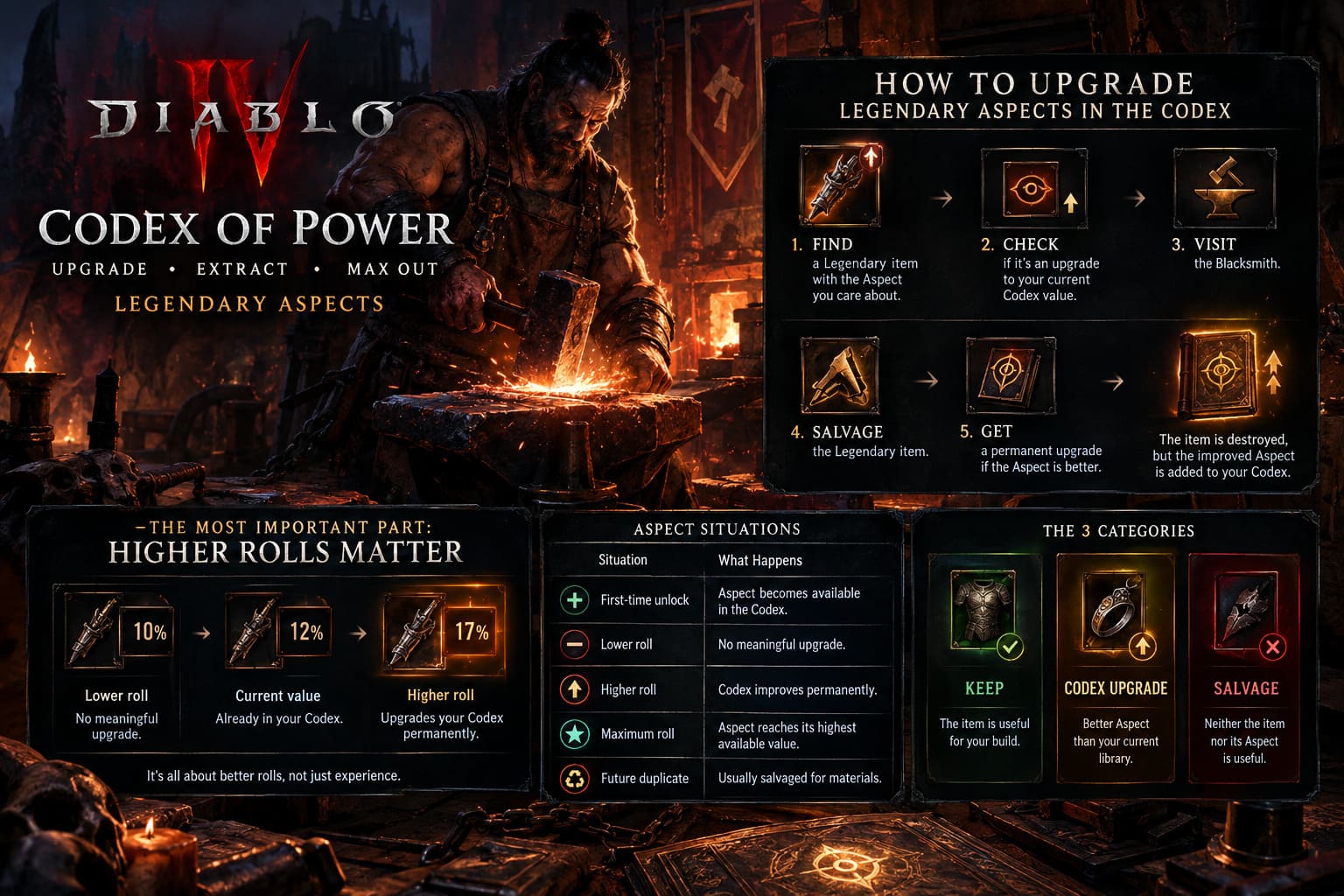
This means I generally treat Legendary drops in three categories:
- Keep — the item itself is useful for your current build.
- Codex upgrade — the item has a better Aspect than your current library.
- Salvage — neither the item nor its Aspect is particularly useful.
That simple mental system saves a ridiculous amount of inventory space.
The Most Important Part: Higher Rolls Matter
Not every Legendary drop improves your Codex.
Suppose your Codex currently contains an Aspect with a 12% effect. You find another Legendary carrying the same Aspect, but its value is only 10%. Salvaging it won’t suddenly make the Aspect stronger.
Now imagine you find the same Aspect at 17%.
That’s the drop you want.
Once salvaged, your Codex can use the stronger 17% version whenever you imprint that Aspect onto another compatible item.
The progression is therefore driven by better rolls rather than traditional character experience.
| Aspect Situation | What Happens |
|---|---|
| First-time unlock | Aspect becomes available in the Codex |
| Lower roll than current value | No meaningful Aspect upgrade |
| Higher roll | Codex improves permanently |
| Maximum roll | Aspect reaches its highest available value |
| Future duplicate | Can usually be salvaged for materials |
This is why I recommend paying attention to the little upgrade indicators on Legendary items instead of manually comparing every number in your inventory.
Why Ancestral Legendaries Become So Important
Eventually, basic Legendary drops stop being enough for serious min-maxing.
Once you’re deep into the endgame and farming higher difficulties, Ancestral Legendary items become especially important for maximizing certain Aspects. Their higher item tier can provide access to stronger Aspect values than ordinary Legendaries.
This creates an important endgame progression loop:
Normal Legendary → stronger Aspect roll → better Codex → Ancestral Legendary → maximum Aspect potential
If you’re trying to perfect a build, this is where the hunt becomes much more interesting.
You might spend hours running endgame content looking for one specific Legendary with the right Aspect and an exceptional roll. When that drop finally appears, the item doesn’t even necessarily need to be equipped. If the Aspect is better, you can salvage it and permanently improve your library.
That’s a much better feeling than finding a perfect Aspect and then being afraid to use it.
Codex Value vs. Actual Imprinted Value
There is one mechanic that regularly confuses newer players: Aspect values can change depending on the gear slot.
Two-handed weapons and amulets can amplify certain Aspect effects when they are imprinted.
For example, imagine your Codex shows an Aspect with a base value of 30%.
If you place that Aspect on a two-handed weapon with a 100% bonus multiplier, the effective value can become 60%.
Amulets can provide a smaller amplification, while most other slots use the normal base value.
Here’s the simplified version:
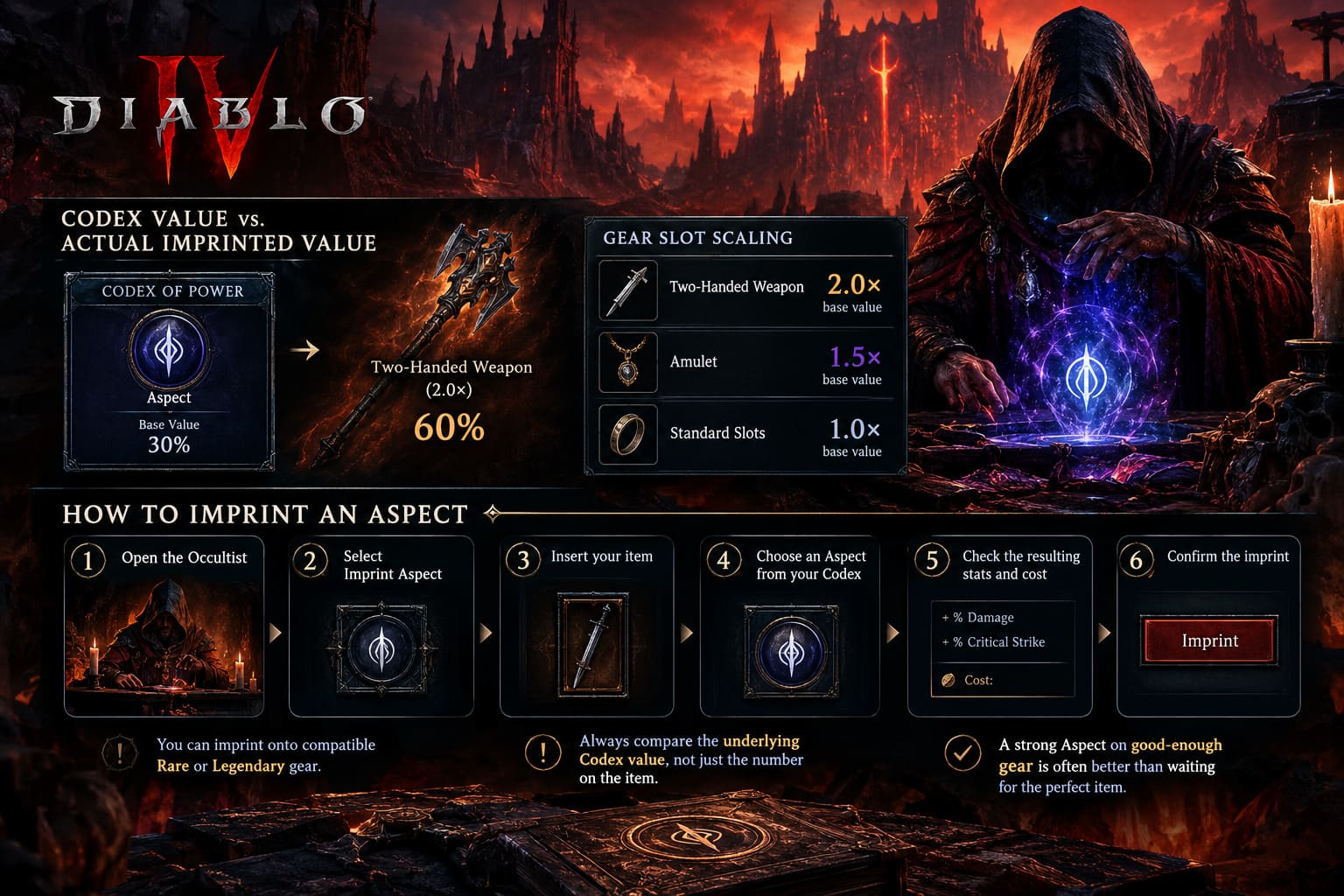
| Gear Slot | Aspect Scaling |
|---|---|
| Two-Handed Weapon | 2.0× base value |
| Amulet | 1.5× base value |
| Standard Slots | 1.0× base value |
This distinction is extremely important when comparing screenshots, build guides, or your own gear.
Seeing 60% on somebody else’s two-handed weapon doesn’t necessarily mean their Codex has a 60% base Aspect. Their Codex may actually contain a 30% Aspect that is being amplified by the weapon.
Always compare the underlying Codex value rather than assuming every displayed number represents the same thing.
How to Imprint an Aspect From Your Codex
Once you’ve upgraded the Aspect you want, the next step is putting it onto your actual gear.
That’s where the Occultist comes in.
Go to the Occultist and select the imprinting interface. From there, place the equipment you want to modify into the appropriate slot.
You can generally imprint onto compatible Rare or Legendary gear. The game then lets you select an Aspect from your Codex and shows the resulting power before you confirm the action.
The process is straightforward:
- Open the Occultist.
- Select Imprint Aspect.
- Insert the item you want to modify.
- Choose an Aspect from your Codex.
- Check the resulting stats and cost.
- Confirm the imprint.
One detail I always check before spending materials is the item’s other affixes. A great Aspect doesn’t magically turn mediocre equipment into a perfect piece of gear.
If you’re leveling, however, don’t overthink it.
A strong Aspect on good-enough gear is usually more useful than sitting on the Aspect forever while waiting for a perfect item.
Don’t Be Afraid to Use Your Best Aspects
This is probably my favorite part of the modern Codex system.
In older versions of Diablo-style loot systems, players often hesitate to use an amazing power because they think they might never get another one.
The Codex removes much of that anxiety.
Once you’ve permanently unlocked a strong Aspect, you can use that stored version again on future compatible gear. That makes it much easier to upgrade equipment while leveling or transitioning into endgame builds.
I would rather see a player use a strong Aspect to make their current character noticeably stronger than keep it locked away for ten hours because they are waiting for a mythical “perfect” item.
Gear gets replaced.
Your upgraded Codex stays with you.
Seasonal and Eternal Codex Progression
Diablo 4’s seasonal structure adds another layer to the system.
Seasonal characters operate within their own progression environment, while Eternal Realm characters retain their permanent progression. When a season eventually ends, seasonal characters move to the Eternal Realm and their progression is incorporated into the permanent ecosystem.
For players who regularly participate in seasons, this creates a familiar rhythm:
Start fresh → rebuild your Aspect library → hunt stronger rolls → push endgame → season ends → progression carries forward
The seasonal reset can initially feel like a chore, especially when you’ve already spent a lot of time perfecting a previous character.
But it also gives the early game a purpose again. Suddenly, a Legendary with an Aspect you haven’t upgraded yet becomes exciting instead of disposable.
The Best Way to Farm Aspect Upgrades
There isn’t one magical activity that solves every Codex problem. Your best source depends on what you’re currently doing and what kind of Aspect you’re hunting.
For general progression, I recommend focusing on content that gives you a healthy mixture of Legendary drops and crafting materials.
- Helltides for large amounts of general loot and materials.
- Nightmare Dungeons for efficient repeated Legendary farming.
- The Pit and other high-end activities when you’re already strong enough to farm them efficiently.
- World bosses and other reward-heavy encounters whenever they’re available.
- Purveyor-style gambling systems when you’re targeting specific gear slots.
The key is efficiency.
There’s little reason to spend ten minutes completing an activity that gives you one Legendary when you can comfortably run another activity that gives you several opportunities for the same Aspect.
Use the Codex Search and Favorites
If you’re working on multiple builds, the Codex can become enormous.
Thankfully, the search and filtering tools make it much easier to find exactly what you need.
I recommend favoriting the Aspects you repeatedly use. If you’re playing a build that constantly swaps equipment while leveling, this small habit can save a surprising amount of time.
You can also search by terms associated with a build, skill, or effect rather than scrolling through the entire list.
This is particularly useful when you’re testing builds.
Instead of remembering where every Aspect lives, you can quickly search for the power, check its current value, and decide whether it’s worth using.
Diablo 4 Salvage vs Sell Legendary Items: 2026 Endgame Guide
The Best Codex Routine for a Fresh Character
If I were starting a fresh character today, I’d keep my Codex routine very simple.
First, unlock the important Aspects for my chosen build as early as possible.
Second, salvage Legendary items whenever the game indicates that their Aspect is an upgrade.
Third, stop obsessing over perfect gear during the early leveling process.
Fourth, once I reach serious endgame content, start paying much more attention to Ancestral drops and maximum Aspect values.
And finally, I’d keep a small list of the Aspects that matter most to the build. Not every Aspect deserves the same amount of farming time.
Some powers are foundational to your build. Others are just nice bonuses.
Knowing the difference saves time.
Diablo 4 World Tier 3 Leveling and Material Farming Guide: Best Zones & Routes
Final Thoughts
The modern Diablo 4 Codex of Power is much more than a collection of Legendary powers. It has become one of the game’s core progression systems, and understanding it makes gearing considerably less frustrating.
The biggest thing to remember is simple: a Legendary item with a better Aspect can be more valuable as salvage than as equipment.
Don’t fill your stash with dozens of mediocre items because you’re afraid of losing a good power. Salvage the upgrades, build your Codex, and use those powers aggressively when they can improve your character.
When you reach the endgame, start hunting for stronger Ancestral versions and pay attention to gear-slot multipliers, especially on two-handed weapons and amulets. That’s where small numerical improvements can become surprisingly large increases in actual performance.
For me, the best part of this system is that every good Aspect drop has a purpose. Even when the Legendary itself is useless, it can still push your permanent power library forward.
And in a game where you’re going to destroy mountains of loot anyway, turning that loot into permanent progression is exactly how the system should work.