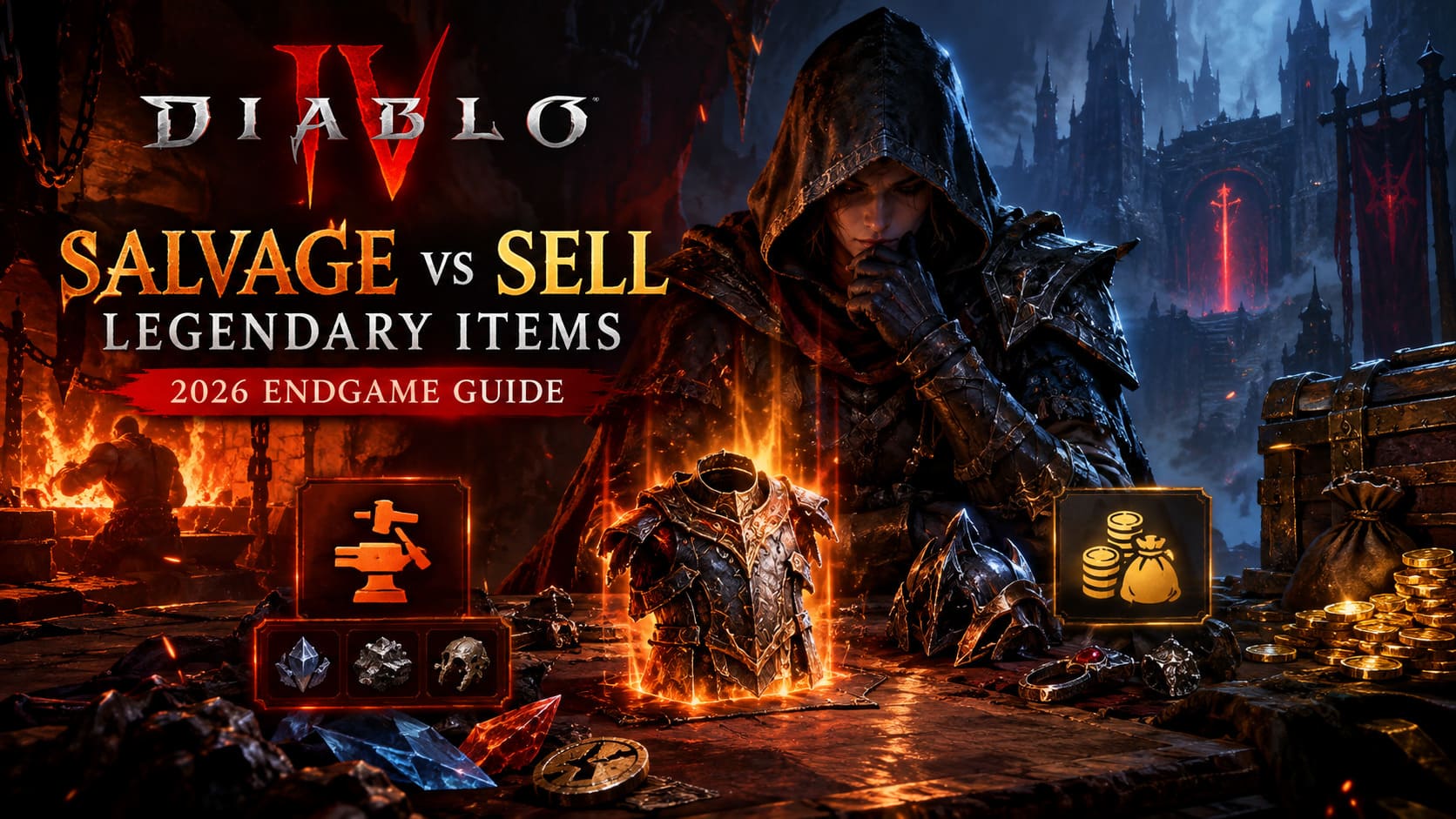
Diablo 4 Salvage vs Sell Legendary Items: 2026 Endgame Guide
If there is one habit that every Diablo 4 player eventually develops, it is standing in town with a completely full inventory and thinking: “Okay, which of this junk is actually worth something?”
That question sounds simple, but in the modern endgame it matters more than it used to. Gold is constantly disappearing into crafting and item optimization, while salvaged materials feed the systems that turn a decent build into a genuinely powerful one. And with Ancestral gear, Greater Affixes, the Codex of Power, Masterworking, and the much faster loot cycle of higher Torment difficulties, blindly selling everything is just as bad as blindly salvaging everything.
I have spent enough time staring at the Blacksmith and vendor screens to develop one rule I trust: don’t think of loot as “good or bad.” Think of every item as either gold, crafting materials, or a potential upgrade.
That mindset makes the whole Diablo 4 salvage vs. sell decision much easier.
Blizzard’s itemization changes have also made salvaging more meaningful. Legendary powers are integrated into the Codex of Power, while Greater Affixes are tied to Ancestral gear and remain an important part of endgame item hunting.
Salvage vs. Sell in Diablo 4: The Short Version
If you just want the answer before we get into the details, this is the loot rule I personally use:
| Item | What I Usually Do | Why |
|---|---|---|
| Legendary with a Codex upgrade | Salvage | Permanent Aspect progression |
| Useful Legendary upgrade | Keep | Potential build improvement |
| Ancestral Legendary with bad affixes | Usually Salvage | Crafting value |
| Ancestral with valuable Greater Affixes | Keep / Trade | Potentially worth far more than vendor gold |
| Ordinary Legendary | Salvage or Sell | Depends on material vs. gold needs |
| Duplicate Unique | Usually Salvage or Sell | Depends on its current value and crafting purpose |
| Rare gear | Usually Sell | Convenient source of gold |
| White/Magic gear | Sell or Salvage | Mostly relevant outside high-end farming |
The important thing is that there isn’t one permanently correct answer.
Your decision should change depending on whether your character is short on gold, short on crafting resources, still filling out the Codex, or hunting the perfect Ancestral item.
Why Salvaging Legendary Items Is Still So Important
The biggest mistake I see newer players make is treating the Blacksmith as nothing more than a place to destroy garbage.
That was never really the whole story, and modern Diablo 4 pushes the Blacksmith even further into the endgame economy.
1. Your Codex of Power Comes First
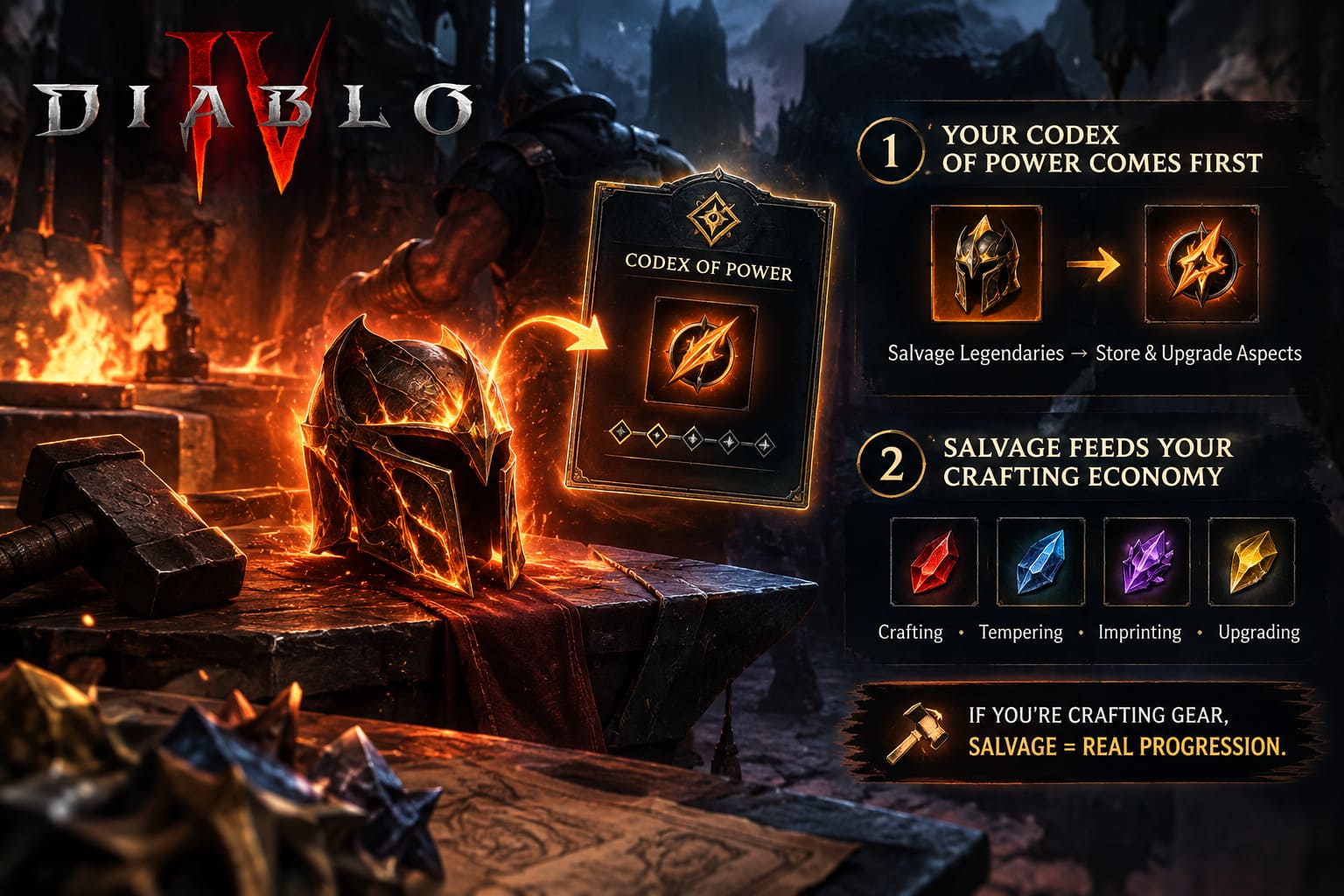
If a Legendary item can improve an Aspect in your Codex, I would salvage it immediately.
The Codex system was redesigned so that Legendary powers could be stored and upgraded rather than forcing players to maintain piles of Aspect items in their inventory. Blizzard specifically introduced the system where salvaging Legendary items stores their powers in the Codex and allows stronger rolls to improve the existing Aspect.
This completely changes how you should look at early and mid-game Legendaries.
That weird orange helmet that you would never equip might still be valuable because its Aspect is better than the version currently sitting in your Codex.
So before selling a Legendary, check the Aspect.
That two-second inspection can save you from throwing away permanent progression.
And the importance of this has only increased as Blizzard has adjusted Legendary drop rates in the early Torment range and continued reducing the need to rely on random methods to complete the Codex.
2. Salvage Feeds Your Crafting Economy
This is the less exciting part of Diablo 4, but it is the part that eventually determines how far your character can be pushed.
You need crafting resources for upgrading equipment, imprinting powers, tempering, and other item-management systems. Blizzard has repeatedly adjusted salvage yields and crafting costs because these resources are an important part of the endgame loop. For example, previous itemization updates significantly changed Legendary salvage yields and the relationship between salvage materials and imprinting/masterworking costs.
The exact economy has changed several times over Diablo 4’s lifespan, which is why I would not blindly follow old guides telling you to hoard a specific number of Coiling Wards, Abstruse Sigils, or Baleful Fragments.
The broader lesson is more useful:
If you’re actively crafting gear, salvage has real progression value.
That is especially true when you’re repeatedly modifying expensive endgame pieces.
When Selling Legendaries Is Actually the Better Choice
Now for the part that often gets lost in “always salvage” advice.
Gold is a resource too.
There are moments when your materials are comfortable but your wallet is getting absolutely destroyed.
Enchanting, crafting, upgrading and repeatedly modifying endgame gear can turn millions of gold into absolutely nothing surprisingly quickly.
If you’ve ever found the perfect base item and then spent an absurd amount of gold trying to get the affix you actually wanted, you already know what I’m talking about.
And Blizzard has historically adjusted Masterworking costs specifically because repeated resets could make the material and gold economy feel restrictive.
So if your crafting inventory is healthy and your gold balance is struggling, selling some of the less valuable loot makes perfect sense.
You don’t get bonus points for having 40,000 crafting materials while being unable to afford the next upgrade.
The Most Important Rule: Never Vendor a Potential God Roll
This is where the Salvage vs. Sell debate gets much more interesting.
A Legendary item isn’t automatically trash because you don’t need it.
If it is an Ancestral item with valuable Greater Affixes, stop.
Don’t salvage it.
Don’t sell it to an NPC.
Don’t click “Sell Junk” while half asleep after a long farming session.
Greater Affixes are specifically associated with high-end Ancestral gear, making these items fundamentally different from ordinary Legendaries.
If the item has several desirable affixes for a popular build, its potential value can be dramatically higher than its vendor price.
This is where the player economy comes into play.
Even if you don’t personally need the item, another player might.
So my rule is simple:
GA + useful stats = investigate before destroying.
It takes seconds and can save you from deleting something genuinely valuable.
My 2026 Diablo 4 Loot Routine
This is the part I would actually recommend copying.
After a serious farming session, I don’t immediately sell everything. I process the inventory in the same order every time.
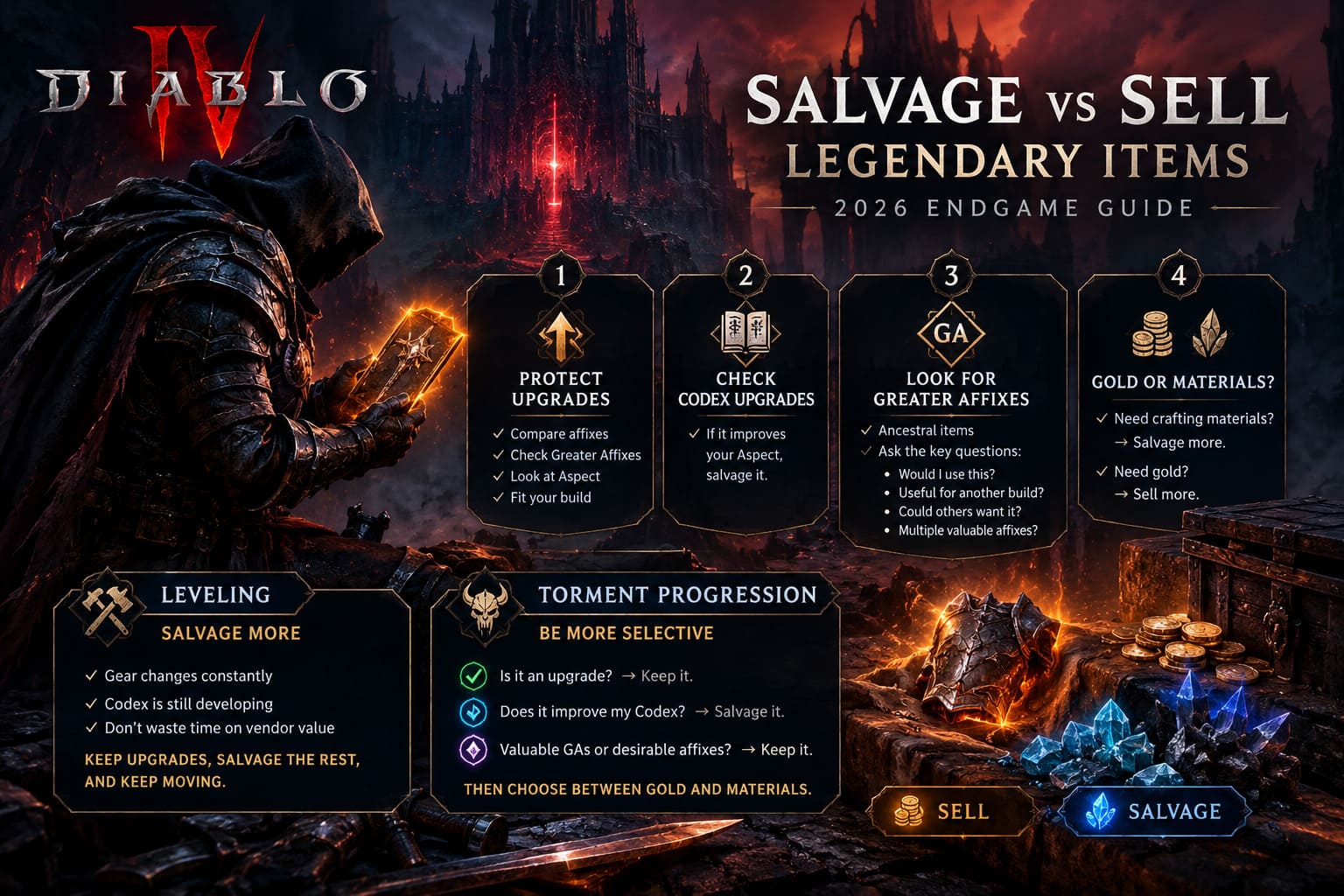
Step 1: Protect obvious upgrades
Anything that could replace your current equipment gets checked first.
Don’t salvage something just because its Item Power is higher. Compare the actual affixes, Greater Affixes, Aspect and how the item fits your build.
Step 2: Check Codex upgrades
If a Legendary improves an Aspect you care about, salvage it.
This is particularly important while building a new character or experimenting with another build.
Step 3: Look for Greater Affixes
An Ancestral item with desirable GAs deserves a second look.
This is the point where you should ask:
- Would I use this?
- Is this useful for another build?
- Could another player want it?
- Does it have multiple valuable affixes?
If the answer is potentially yes, don’t destroy it yet.
Step 4: Decide whether you need gold or materials
This is the part most guides overcomplicate.
Look at your resources.
If you’re constantly crafting and running out of salvage materials, salvage more.
If your materials are comfortable but you’re repeatedly running out of gold, sell more.
That’s it.
Early Game vs. Endgame: Your Strategy Should Change
Leveling
During leveling, I lean heavily toward salvaging.
Your character is replacing gear constantly, your Codex is still developing, and you’re not yet in the serious gold-burning phase of endgame optimization.
Don’t spend ten minutes calculating the vendor value of every pair of boots.
Salvage the useful stuff, keep upgrades, and keep moving.
Your time killing demons is worth more than squeezing a little extra gold from low-level equipment.
Torment Progression
Once you reach the Torment difficulties, your inventory management becomes more selective.
Ancestral items become much more important, and Greater Affixes become part of the loot hunt. Blizzard’s later item-quality changes made Ancestral items the high-end gear tier, with Greater Affixes restricted to Ancestral items.
At this point, I use a simple three-question filter:
Is it an upgrade?
Keep it.
Does it improve my Codex?
Salvage it.
Does it have valuable GAs or desirable affixes?
Keep it for further evaluation.
Everything else becomes an economic decision between gold and materials.
What About Unique Items?
This one deserves a little caution.
I wouldn’t automatically sell every Unique just because it doesn’t fit your current build.
Some Uniques have build-specific value, and duplicate items can have uses depending on the current crafting economy and your progression.
There is also a long history of Blizzard giving players reasons to salvage unwanted high-end Unique items. For example, Uber Uniques were given a salvage path that rewarded Resplendent Sparks, allowing players to eventually craft a chosen Uber Unique.
So before deleting a Unique, check what the current season’s systems actually reward for it.
This is one of those areas where old Diablo 4 guides become dangerous. A recommendation that was perfect two seasons ago may be completely wrong after an itemization update.
Salvage vs. Sell: My Personal Priority List
If I had to reduce the entire system to one practical checklist, this is how I’d approach a full inventory:
- Check potential upgrades first.
- Salvage Legendary items that improve your Codex.
- Inspect Ancestral items for Greater Affixes before doing anything else.
- Salvage when your crafting materials are becoming the bottleneck.
- Sell when gold is clearly your limiting resource.
- Never blindly vendor or salvage valuable GA gear.
- Don’t waste time maximizing tiny vendor profits during fast farming sessions.
That last point is surprisingly important.
The best loot strategy isn’t necessarily the one that generates the most gold per item.
It’s the one that lets you spend more time killing monsters and less time standing in town.
Diablo 4 World Tier 3 Leveling and Material Farming Guide: Best Zones & Routes
The Biggest Mistakes I Would Avoid
Selling every Legendary
This is probably the easiest way to slow down your Codex and crafting progression.
Salvaging everything without checking GAs
This is the endgame version of throwing away a lottery ticket.
Hoarding every item “just in case”
The opposite problem is just as bad. Your stash should not become a museum for 200 mediocre Legendaries.
Following old material thresholds
Diablo 4’s crafting economy has changed repeatedly. Blizzard has adjusted salvage yields, Masterworking requirements, imprinting costs and other item systems over multiple updates.
Don’t treat a random number from an old Reddit post as gospel.
Forgetting that your bottleneck changes
This is the big one.
Today you’re desperate for crafting materials.
Tomorrow you might have a mountain of them and be broke.
Your loot strategy should follow your current bottleneck, not some universal rule.
How to Link Battle.net Account to Xbox Live for Diablo 4 (2026 Guide)
The Diablo 4 Loot Rule I Actually Use
After years of playing ARPGs, I’ve become much less interested in trying to squeeze maximum theoretical value out of every individual drop.
In Diablo 4, I think the better approach is to build a simple loop:
Upgrade → Codex check → GA check → Salvage or Sell.
That’s enough.
If an item improves your build, keep it.
If it improves your Codex, salvage it.
If it has valuable Greater Affixes, investigate it.
If none of those things apply, ask yourself whether you need gold or materials more right now.
That’s the real answer to the Diablo 4 salvage vs. sell debate in 2026.
The Blacksmith and vendor aren’t competing systems. They’re two sides of the same endgame economy. Salvaging turns unwanted gear into progression resources, while selling converts it into the gold needed to keep expensive optimization moving.
And honestly, once you stop treating every orange item as either “sell” or “salvage” and start thinking about what your character needs next, inventory management becomes dramatically less annoying.
For me, that’s the sweet spot: salvage for progression, sell for liquidity, and never destroy an Ancestral GA item without checking it twice.