Destiny 2 Server Status Explained: Maintenance Mode and What It Means
There has been a lot of confusion and emotional discussion recently about the future of Destiny 2, especially around the idea of servers shutting down or the game suddenly disappearing.
If you’ve spent years playing live-service games, grinding raids, chasing loot, and building characters, you probably know how fast rumors can spiral out of control in gaming communities. So let’s clear things up in a grounded, realistic way and talk about what is actually happening with Destiny 2 and its servers.
Are Destiny 2 Servers Shutting Down?
No, Destiny 2 servers are not shutting down. The game is still going to remain online and fully playable. Players will still be able to log in, access their characters, run raids, play PvP, and use all their existing gear and progress. Nothing is being deleted or erased from player accounts.
What is changing is not the existence of the game itself, but the pace and structure of its development. Destiny 2 is moving away from constant expansion-driven updates and entering a long-term stable state often referred to as maintenance mode.
Forza Horizon 6 Custom Tracks Guide: Share Codes and Building Tips
What Maintenance Mode Actually Means
Maintenance mode is often misunderstood as “the end” of a game, but in reality it simply means that active content development slows down or stops, while the game itself continues to run. Instead of new expansions and seasonal storylines, the focus shifts to keeping the servers stable and the game functional.
This includes backend support, bug fixes, security updates, and occasional emergency patches if something breaks. However, the major content pipeline — new expansions, seasonal narratives, and constant balance overhauls — is no longer the focus.
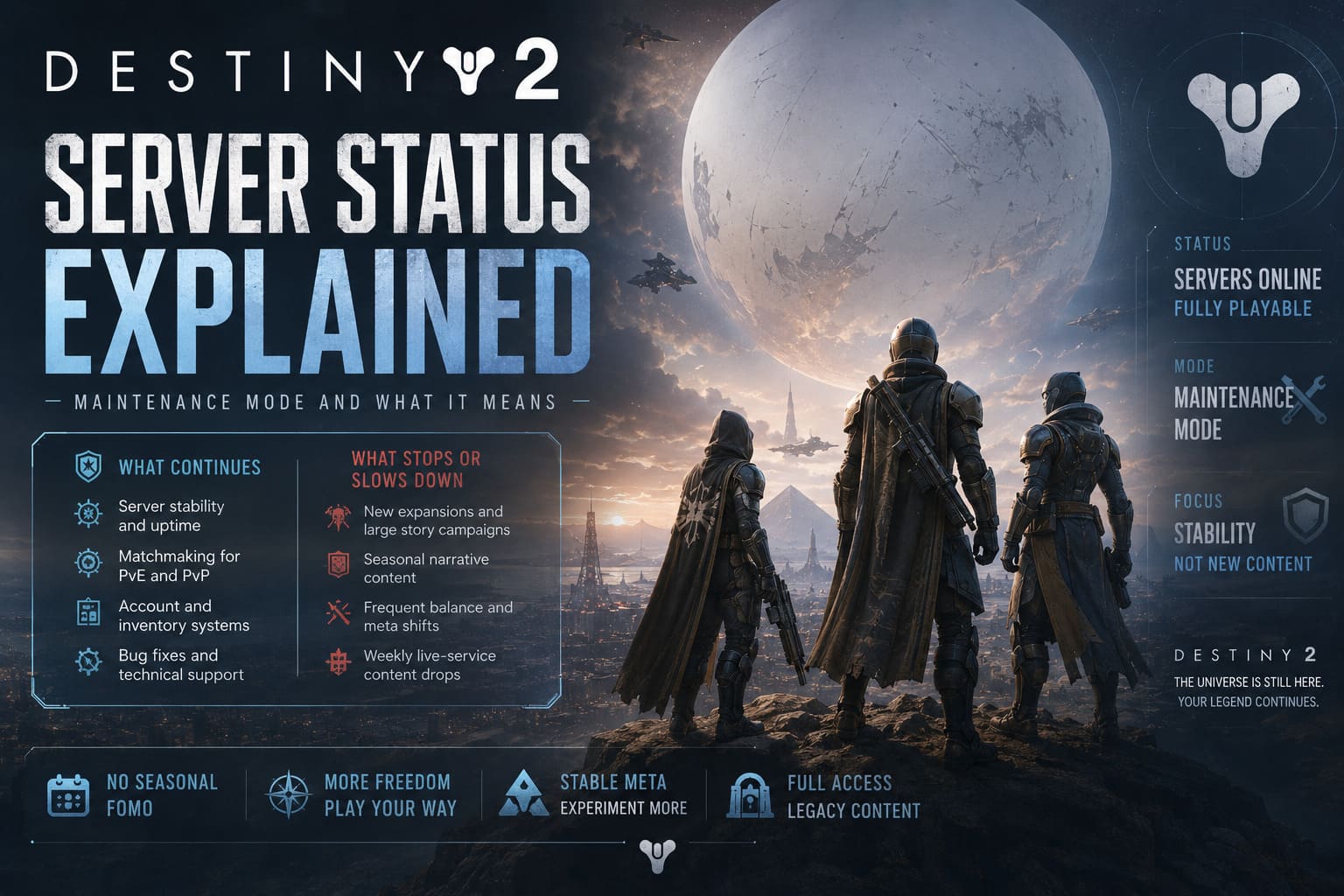
What continues
- Server stability and uptime maintenance
- Matchmaking for PvE and PvP activities
- Account and inventory systems
- Bug fixes and technical support
What stops or slows down
- New expansions and large story campaigns
- Seasonal narrative content
- Frequent balance and meta shifts
- Weekly live-service content drops

How the Game Will Feel for Players
From a gameplay perspective, Destiny 2 will feel more stable and less pressured. One of the biggest changes is the removal of constant FOMO-driven design. Players will no longer feel like they need to log in every week to avoid missing limited-time content or seasonal rewards.
Instead, the game becomes more like a permanent sandbox where all existing content remains available. Raids, dungeons, and PvP playlists continue to exist, but without the constant pressure of new seasonal resets changing everything every few months.
Best JDM Street Racing Builds in Forza Horizon 6 (Ultimate Tuning Guide)
Positive changes for players
- No seasonal fear of missing out
- More freedom to play at your own pace
- Stable meta and build experimentation
- Full access to legacy content
Live Service vs Maintenance Mode
The transition from live service to maintenance mode represents a major shift in how the game operates. Live service games are designed to constantly evolve, while maintenance mode prioritizes long-term stability and accessibility.
Comparison overview
| Feature | Live Service Era | Maintenance Mode |
|---|---|---|
| New Content | Frequent expansions and seasons | No new expansions |
| Story Updates | Ongoing narrative development | Stopped |
| Balance Changes | Regular updates | Rare adjustments |
| Server Support | Active evolution | Stability-focused |
| Player Pressure | High due to limited-time content | Much lower |

Why This Transition Is Happening
The decision to move Destiny 2 into a long-term maintenance state is largely driven by industry realities and resource allocation. Supporting a live-service game at this scale requires massive ongoing investment in development teams, infrastructure, and content production pipelines.
At the same time, both Bungie and its publishing structure under Sony Interactive Entertainment have been shifting focus toward future projects and new intellectual properties. This naturally reduces the emphasis on continuously expanding an already long-running title.
Instead of endlessly extending the live-service model, the goal becomes preserving Destiny 2 as a stable, playable world that can exist for years without major structural changes.
Community Reaction
The player community reaction has been mixed, combining nostalgia, frustration, and acceptance. Many long-time players are reflecting on years of raids, expansions, and shared experiences that defined Destiny 2 as more than just a shooter.
At the same time, there is frustration that some of the most requested improvements arrived very late in the game’s lifecycle. This creates a bittersweet feeling where the game is becoming its most refined version just as active development is winding down.
What You Can Still Do in Destiny 2
Even in maintenance mode, Destiny 2 remains a highly playable and content-rich game. In fact, the reduced pressure may actually improve the experience for returning or casual players.
- Play all existing raids and dungeons at any time
- Enjoy PvP without constant seasonal resets
- Experiment with builds without fear of rapid meta shifts
- Explore old expansions and story content freely
- Focus on cosmetics, gear collection, and mastery gameplay
This creates a more relaxed version of the game where players can engage at their own pace instead of chasing constant updates.
Final Thoughts
Destiny 2 is not ending, and it is not being shut down. Instead, it is transitioning into a long-term stable state where the servers remain active, but the constant flow of new content slows down significantly. For some players, this marks the end of an era. For others, it creates a more accessible and stress-free version of the game they can return to anytime.
The universe is no longer expanding at full speed, but it is still there, fully intact, waiting for anyone who wants to jump back in.