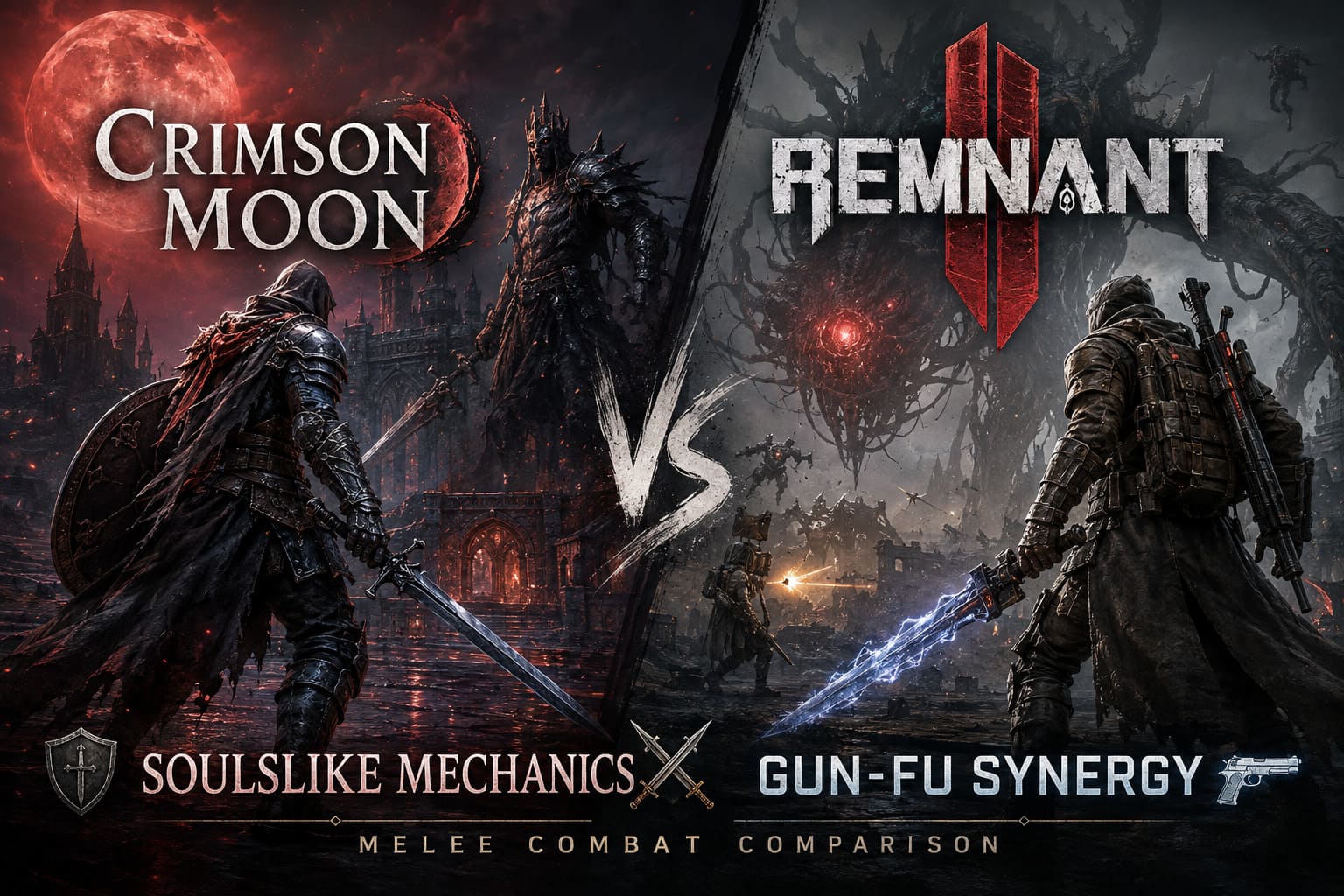
Crimson Moon vs Remnant 2 Melee Combat Comparison: Soulslike Mechanics vs Gun-Fu Synergy
I have a soft spot for games that make melee combat feel dangerous. Not necessarily difficult for the sake of being difficult, but games where pressing the attack button actually feels like a decision. After spending time with Crimson Moon and going back to Remnant 2, I kept coming back to the same question: which one actually handles melee combat better?
At first glance, these two games seem like an odd comparison. One is built around Soulslike combat and puts swords, shields, dodges, and parries front and center. The other is fundamentally a third-person shooter where guns are usually the fastest answer to a problem.
And yet, both games have surprisingly deep melee systems.
The important distinction is that Crimson Moon treats melee as the main event, while Remnant 2 treats it as one extremely powerful part of a much larger combat sandbox. That difference affects everything from stamina management and weapon movesets to boss design and character builds.
After comparing the two systems, I think the answer is pretty clear—but it depends heavily on what you expect from melee combat in the first place.
Crimson Moon Makes Every Swing Feel Like a Commitment
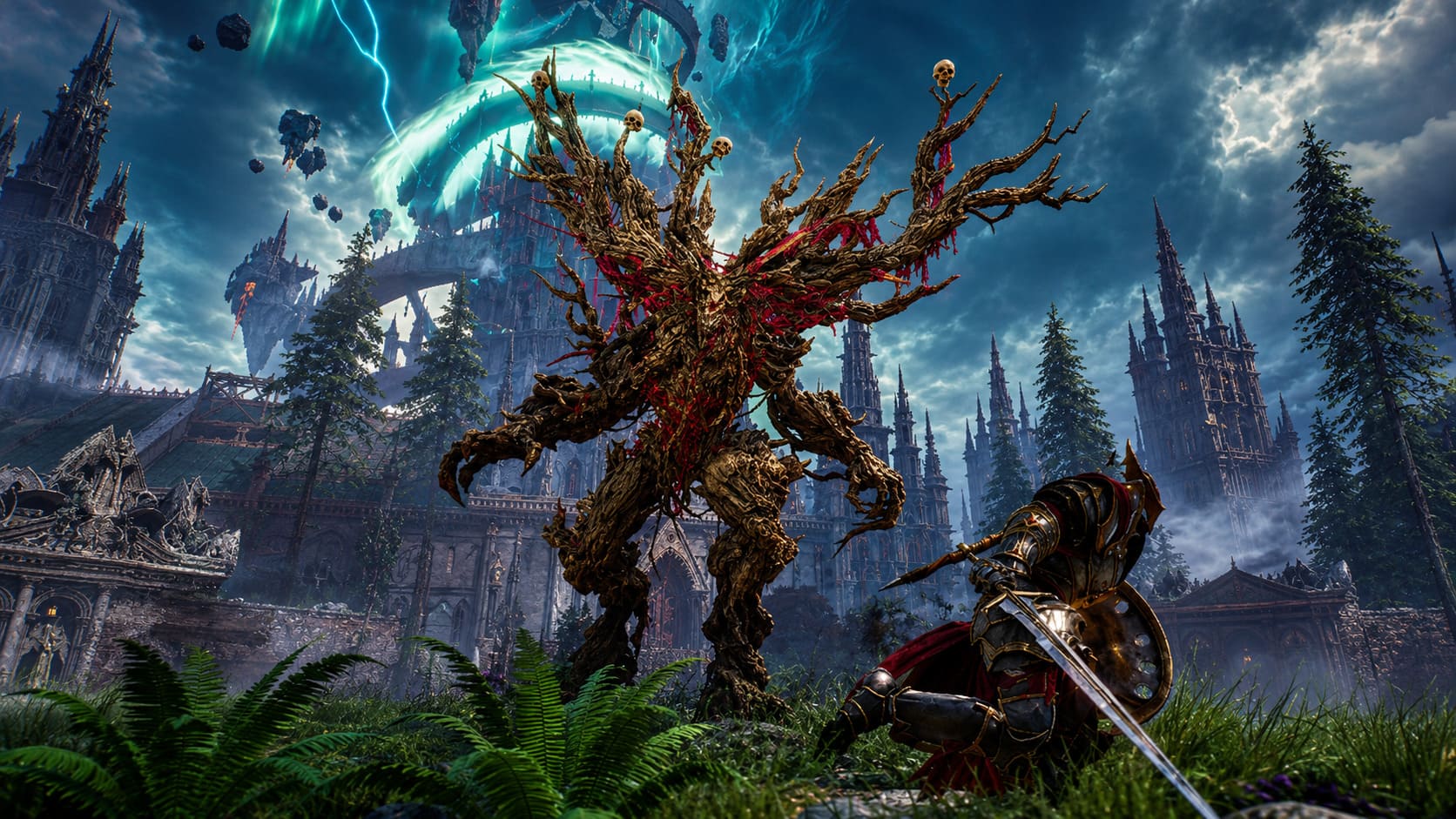
The biggest thing I noticed when playing Crimson Moon is how much more deliberate the combat feels. Attacking isn’t something I do in the background while thinking about my next move. I’m constantly watching stamina, enemy positioning, attack recovery, and the distance between me and whatever is trying to kill me.
Every swing has a cost.
Light attacks are obviously easier to work into a combo, while heavy attacks can deliver serious punishment at the expense of stamina and recovery time. There are also running attacks, jumping attacks, positional strikes, and backstabs, giving the basic moveset considerably more depth than you might expect at first.
The backstab system is particularly satisfying against normal enemies. Getting behind an opponent, triggering the animation, knocking them down, and preparing the follow-up attack creates that classic Soulslike rhythm that fans instantly recognize.
But Crimson Moon isn’t simply about fishing for backstabs. Larger enemies and bosses force you to engage with its defensive mechanics properly. Blocking, dodging, and especially parrying become essential once enemies start throwing out attacks that can’t simply be avoided by standing behind them.
When a parry lands perfectly, the payoff is enormous. There’s a very specific feeling that comes from turning an enemy’s most dangerous attack into your biggest opening. Crimson Moon understands that feeling extremely well.
Remnant 2 Plays by Completely Different Rules
Remnant 2 initially feels much looser. That’s because it is. You’re playing a shooter first, and melee is integrated into that movement system rather than replacing it.
Instead of building the entire combat loop around shields and parries, Remnant 2 gives you an enormous number of movement and attack interactions. Dodging can lead directly into melee attacks. Running and sliding can transition into lunges. Neutral dodges create their own attack opportunities.
One of my favorite details is the ability to control the vertical direction of certain melee attacks. That sounds like a tiny feature until you’re fighting smaller enemies, crawling creatures, or trying to connect with a weak point that isn’t conveniently positioned at chest height.
And then there are charged attacks.
This is where Remnant 2’s melee design starts getting weird—in the best possible way.
A charged attack isn’t necessarily just a stronger version of the regular attack. Depending on the weapon, it can completely change how you approach an encounter. Heavy weapons can create shockwaves, spears can be thrown, and certain swords effectively become ranged weapons without abandoning their melee identity.
That’s the essence of Remnant 2’s melee combat: it doesn’t try to turn the game into Dark Souls. Instead, it asks, “What if melee weapons had to work inside a shooter?”
Honestly, that approach is much more creative than I expected.
Weapon Variety: Traditional Fantasy vs Completely Unhinged Ideas
This is probably the category where I had the hardest time choosing a winner.
Crimson Moon has the advantage if you want weapons to feel like believable extensions of a traditional action RPG combat system. Sword-and-shield setups encourage a defensive approach, while polearms and halberds give you additional reach and sweeping attacks.
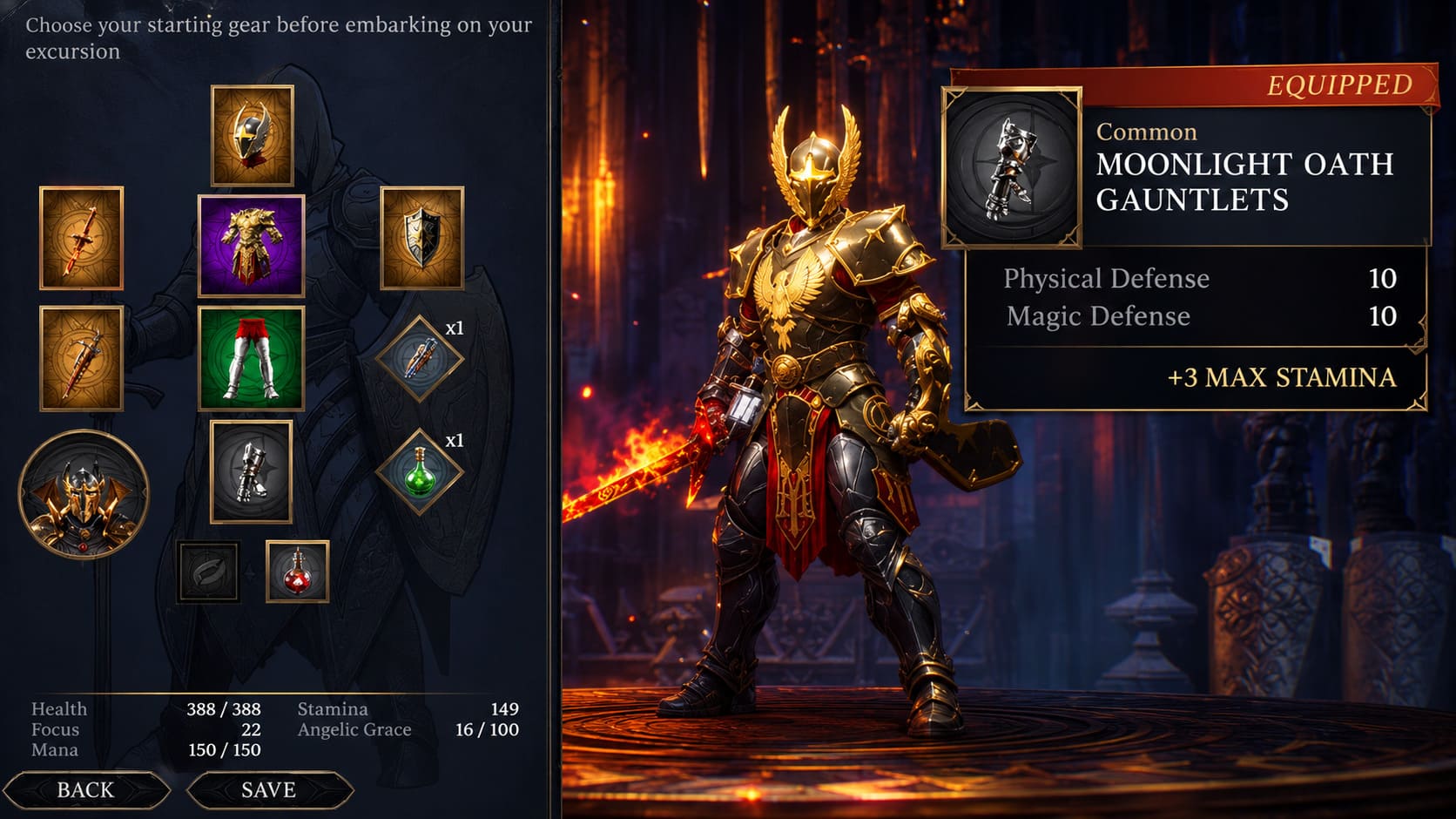
The weapons feel like tools designed around different combat philosophies.
Then Crimson Moon adds Weapon Arts, which push those traditional weapons into more spectacular territory. These abilities can provide crowd control, ranged pressure, or powerful area attacks without forcing you to abandon your melee build.
Remnant 2 goes in the opposite direction.
Weapons such as the Spectral Blade, Stone Breaker, Wrathbringer, Huntress Spear, and World’s Edge aren’t simply variations on “sword, but with different numbers.” Their special attacks can completely change how they function.
The Stone Breaker can turn a melee swing into a shockwave. A spear can become a projectile. World’s Edge can send energy across the battlefield.
At that point, I wouldn’t even call some of these weapons purely melee anymore—and that’s precisely why they’re so much fun.
| Category | Crimson Moon | Remnant 2 |
|---|---|---|
| Combat Focus | Pure melee | Melee + shooting |
| Defense | Blocking, dodging, parrying | Primarily dodging and positioning |
| Weapon Identity | Traditional movesets + Weapon Arts | Transforming attacks + special effects |
| Ranged Melee | Limited but supported through Weapon Arts | Extremely important for certain builds |
| Build Complexity | Gear + boons + forms | Archetypes + rings + amulets + mutators |
| Best For | Soulslike purists | Build-crafting enthusiasts |
Build Crafting Is Where Remnant 2 Pulls Ahead
If we’re talking about pure melee combat feel, Crimson Moon wins for me. But when the conversation changes to build depth, Remnant 2 becomes a completely different beast.
Remnant 2’s build system can get ridiculously specific. You aren’t just choosing a weapon and upgrading it. You’re combining Archetypes, Rings, Amulets, Mutators, traits, and equipment effects to create interactions that can fundamentally change how your character behaves.
The Challenger is the obvious starting point for many melee builds because it naturally supports close-range aggression, damage reduction, armor management, and melee damage.
But the really interesting part comes when you combine it with another Archetype. Invader can change your mobility and survivability. Alchemist can provide another layer of utility. Ritualist opens up completely different approaches.
Then you start stacking equipment synergies.
Something like Matriarch’s Insignia can reward constant melee attacks by improving damage while restoring stamina. Combine that kind of effect with Steadfast, and suddenly charged attacks become much safer because interruption and incoming damage are handled differently.
This is the kind of system that makes me spend far too much time in menus.
Crimson Moon has an interesting advantage of its own, though. Its hunt-based structure means your build can change during a run. Temporary boons found through Nexus Gates allow you to adapt rather than simply following a predetermined endgame spreadsheet.
One run might push you toward aggressive health recovery through light attacks. Another might turn you into a slow, armored tank focused on posture and survivability.
That randomness gives Crimson Moon’s progression a more immediate sense of discovery.
The Problem Neither Game Can Completely Escape: Flying Enemies
Here’s where the difference between the two designs becomes impossible to ignore.
Crimson Moon was designed around the assumption that your character needs to be able to fight enemies at close range. Its bosses and elites are therefore structured around giving melee players meaningful opportunities to engage.
Remnant 2 doesn’t have that luxury.
Some enemies fly. Some bosses move around enormous arenas. Others simply spend enough time outside normal melee range to make a traditional sword feel like a terrible joke.
I’ve had moments in Remnant 2 where a melee build felt incredibly powerful right up until the game decided to put the enemy thirty feet in the air.
This is why ranged melee weapons are so important.
World’s Edge is probably the most obvious solution, with its charged energy wave allowing melee-focused characters to attack targets they otherwise couldn’t reach. Throwing weapons such as the Krell Axe or Huntress Spear can serve a similar purpose.
These tools are clever, but they also expose a fundamental weakness in the system. If you insist on playing “pure melee” in Remnant 2, you’re eventually going to encounter situations where the game strongly suggests that you stop being pure melee.
Crimson Moon simply doesn’t have that same problem.
Which Game Feels Better in a Boss Fight?
For me, this isn’t particularly close.
Crimson Moon wins the boss-fight category.
There’s something satisfying about learning a boss’s attack pattern, staying close, recognizing the animation for a heavy strike, and responding with a perfectly timed dodge or parry.
The entire encounter is built around that relationship between you and the enemy.
Remnant 2’s bosses are often more chaotic. You’re managing adds, projectiles, environmental hazards, weak points, movement, and weapon swapping while trying to maintain your build’s ideal range.
That makes Remnant 2 exciting in a completely different way, but it doesn’t produce the same intimate sword-fighting feeling.
If what you want is the classic “learn the boss until I can practically dance around it” experience, Crimson Moon is much closer to the Soulslike ideal.
Is Crimson Moon Coming to PS5, Xbox, and Nintendo Switch 2? Release Date and Platform Breakdown
So, Which Melee System Is Actually Better?
After putting both systems side by side, I don’t think there’s a universal winner.
Crimson Moon is the better melee game.
That’s the one I’d recommend to someone who specifically wants sword combat, stamina management, parrying, positioning, defensive play, and the satisfying brutality associated with traditional Soulslikes.
Its combat has a stronger sense of physicality. Attacks feel committed. Defensive mistakes hurt. Successful parries feel earned. Weapon Arts add spectacle without taking away from the fundamental melee loop.
Remnant 2 is the more interesting combat sandbox.
Its melee system isn’t trying to beat Crimson Moon at its own game. Instead, it takes melee weapons and throws them into a shooter framework filled with Archetypes, mutations, rings, buffs, projectiles, and absurd build combinations.
Sometimes that produces awkward situations—especially against flying enemies—but when everything comes together, Remnant 2 can make you feel ridiculously powerful.
My Final Take
If I boot up a game specifically because I want Soulslike melee combat, I’m picking Crimson Moon without hesitation. It understands why people love this style of combat in the first place. The slow commitment, the stamina pressure, the parries, the positioning, and the punishment all work toward the same goal.
But if you tell me you want to spend an entire weekend theory-crafting a completely ridiculous melee build, I’m probably launching Remnant 2.
That’s the funny thing about this comparison. Crimson Moon makes me feel like a warrior. Remnant 2 makes me feel like a mad scientist who accidentally created a sword that shoots energy while wearing enough rings to bankrupt a kingdom.
And honestly?
I want both.
Crimson Moon is the game I’d choose for the purest close-quarters experience, while Remnant 2 remains the better choice for players who want melee combat to interact with a much larger build-crafting machine.
So if your definition of “better melee combat” means precision, weight, parries, and classic Soulslike fundamentals, Crimson Moon takes the crown.
If it means experimentation, build synergy, ridiculous weapons, and Gun-Fu freedom, Remnant 2 still has an argument that is very difficult to ignore.